MCQ
Newton's third law of motion gives.
- ADefinition of force
- ✓Property of force
- CDefinition of inertia
- DProperty of inertia
Generate a complete, print-ready paper with questions like this in minutes — across 16+ boards, with answer keys.
$(A)$ With a node at $O$, the minimum frequency of vibration of the composite string is $v_0$
$(B)$ With an antinode at $O$, the minimum frequency of vibration of the composite string is $2 v_0$
$(C)$ When the composite string vibrates at the minimum frequency with a node at $O$, it has $6$ nodes, including the end nodes
$(D)$ No vibrational mode with an antinode at $O$ is possible for the composite string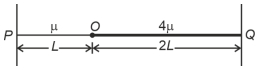
$\text{qv}\frac{\mu_0\text{i}}{2\text{a}}$
$\text{qv}\frac{\mu_0\text{i}}{2\pi\text{a}}$
$\text{qv}\frac{\mu_0\text{i}}{\text{a}}$
$\text{Zero}$