Question
No real engine can have efficiency greater than that of a Carnot engine working between the same two temperatures, why?

Answer

A Carnot engine is an ideal heat engine from the following points of view:
  1. There is absolutely no friction between the walls of cylinder and the piston.
  2. The working substance is an ideal gas. In a real engine, these conditions cannot be fulfilled and hence no heat engine working between the same two temperatures can have efficiency greater than that of Carnot engine.

Need a full question paper?

Generate a complete, print-ready paper with questions like this in minutes — across 16+ boards, with answer keys.
Start Generating Free

Similar questions

A cricket bowler releases the ball in two different ways.
  1. Giving it only horizontal velocity, and
  2. Giving it horizontal velocity and a small downward velocity. The speed $v_s$ at the time of release is the same. Both are released at a height H from the ground. Which one will have greater speed when the ball hits the ground? Neglect air resistance.
A bulb rated 60W at 220V is connected across a household supply of alternating voltage of 220V. Calculate the maximum instantaneous current through the filament.
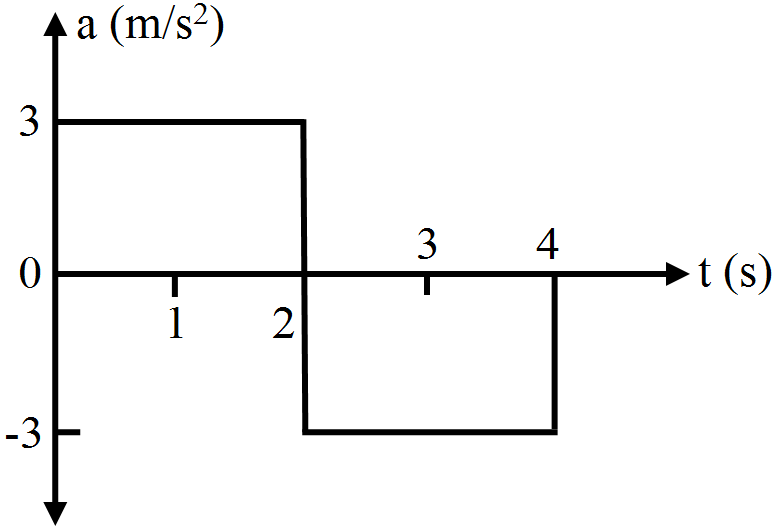
A particle starts from rest at $t = 0$ and has an acceleration as given in the figure below. Draw the v-t graph for $4$ seconds.
A jet airplane travelling at the speed of $500 km h^{–1}$ ejects its products of combustion at the speed of $1500km h^{–1}$ relative to the jet plane. What is the speed of the latter with respect to an observer on the ground?
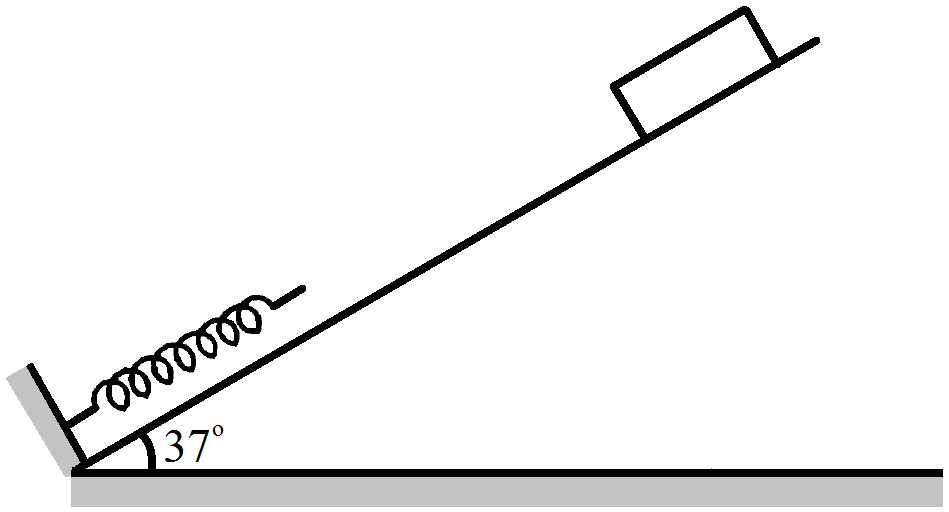
Figure shows a spring fixed at the bottom end of an incline of inclination $37^\circ$. A small block of mass 2kg starts slipping down the incline from a point 4.8m away from the spring. The block compresses the spring by 20cm, stops momentarily and then rebounds through a distance of 1m up the incline. Find.
  1. The friction coefficient between the plane and the block.
  2. The spring constant of the spring. Take $g = 10m/s^2.$
Does a nucleus lose mass when it suffers gamma decay?
A solid sphere rolling on a rough horizontal surface with a linear speed v collides elastically with a fixed, smooth, vertical wall. Find the speed of the sphere after it has started pure rolling in the backward direction.
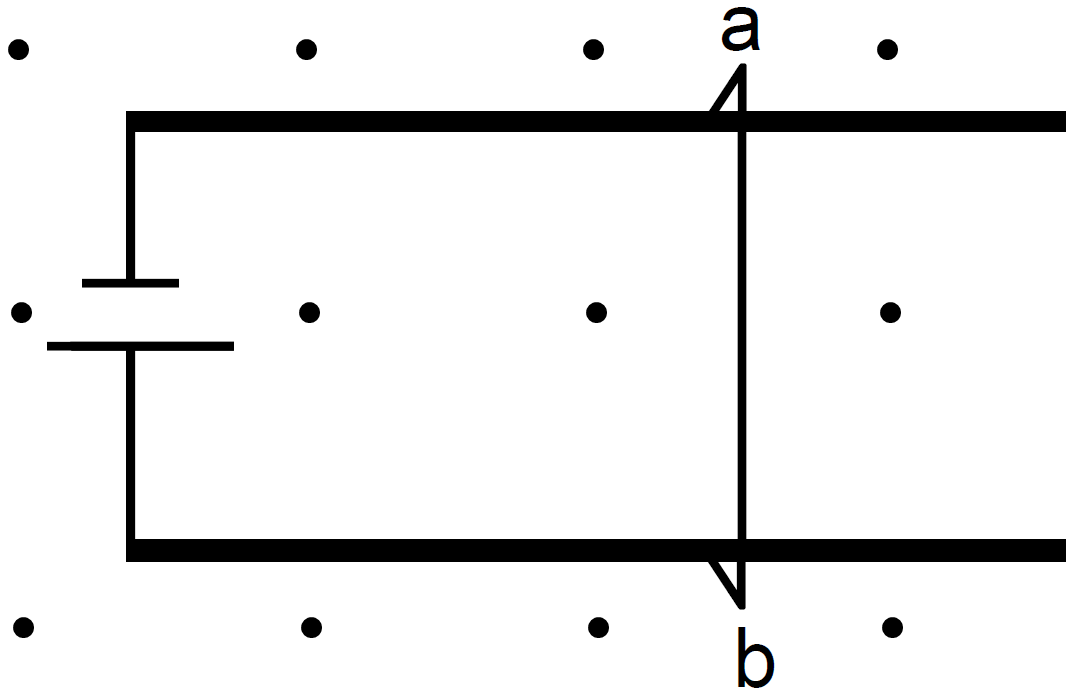
Figure shows a smooth pair of thick metallic rails connected across a battery of $\text{emf} \in$ having a negligible internal resistance. A wire $ab$ of length $l$ and resistance $r$ can slide smoothly on the rails. The entire system lies in a horizontal plane and is immersed in a uniform vertical magnetic field $B.$ At an instant $t,$ the wire is given a small velocity $u$ towards right.
  1. Find the current in it at this instant. What is the direction of the current?
  2. What is the force acting on the wire at this instant?
  3. Show that after some time the wire $ab$ will slide with a constant velocity. Find this velocity.
Prove that as the object moves towards the ground from some height, its potential energy decreases and kinetic energy increases by the same amount.
Calculate the energy that can be obtained from $1 kg$ of water through the fusion reaction
${ }^2 \mathrm{H}+{ }^2 \mathrm{H} \rightarrow{ }^3 \mathrm{H}+\text { p. }$
Assume that $1.5 \times 10^{-2} \%$ of natural water is heavy water $\mathrm{D}_2 \mathrm{O}$ (by number of molecules) and all the deuterium is used for fusion.