Question
Obtain the formula for acceleration due to gravity at the depth ‘d’ below the Earth’s surface.
Answer

  1. The Earth can be considered to be a sphere made of large number of concentric uniform spherical shells.
  2. When an object is on the surface of the Earth it experiences the gravitational force as if the entire mass of the Earth is concentrated at its centre.
  3. The acceleration due to gravity on the surface of the Earth is, $g=\frac{G M}{R^2}$
  4. Assuming that the density of the Earth is uniform, mass of the Earth is given by $M=$ volume $x$ density $=\frac{4}{3} \pi R^3 \rho$ $\therefore g =\frac{ G \times \frac{4}{3} \pi R ^3 \rho}{ R ^2}=\frac{4}{3} \pi R \rho G$
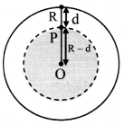
  5. Consider a body at a point P at the depth d below the surface of the Earth as shown in figure.
    Image Here the force on a body at P due to outer spherical shell shown by shaded region, cancel out due to symmetry.
    The net force on P is only due to the inner sphere of radius OP = R – d.
  6. Acceleration due to gravity because of this sphere is,
    $g_d=\frac{ GM ^{\prime}}{( R - d )^2}$
    where,
    $ M ^{\prime}=\text { volume of the inner sphere } \times \text { density }$
    $\therefore \quad M^{\prime}=\frac{4}{3} \pi(R-d)^3 \times \rho$
    $\therefore \quad g_d=\frac{G \times \frac{4}{3} \pi(R-d)^3 \rho}{(R-d)^2}$
    $\therefore \quad g_d=G \times \frac{4}{3} \pi(R-d) \rho$
  7. Dividing equation (2) by equation (1) we get,
    $ \frac{g_{ d }}{ g }  =\frac{ R - d }{ R }$
    $\therefore  \frac{ g _{ d }}{ g } =1-\frac{ d }{ R }$
    $\therefore  g_d  = g \left(1-\frac{ d }{ R }\right) $
    This equation gives acceleration due to gravity at depth d below the Earth's surface.

Need a full question paper?

Generate a complete, print-ready paper with questions like this in minutes — across 16+ boards, with answer keys.

Start Generating Free