MCQ
One astronomical unit is a distance equal to ...... $m$
  • A
    $9.46 \times 10^{15}$
  • $1.496 \times 10^{11}$
  • C
    $3 \times 10^8$
  • D
    $3.08 \times 10^{16}$

Answer

Correct option: B.
$1.496 \times 10^{11}$
b
(b)

One astronomical unit is the average distance between earth and sun

$1 \text { astronomical unit }( AU )=1.496 \times 10^{11} \,m$

Need a full question paper?

Generate a complete, print-ready paper with questions like this in minutes — across 16+ boards, with answer keys.
Start Generating Free

Similar questions

Ten capacitor are joined in parallel and charged with a battery up to a potential $V$. They are then disconnected from battery and joined again in series then the potential of this combination will be.......$V$
A negative test charge is moving near a long straight wire carrying a current. The force acting on the test charge is parallel to the direction of the current. The motion of the charge is
A person moves $30\, m$ north and then $20\, m$ towards east and finally $30\sqrt 2 \,m$  in south-west direction. The displacement of the person from the origin will be
An electron is travelling along the $x$-direction. It encounters a magnetic field in the $y$-direction. Its subsequent motion will be
Two solid rubber balls $A$ and $B$ having masses $200$ and $400\, gm$ respectively are moving in opposite directions with velocity of $A$ equal to $0.3 \,m/s$. After collision the two balls come to rest, then the velocity of $B$ is .............. $\mathrm{m} / \mathrm{s} $
Self induction of a solenoid is
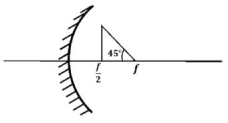
A wire is bent in the shape of a right angled triangle and is placed in front of a concave mirror of focal length $f$, as shown in the figure. Which of the figures shown in the four options qualitatively represent(s) the shape of the image of the bent wire? (These figures are not to scale.)
If the ratio of amplitude of two waves is $4 : 3$, then the ratio of maximum and minimum intensity is
If ${l_1},\,{l_2},\,{l_3}$ are the lengths of the emitter, base and collector of a transistor then
In a radioactive decay process, the activity is defined as $A=-\frac{\mathrm{d} N}{\mathrm{~d} t}$, where $N(t)$ is the number of radioactive nuclei at time $t$. Two radioactive sources, $S_1$ and $S_2$ have same activity at time $t=0$. At a later time, the activities of $S_1$ and $S_2$ are $A_1$ and $A_2$, respectively. When $S_1$ and $S_2$ have just completed their $3^{\text {rd }}$ and $7^{\text {th }}$ half-lives, respectively, the ratio $A_1 / A_2$ is. . . . . . .