One insulated conductor from a household extension cord has a mass per unit length of $μ.$ A section of this conductor is held under tension between two clamps. A subsection is located in a magnetic field of magnitude $B$ directed perpendicular to the length of the cord. When the cord carries an $AC$ current of $"i"$ at a frequency of $f,$ it vibrates in resonance in its simplest standing-wave vibration state. Determine the relationship that must be satisfied between the separation $d$ of the clamps and the tension $T$ in the cord.
Medium


Download our appand get started for free
Experience the future of education. Simply download our apps or reach out to us for more information. Let's shape the future of learning together!No signup needed.*
Similar Questions
- 1A uniform wire of length $L$ and mass $M$ is stretched between two fixed points, keeping tension $F$. A sound of frequency $m$ is impressed on it. Then the maximum vibrational energy is existing in the wire when $\mu $ =View Solution
- 2Two waves represented by the following equations are travelling in the same medium ${y_1} = 5\sin 2\pi (75t - 0.25x)$, ${y_2} = 10\sin 2\pi (150t - 0.50x)$ The intensity ratio ${I_1}/{I_2}$ of the two waves isView Solution
- 3Ultrasonic, Infrasonic and audible waves travel through a medium with speeds ${V_u},\,{V_i}$ and ${V_a}$ respectively, thenView Solution
- 4A wave disturbance in a medium is described by $y(x,\,t) = 0.02\cos \,\left( {50\,\pi t + \frac{\pi }{2}} \right)\cos (10\pi x)$, where $ x$ and $y$ are in metres and $t$ in secondsView Solution
- 5The equation of a stationary wave is $y = 0.8\cos \,\left( {\frac{{\pi x}}{{20}}} \right)\sin 200\,\pi t$, where $x$ is in $cm$ and $t$ is in sec. The separation between consecutive nodes will be..... $cm$View Solution
- 6A $1 cm$ long string vibrates with fundamental frequency of $256\, Hz$. If the length is reduced to $\frac{1}{4}cm$ keeping the tension unaltered, the new fundamental frequency will beView Solution
- 7A tunning fork produces $5\, beats/sec$ when the length of a sonometer wire is either $1\, m$ or $1.05\, m$. Calculate the frequency of tunning fork .... $Hz$View Solution
- 8Two identical flutes produce fundamental nodes of frequency $300\,Hz$ at $27\,^oC.$ If the temperature of air in one flute is increased to $31\,^oC,$ the numbe of the beats heard per second will beView Solution
- 9The intensity level due to two waves of the same frequency in a given medium are $1\, bel$ and $5\, bel$. Then the ratio of amplitudes isView Solution
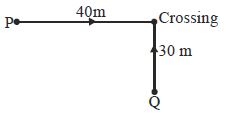
- 10A car $P$ approaching a crossing at a speed of $10\, m/s$ sounds a horn of frequency $700\, Hz$ when $40\, m$ in front of the crossing. Speed of sound in air is $340\, m/s$. Another car $Q$ is at rest on a road which is perpendicular to the road on which car $P$ is reaching the crossing (see figure). The driver of car $Q$ hears the sound of the horn of car $P$ when he is $30\, m$ in front of the crossing. The apparent frequency heard by the driver of car $Q$ is .... $Hz$View Solution