MCQ
Output $W$ is given by
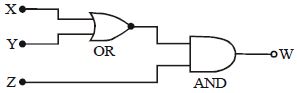
  • A
    $(\overline {X.Y} )\, + \,Z$
  • B
    $(\overline {X+Y} )\, . \,Z$
  • C
    $(\overline X .\overline Y )\,.\,Z$
  • Both $(B)$ and $(C)$

Answer

Correct option: D.
Both $(B)$ and $(C)$
d

Need a full question paper?

Generate a complete, print-ready paper with questions like this in minutes — across 16+ boards, with answer keys.

Start Generating Free

Similar questions

For an isothermal expansion of a perfect gas, the value of $\frac{{\Delta P}}{P}$ is equal
A thin spherical insulating shell of radius $R$ carries a uniformly distributed charge such that the potential at its surface is $V _0$. A hole with a small area $\alpha 4 \pi R ^2(\alpha<<1)$ is made on the shell without affecting the rest of the shell. Which one of the following statements is correct?
A transformer connected to $220 \,volt$ line shows an output of $2 \,A$ at $11000 \,volt$. The efficiency is $100/%$. The current drawn from the line is......$A$
The Young's modulus of a wire is $Y.$ If the energy per unit volume is $E$, then the strain will be
When air is replaced by a dielectric medium of constant $k$, the maximum force of attraction between two charges separated by a distance
$ + 2\,C$ and $ + 6\,C$ two charges are repelling each other with a force of $12\,N$. If each charge is given $ - 2\,C$ of charge, then the value of the force will be
A spherically symmetric charge distribution is characterised by a charge density having the following variations

$\rho (r)\, = \,{\rho _0}\left( {1 - \frac{r}{R}} \right)$ for $r < R$

$\rho (r)\,=\,0$ for $r\, \ge \,R$

Where $r$ is the distance from the centre of the charge distribution $\rho _0$ is a constant. The electric field at an internal point $(r < R)$ is
A circular disc of mass $10 \;kg$ is suspended by a wire attached to its centre. The wire is twisted by rotating the disc and released. The period of torsional oscillations is found to be $1.5 \;s$. The radius of the disc is $15\; cm .$ Determine the torsional spring constant of the wire in $N\;m\;rad^{-1}$. (Torsional spring constant $\alpha$ is defined by the relation $J=-\alpha \theta,$ where $J$ is the restoring couple and $\theta$ the angle of twist).
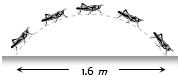
A grasshopper can jump maximum distance $1.6\; m$. It negligible time of the ground. How far can it go in $10 \;s$?
During mean life of a radioactive element, the fraction that disintegrates is