Question
pH of 0.08mol dm–3 HOCl solution is 2.85. Calculate its ionisation constant.

Answer

pH of HOCl = 2.85
But, $-\text{pH}=\log\text{[H}^+]$
$\therefore-2.85=\log\text{[H}^+]$
$\Rightarrow\overline{3}.15=\log\text{[H}^+]$
$\Rightarrow\log\text{[H}^+]=1.413\times10^{-3}$
For weak mono basic acid $[\text{H}^+]=\sqrt{\text{K}_\text{a}\times\text{C}}$
$\Rightarrow\text{K}_\text{}a=\frac{[\text{H}^+]^2}{\text{C}}=\frac{(1.413\times10^{-3})^2}{0.08}$
$=24.957\times10^{-6}=2.4957\times10^{-5}$

Need a full question paper?

Generate a complete, print-ready paper with questions like this in minutes — across 16+ boards, with answer keys.

Start Generating Free

Similar questions

How many grams of KClO3 must be decomposed to prepare 3.36 litres of oxygen at STP? (Atomic weight of K = 39, Cl= 35.5, 0 = 16u)
  1. State Hess's Law of constant heat summation. How does it follow from the first law of thermodynamics.
  2. Determine $\Delta_\text{r}\text{H}^\circ,$ at 298K for reaction:

$\text{C(graphite)}+2\text{H}_2(\text{g})\overrightarrow{\ \ \ \ \ \ \ \ }\ \text{CH}_4(\text{g});\ \Delta_\text{r}\text{H}^\circ=?$

You are given:

  1. $\text{C(graphite)}+\text{O}_2(\text{g})\overrightarrow{\ \ \ \ \ \ \ }\ \text{CO}_2(\text{g});$ $\Delta_\text{r}\text{H}^\circ=-393.51\text{kJ/ mol}$

  2. $\text{H}_2\text{(g)}+\frac{1}{2}\text{O}_2(\text{g})\overrightarrow{ \ \ \ \ \ \ \ }\ \text{H}_2\text{O(l)};$ $\Delta_\text{r}\text{H}^\circ=-285.8\text{kJ/ mol}$

  3. $\text{CO}_2(\text{g})+2\text{H}_2\text{O(l)}\overrightarrow{\ \ \ \ \ \ \ \ \ }\ \text{CH}_4(\text{g})+2\text{O}_2(\text{g});$ $\Delta_\text{r}\text{H}=+890.3\text{kJ/ mol}$
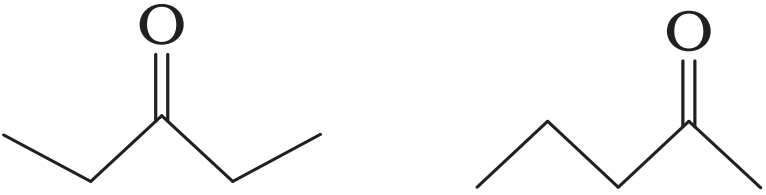
What is the relationship between the members of following pairs of structures? Are they structural or geometrical isomers or resonance contributors?

Elements X, Y and Z have 4, 5 and 7 valence electrons respectively:
  1. Write the molecular formula of the compounds formed by these elements individually with hydrogen.
  2. Which of there compound will have the highest dipole moment?
(i) An atomic orbital has $n=3$. What are the possible values of $l$ and $m_l$ ?
(ii) List the quantum number ( $m_l$ and $l$ ) of electrons for $3 d$ orbital.
(iii) Which of the following orbitals are possible? $1 p, 2 s, 2 p$ and $3 f$
An organometallic compound on analysis was found to contain, C = 64.4%, H = 5.5% and Fe= 29.9%. Determine its empirical formula (At. mass of Fe = 56u).
  1. The frequency of the strong yellow line in the spectrum of sodium is 5.09 × 10¹⁴ s-1. Calculate the wavelength of the light in nanometer.
  2. Using s, p, d notations, describes the orbital with the following quantum numbers:
  • n = 3, l = 1, m = 0, (b) n = 1, l = 0
  1. Which quantum number distinguishes the electron in the same orbital? Name the principle involved.
Differentiate between the following (with examples)
  1. Open and closed system.
  2. Adiabatic and isothermal process.
  3. State function and path function.
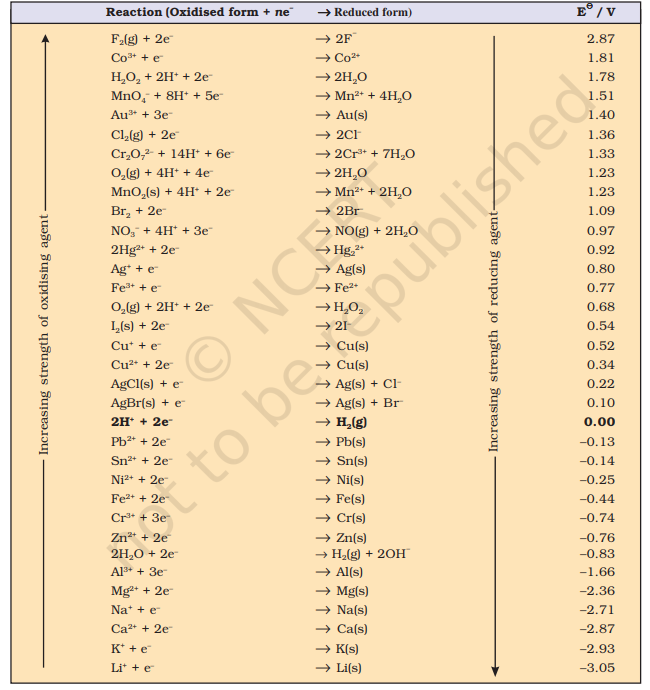
Using the standard electrode potentials given in the Table, predict if the reaction between the following is feasible:

Ag+(aq) and Cu(s).

Predict the dipole moment of
1. a molecule of the type $AX _2$ having a linear geometry.
2. a molecule of the type $AX _4$ having tetrahedral geometry.
3. a molecule of the type $AX _2$ having angular geometry.
4. a molecule of the type $AX _4$ having square planar geometry.