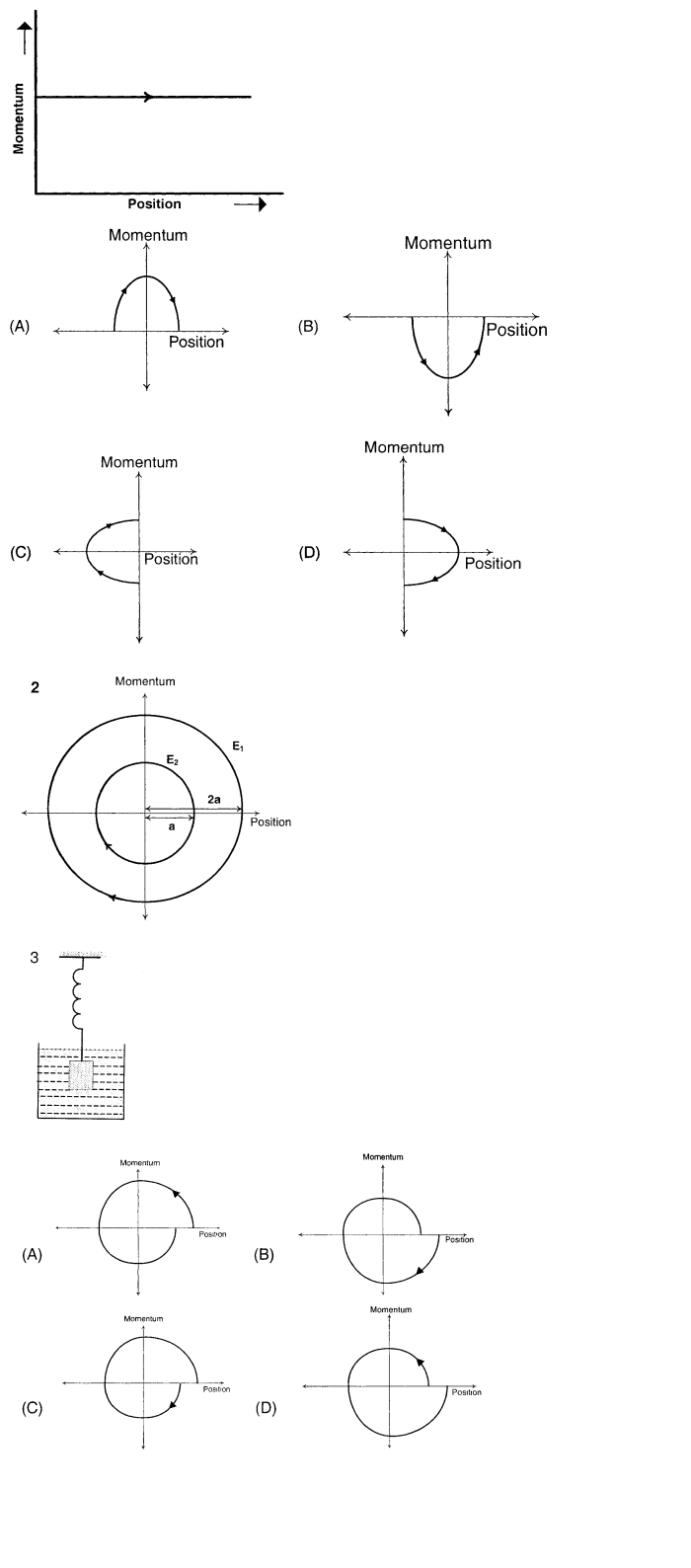
Phase space diagrams are useful tools in analyzing all kinds of dynamical problems. They are especially useful in studying the changes in motion as initial position and momentum are changed. Here we consider some simple dynamical systems in one-dimension. For such systems, phase space is a plane in which position is plotted along horizontal axis and momentum is plotted along vertical axis. The phase space diagram is $x(t)$ vs. $p(t)$ curve in this plane. The arrow on the curve indicates the time flow. For example, the phase space diagram for a particle moving with constant velocity is a straight line as shown in the figure. We use the sign convention in which position or momentum upwards (or to right) is positive and downwards (or to left) is negative. $Image$

$1.$ The phase space diagram for a ball thrown vertically up from ground is

mcq $Image$

$2.$ The phase space diagram for simple harmonic motion is a circle centered at the origin. In the figure, the two circles represent the same oscillator but for different initial conditions, and $E_1$ and $E_2$ are the total mechanical energies respectively. Then $Image$

$(A)$ $ E_1=\sqrt{2} E_2$ $(B)$ $ E_1=2 E_2$

$(C)$ $ E_1=4 E_2$ $(D)$ $ E_1=16 E_2$

$3.$ Consider the spring-mass system, with the mass submerged in water, as shown in the figure. The phase space diagram for one cycle of this system is $Image$

mcq $Image$

Give the answer question $1,2$ and $3.$
  • A$(D,C,B)$
  • B$(A,B,C)$
  • C$(B,B,D)$
  • D$(D,A,D)$
IIT 2011, Advanced
art

Download our app
and get started for free

Experience the future of education. Simply download our apps or reach out to us for more information. Let's shape the future of learning together!No signup needed.*

Similar Questions

  • 1
    A particle executes simple harmonic motion represented by displacement function as $x(t)=A \sin (\omega t+\phi)$

    If the position and velocity of the particle at $t=0\, {s}$ are $2\, {cm}$ and $2\, \omega \,{cm} \,{s}^{-1}$ respectively, then its amplitude is $x \sqrt{2} \,{cm}$ where the value of $x$ is ..... .

    View Solution
  • 2
    A $LCR$ circuit behaves like a damped harmonic oscillator. Comparing it with a physical springmass damped oscillator having damping constant $\mathrm{b}$, the correct equivalence would be:
    View Solution
  • 3
    Which of the following quantities are always negative in a $SHM$
    View Solution
  • 4
    Two particles of mass $m$ are constrained to move along two horizontal frictionless rails that make an angle $2\theta $ with respect to each other. They are connected by a spring with spring constant $k$ . The angular frequency of small oscillations for the motion where the two masses always stay parallel to each other (that is the distance between the meeting point of the rails and each particle is equal) is 
    View Solution
  • 5
    A particle of mass $m$ moves in a one-dimensional potential energy $U(x) = -ax^2 + bx^4,$ where $'a'$ and $'b'$ are positive constants. The angular frequency of small oscillations about the minima of the potential energy is equal to
    View Solution
  • 6
    A man measures the period of a simple pendulum inside a stationary lift and finds it to be $T$ sec. If the lift accelerates upwards with an acceleration $\frac{g}{4}$, then the period of the pendulum will be
    View Solution
  • 7
    Which one of the following is a simple harmonic motion
    View Solution
  • 8
    A particle executes $SHM$ with amplitude of $20 \,cm$ and time period is $12\, sec$.  What is the minimum time required for it to move between two points $10\, cm$ on  either side of the mean position ..... $\sec$ ?
    View Solution
  • 9
    The length of a spring is $l$ and its force constant is $k$. When a weight $W$ is suspended from it, its length increases by $x$. If the spring is cut into two equal parts and put in parallel and the same weight $W$ is suspended from them, then the extension will be
    View Solution
  • 10
    Three simple harmonic motions in the same direction having the same amplitude a and same period are superposed. If each differs in phase from the next by ${45^o}$, then
    View Solution