Question
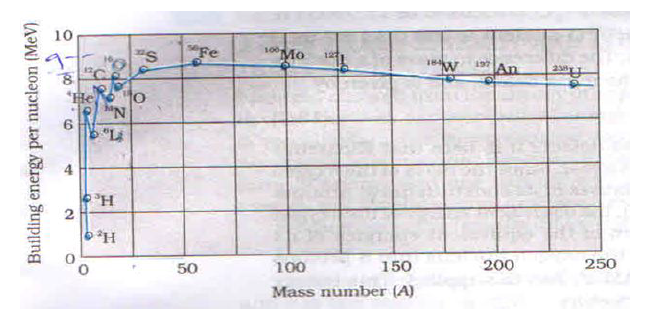
Plot a graph showing the variation of binding energy per nucleon as a function of mass number. Which property of nuclear force explains the approximate constancy of binding energy in the range 30 < A < 170? How does one explain the release of energy in both the processes of nuclear fission and fusion from the graph?
Answer

Nuclear force is Saturated, or short ranged The final system is more tightly bound when heavy nucleus undergoes nuclear fission. Hence, there is a release of energy. The final system is more tightly bound when light nuclei undergoes nuclear fusion. Hence, there is a releases of energy.Alternate Answer
There is an increase in BE/nucleon both during:
  1. Nuclear fission of heavy nuclei and,
  2. Nuclear fussion of light nuclei Nuclear.

Need a full question paper?

Generate a complete, print-ready paper with questions like this in minutes — across 16+ boards, with answer keys.

Start Generating Free

Similar questions

A capacitor of capacitance $10\mu\text{F}$ is connected across a battery of emf 6.0V through a resistance of $20\text{k}\Omega$ for 4.0s. The battery is then replaced by a thick wire. What will be the charge on the capacitor 4.0s after the battery is disconnected?
A straight wire carrying a current of 12A is bent into a semi-circular arc of radius 2.0cm as shown. What is the magnetic field at O due to:
  1. Straight segments.
  2. The semi-circular arc?
  1. Using Bohr's second postulate of quantization of orbital angular momentum show that the circumference of the electron in the $n^{th}$ orbital state in hydrogen atom is n times the de Broglie wavelength associated with it.
  2. The electron in hydrogen atom is initially in the third excited state.What is the maximum number of spectral lines which can be emitted when it finally moves to the ground state?
Average lifetime of a hydrogen atom excited to $n = 2$ state is $10^{-8}s$. Find the number of revolutions made by the electron on the average before it jumps to the ground state.
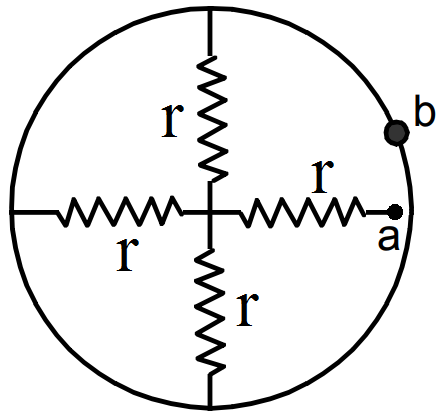
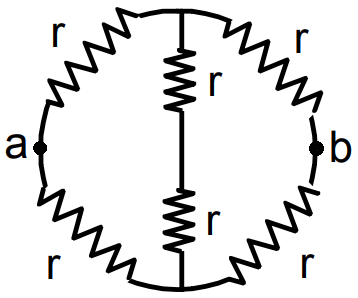
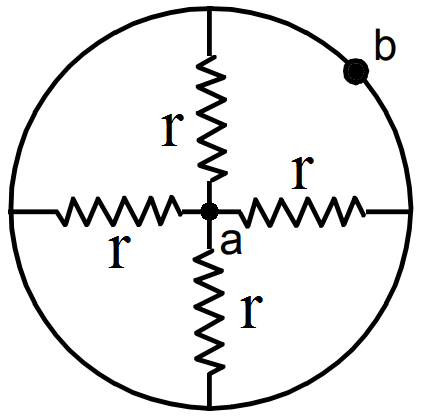
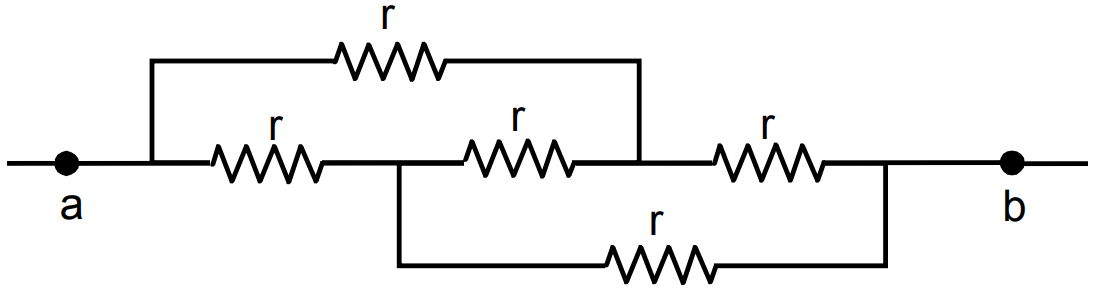
Find the equivalent resistances of the networks shown in the figure. between the points a and b.
  1.  
  1.  
  1.  
  1.  
  1.  
Is Huygen’s principle valid for longitudunal sound waves?
In one-dimensional elastic collision of equal masses, the velocities are interchanged. Can velocities in a onedimensional collision be interchanged if the masses are not equal?
Write the order of frequency range and one use of each of the following electromagnetic radiations$:$
  1. Microwaves.
  2. Ultra$-$violet rays.
  3. Gamma rays.
A coil of inductance 5.0mH and negligible resistance is connected to the oscillator of the previous problem. Find the peak currents in the circuit for $\omega=100\text{s}^{-1},500\text{s}^{-1},1000\text{s}^{-1}.$
  1. Two cells of emf $E_1$ and $E_2$ have their internal resistances $r_1$ and $r_2$, respectively. Deduce an expression for the equivalent emf and internal resistance of their parallel combination when connected across an external resistance $R.$ Assume that the two cells are supporting each other.
  2. In case the two cells are identical, each of emf $E = 5V$ and internal resistance $\text{r}=2\Omega,$ calculate the voltage across the external resistance $\text{R}=10\Omega.$