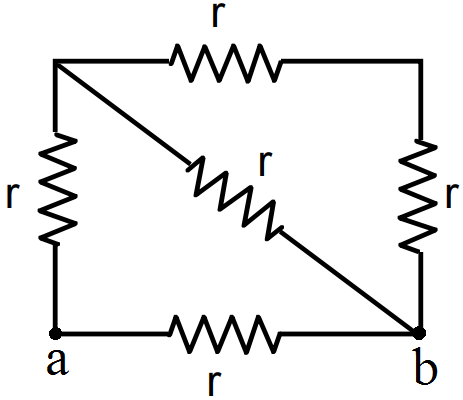
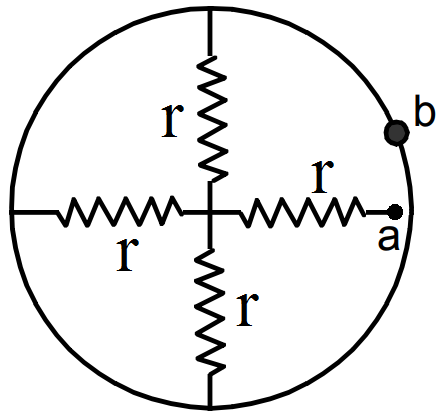
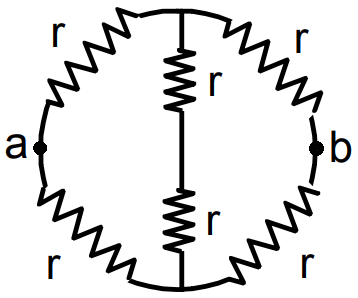
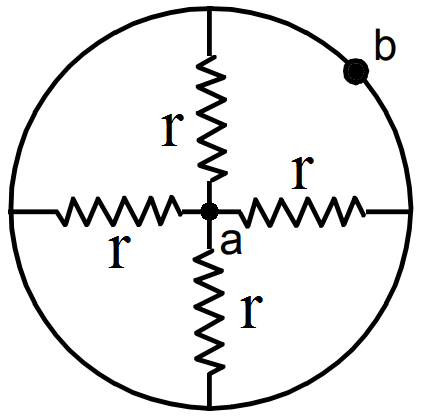
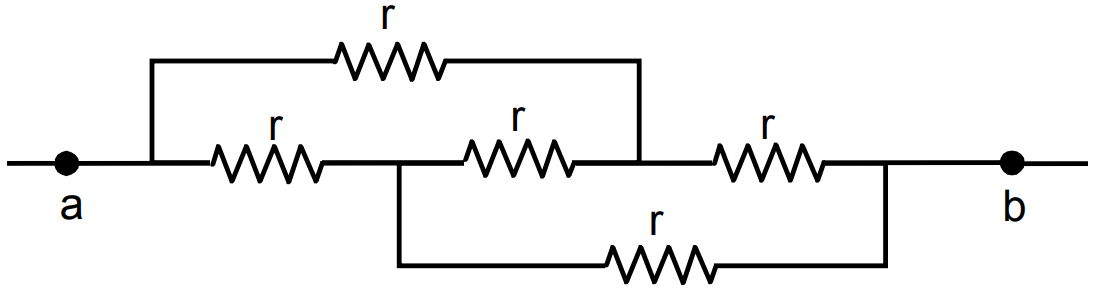
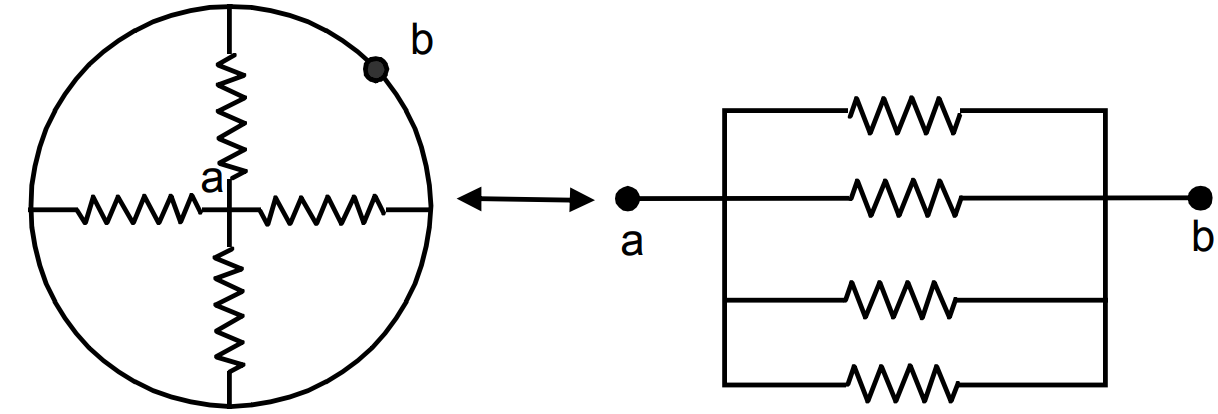
Find the equivalent resistances of the networks shown in the figure. between the points a and b.
Download our app for free and get started
$\text{R}_\text{eff}=\frac{\Big(\frac{2\text{r}}{3}+\text{r}\Big)\text{r}}{\Big(\frac{2\text{r}}{3}+\text{r}+\text{r}\Big)}=\frac{5\text{r}}{8}$ 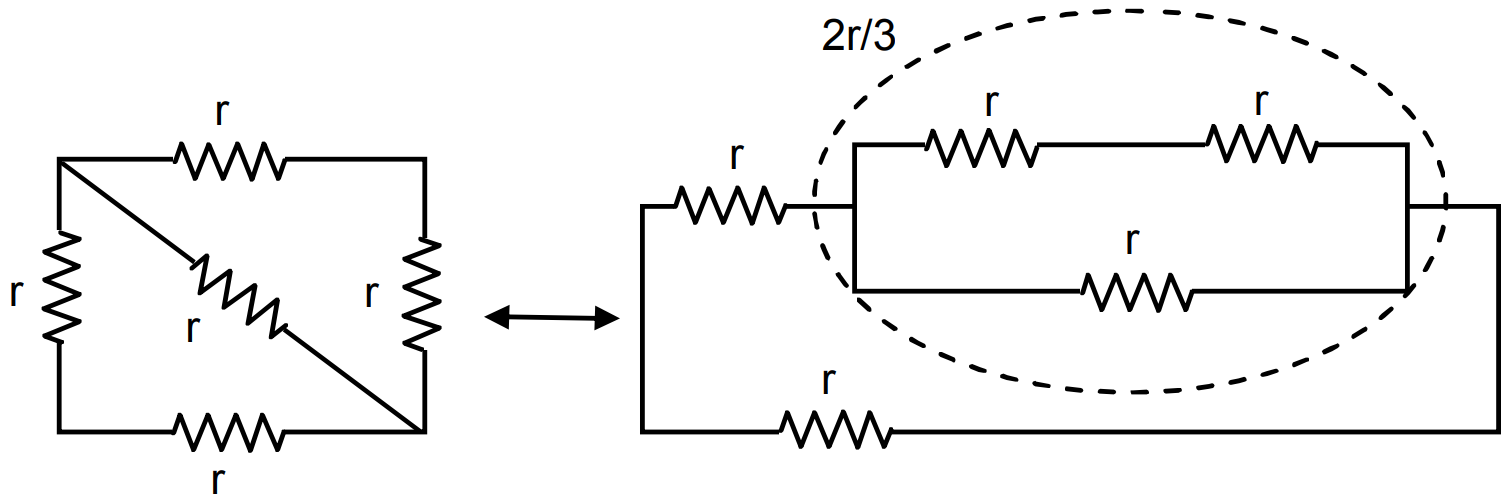 $\text{R}_\text{eff}=\frac{\text{r}}{3}+\text{r}=\frac{4\text{r}}{3}$
 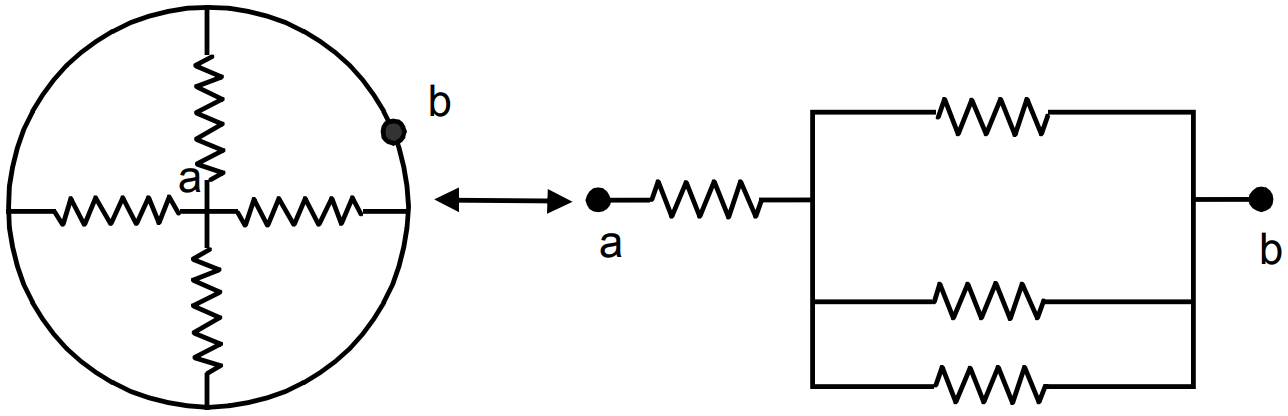 $\text{R}_\text{eff}=\frac{2\text{r}}{2}=\text{r}$
 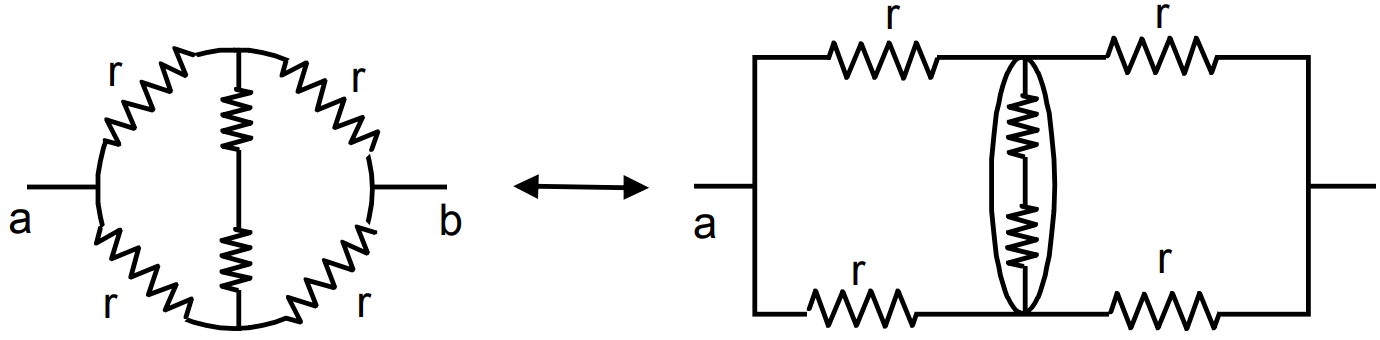 $\text{R}_\text{eff}=\frac{\text{r}}{4}$
  $\text{R}_\text{eff}=\text{r}$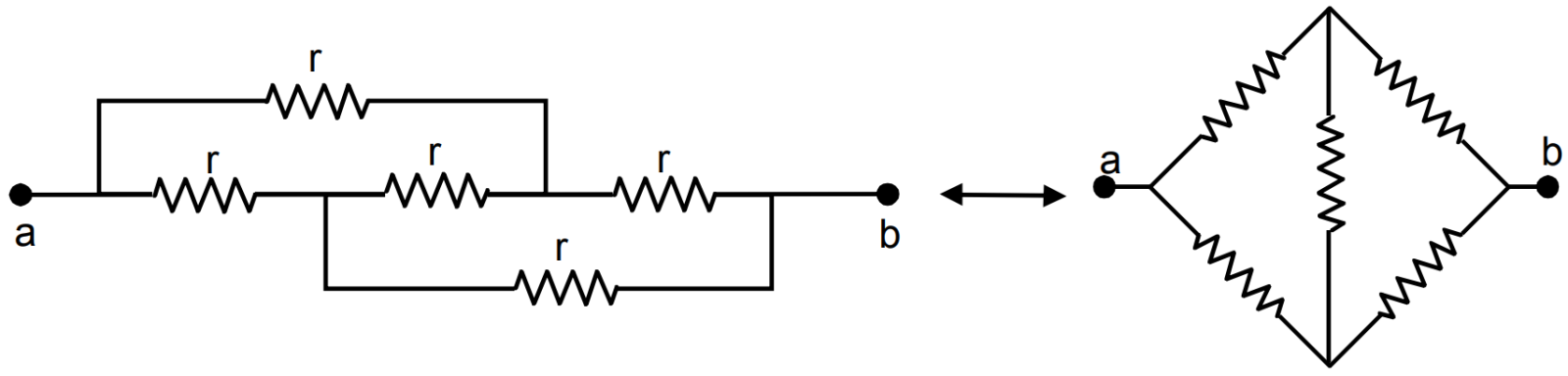
$\text{R}_\text{eff}=\frac{\text{r}}{3}+\text{r}=\frac{4\text{r}}{3}$ $\text{R}_\text{eff}=\frac{2\text{r}}{2}=\text{r}$ $\text{R}_\text{eff}=\frac{\text{r}}{4}$ $\text{R}_\text{eff}=\text{r}$
Download our appand get started for free
Experience the future of education. Simply download our apps or reach out to us for more information. Let's shape the future of learning together!No signup needed.*
Similar Questions
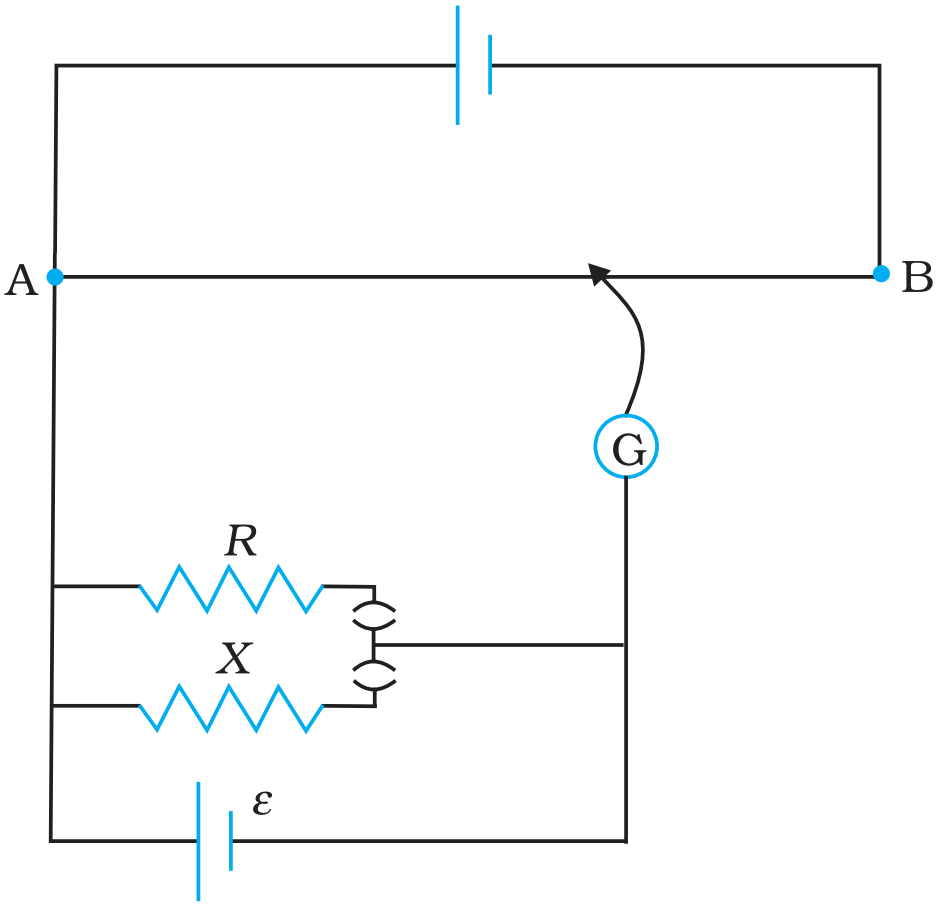
- 1Figure shows a potentiometer circuit for comparison of two resistances. The balance point with a standard resistor $\text{R}=10.0\ \Omega$ is found to be $58.3 \ cm,$ while that with the unknown resistance $X$ is $68.5 \ cm$. Determine the value of $X$. What might you do if you failed to find a balance point with the given cell of emf $\varepsilon?$View Solution
- 2A capacitance C charged to a potential difference V is discharged by connecting its plates through a resistance R. Find the heat dissipated in one time constant after the connections are made. Do this by calculating $\int\text{i}^2\text{R}$ dt and also by finding the decrease in the energy stored in the capacitor.View Solution
- 3View SolutionA number of identical cells, n, each of emf E, internal resistance r connected in series are charged by a d.c. source of emf E', using a resistor R.
- Draw the circuit arrangement.
- Deduce the expressions for (a) the charging current and (b) the potential difference across the combination of the cells.
- 4(a) In Example 3.1, the electron drift speed is estimated to be only a few $mm s ^{-1}$ for currents in the range of a few amperes? How then is current established almost the instant a circuit is closed?View Solution
(b) The electron drift arises due to the force experienced by electrons in the electric field inside the conductor. But force should cause acceleration. Why then do the electrons acquire a steady average drift speed?
(c) If the electron drift speed is so small, and the electron's charge is small, how can we still obtain large amounts of current in a conductor?
(d) When electrons drift in a metal from lower to higher potential, does it mean that all the 'free' electrons of the metal are moving in the same direction?
(e) Are the paths of electrons straight lines between successive collisions (with the positive ions of the metal) in the (i) absence of electric field, (ii) presence of electric field? - 5View SolutionWrite the mathematical relation for the resistivity of a material in terms of relaxation time, number density and mass and charge of charge carriers in it. Explain, using this relation, why the resistivity of a metal increases and that of a semi-conductor decreases with rise in temperature.
- 6View Solution
- Define the term ‘conductivity’ of a metallic wire. Write its SI unit.
- Using the concept of free electrons in a conductor, derive the expression for the conductivity of a wire in terms of number density and relaxation time. Hence obtain the relation between current density and the applied electric field E.
- 7A potentiometer wire of length 1 m has a resistance of 5 $\Omega$. It is connected to a 8 V battery in series with a resistance of 15 $\Omega$. Determine the emf of the primary cell which gives a balance point at 60 cm.View Solution
- 8View SolutionIs the motion of a charge across junction momentum conserving? Why or why not?
- 9View SolutionWrite the principle of working of a potentiometer. Describe briefly, with the help of a circuit diagram, how a potentiometer is used to determine the internal resistance of a given cell.
- 10The current through a wire depends on time as $\text{i}=\text{i}_0+\alpha\text{t},$View Solution
Where $\text{i}_0=10\text{A}$ and $\alpha=4\text{A/ s}.$ Find the charge that crosses through a section of the wire in 10 seconds.