Point charge ${q_1} = 2\,\mu C$ and ${q_2} = - 1\,\mu C$ are kept at points $x = 0$ and $x = 6$ respectively. Electrical potential will be zero at points
Diffcult
Download our app for free and get started
(c) Potential will be zero at two points
At internal point $(M)$ :$\frac{1}{{4\pi {\varepsilon _0}}} \times \left[ {\frac{{2 \times {{10}^{ - 6}}}}{{(6 - l)}} + \frac{{( - 1 \times {{10}^{ - 6}})}}{l}} \right] = 0$
$==>$ $l = 2$
So distance of $M$ from origin; $x = 6 -2 = 4$
At exterior point $(N)$ :$\frac{1}{{4\pi {\varepsilon _0}}}$ $×$ $\left[ {\frac{{2 \times {{10}^{ - 6}}}}{{6 - l'}} + \frac{{ - 1 \times {{10}^{ - 6}}}}{{l'}}} \right] =0 $
At internal point $(M)$ :$\frac{1}{{4\pi {\varepsilon _0}}} \times \left[ {\frac{{2 \times {{10}^{ - 6}}}}{{(6 - l)}} + \frac{{( - 1 \times {{10}^{ - 6}})}}{l}} \right] = 0$
$==>$ $l = 2$
So distance of $M$ from origin; $x = 6 -2 = 4$
At exterior point $(N)$ :$\frac{1}{{4\pi {\varepsilon _0}}}$ $×$ $\left[ {\frac{{2 \times {{10}^{ - 6}}}}{{6 - l'}} + \frac{{ - 1 \times {{10}^{ - 6}}}}{{l'}}} \right] =0 $
$l'=6$
So distance of $N$ from origin, $x = 6 + 6 = 12$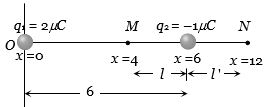

Download our appand get started for free
Experience the future of education. Simply download our apps or reach out to us for more information. Let's shape the future of learning together!No signup needed.*
Similar Questions
- 1While working on a physics project at school physics lab, you require a $4 \,\mu F$ capacitor in a circuit across a potential difference of $1 \,kV$. Unfortunately, $4 \,\mu F$ capacitors are out of stock in your lab but $2 \,\mu F$ capacitors which can withstand a potential difference of $400 \,V$ are available in plenty. If you decide to use the $2 \,\mu F$ capacitors in place of $4 \,\mu F$ capacitor, minimum number of capacitors required areView Solution
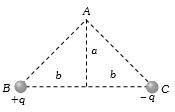
- 2As shown in the figure, charges $ + q$ and $ - q$ are placed at the vertices $B$ and $C$ of an isosceles triangle. The potential at the vertex $A$ isView Solution
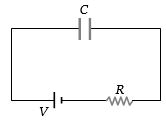
- 3As in figure shown, if a capacitor $C$ is charged by connecting it with resistance $R$, then energy is given by the battery will beView Solution
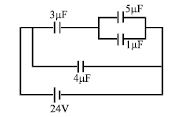
- 4In the circuit shown, the energy stored in $1\,\mu F$ capacitor is.....$\mu J$View Solution
- 5Two capacitors with capacitance values $C _1=2000 \pm 10 pF$ and $C_2=3000 \pm 15 pF$ are connected in series. The voltage applied across this combination is $V=5.00 \pm 0.02 V$. The percentage error in the calculation of the energy stored in this combination of capacitors is . . . . . .View Solution
- 6View SolutionA capacitor is charged by using a battery which is then disconnected. A dielectric slab is then slipped between the plates, which results in
- 7View SolutionFor the situation shown in the figure below, mark out the correct statement
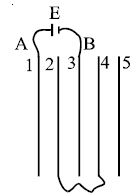
- 8Five conducting parallel plates having area $A$ and separation between them $d$, are placed as shown in the figure. Plate number $2$ and $4$ are connected wire and between point $A$ and $B$, a cell of emf $E$ is connected. The charge flown through the cell isView Solution
- 9A capacitor when filled with a dielectric $K = 3$ has charge ${Q_0}$, voltage ${V_0}$ and field ${E_0}$. If the dielectric is replaced with another one having $K = 9$ the new values of charge, voltage and field will be respectivelyView Solution
- 10View SolutionConsider the points lying on a straight line joining two fixed opposite charges. Between the charges there is