Question
Population composition and Population structure
| Population composition | Population structure |
| (i) Population composition covers all the characteristics of population that can be measured. | (i) Composition of population gives idea about the structure of population. |
| (ii) On the basis of composition, we can classify and understand it’s characteristics. | (ii) Population structure gives idea about dependency ratio and its impact on economy of the country. |
| (iii) Examples of population composition are age structure, sex ratio, literacy rate, occupational structure etc. | (iii) For example, age composition gives idea about percentage of young, adult and old age population. |
Generate a complete, print-ready paper with questions like this in minutes — across 16+ boards, with answer keys.
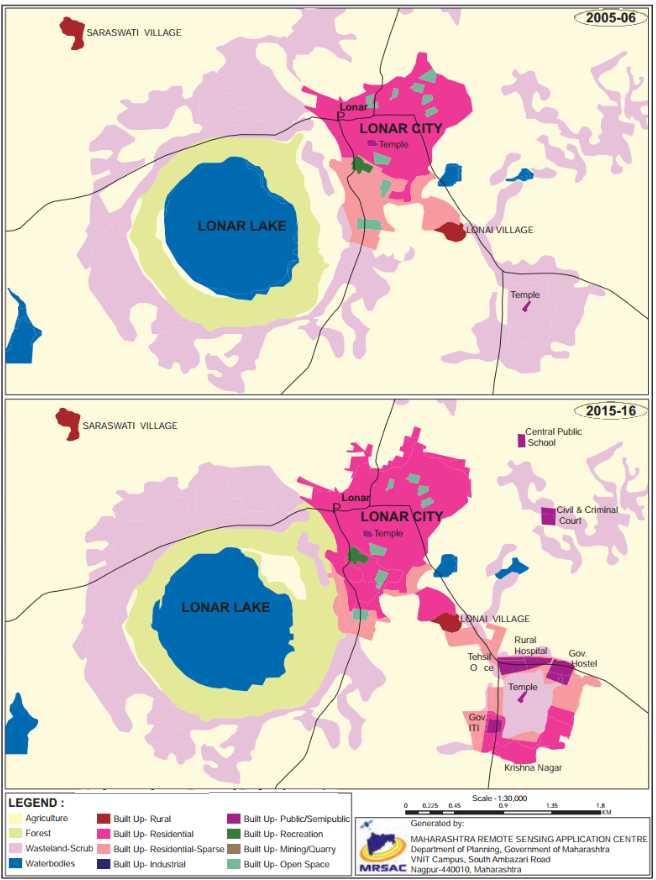
(i) Which periods do the map belongs to?
(ii) Which land covers have reduced? What are their colours?
(iii)Which landcovers seen to have increased? what are their colours?
(iv) Which land cover has been replaced by increased landcovers?
(vi) Write a conclusive note comparing both the maps.
| Regions | Contribution of Primary Sector to GDP (%) | Contribution of Secondary Sector to GDP (%) | Contribution of Tertiary Sector to GDP (%) | Human Development Index (HDI) |
| 2018 | 2018 | 2018 | 2018 | |
| A | 1 | 34 | 65 | 0.93 |
| B | 2 | 32 | 66 | 0.85 |
| C | 2 | 37 | 61 | 0.71 |
| D | 6 | 33.2 | 60.8 | 0.81 |
| E | 14 | 30 | 56 | 0.65 |
(i) In which region is contribution of primary activities the least?
(ii) In which region is the contribution of primary activities the most?
(iii) In which region the contribution of tertiary activities is the most?
(iv) Which region has the highest HDI?
(v) Can you draw a conclusion on basis of the answers from Q (i) to Q (iv)?
| A | B | C |
| (1) Climate | (1) Soil | (1) Import food |
| (2) Natural Resources | (2) High density | (2) Woollen products |
| (3) Population | (3) Dry farming | (3) Agriculture |
| (4) Culture | (4) Snow covered area | (4) Kashmiri shawl |
| (5) Israel | (5) Art and craft | (5) Export services for agriculture |


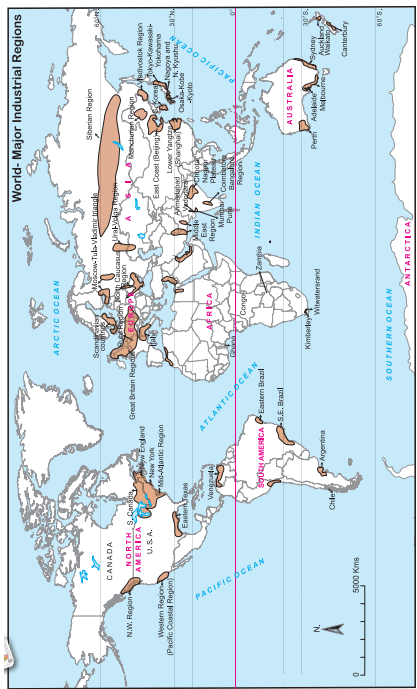
Observe the map and an swer the following questions
(i) Which economic activities are shown in the following map?
(ii) In which region do you don’t find any activity? what could be the reason?
(iii) In which latitudes do you primarily find the distribution of lumbering activity?
(iv) Why is fishing occupation only found in certain areas in the oceans?
(v) Which primary economic activities are mostly found in Europe?