Question
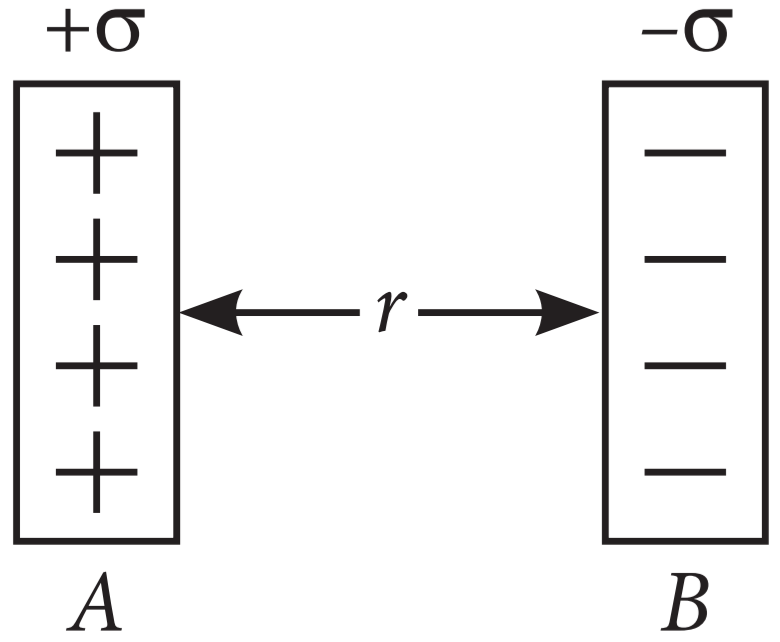
Potential difference $(\triangle\text{V})$ between two points $A$ and $B$ separated by a distance $x,$ in a uniform electric field $E$ is given by $\triangle\text{V}=-\text{Ex},$ where xis measured parallel to the field lines. If a charge $q_0$ moves from $P$ to $Q,$ the change in potential energy $(\triangle\text{U})$ is given as $\triangle\text{U}=-\text{q}_0\triangle\text{V}.$ A proton is released from rest in uniform electric field of magnitude $4.0 \times 10^8Vm^{-1}$ directed along the positive $X-$ axis. The proton undergoes a displacement of $0.25m$ in the direction of $E$. Mass of a proton $= 1.66 \times 10^{-27}kg$ and charge of proton $ = 1.6 \times 10^{-19}C$.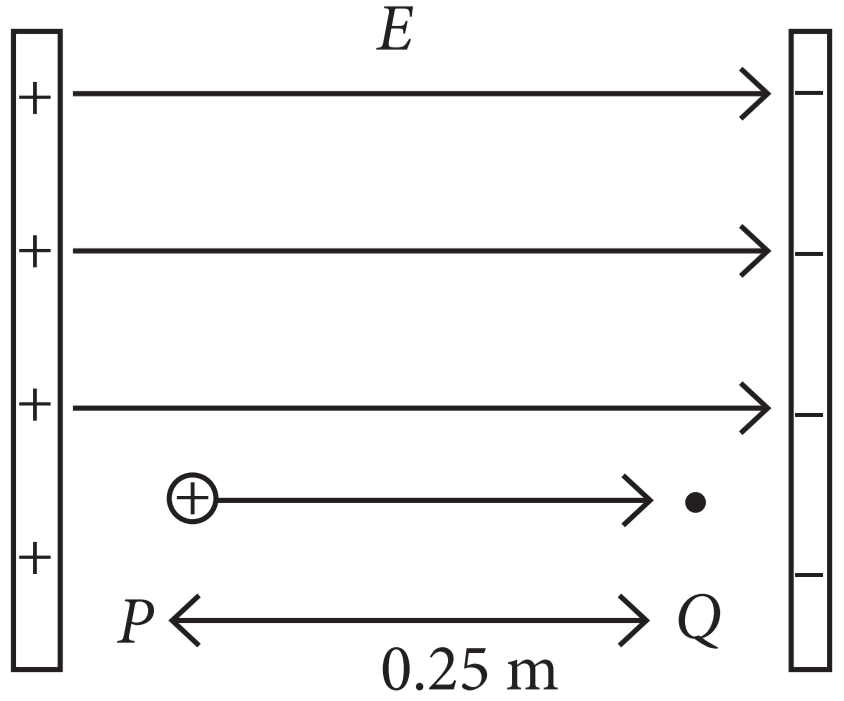
- The change in electric potential of the proton between the points $A$ and $B$ is:
- The potential energy of proton decreases.
- The potential energy of proton increases.
- The proton loses kinetic energy.
- $-1.1J$
- $2J$
- $2.5J$
- $3J$
- $1.56 \times 10^{-14}J$
- $5.5 \times 10^{-14}J$
- $2.56 \times 10^{-14}J$
- $4.56 \times 10^{-14}J$
- $1.6 \times 10^{11}J$
- $0.5 \times 10^{23}J$
- $-1.6 \times 10^{-11}J$
- $3.2 \times 10^{22}J$
- $-1 \times 10^8V$
- $1 \times 10^8V$
- $6.4 \times 10^{-19}V$
- $-6.4 \times 10^{-19}V$