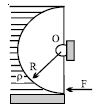
A light semi cylindrical gate of radius $R$ is piovted at its mid point $O$, of the diameter as shown in the figure holding liquid of density $\rho $. The force $F$ required to prevent the rotation of the gate is equal to
Advanced
Download our app for free and get started
The pressure at any point in a liquid is a function of the density of the liquid and the height of the point from some base reference.
Therefore, $P=\rho g h$
Let's consider the topmost point as the base reference to be at zero pressure.
As we move below, consider a semi-circular ring of radius $r$ and thickness $dr.$
The height of this ring from the topmost reference point $=\mathrm{R}-\mathrm{r}$
Hence, the pressure outside any such ring, $\mathrm{dP}=\rho g(R-r)$
The force exerted by the fluid on any such ring, $\mathrm{dF}=d P \times A$
Hence, dF $=\rho g(R-r) \times 2 \pi r d r$
The counteracting force required to keep the gate stable is the integration of this pressure exerted force.
$\mathrm{F}=\int_{0}^{R} \rho g(R-r) \times 2 \pi r d r$
$F=\frac{\pi \rho g R^{3}}{3}$
Hence, the answer is none of these.

Download our appand get started for free
Experience the future of education. Simply download our apps or reach out to us for more information. Let's shape the future of learning together!No signup needed.*
Similar Questions
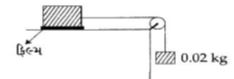
- 1A metal block of base area $0.2\; m ^{2}$ is connected to a $0.02\; kg$ mass via a string that passes over an ideal pulley as shown in figure. A liquid film of thickness $0.6\; mm$ is placed between the block and the table. When released the block moves to the right with a constant speed of $0.17\; m / s$. The co-efficient of viscosity of the liquid isView Solution
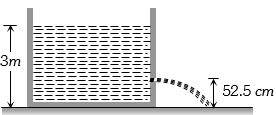
- 2Water is filled in a cylindrical container to a height of $3m. $ The ratio of the cross-sectional area of the orifice and the beaker is $ 0.1. $ The square of the speed of the liquid coming out from the orifice is ....... $m^2/s^2$ ($g = 10 m/s^2$)View Solution
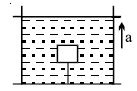
- 3A body having volume $V$ and density $\rho$ is attached to the bottom of a container as shown. Density of the liquid is $d( > \rho )$. Container has a constant upward acceleration $a.$ Tension in the string isView Solution
- 4A table tennis ball has radius $(3 / 2) \times 10^{-2} m$ and mass $(22 / 7) \times 10^{-3} kg$. It is slowly pushed down into a swimming pool to a depth of $d=0.7 m$ below the water surface and then released from rest. It emerges from the water surface at speed $v$, without getting wet, and rises up to a height $H$. Which of the following option(s) is (are) correct?View Solution
[Given: $\pi=22 / 7, g=10 ms ^{-2}$, density of water $=1 \times 10^3 kg m ^{-3}$, viscosity of water $=1 \times 10^{-3} Pa$-s.]
$(A)$ The work done in pushing the ball to the depth $d$ is $0.077 J$.
$(B)$ If we neglect the viscous force in water, then the speed $v=7 m / s$.
$(C)$ If we neglect the viscous force in water, then the height $H=1.4 m$.
$(D)$ The ratio of the magnitudes of the net force excluding the viscous force to the maximum viscous force in water is $500 / 9$.
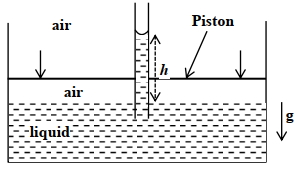
- 5An incompressible liquid is kept in a container having a weightless piston with a hole. A capillary tube of inner radius $0.1 \mathrm{~mm}$ is dipped vertically into the liquid through the airtight piston hole, as shown in the figure. The air in the container is isothermally compressed from its original volume $V_0$ to $\frac{100}{101} V_0$ with the movable piston. Considering air as an ideal gas, the height $(h)$ of the liquid column in the capillary above the liquid level in $\mathrm{cm}$ is. . . . . . .View Solution
[Given: Surface tension of the liquid is $0.075 \mathrm{Nm}^{-1}$, atmospheric pressure is $10^5 \mathrm{~N} \mathrm{~m}^{-2}$, acceleration due to gravity $(g)$ is $10 \mathrm{~m} \mathrm{~s}^{-2}$, density of the liquid is $10^3 \mathrm{~kg} \mathrm{~m}^{-3}$ and contact angle of capillary surface with the liquid is zero]
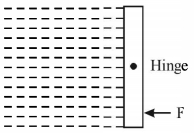
- 6A square gate of size $1\,m \times 1\,m$ is hinged at its mid-point. A fluid of density $\rho$ fills the space to the left of the gate. The force F required to hold the gate stationary isView Solution
- 7A ball of mass $m$ and radius $ r $ is gently released in a viscous liquid. The mass of the liquid displaced by it is $m' $ such that $m > m'$. The terminal velocity is proportional toView Solution
- 8A large open tank has two holes in the wall. One is a square hole of side $L$ at a depth $y $ from the top and the other is a circular hole of radius $ R$ at a depth $ 4y $ from the top. When the tank is completely filled with water the quantities of water flowing out per second from both the holes are the same. Then $ R$ is equal toView Solution
- 9A wooden block floats in a liquid with $40\%$ of its volume inside the liquid. When the vessel containing he liquid starts rising upwards with acceleration $a = g/2$, the percentage of volume inside the liquid is ......... $\%$View Solution
- 10A small metal sphere of radius $a$ is falling with a velocity $v$ through a vertical column of a viscous liquid. If the coefficient of viscosity of the liquid is $\eta $ , then the sphere encounters an opposing force ofView Solution