Question
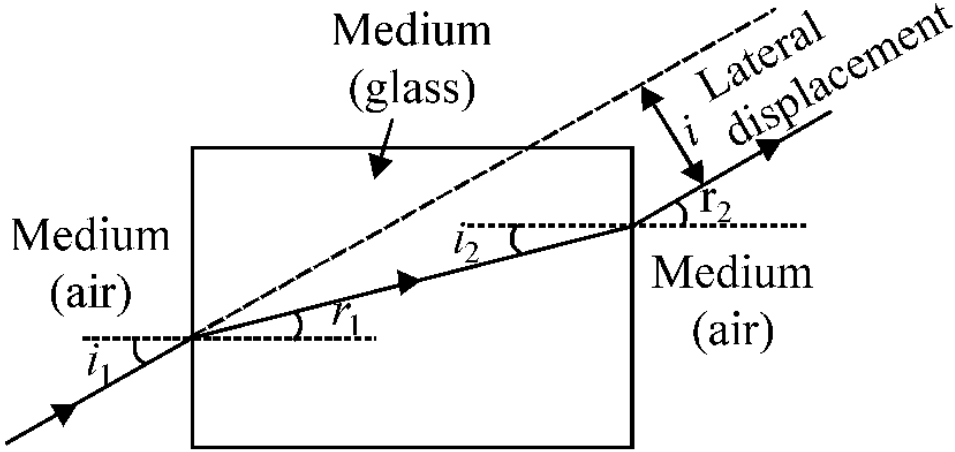
Prove : $n_{12}=\frac{1}{n_{21}}$

Need a full question paper?

Generate a complete, print-ready paper with questions like this in minutes — across 16+ boards, with answer keys.
Start Generating Free

Similar questions

A ball falls on an inclined plane of inclination $\theta$ from a height h above the point of impact and makes a perfectly elastic collision. Where will it hit the plane again?
Two particles A and B, each having a charge Q, are placed a distance d apart. Where should a particle of charge q be placed on the perpendicular bisector of AB so that it experiences maximum force What is the magnitude of this maximum force?
A rectangular frame of wire abcd has dimensions 32cm × 8.0cm and a total resistance of $2.0\Omega.$ It is pulled out of a magnetic field B = 0.020T by applying a force of 3.2 × 10⁻⁵N (figure). It is found that the frame moves with constant speed. Find
  1. This constant speed.
  2. The emf induced in the loop.
  3. The potential difference between the points a and b.
  4. The potential difference between the points c and d.

Figure shows a smooth track which consists of a straight inclined part of length 1 joining smoothly with the circular part. A particle of mass m is projected up the incline from its bottom.
  1. Find the minimum projection-speed v0, for which the particle reaches the top of the track.
  2. Assuming that the projection-speed is 2v0 and that the block does not lose contact with the track before reaching its top, find the force acting on it when it reaches the top.
  3. Assuming that the projection-speed is only slightly greater than v0, where will the block lose contact with the track?
A reference frame attached to the earth:
  1. Is an inertial frame by definition.
  2. Cannot be an inertial frame because the earth is revolving around the sun.
  3. Is an inertial frame because Newton's laws are applicable in this frame.
  4. Cannot be an inertial frame because the earth is rotating about its axis.
While doing an experiment with potentiometer (Fig.) it was found that the deflection is one sided and (i) the deflection decreased while moving from one end A of the wire to the end B; (ii) the deflection increased. while the jockey was moved towards the end B.

  1. Which terminal +or -ve of the cell E1, is connected at X in case (i) and how is E1 related to E?
  2. Which terminal of the cell E1 is connected at X in case (ii)?
Twelve wires, each of equal resistance r, are joined to form a cube, as shown in the figure. Find the equivalent resistance between the diagonally opposite points a and f.

We have stimulated emission and spontaneous emission. Do we also have stimulated absorption and spontaneous absorption?
Two wires carrying equal currents i each, are placed perpendicular to each other, just avoiding a contact. If one wire is held fixed and the other is free to move under magnetic forces, what kind of motion will result?
A spherical tungsten piece of radius 1.0cm is suspended in an evacuated chamber maintained at 300K. The piece is maintained at 1000K by heating it electrically. Find the rate at which the electrical energy must be supplied. The emissivity of tungsten is 0.30 and the Stefan constant $\sigma$ is 6.0 × 10-8Wm-2K-4.