Question
Prove the following trigonometric identities.
$\frac{1}{1+\sin\text{A}}+\frac{1}{1-\sin\text{A}}=2\sec^2\text{A}$

Answer

$\text{L.H.S}=\frac{1-\sin\text{A}+1+\sin\text{A}}{(1+\sin\text{A})(1-\sin\text{A})}$
$\Rightarrow\ \frac{2}{1-\sin^2\text{A}} \big[\because (1+\sin\text{A})(1-\sin\text{A})=1-\sin^2\text{A}\big]$
$\Rightarrow\ \frac{2}{\cos^2\text{A}}\Rightarrow 2\sec^2\text{A} \big[\because 1-\sin\text{A}=\cos\text{A}\big]$
$\therefore\ \text{L.H.S}=\text{R.H.S}$
Hence proved

Need a full question paper?

Generate a complete, print-ready paper with questions like this in minutes — across 16+ boards, with answer keys.
Start Generating Free

Similar questions

An urn contains 10 red and 8 white balls. Write sample space $S$ and $n(S)$. Write the events $A$ and B using Set and mention $n(A)$ and $n(B)$ if $A$ is the event that ball is white, B is the event that ball is neither white nor red.
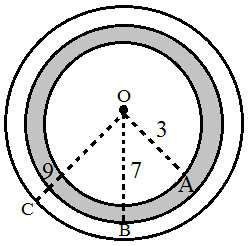
A target shown in the figure consists of three concentric circles of radii 3, 7 and 9cm respectively. A dart is thrown and lands on the target. What is the probability that the dart will land on the shaded region?
Shri. Batliwala sold shares of Rs. 30,350 and purchased shares of Rs. 69,650 in a day. He paid brokerage at the rate of 0.1% on sale and purchase. 18% GST was charged on brokerage. Find his total expenditure on brokerage and tax.
Find the smallest number which leaves remainders $8$ and $12$ when divided by $28$ and $32$ respectively.
The sums of first n terms of three A.P. S are $S_1, S_2$_ and $S_3.$ The first term of each is 5 and their common differences are $2, 4$ and $6$ respectively. Prove that $S_1 + S_3 = 2S_2.$
In the following, determine whether the given values are solution of the given equation or not:
$x^2 + x + 1 = 0, x = 0, x = 1$
Solve the following quadratic equations by factorisation : 3y² = 15 y
Shri Maniklal has purchased 300 shares of F.V. ₹ 100, for M.V. ₹ 120. Company has paid dividend at 7%. Complete the following activity to find the rate of return on his investment.
Activity :
F.V. = ₹ 100
Number of shares = 300
Market value = ₹ 120
(a) Sum invested = M.V. × No. of shares
$\therefore$ = ⬜ x ⬜
= ₹ 36,000
(b) Dividend per share $=$ F.V. × rate of dividend
= ⬜ x $\frac{⬜}{100} $
= ₹ 7
$\therefore \quad$ Total dividend received $=300 \times 7$
= ₹ ⬜
(c) Rate of return $=\frac{\text { Dividend income }}{\text { Sum invested }} \times 100$
$=\frac{2,100}{36,000} \times 100 $
= ⬜ %
Solve for x and y:
2x - 3y = 13,
7x - 2y = 20
A building is in the form of a cylinder surmounted by a hemi-spherical vaulted dome and contains $41\Big(\frac{19}{21}\Big)\text{m}^3$ of air. If the internal diameter of dome is equal to its total height above the floor, find the height of the building?