Question
Radioactive isotopes are produced in a nuclear physics experiment at a constant rate $\frac{\text{dN}}{\text{dt}}=\text{R}.$ An inductor of inductance 100mH, a resistor of resistance $100\Omega$ and a battery are connected to form a series circuit. The circuit is switched on at the instant the production of radioactive isotope starts. It is found that $\frac{\text{i}}{\text{N}}$ remains constant in time where i is the current in the circuit at time t and N is the number of active nuclei at time t. Find the half-life of the isotope.
Answer

$\text{R}=100\Omega;\text{ L}=100\text{mH}$
After time t, $\text{i = i}_0\Big(1-\text{e}^{\frac{-\text{t}}{\text{Lr}}}\Big)\text{ N = N}_0\big(\text{e}^{-\lambda\text{t}}\big)$
$\frac{\text{i}}{\text{N}}=\frac{\text{i}_0\big(1-\text{e}^{-\frac{\text{tR}}{\text{L}}}\big)}{\text{N}_0\text{e}^{-\lambda\text{t}}}\frac{\text{i}}{\text{N}}$ is constant i.e. independent of time.
Coefficients of t are equal $-\frac{\text{R}}{\text{L}}=-\lambda\Rightarrow\frac{\text{R}}{\text{L}}=\frac{0.693}{\text{t}_{\frac{1}{2}}}$
$=\text{t}_{\frac{1}{2}}=0.693\times10^{-3}=6.93\times10^{-4}\text{sec}.$

Need a full question paper?

Generate a complete, print-ready paper with questions like this in minutes — across 16+ boards, with answer keys.

Start Generating Free

Similar questions

A boy is holding a smooth, hollow and non-conducting pipe vertically with charged spherical ball of mass 10 g carrying a charge of +10 mC inside it which is free to move along the axis of the pipe. The boy is moving the pipe from East to West direction in the presence of magnetic field of 2T. With what minimum velocity, should the boy move the pipe such that the ball does not move along the axis. Also determine the direction of the magnetic field.
We have valence electrons and conduction electrons in a semiconductor. Do we also have 'valence holes' and 'conduction holes'?
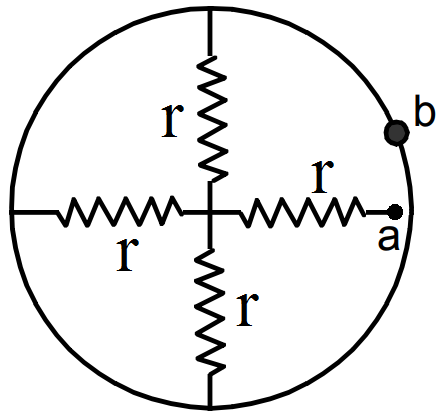
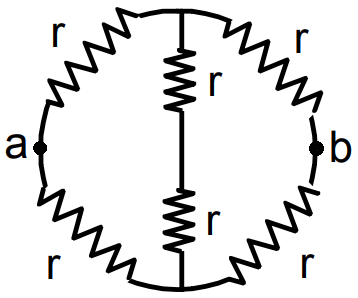
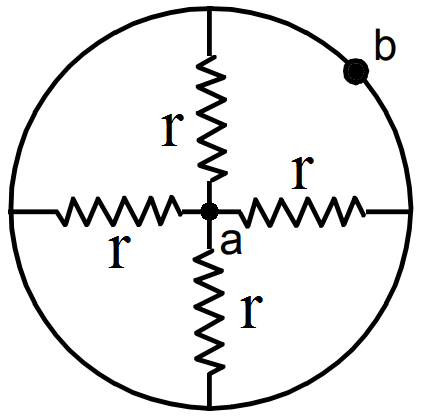
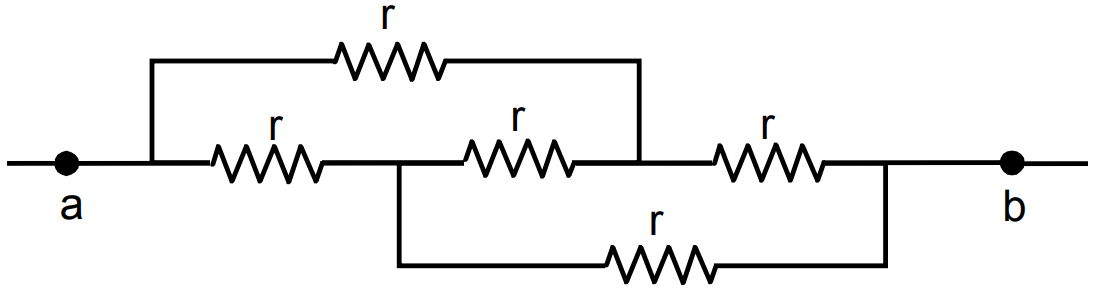
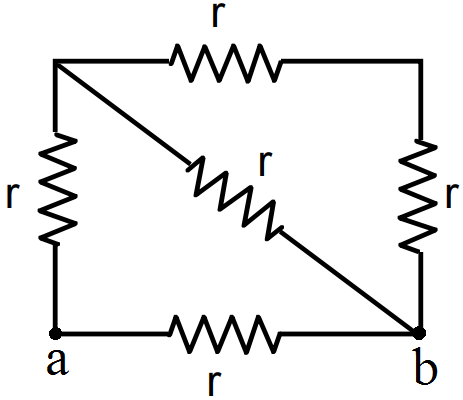
Find the equivalent resistances of the networks shown in the figure. between the points a and b.
  1.  
  1.  
  1.  
  1.  
  1.  
Explain polarisation of light.
Explain with example, whether the neutron-proton ratio in a nucleus increases or decreases due to $\beta-$decay.
The electric field in a region is given by $\overrightarrow{\text{E}}=\frac{3}{5}\text{E}_0\overrightarrow{\text{i}}+\frac{4}{5}\text{E}_0\overrightarrow{\text{j}}$ with $\text{E}_0=2.0\times10^3\text{NC}^{-1}.$ Find the flux of this field through a rectangular surface of area $0.2m^2$ parallel to the $y-z$ plane.
In a $p-n$ junction, the depletion region is $400\ nm$ wide and an electric field of $5 \times 10^5\ V/m$ exists in it.
  1. Find the height of the potential barrier.
  2. What should be the minimum kinetic energy of a conduction electron which can diffuse from the $n-$side to the $p-$side?
$a.$ Using the Bohr's model, calculate the speed of the electron in a hydrogen atom in the $n = 1, 2$ and $3$ levels.
$b$. Calculate the orbital period in each of these levels.
Write characteristics of Laser rays.
It is said that any charge given to a conductor comes to its surface. Should all the protons come to the surface? Should all the electrons come to the surface? Should all the free electrons come to the surface?