Question
Read the following and answer any four questions from (i) to (v) given below:
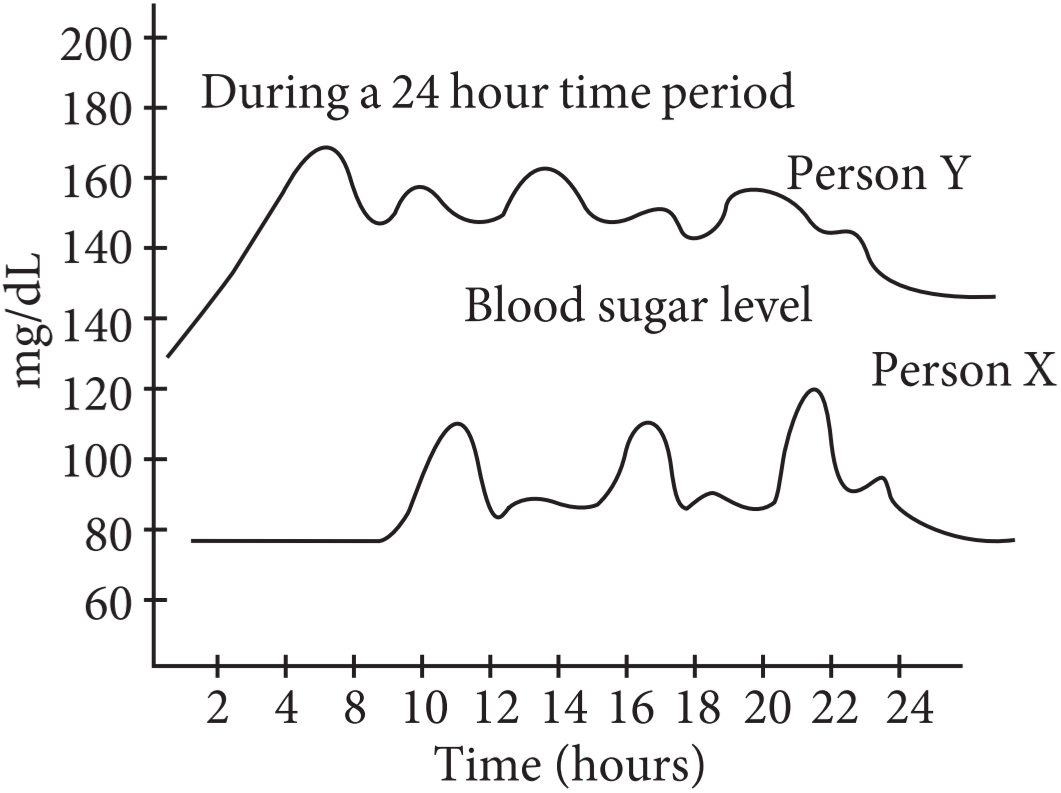
The given graphs show fluctuations in blood sugar of person X and Y during a 24 hour time period.
Based on the above information, answer the following questions.
  1. Which of the following holds true for person X?
  1. Person X is suffering from type I diabetes.
  2. Person X shows severe insulin deficiency and beta cell depletion.
  3. Person X is normal and shows good control of blood sugar level.
  4. Person X is subjected to excessive urination and abnormal thrust.
  1. The given graph indicates that person Y is suffering from.
  1. Diabetes
  2. Hypertension
  3. Atherosclerosis
  4. Rheumatic heart disease.
  1. Which of the following conditions are common in person Y?
  1. Excretion of glucose in urine and excessive urination.
  2. Polydipsia and mild beta cell depletion.
  3. Progressive erosion of articular cartilage at synovial joint.
  4. Both (a) and (b).
  1. A person suffering from diabetes mellitus becomes weak because.
  1. The cells are unable to utilise glucose and other carbohydrates for energy production.
  2. Degradation of fat increases production of toxic ketone bodies.
  3. Cells utilise proteins for obtaining energy
  4. All of these.
  1. Assertion: Type I diabetes involves failure of insulin to facilitate the movement of glucose into cells.
Reason: Type II diabetes is caused by failure of beta cells to produce adequate amount of insulin due to beta cell depletion.
  1. Both assertion and reason are true, and reason is the correct explanation of assertion.
  2. Both assertion and reason are true, but reason is not the correct explanation of assertion.
  3. Assertion is true, but reason is false.
  4. Both assertion and reason are false.

Answer

  1. (c) Person X is normal and shows good control of blood sugar level.
Explanation:

Blood sugar level fluctuations in person X indicate that sugar level never exceed the normal limit and sufficient secretion of insulin at required times removes any extra sugar from blood and converts it into glycogen for future use. This implies that person Xis normal and healthy.
  1. (a) Diabetes
Explanation:

Elevated blood sugar levels in person Y indicate that he is suffering from diabetes mellitus.
  1. (d) Both (a) and (b).
  2. (d) All of these.
  3. (d) Both assertion and reason are false.
Explanation:

Type I diabetes or insulin dependent diabetes mellitus or juvenile diabetes is an autoimmune disorder caused by failure of beta cells to produce adequate amount of insulin. Type II diabetes or non insulin dependent diabetes mellitus involves failure of insulin to facilitate the movement of glucose into body cells.

Need a full question paper?

Generate a complete, print-ready paper with questions like this in minutes — across 16+ boards, with answer keys.

Start Generating Free

Similar questions

Natality and Mortality.
(1) Column A (Asexual)Column B (Examples)
(1) Spore formation(a) Spirogyra
(2) Conidia formation(b) Yeast
(3) Fragmentation(c) Chlamydomonas
(4) Budding(d) Penicillium
Distinguish between : Sympathetic and parasympathetic nervous system.
Distinguish between : Systolic blood circulation and Diastolic blood circulation.
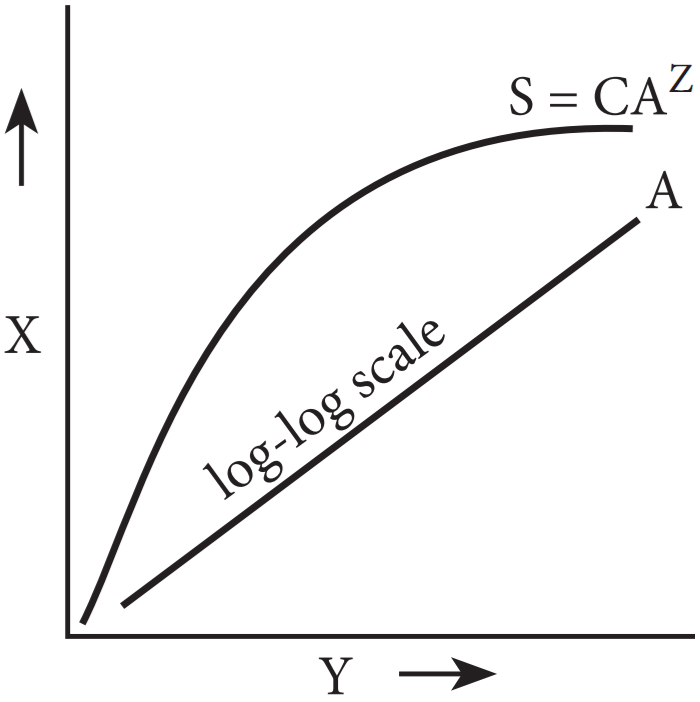
Read the following and answer any four questions from (i) to (v) given below: Within a region, species richness increases with increasing explored area, but only upto a limit. TI1e given graph explains this relationship.
  1. What does the given figure show?
  1. Rivet-popper hypothesis.
  2. Species-area relationship.
  3. Proportionate number of species of major taxa.
  4. $\alpha-\text{ecological diversity }$
  1. Equation for relationship (A) between species richness and area is:
  1. $\log\text{ S}=\log\text{ C}+\text{Z }\log\text{ A}$
  2. $\log\text{ C}=\log\text{ S}+\text{Z }\log\text{ A}$
  3. $\text{Z }\log\text{ A}=\log\text{ S}+\log\text{ C}$
  4. $\log\text{ S}=\log\text{ C}+\log\text{ A}$
  1. What is the value of slope of line or regression coefficient Z for frugivorous birds?
  1. 0.1 - 0.2
  2. 1.15
  3. 0.01 - 0.1
  4. 0.6 - 1.2
  1. The shape of curve for relationship between species richness and areas for wide variety of taxa is:
  1. Straight line.
  2. Parabola.
  3. Rectangular hyperbola.
  4. Bell shaped.
  1. Who gave this concept of increase in species richness with increasing offered area?
  1. Humboldt.
  2. Odum.
  3. Edward Wilson.
  4. Paul Ehrlich.
Read the following and answer any four questions from (i) to (v) given below:
Oogenesis is the process of formation of ovum in ovaries. It consists of three phases : multiplication, growth and maturation. Oogenesis is controlled by hormones GnRH, LH, FSH. GnRH secreted by the hypothalamus stimulates the anterior lobe of pituitary gland to secrete LH and FSH.
  1. What is the function of hormone FSH?
  1. It inhibits the formation of estrogen.
  2. It induces the release of secondary oocyte.
  3. It stimulates the growth of Graafian follicles.
  4. It causes ovulation.
  1. Which hormone induces the rupture of the mature Graafian follicle?
  1. Follicle stimulating hormone.
  2. Gonadotropin releasing hormone.
  3. Progesterone.
  4. Luteinising hormone.
  1. Which cell division is involved in the formation of secondary oocyte?
  1. Mitosis.
  2. Meiosis I.
  3. Amitosis.
  4. Meiosis II.
  1. Identify the function(s) of LH.
  1. Release of secondary oocyte from Graafian follicle.
  2. Stimulates corpus luteum to secrete progesterone.
  3. Stimulates estrogen formation.
  4. Promotes development of egg to form secondary oocyte.
  1. (A) and (B) only.
  2. (B) and (C) only.
  3. (A), (C) and (D) only.
  4. (B) only.
  1. Assertion: The increase in progesterone level exerts positive feedback on GnRH.
Reason: The rising level of progesterone stimulate production of FSH and LH.
  1. Both assertion and reason are true, and reason is the correct explanation of assertion.
  2. Both assertion and reason are true, but reason is not the correct explanation of assertion.
  3. Assertion is true, but reason is false.
  4. Both assertion and reason are false.
Read the following and answer any four questions from (i) to (v) given below:
X and Y are communicable diseases, whereas Wand Z are non-communicable diseases.X is transmitted through vectors whereas Y is transmitted through droplet infection. Wis caused due to a hormone deficiency, whereas Z is a degenerative disease. Based on the above information, answer the following questions.
  1. Identify W, X, Y and Z.
 
W
X
Y
Z
(a)
Coronary artery disease
Cholera
Chikungunya
Chikungunya
(b)
Diabetes
Malaria
Rhinitis
Alzheimer's disease
(c)
Alzheimer's disease
AIDS
Shigella
Plague
(d)
Gonorrhea
Diphtheria
Pertussis
Anthrax
  1. Select the correct statement.
  1. If X is sleeping sickness then its vector is Leishrnania.
  2. If Y is diphtheria then it is caused by Bacillus anthracis.
  3. If W is hypothyroidism then it is caused by deficiency of thyroxine hormone.
  4. If Z is myocardial infarction then patient develops acute rheumatic fever, joint pain and throat infection.
  1. If X and Y both are usual diseases then which of the following holds true?
  1. X could be dengue caused by flavivirus and Y could be AIDS caused by HIV.
  2. X could be chikungunya whereas Y could be rhinitis.
  3. X could be hepatitis whereas Y could be rabies.
  4. X could be chicken pox caused by Va rice/la zoster virus whereas Y could be yellow fever caused by flavivirus
  1. If X and Y both are bacterial diseases then select the correct match from the following.
  1. X- Bubonic plague-Yersinia pestis
  2. Y-Leprosy- Mycobacteriurn leprae
  3. X-Whooping cough-Bordetella pertussis
  4. Y-Botulism-Clostridiurn botulinum
  1. Assertion: Communicable diseases could be contagious or non-contagious.
Reason: Diseases that spread through vectors are non-contagious disease.
  1. Both assertion and reason are true, and reason is the correct explanation of assertion.
  2. Both assertion and reason are true, but reason is not the correct explanation of assertion.
  3. Assertion is true, but reason is false.
  4. Both assertion and reason are false.
Match the hormones with their sourc
Column AColumn B
(1) Glucagon(i) Neurohypophysis
(2) Adrenaline(ii) Islets of Langerhans
(3) Somato tropins(iii) Adenohypophysis
(4) ADH(iv) Medulla 
Column AColumn B
(1) Frederick Griffith(a) Test tube assay
(2) Avery, McCarty and MacLeod(b) Streptococcus pneumoniae
(3) Alfred Hershey and Martha Chase(c) E. coli
(4) Meselson and Stahl(d) Bacteriophages
Distinguish between : Neutrophils and Eosionophils.