Question
Read the passage given below and answer the following questions:
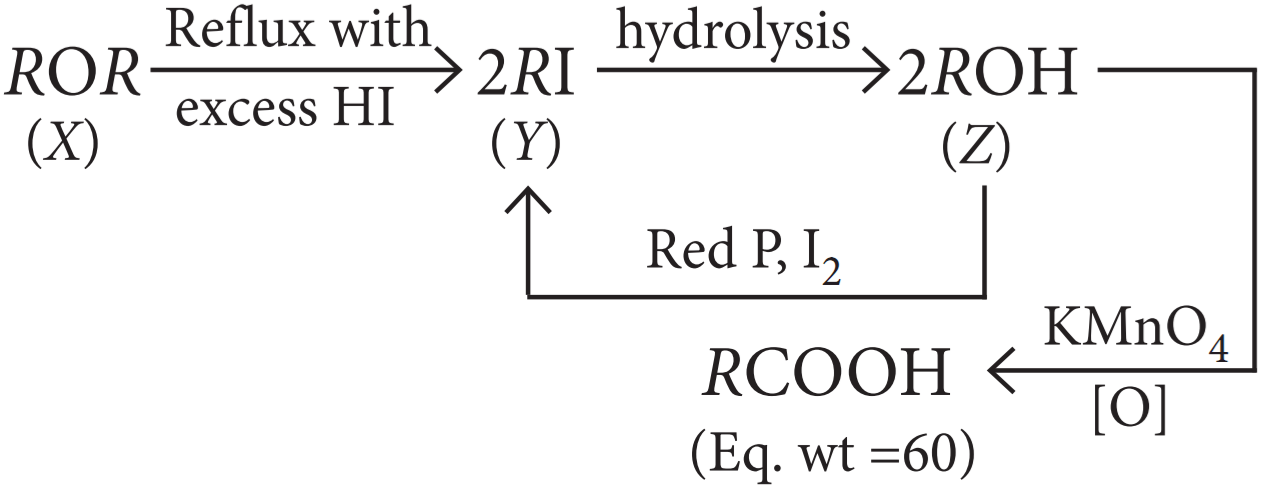
A compound $(X)$ containing $C, H$ and $O$ is unreactive towards sodium. It also does not react with Schiff s reagent. On refluxing with an excess of hydroiodic acid, $(X)$ yields only one organic product $( Y).$ On hydrolysis, $(Y)$ yields a new compound $(Z)$ which can be converted into $(Y)$ by reaction with red phosphorus and iodine. The compound $(Z)$ on oxidation with potassium permanganate gives a carboxylic acid. The equivalent weight of this acid is $60.$
The following questions are multiple choice questions. Choose the most appropriate answer:
  1. The compound $(X)$ is an:
  1. Acid.
  2. Aldehyde.
  3. Alcohol.
  4. Ether.
  1. The $\text{IUPAC}$ name of the acid formed is:
  1. Methanoic acid.
  2. Ethanoic acid.
  3. Propanoic acid.
  4. Butanoic acid.
  1. Compound $(Y)$ is:
  1. Ethyl iodide.
  2. Methyl iodide.
  3. Propyl iodide.
  4. Mixture of $(a)$ and $(b).$
  1. Compound $(Z)$ is:
  1. Methanol.
  2. Ethanol.
  3. Propanol.
  4. Butanol.
  1. Compound $(X)$ on treatment with excess of $Cl_2$ in presence of tight gives:
  1. $\propto-$ Chlorodiethyl ether.
  2. $\propto,\propto\ '-$ Dichlorodiethyl ether.
  3. Perchlorodiethyl ether.
  4. None of these.

Answer

  1. $(d)$ Ether.
Since the compound $X$ is unreactive towards sodium so it is neither an acid nor an alcohol. Since the compound $X$ is unreactive towards Schiff's base so it is not an aldehyde.
The compound $X$ forms only one product on reaction with excess $HI,$ indicates that the compound $X$ may be ether.
  1. $(b)$ Ethanoic acid.
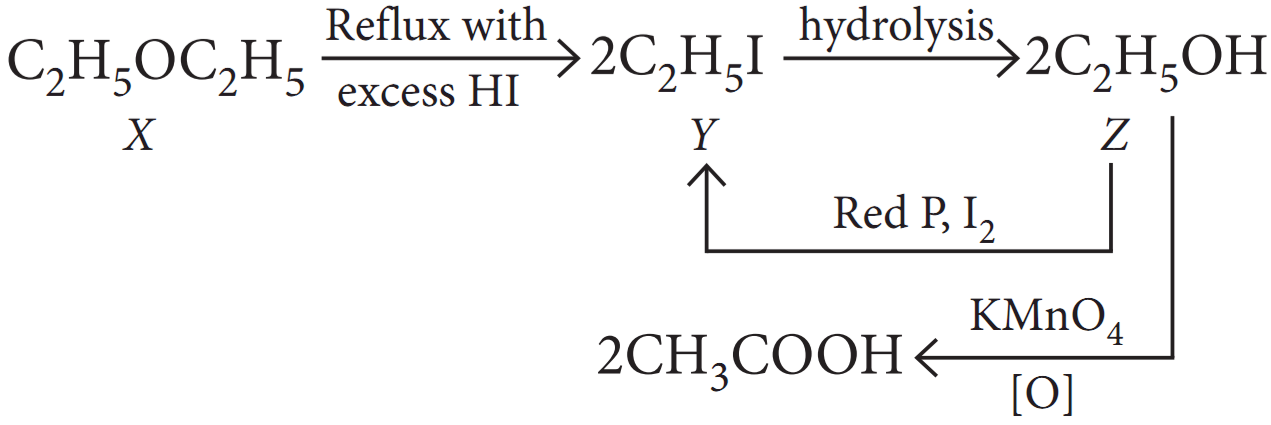
The reactions can be written as:

Since the equivalent weight of carboxylic acid is $60.$
So, it must be $\ce{CH_3COOH}$ i.e., ethanoic acid.
  1. $(a)$ Ethyl iodide.
​​​​​​​​​​​​​​​​​​​​​The alcohol $Z$ in that case should be $\ce{C_2H_5OH}$ and the compound $Y$ should be ethyl iodide. $X$ is therefore diethyl ether $\ce{(C_2H_5 — O — C_2H_5)​​​​​​​}$
  1. $(b)$ Ethanol.
  2. $(c)$ Perchlorodiethyl ether.
​​​​​​​​​​​​​​​​​​​​​​​​​​​​In the presence of light and excess of chlorine, all the hydrogen atoms of diethyl ether are substituted to give perchlorodiethyl ether.
$\text{CH}_3\text{CH}_2-\text{O}-\text{CH}_2\text{CH}_3+10\text{Cl}_2\xrightarrow{\text{hu}}\\ \ \ \ \ \ \ \ \ \ \ \ \ \ \ \ \ \ \ \ \ \ \ \ \ \ \ \ \ \ \ \ \ \ \ \ \ \ \ \ \ \ \ \ \ \ \ \text{(excess)}$
$\text{CCl}_3\text{CC}_2-\text{O}-\text{CCl}_2-\text{CCl}_3+\text{10HCI}\\ \ \ \ \ \ \ \ \ \ \ \ \ \ \ \text{Perchlorodierhyl ether }$​​​​​​​

Need a full question paper?

Generate a complete, print-ready paper with questions like this in minutes — across 16+ boards, with answer keys.

Start Generating Free

Similar questions

Molar conductivity of ions are given as product of charge on ions to their ionic mobilities and Faradays constant.
$\lambda_\text{A}\text{n}+=\text{n}\mu_\text{A}\text{n}+\text{F} ($here $\mu$ is the ionic mobility of $A^{n+})$
For electrolytes say $A_xB_y,$ molar conductivity is given by
$\lambda_{\text{m}(\text{A}_\text{x}\text{B}_\text{y})}=\text{x}_\text{n}\mu_{\text{A}^\text{n}}+\text{F}+\text{y}_\text{m}\lambda_{\text{A}^\text{m}}-\text{F}$
Ions
Ionic mobility
$K^+$ $7.616 \times 10^{-4}$
$Ca^{2+}$ $12.33 \times 10^{-4}$
$Br^-$ $8.09 \times 10^{-4}$
$\text{SO}_{4}^{2-}$
$16.58 \times 10^{-4}$
The following questions are multiple choice questions. Choose the most appropriate answer:
  1. At infinite dilution, the equivalent conductance of $\ce{CaSO_4}$ is:
  1. $256 \times 10^{-4}$
  2. $279$
  3. $23.7$
  4. $2.0 \times 10^{-8}$
  1. If the degre
  2. e of dissociation of $\ce{CaSO_4}$ solution is $10\%$ then equivalent conductance of $\ce{CaSO_4}$ is:
  1. $3.59$
  2. $36.9$
  3. $27.9$
  4. $30.6$
  1. The correct order of equivalent conductance at infinite dilution of $\ce{LiCl, NaCl, KCl}$ is:
  1. $\ce{LiCl = NaCl = KCl}$
  2. $\ce{LiCl > NaCl > KCl}$
  3. $\ce{KCl > LiCl > NaCl}$
  4. $\ce{KCl > NaCl > LiCl}$
  1. What is the unit of equivalent conductivity?
  1. $ohm^{-1} \ cm^2 eq^{-1}$
  2. $ohm \ cm^2 eq-1$
  3. $ohm^{-1} \ cm eq^{-1}$
  4. $ohm \ cm^{-2}eq^{-2}$
  1. If the molar conductance value of $Ca^{2+}$ and $Cl^-$ at infinite dilution are $118.88 \times 10^{-4}\ m^2\ mho\ mol^{-1}$ and $77.33 \times 10^{-4}\ m^2\ mho\ mol^{-1}$ respectively then the molar conductance of $CaCl_2 ($ in $m^2 mho\ mol^{-1})$ will be:
  1. $120.18 \times 10^{-4}$
  2. $135 \times 10^{-4}$
  3. $273.54 \times 10^{-4}$
  4. $192.1 \times 10^{-4}$
Read the passage given below and answer the following questions:
$(A), (B)$ and $(C)$ are three non $-$ cyclic functional isomers of a carbonyl compound with molecular formula $\ce{C_4H_8O}$. Isomers $(A)$ and $(C)$ give positive Tollen's test whereas isomer $(B)$ does not give Tollen's test but gives positive iodoform test. Isomers $(A)$ and $(B)$ on reduction with $\frac{Zn}{(Hg)}$ conc.  $\text{HCl}$ give the same product $(D).$
The following questions are multiple choice questions. Choose the most appropriate answer:
  1. Compound $A$ is:
  1. $\text{CH}_3-\text{CH}-\text{CHO}\\\ \ \ \ \ \ \ \ \ \ \ \ \ |\\ \ \ \ \ \ \ \ \ \ \ \ \ \text{CH}_3$
  2. $\text{CH}_3\text{CH}_2\text{CH}_2\text{CHO}$
  3. $\ \ \ \ \ \ \ \ \ \ \ \ \text{O}\\\ \ \ \ \ \ \ \ \ \ \ \ \ ||\\\text{CH}_3-\text{C}-\text{CH}_2-\text{CH}_3$
  4. None of these.
  1. Compound $(C)$ is:
  1. Iso $-$ butyraldehyde
  2. Butyraldehyde
  3. Crotonaldehyde
  4. Acrolein
  1. Compound $(B)$ can be obtained by:
  1. $\text{CH}_3-\text{C}\equiv\text{C}-\text{CH}_2-\text{CH}_3\xrightarrow[333\text{K}]{\text{dil.H}_2\text{SO}_4+\text{HgSO}_4}$
  2. $(\text{CH}_3\text{CH}_2\text{COO})_2\text{Ca}\xrightarrow{\text{Dry distill}}$
  3. $\text{CH}_3-\text{C}\equiv\text{C}-\text{CH}_3\xrightarrow[\frac{\text{H}_2\text{O}_2}{\text{NaOH}}]{\frac{\text{B}_2\text{H}_6}{\text{THF}}}$
  4. $\text{CH}_3-\text{CH}=\text{CH}-\text{CH}_3\xrightarrow[\frac{\text{ZN}}{\text{H}_2\text{O}}]{\text{O}_3}$
  1. Out of $(A), (B)$ and $(C)$ isomers, which one is least reactive towards addition of $\text{HCN}$ ?
  1. $A$
  2. $B$
  3. $C$
  4. All are equally reactive.
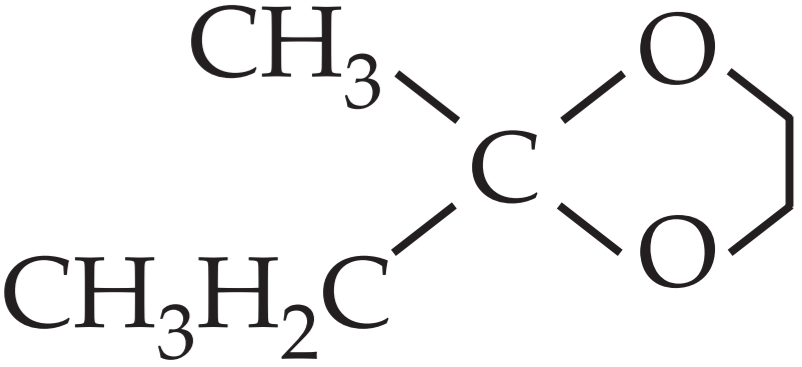
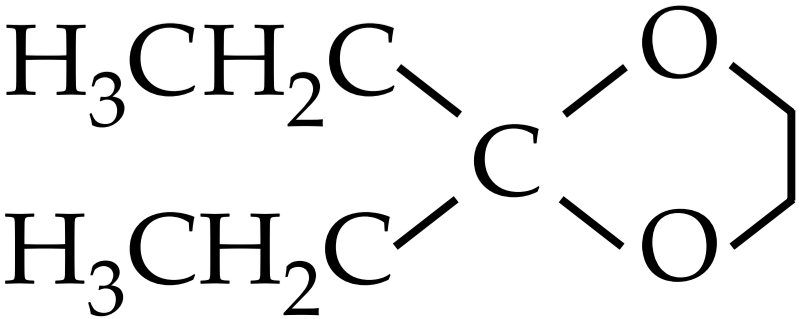
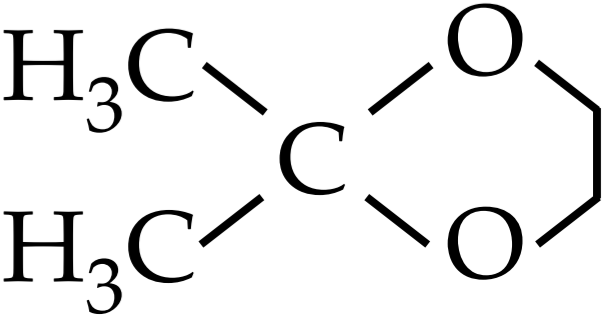
  1. What will be the product when $(B)$ reacts with ethylene glycol in presence of $\text{HCl}$ gas?
  1.  
  1.  
  1.  
  1. None of these.
Read the passage given below and answer the following questions: Due to intermolecular hydrogen bonding, the boiling points of alcohols and phenols are much higher than those of corresponding haloalkanes, haloarenes, aliphatic and aromatic hydrocarbons. Among isomeric alcohols, the boiling points follow the order: primary > secondary > tertiary. Boiling points of ethers are much lower than those of isomeric alcohols. The solubility of alcohols in water decreases as the molecular mass of alcohols increases. Amongst isomeric alcohols solubility increases with branching. The solubility of phenols in water is much lower than that of alcohols. Lower ethers such as dimethyl ether and ethyl methyl ether are soluble in water, but the solubility decreases as the molecular mass increases. In these questions (Q. No. i-iv), a statement of assertion followed by a statement of reason is given. Choose the correct answer out of the following choices.
  1. Assertion and reason both are correct statements and reason is correct explanation for assertion.
  2. Assertion and reason both are correct statements but reason is not correct explanation for assertion.
  3. Assertion is correct statement but reason is wrong statement.
  4. Assertion is wrong statement but reason is correct statement.
  1. Assertion: Alcohols have higher boiling points than ethers of comparable molecular masses.
Reason: Alcohols and ethers are isomeric in nature.
  1. Assertion: The solubility of phenols in water is much lower than that of alcohols.
Reason: Phenols do not form H-bonds with water.
  1. Assertion: Among n-butane, ethoxyethane, 1-propanol and 2-propanol, the increasing order of boiling points is, 1-butanol < 1-propanol < ethoxyethane < n-butane.
Reason: Boiling point increases with increase in molecular mass.
  1. Assertion: Dimethyl ether and diethylether are soluble in water.
Reason: As the molecular mass increases, solubility of ethers in water decreases.
  1. Assertion: Butan-2-ol has higher boiling point than 2-methylpropan-2-ol.
Reason: Amongst isomeric alcohols, the boiling points decreases with branching.
Read the passage given below and answer the following questions:
Nucleophilic substitution reactions are of two types; substitution nucleophilic bimolecular $(S_N2)$ and substitution nucleophilic unimolecular $(S_N1)$ depending on molecules taking part in determining the rate of reaction. Reactivity of alkyl halide towards $S_N1$ and $S_N2$ reactions depends on various factors such as steric hindrance, stability of intermediate or transition state, and polarity of solvent. $S_N2$ reaction mechanism is favoured mostly by primary alkyl halide then secondary and then tertiary. This order is reversed in case of $S_N1$ reactions.
The following questions are multiple choice questions. Choose the most appropriate answer:
  1. Which of the following is most reactive towards nucleophilic substitution reaction?
  1. $\ce{C_6H_5Cl}$
  2. $\ce{CH_2 = CHCl}$
  3. $\ce{ClCH_2CH = CH_2}$
  4. $\ce{CH_3CH = CHCl}$
  1. Isopropyl chloride undergoes hydrolysis by:
  1. $S_N1$ mechanism.
  2. $S_N2$ mechanism.
  3. $S_N1$ and $S_N2$ mechanism.
  4. Neither $S_N1$ nor $S_N2$ mechanism.
  1. The most reactive nucleophile among the following is:
  1. $\ce{CH_3O^-}$
  2. $\ce{C_6H_5O^-}$
  3. $\ce{(CH_3)_2CHO^-}$
  4. $\ce{(CH_3)_3CO^-}$
  1. Tertiary alkyl halides are practically inert to substitution by $S_N2$ mechanism because of:
  1. Insolubility.
  2. Instability.
  3. Inductive effect.
  4. Stearic hindrance.
  1. Which of the following is the correct order of decreasing $S_N2$ reactivity?
  1. $\ce{RCH_2X > R_2CHX > R_3CX}$
  2. $\ce{R_3CX > R_2CHX > RCH_2X}$
  3. $\ce{R_2CHX > R_3CX > RCH_2X}$
  4. $\ce{RCH_2X > R_3CX > R_2CHX}$
Read the passage given below and answer the following questions :
The transition elements have incompletely filled $d-$subshells in their ground state or in any of their oxidation states. The transition elements occupy position in betweens- and $p-$blocks in groups $3-12$ of the Periodic table. Starting from fourth period, transition elements consists of four complete series : $Sc$ to $Zn, Y$ to $Cd$ and $La, Hf$ to $Hg$ and $Ac, Rf$ to $Cn$. In general, the electronic configuration of outer orbitals of these elements is $(n - 1)d^{1-10} n^{1-2}$. The electronic configurations of outer orbitals of $Zn, Cd, Hg$ and $Cn$ are represented by the general formula $(n - 1)d^{10}ns^2$. All the transition elements have typical metallic properties such as high tensile strength, ductility, malleability. Except mercury, which is liquid at room temperature, other transition elements have typical metallic structures. The transition metals and their compounds also exhibit catalytic property and paramagnetic behaviour. Transition metal also forms alloys. An alloy is a blend of metals prepared by mixing the components. Alloys may be homogeneous solid solutions in which the atoms of one metal are distributed randomly among the atoms of the other.
The following questions are multiple choice questions. Choose the most appropriate answer:
  1. Which of the following characteristics of transition metals is associated with higher catalytic activity?
  1. High enthalpy of atomisation.
  2. Variable oxidation states.
  3. Paramagnetic behaviour.
  4. Colour of hydrated ions.
  1. Transition elements form alloys easily because they have.
  1. Same atomic number.
  2. Same electronic configuration.
  3. Nearly same atomic size.
  4. Same oxidation states.
  1. The electronic configuration of tantalum $(Ta)$ is:
  1. $[Xe]4f^05d^16s^2$
  2. $[Xe]4f^{14}5d^26s^2$
  3. $[Xe]4f^{14}5d^36s^2$
  4. $[Xe]4f^{14}5d^46s^2$
  1. Which one of the following outer orbital configurations may exhibit the largest number of oxidation states?
  1. $3d^54s^1$
  2. $3d^54s^2$
  3. $3d^24s^2$
  4. $3d^34s^2$
  1. The correct statement$(s)$ among the following is/ are :
  1. All $d$ and $f-$block elements are metals.
  2. All $d$ and $f-$block elements form coloured ions.
  3. All $d$ and $f-$block elements are paramagnetic.
  1. $(I)$ only
  2. $(I)$ and $(II)$ only
  3. $(II)$ and $(III)$ only
  4. $(I), (II)$ and $(III)$
Read the passage given below and answer the following questions: According to Raoult's law, the partial pressure of two components of the solution maybe given as: $\text{P}_\text{A}=\stackrel{{0}}{\hbox{PA }}\text{x}_\text{A}$ and $\text{P}_\text{B}=\stackrel{{0}}{\hbox{PB }}\text{x}_\text{B}$ For an ideal solution (obeys Raoult's law always) $\Delta\text{H}_\text{mix}=0,\Delta\text{mix}=0$ All solutions do not obey Raoults law over entire range of concentration. These are known as non-ideal solutions. For non-ideal solutions, $\text{P}_\text{A}\not=\stackrel{{0}}{\hbox{PA }}\text{x}_\text{A}$ or $\text{P}_\text{B}\not=\stackrel{{0}}{\hbox{PB }}\text{x}_\text{B}$ Positive deviation $\Rightarrow\text{P}_\text{A}>\stackrel{{0}}{\hbox{PA }}\text{x}_\text{A}$ and $\text{P}_\text{B}>\stackrel{{0}}{\hbox{PB }}\text{x}_\text{B}$ Negative deviation $\text{P}_\text{A}<\stackrel{{0}}{\hbox{PA }}\text{x}_\text{A}$ and $\text{P}_\text{B}\stackrel{{0}}{\hbox{PB }}\text{x}_\text{B}$ A statement of assertion followed by a statement ofreason is given. Choose the correct answer out of the following choices.
  1. Assertion and reason both are correct statements and reason is correct explanation for assertion.
  2. Assertion and reason both are correct statements but reason is not correct explanation for assertion.
  3. Assertion is correct statement but reason is wrong statement.
  4. Assertion is wrong statement but reason is correct statement.
  1. Assertion: An ideal solution obeys Raoult's law.
Reason: In an ideal solution, solute-solute as well as solvent-solvent interactions are similar to solute-solvent interactions.
  1. Assertion: Acetone and aniline show negative deviations.
Reason: H-bonding between acetone and aniline is stronger than that between acetone-acetone and aniline-aniline.
  1. Assertion: Azeotropic mixtures are formed only by non-ideal solutions and they may have boiling points either greater than both the components or lesser than both the components.
Reason: The composition of the vapour phase is same as that of the liquid phase of an azeotropic mixture.
  1. Assertion: The solutions which show negative deviations from Raoult's law are called maximum boiling azeotropes.
Reason: 68% nitric acid and 32% water by mass fonn maximum boiling azeotrope.
  1. Assertion: $\Delta\text{H}_{\text{mix}}$ mix and $\Delta\text{V}_{\text{mix}}$ are positive for an ideal solution.
Reason: The interactions between the particles of the components of an ideal solution are almost identical as between particles in the liquids.
Read the passage given below and answer the following questions:
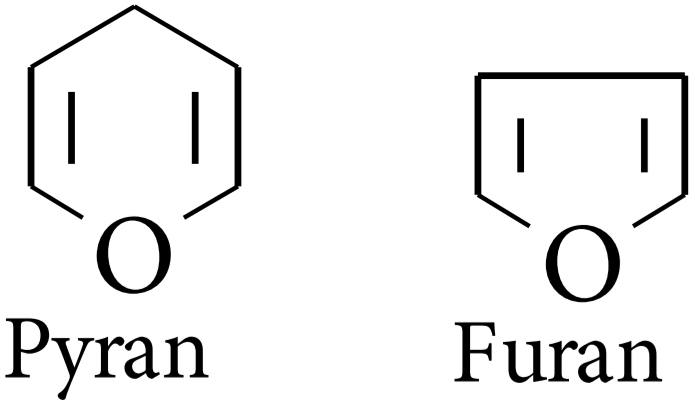
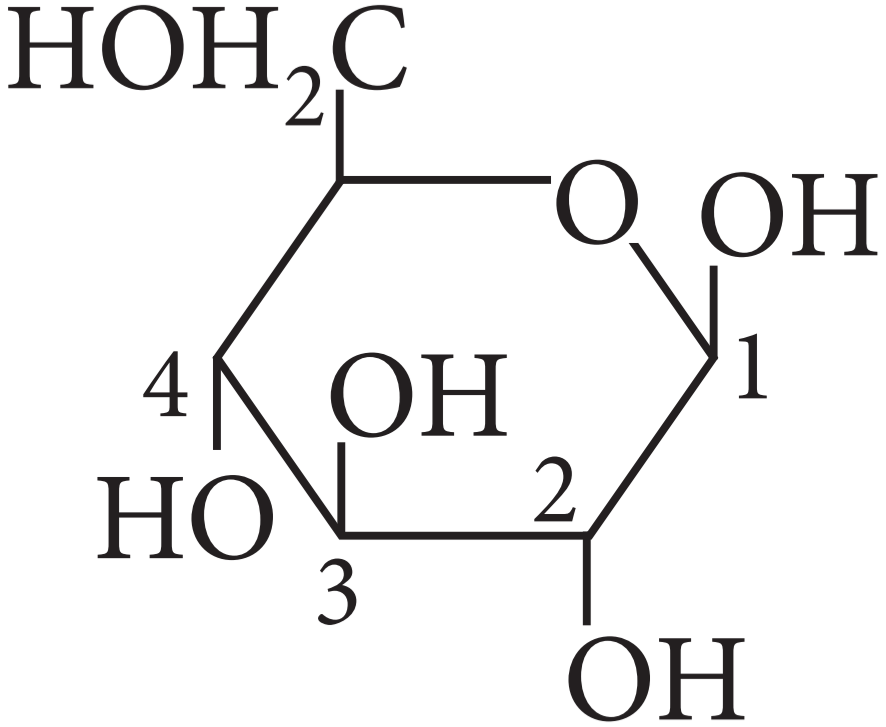
Pentose and hexose undergo intramolecular hemiacetal or hemiketal formation due to combination of the $–\ce{OH}$ group with the carbonyl group. The actual structure is either of five or six membered ring containing an oxygen atom. In the free state all pentoses and hexoses exist in pyranose form $($resembling pyran$).$ However,inthe combined state some of them exist as five membered cyclic structures, called furanose $($resembling furan$).$

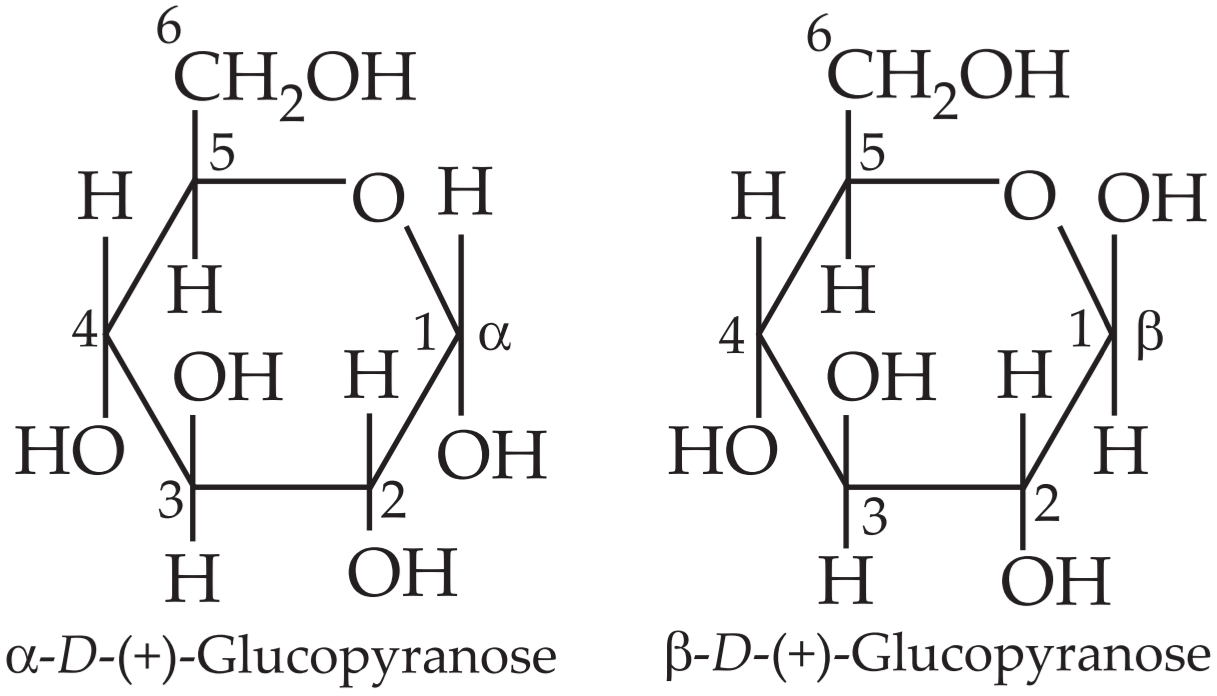
The cyclic structure of glucose is represented by Haworth structure:

$\alpha$ and $\beta D-$glucose have different configuration at anomeric $(C-1)$ carbon atom, hence are called anomers and the $C-1$ carbon atom is called anomeric carbon $($glycosidic carbon$).$
The six membered cyclic structure of glucose is called pyranose structure.
The following questionsare multiple choice questions. Choose the most appropriate answer:
  1. $\alpha D(+)-$glucose and $\beta D(+)$ glucose are:
  1. Enantiomers.
  2. Conformers.
  3. Epimers.
  4. Anomers.
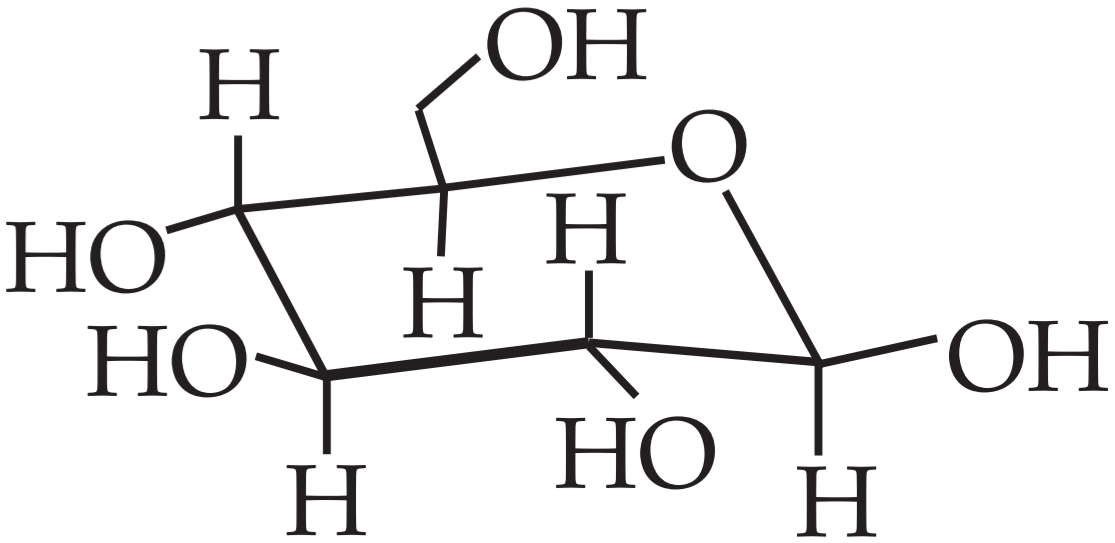
  1. The following carbohydrate is:
 
  1. A ketohexose.
  2. An aldohexose.
  3. An $n-$furanose.
  4. An $\alpha-$pyranose.
  1. In the following structure, anomeric carbon is:
  1. $C-1$
  2. $C-2$
  3. $C-3$
  4. $C-4$
  1. The term anomers of glucose refers to:
  1. Isomers of glucose that differ in configurations at carbons one and four $(C-1$ and $C-4).$
  2. A mixture of $(D)-$glucose and $(L)-$glucose.
  3. Enantiomers of glucose.
  4. Isomers of glucose that differ in configuration at carbon one $(C-1).$
  1. What percentage of $\beta-D-(+)$ glucopyranose is found at equilibrium in the aqueous solution?
  1. $50\%$
  2. $\approx100%$
  3. $36\%$
  4. $64\%$
Read the passage given below and answer the following questions:
The properties of the solutions which depend only on the number of solute particles but not on the nature of the solute are called colligative properties. Relative lowering in vapour pressure is also an example of colligative properties. For an experiment, sugar solution is prepared, for which lowering in vapour pressure was found to be 0.061 mm of Hg. (Vapour pressure of water at 20° C is 17.5 mm of Hg)
The following questions are multiple choice questions. Choose the most appropriate answer:
  1. Relative lowering of vapour pressure for the given solution is.
  1. 0.00348
  2. 0.061
  3. 0.122
  4. 1.75
  1. The vapour pressure (mm of Hg) of solution will be.
  1. 17.5
  2. 0.61
  3. 17.439
  4. 0.00348
  1. Mole fraction of sugar in the solution is.
  1. 0.00348
  2. 0.9965
  3. 0.061
  4. 1.75
  1. If weight of sugar taken is 5g in 108g of water, then molar mass of sugar will be.
  1. 358
  2. 120
  3. 240
  4. 400
  1. The vapour pressure (mm of Hg) of water at 293K when 25g of glucose is dissolved in 450g of water is.
  1. 17.2
  2. 17.4
  3. 17.120
  4. 17.02
Explain the D and L notation method of spatial arrangement with respect to glucose.
Read the passage given below and answer the following questions: Arrangement of ligands in order of their ability to cause splitting $(\Delta)$ is called spectrochemical series. Ligands which cause large splitting $($large $\Delta)$ are called strong field ligands while those which cause small splitting $($small $\Delta)$ are called weak field ligands. When strong field ligands approach metal atom/ ion, the value of $\Delta_0$ is large, so that electrons are forced to get paired up in lower energy $t_{2g}$ orbitals. Hence, a low$-$spin complex is resulted from strong field ligand. When weak field ligands approach metal atom/ ion, the value of $\Delta_0$ is small, so that electrons enter high energy egorbitals rather than pairing in low energy $t_{2g}$ orbitals. Hence, a high$-$spin complex is resulted from weak field ligands. Strong field ligands have tendency to form inner orbital complexes by forcing the electrons to pair up. Whereas weak field ligands have tendency to form outer orbital complex because inner electrons generally do not pair up. In these questions $(Q.$ No. $i-iv),$ a statement of assertion followed by a statement ofreason is given. Choose the correct answer out of the following choices.
  1. Assertion and reason both are correct statements and reason is correct explanation for assertion.
  2. Assertion and reason both are correct statements but reason is not correct explanation for assertion.
  3. Assertion is correct statement but reason is wrong statement.
  4. Assertion is wrong statement but reason is correct statement.
The following questions are multiple choice questions. Choose the most appropriate answer:
  1. Assertion: In tetrahedral coordination entity formation, the $d$ orbital splitting is inverted and is smaller as compared to the octahedral field splitting.
Reason : Spectrochemical series is based on the absorption of light by complexes with different ligands.
  1. Assertion: In high spin situation, configuration of $d^5$ ions will be $\text{t}^3_{2\text{g}}\text{e}^2_\text{g}.$
Reason : In high spin situation, pairing energy is less than crystal field energy.
  1. Assertion: $F^-$ ion is a weak field ligand and fonns outer orbital complex.
Reason : $F^-$ ion cannot force the electrons of $d_{z^2}$ and $d_{x^2-y^2}$ orbitals of the inner shell to occupy $d_{xy}, d_{yz}$ and $d_{zx} $orbitals of the same shell.
  1. Assertion: The crystal field model is successful in explaining the formation, structures, colour and magnetic properties of coordination compounds.
Reason: In spectrochemical series, ligands are arranged in a series of increasing field strength.
  1. Assertion: $NF_3$ is a weaker ligand than $N(CH_3)_3.$
Reason: $NF_3$ ionizes to give $F^-$ ions in aqueous solution.