Question
Read the passage given below and answer the following questions :
The transition elements have incompletely filled $d-$subshells in their ground state or in any of their oxidation states. The transition elements occupy position in betweens- and $p-$blocks in groups $3-12$ of the Periodic table. Starting from fourth period, transition elements consists of four complete series : $Sc$ to $Zn, Y$ to $Cd$ and $La, Hf$ to $Hg$ and $Ac, Rf$ to $Cn$. In general, the electronic configuration of outer orbitals of these elements is $(n - 1)d^{1-10} n^{1-2}$. The electronic configurations of outer orbitals of $Zn, Cd, Hg$ and $Cn$ are represented by the general formula $(n - 1)d^{10}ns^2$. All the transition elements have typical metallic properties such as high tensile strength, ductility, malleability. Except mercury, which is liquid at room temperature, other transition elements have typical metallic structures. The transition metals and their compounds also exhibit catalytic property and paramagnetic behaviour. Transition metal also forms alloys. An alloy is a blend of metals prepared by mixing the components. Alloys may be homogeneous solid solutions in which the atoms of one metal are distributed randomly among the atoms of the other.
The following questions are multiple choice questions. Choose the most appropriate answer:
  1. Which of the following characteristics of transition metals is associated with higher catalytic activity?
  1. High enthalpy of atomisation.
  2. Variable oxidation states.
  3. Paramagnetic behaviour.
  4. Colour of hydrated ions.
  1. Transition elements form alloys easily because they have.
  1. Same atomic number.
  2. Same electronic configuration.
  3. Nearly same atomic size.
  4. Same oxidation states.
  1. The electronic configuration of tantalum $(Ta)$ is:
  1. $[Xe]4f^05d^16s^2$
  2. $[Xe]4f^{14}5d^26s^2$
  3. $[Xe]4f^{14}5d^36s^2$
  4. $[Xe]4f^{14}5d^46s^2$
  1. Which one of the following outer orbital configurations may exhibit the largest number of oxidation states?
  1. $3d^54s^1$
  2. $3d^54s^2$
  3. $3d^24s^2$
  4. $3d^34s^2$
  1. The correct statement$(s)$ among the following is/ are :
  1. All $d$ and $f-$block elements are metals.
  2. All $d$ and $f-$block elements form coloured ions.
  3. All $d$ and $f-$block elements are paramagnetic.
  1. $(I)$ only
  2. $(I)$ and $(II)$ only
  3. $(II)$ and $(III)$ only
  4. $(I), (II)$ and $(III)$

Answer

  1. $(b)$ Variable oxidation states.
The transition metals and their compounds are known for their catalytic activity.
This activity is ascribed to their ability to adopt multiple oxidation states to form complexes.
  1. $(c)$ Nearly same atomic size.
Because of similar radii and other characteristics of transition metals, alloys are readily formed by these metals.
  1. $(c)\ [Xe]4f^{14}5d^36s^2$
  2. $(b) \ d^54s^2$
Greater the number of valence electrons, more will be the number of oxidation states exhibited by the element.
  1. $(a)\ (i)$ only
All the $d-$block elements are metals, they exhibit most properties of metals like lustre, malleability, ductility, high density, high melting and boiling point, hardness, conduction of heat and electricity, etc.
All the $f-$block elements are also metals but they are not good conductors of heat and electricity.

Need a full question paper?

Generate a complete, print-ready paper with questions like this in minutes — across 16+ boards, with answer keys.

Start Generating Free

Similar questions

Molar conductivity of ions are given as product of charge on ions to their ionic mobilities and Faradays constant.
$\lambda_\text{A}\text{n}+=\text{n}\mu_\text{A}\text{n}+\text{F} ($here $\mu$ is the ionic mobility of $A^{n+})$
For electrolytes say $A_xB_y,$ molar conductivity is given by
$\lambda_{\text{m}(\text{A}_\text{x}\text{B}_\text{y})}=\text{x}_\text{n}\mu_{\text{A}^\text{n}}+\text{F}+\text{y}_\text{m}\lambda_{\text{A}^\text{m}}-\text{F}$
Ions
Ionic mobility
$K^+$ $7.616 \times 10^{-4}$
$Ca^{2+}$ $12.33 \times 10^{-4}$
$Br^-$ $8.09 \times 10^{-4}$
$\text{SO}_{4}^{2-}$
$16.58 \times 10^{-4}$
The following questions are multiple choice questions. Choose the most appropriate answer:
  1. At infinite dilution, the equivalent conductance of $\ce{CaSO_4}$ is:
  1. $256 \times 10^{-4}$
  2. $279$
  3. $23.7$
  4. $2.0 \times 10^{-8}$
  1. If the degre
  2. e of dissociation of $\ce{CaSO_4}$ solution is $10\%$ then equivalent conductance of $\ce{CaSO_4}$ is:
  1. $3.59$
  2. $36.9$
  3. $27.9$
  4. $30.6$
  1. The correct order of equivalent conductance at infinite dilution of $\ce{LiCl, NaCl, KCl}$ is:
  1. $\ce{LiCl = NaCl = KCl}$
  2. $\ce{LiCl > NaCl > KCl}$
  3. $\ce{KCl > LiCl > NaCl}$
  4. $\ce{KCl > NaCl > LiCl}$
  1. What is the unit of equivalent conductivity?
  1. $ohm^{-1} \ cm^2 eq^{-1}$
  2. $ohm \ cm^2 eq-1$
  3. $ohm^{-1} \ cm eq^{-1}$
  4. $ohm \ cm^{-2}eq^{-2}$
  1. If the molar conductance value of $Ca^{2+}$ and $Cl^-$ at infinite dilution are $118.88 \times 10^{-4}\ m^2\ mho\ mol^{-1}$ and $77.33 \times 10^{-4}\ m^2\ mho\ mol^{-1}$ respectively then the molar conductance of $CaCl_2 ($ in $m^2 mho\ mol^{-1})$ will be:
  1. $120.18 \times 10^{-4}$
  2. $135 \times 10^{-4}$
  3. $273.54 \times 10^{-4}$
  4. $192.1 \times 10^{-4}$
Read the passage given below and answer the following questions:
The addition reaction of enol or enolate to the carbonyl functional group of aldehyde or ketone is known as aldol addition. The $\beta-$ hydroxyaldehyde or $\beta-$ hydroxyketone so obtained undergo dehydration in second step to produce a conjugated enone. The first part of reaction is an addition reaction and the second part is an elimination reaction. Carbonyl compound having propto $-$ hydrogen undergoes aldol condensation reaction.

The following questions are multiple choice questions.
Choose the most appropriate answer:
  1. Condensation reaction is the reverse of which of the following reaction?
  1. Lock and key hypothesis.
  2. Oxidation.
  3. Hydrolysis.
  4. Glycogen formation.
  1. Which of the following compounds would be the main product of an aldol condensation of acetaldehyde and acetone?
  1. $\ce{CH_3CH = CHCHO}$
  2. $\ce{CH_3CH = CHCOCH_3}$
  3. $\ce{(CH_3)_2C = CHCHO}$
  4. $\ce{(CH_3)_2C = CHCOCH_3}$
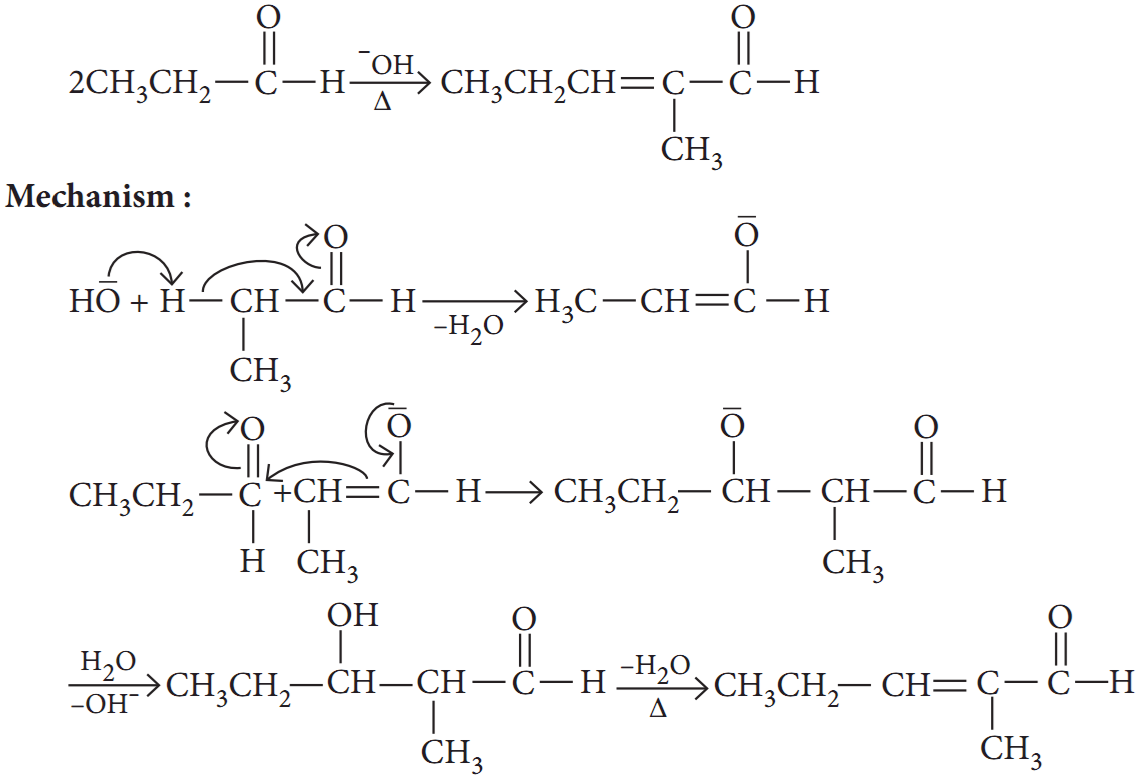
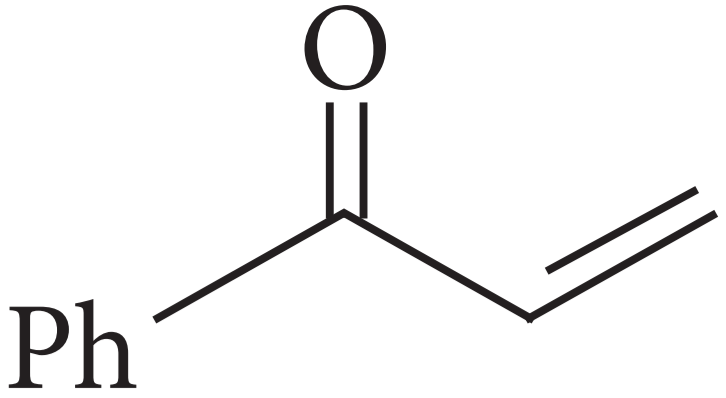
  1. Which combination of carbonyl compounds gives phenyl vinyl ketone by an aldol condensation?
  1. Acetophenone and Formaldehyde.
  2. Acetophenone and acetaldehyde.
  3. Benzaldehyde and acetaldehyde.
  4. Benzaldehyde and acetone.
  1. Which of the following will undergo aldol condensation?
  1. $\ce{HCHO}$
  2. $\ce{CH_3CH_2OH}$
  3. $\ce{C_6H_5CHO}$
  4. $\ce{CH_3CH_2CHO}$
  1. Which of the following does not undergo aldol condensation?
  1. $\ce{CH_3CHO}$
  2. $\ce{CH_3CH_2CHO}$
  3. $\ce{CH_3COCH_3}$
  4. $\ce{C_3H_2CHO}$
Read the passage given below and answer the following questions: Carbohydrates are polyhydroxy aldehydes and ketones and those compounds which on hydrolysis give such compounds are also carbohydrates. The carbohydrates which are not hydrolysed are called monosaccharides. Monosaccharides with aldehydic group are called aldose and those which free ketonic groups are called ketose. Carbohydrates are optically active. Number of optical isomers $= 2^n$ Where $n =$ numberofasymmetric carbons. Carbohydrates are mainlysynthesised by plants during photosynthesis. The monosaccharides give the characteristic reactions of alcohols and carbonyl group $($aldehydes and ketones$).$ It has been found that these monosaccharides exist in the form of cyclic structures. In cyctization, the $-OH$ groups $($generally $C_5$ or $C_4$ in aldohexoses and $C_5$ or $C_6$ in ketohexoses$)$ combine with the aldehyde or keto group. As a result, cyclic structures of five or six membered rings containing one oxygen atom are formed, e.g., glucose forms a ring structure. Glucose contains one aldehyde group, one $IO$ alcoholic group and four $2^\circ$ alcoholic groups in its open chain structure. The following questions are multiple choice questions. Choose the most appropriate answer:
  1. First member of ketos sugar is:
  1. Ketotriose.
  2. Ketotetrose.
  3. Ketopentose.
  4. Ketohexose.
  1. In $\ce{CH_2OHCHOHCHOHCHOHCHOHCHO,}$ the number of optical isomers will be:
  1. $16$
  2. $8$
  3. $32$
  4. $4$
  1. Some statements are given below:
  1. Glucose is aldohexose.
  2. Naturally occurring glucose is dextrorotatory.
  3. Glucose contains three chiral centres.
  4. Glucose contains one $1^\circ $ alcoholic group and four $2^\circ$ alcoholic groups.
Among the above, correct statements are:
  1. $1$ and $2$ only
  2. $3$ and $4$ only
  3. $1, 2$ and $4$ only
  4. $1, 2, 3$ and $4$
  1. Two hexoses fonn the same osazone, find the correct statement about these hexoses.
  1. Both of them must be aldoses.
  2. They are epimers at $C-3.$
  3. The carbon atoms $I$ and $2$ in both have the same configuration.
  4. The carbon atoms $3, 4$ and $5$ in both have the same configuration.
  1. Which of the following reactions of glucose can be explained only by its cyclic structure?
  1. Glucose forms cyanohydrin with $\text{HCN}.$
  2. Glucose reacts with hydroxylamine to form an oxime.
  3. Pentaacetate of glucose does not react with hydroxylamine.
  4. Glucose is oxidised by nitric acid to gluconic acid.
Read the passage given below and answer the following questions
Few colligative properties are:
  1. Relative lowering of vapour pressure: depends only on molar concentration of solute $($mole fraction$)$ and independent of its nature.
  2. Depression in freezing point: it is proportional to the molal concentration of solution.
  3. Elevation of boiling point: it is proportional to the molal concentration of solute.
  4. Osmotic pressure: it is proportional to the molar concentration of solute
A solution of glucose is prepared with $0.052 g$ at glucose in $80.2 g$ of water.$(KJ = 1.86K \ \text{kg \ mol}^{-1}$ and $K_b = 5.2K \ \text{kg \ mol}^{-1})$
The following questions are multiple choice questions. Choose the most appropriate answer:
  1. Molality of the given solution is.
  1. $0.0052m$
  2. $0.0036m$
  3. $0.0006m$
  4. $1.29m$
  1. Boiling point for the solution will be.
  1. $373.05K$
  2. $373.15K$
  3. $373.02K$
  4. $373.02K$
  1. The depression in freezing point of solution will be.
  1. $0.0187K$
  2. $0.035K$
  3. $0.082K$
  4. $0.067K$
  1. Mole fraction of glucose in the given solution is.
  1. $6.28 \times 10^{-5}$
  2. $6.28 \times 10^{-4}$
  3. $0.00625$
  4. $0.00028$
  1. If same amount of sucrose $\ce{(C_{12} H_{22} O_{11})}$ is taken instead of glucose, then.
  1. Elevation in boiling point will be higher.
  2. Depression in freezing point will be higher.
  3. Depression in freezing point will be lower.
  4. Both $(a)$ and $(b).$
Read the passage given below and answer the following questions:
To explain bonding in coordination compounds various theories were proposed. One of the important theory was valence bond theory. According to that, the central metal ion in the complex makes available a number of empty orbitals for the formation of coordination bonds with suitable ligands. The appropriate atomic orbitals of the metal hybridise to give a set of equivalent orbitals of definite geometry.
The $d-$orbitals involved in the hybridisation may be either inner $d-$orbitals i.e.$, (n - 1)d$ or outer $d-$orbitals i.e.$, nd.$
For example, $Co^{3+}$ forms both inner orbital and outer orbital complexes, with ammonia it forms $[\ce{Co(NH3)6]^{3+}}$ and with fluorine it forms $[\ce{CoF6]^{3-}}$ complex ion.
The following questions are multiple choice questions. Choose the most appropriate answer :
  1. Which of the following is not true for $[\ce{CoF6}]^{3-}$?
  1. It is paramagnetic.
  2. It has coordination number of $6.$
  3. It is outer orbital complex.
  4. It involves $d^2sp^3$ hybridisation.
  1. $[\ce{Cr(H2O)6]Cl3}\ ($at. no. of $Cr = 24)$ has a magnetic moment of $3.83\ B.M.$ The correct distribution of $3d-$electrons in the central metal of the complex is :
  1. $3\text{d}^1_\text{xy},3\text{d}^1_{\text{x}^2-\text{y}^2},3\text{d}^1_\text{yz}$
  2. $3\text{d}^1_\text{xy},3\text{d}^1_{\text{yz}},3\text{d}^1_\text{zx}$
  3. $3\text{d}^1_\text{xy},3\text{d}^1_{\text{zy}},3\text{d}^1_{\text{z}^2}$
  4. $3\text{d}^1_{\text{x}^2-\text{y}^2},3\text{d}^1_{\text{z}^2},3\text{d}^1_\text{xz}$
  1. Which of the following is true for $[\ce{Co(NH3)6}]^{3+}$?
  1. It is an octahedral, di magnetic and outer orbital complex.
  2. It is an octahedral, paramagnetic and outer orbital complex.
  3. It is an octahedral, paramagnetic and inner orbital complex.
  4. It is an octahedral, di magnetic and inner orbital complex.
  1. The paramagnetism of $[\ce{CoF6}]^{3-}$ is due to.
  1. $3$ electrons.
  2. $4$ electrons.
  3. $2$ electrons.
  4. $1$ electron.
  1. Which of the following is an inner orbital or low spin complex?
  1. $[\ce{Ni(H2O)6}]^{3+}$
  2. $[\ce{FeF6}]^{3-}$
  3. $[\ce{Co(CN)6}]^{3-}$
  4. $[\ce{NiCl4}]^{2-}$
The electrochemical cell shown below is concentration cell. $M|M^{2+}\ ($saturated solution of a sparingly soluble salt$, MX_2) || M^{2+} (0.001\ mol\ dm^{-3})\ |M$ The emfof the cell depends on the difference in concentrations of $M^{2+}$ ions at the two electrodes. The emf of the cell at $298 K$ is $0.059V$. The following questions are multiple choice questions. Choose the most appropriate answer:
  1. The solubility product $(K_{sp'}\ mol^3\ dm^{-9})$ of $MX_2$ at $298 K$ based on the information available for the given concentration cell is $(\text{take }2.303 \times \text{R}\times \frac{298}{\text{F}} = 0.059)$
  1. $2 \times 10^{-15}$
  2. $4 \times 10^{-15}$
  3. $3 \times 10^{-12}$
  4. $1 \times 10^{-12}$
  1. The value of $\triangle\text{G}\ ($in $kJ\ mol^{-1})$ for the given cell is $($take $1 F = 96500 C\ mol^{-1})$
  1. $3.7$
  2. $-3.7$
  3. $10.5$
  4. $-11.4$
  1. The equilibrium constant for the following reaction is:
$\text{Fe}^{2+}+\text{Ce}^{4+}\rightleftharpoons\text{Ce}^{3+}+\text{Fe}^{3+}$
(Given, $\text{E}^\circ_\frac{\text{Ce}^{4+}}{\text{Ce}^{3+}}=1.44\text{V}$ and $\text{E}^\circ_\frac{\text{Fe}^{3+}}{\text{Fe}^{2+}}=0.68\text{V})$
  1. $7.6 \times 10^{12}$
  2. $6.5 \times 10^{10}$
  3. $5.2 \times 10^9$
  4. $3.4 \times 10^{12}$
  1. The solubility product of a saturated solution of $\ce{Ag2CrO4}$ in water at $298 K$ if the emf of the cell
$Ag|Ag^+ ($satd. $\ce{Ag2CrO4}$ soln$) || Ag^+ (0.1 M) | Ag$
is $0.164V$ at $298 K,$ is :
  1. $3.359 \times 10^{-12}\ mol^3\ L^{-3}$
  2. $2.287 \times 10^{-12}\ mol^3\ L^{-3}$
  3. $1.158 \times 10^{-12}\ mol^3\ L^{-3}$
  4. $4.135 \times 10^{-12}\ mol^3\ L^{-3}$
  1. To calculate the emf of the cell, which of the following options is correct?
  1. $emf = E_{cathode }- E_{anode}$
  2. $emf = E_{anode }- E_{cathode}$
  3. $emf = E_{anode} + E_{cathode}$
  4. None of these.
Write detailed note on: Starch
Read the passage given below and answer the following questions:
$(A), (B)$ and $(C)$ are three non $-$ cyclic functional isomers of a carbonyl compound with molecular formula $\ce{C_4H_8O}$. Isomers $(A)$ and $(C)$ give positive Tollen's test whereas isomer $(B)$ does not give Tollen's test but gives positive iodoform test. Isomers $(A)$ and $(B)$ on reduction with $\frac{Zn}{(Hg)}$ conc.  $\text{HCl}$ give the same product $(D).$
The following questions are multiple choice questions. Choose the most appropriate answer:
  1. Compound $A$ is:
  1. $\text{CH}_3-\text{CH}-\text{CHO}\\\ \ \ \ \ \ \ \ \ \ \ \ \ |\\ \ \ \ \ \ \ \ \ \ \ \ \ \text{CH}_3$
  2. $\text{CH}_3\text{CH}_2\text{CH}_2\text{CHO}$
  3. $\ \ \ \ \ \ \ \ \ \ \ \ \text{O}\\\ \ \ \ \ \ \ \ \ \ \ \ \ ||\\\text{CH}_3-\text{C}-\text{CH}_2-\text{CH}_3$
  4. None of these.
  1. Compound $(C)$ is:
  1. Iso $-$ butyraldehyde
  2. Butyraldehyde
  3. Crotonaldehyde
  4. Acrolein
  1. Compound $(B)$ can be obtained by:
  1. $\text{CH}_3-\text{C}\equiv\text{C}-\text{CH}_2-\text{CH}_3\xrightarrow[333\text{K}]{\text{dil.H}_2\text{SO}_4+\text{HgSO}_4}$
  2. $(\text{CH}_3\text{CH}_2\text{COO})_2\text{Ca}\xrightarrow{\text{Dry distill}}$
  3. $\text{CH}_3-\text{C}\equiv\text{C}-\text{CH}_3\xrightarrow[\frac{\text{H}_2\text{O}_2}{\text{NaOH}}]{\frac{\text{B}_2\text{H}_6}{\text{THF}}}$
  4. $\text{CH}_3-\text{CH}=\text{CH}-\text{CH}_3\xrightarrow[\frac{\text{ZN}}{\text{H}_2\text{O}}]{\text{O}_3}$
  1. Out of $(A), (B)$ and $(C)$ isomers, which one is least reactive towards addition of $\text{HCN}$ ?
  1. $A$
  2. $B$
  3. $C$
  4. All are equally reactive.
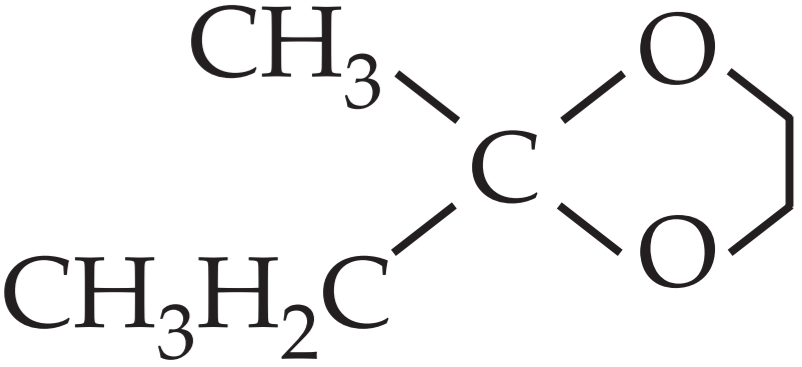
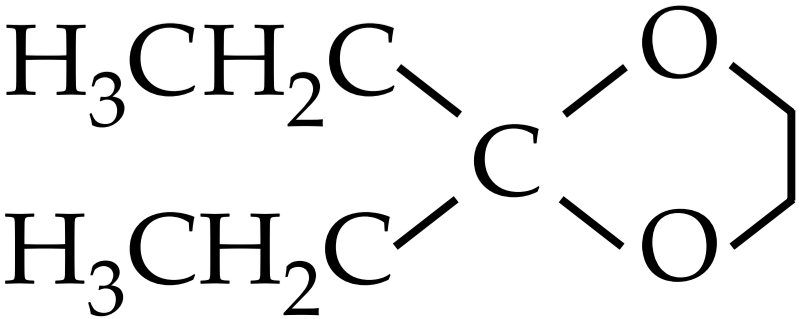
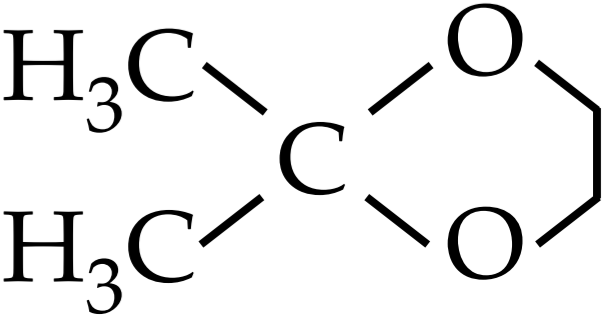
  1. What will be the product when $(B)$ reacts with ethylene glycol in presence of $\text{HCl}$ gas?
  1.  
  1.  
  1.  
  1. None of these.
Standard electrode potentials are used for various processes :
  • It is used to measure relative strengths of various oxidants and reductants.
  • It is used to calculate standard cell potential.
  • It is used to predict possible reactions.
A set of half$-$reactions $($in acidic medium$)$ along with their standard reduction potential$, E^\circ\ ($in volt$)$ values are given below :
$\ce{I_2 + 2e^- \rightarrow 2I^- ; E^\circ = 0.54 V}$
$\ce{Cl_2 + 2e^- \rightarrow 2Cl^- ; E^\circ = 1.36 V}$
$\ce{Mn^{3+} +e^- \rightarrow Mn^{2+}; E^\circ = 1.50 V}$
$\ce{Fe^{3+} + e^- \rightarrow Fe^{2+}; E^\circ = 0.77 V}$
$\ce{O2 + 4H^+ + 4e^- \rightarrow 2H2O ; E^\circ = 1.23 V}$
The following questions are multiple choice questions. Choose the most appropriate answer :
  1. Which of the following statements is correct?
  1. $Cl^-$ is oxidised by $\ce{O_2}$.
  2. $Fe^{2+}$ is oxidised by iodine.
  3. $I^-$ is oxidised by chlorine.
  4. $Mn^{2+}$ is oxidised by chlorine.
  1. $Mn^{3+}$ is not stable in acidic medium, while $Fe^{3+}$ is stable because :
  1. $\ce{O2}$ oxidises $Mn^{2+}$ to $Mn^{3+}$
  2. $\ce{O2}$ oxidises both $Mn^{2+}$ to $Mn^{3+}$ and $Fe^{2+}$ to $Fe^{3+}$
  3. $Fe^{3+}$ oxidises $\ce{H2O}$ to $\ce{O2}$
  4. $Mn^{3+}$ oxidises $\ce{H2O}$ to $\ce{O2}$
  1. The strongest reducing agent in the aqueous solution is :
  1. $I^-$
  2. $Cl^-$
  3. $Mn^{2+}$
  4. $Fe^{2+}$
  1. The emf for the following reaction is :
$\text{I}_2+\text{KCl}\rightleftharpoons2\text{KI}+\text{Cl}_2$
  1. $-0.82 V$
  2. $+0.82 V$
  3. $-0.73 V$
  4. $+0.73 V$
  1. Which of the following statements is correct for the following reaction?
$Fe^{3+} + Mn^{2+} \rightarrow Fe^{2+ }+ Mn^{3+}$
  1. The emf of the cell is positive.
  2. $Fe^{3+}$ oxidises $Mn^{2+}$.
  3. The reaction does not occur.
  4. All are correct.
What is the most suitable pKa value of the substituted propylamine formed with substituent "X" with electronegativity 3.0
(i)10.67 (ii)10.08 (iii) 10.15 (iv)11.10