Question
Read the passage given below and answer the following questions:

Amines are produced when an alcoholic solution of ammonia and an alkyl or a benzyl halide is heated in a sealed tube at 373K. This reaction is called ammonolysis and usually gives a mixture of primary, secondary and tertiary amines along with some quarternary ammonium salts. This reaction is an example of nucleophilic substitution reaction in which ammonia acts as a nucleophile due to the presence of a lone pair of electrons on the nitrogen atom. However this method cannot be used for the preparation of aryl amines. One of the most convenient methods for the preparation of aryl amines is reduction of nitro compounds. Aryl amines can also be prepared by reduction of nitrites or Gabriel phthalimide synthesis.

A statement of assertion followed by a statement of reason is given. Choose the correct answer out of the following choices.

  1. Assertion and reason both are correct statements and reason is correct explanation for assertion.
  2. Assertion and reason both are correct statements but reason is not correct explanation for assertion.
  3. Assertion is correct statement but reason is wrong statement.
  4. Assertion is wrong statement but reason is correct statement.
  1. Assertion: Ammonolysis of alkyl halides only produces 2° amines.

Reason: Ammonolysis of alkyl halides involves the reaction between alkyl halides and alcoholic ammonia.

  1. Assertion: Gabriel-phthalimide reaction can be used to prepare both aryl and alkyl primary amines.

Reason: Aryl halides are more reactive alkyl halides towards nucleophilic substitution reactions.

  1. Assertion: Anunonolysis method cannot be used for the preparation of aryl amines.

Reason: Aryl halides are much less reactive than alkyl halides towards nucleophilic substitution reaction.

  1. Assertion: Ammonolysis can be used to prepare pure primary amines.

Reason: Ammonolysis of haloalkanes lead to multiple ammonium salts.

  1. Assertion: Aromatic 1º amines can not be prepared by Gabriel phthalimide synthesis.

Reason: Aryl halides do not undergo nucleophilic substitution with anion formed by phthalimide.
Answer

  1. (d) Assertion is wrong statement but reason is correct statement.

Explanation:

Reaction can be used to prepare 1º, 2º, 3º amines and finally quaternary ammonium salts.

  1. (c) Assertion is correct statement but reason is wrong statement.

Explanation:

Aryl halides are less reactive than aralkyl halides towards nucleophilic substitution reactions.

  1. (a) Assertion and reason both are correct statements and reason is correct explanation for assertion.
  1. (d) Assertion is wrong statement but reason is correct statement.

Explanation:

Ammonolysis cannot be used to prepare pure primary amines. This method usually gives a mixture of primary, secondary and tertiary amines along with some quaternary ammonium salts.

  1. (a) Assertion and reason both are correct statements and reason is correct explanation for assertion.

Need a full question paper?

Generate a complete, print-ready paper with questions like this in minutes — across 16+ boards, with answer keys.

Start Generating Free

Similar questions

The potential of each electrode is known as electrode potential. Standard electrode potential is the potential when concentration of each species taking part in electrode reaction is unity and the reaction is taking place at 298K. By convention, the standard electrode potential of hydrogen (SHE) is 0.0V. The electrode potential value for each electrode process is a measure of relative tendency of the active species in the process to remain in the oxidised/ reduced form. The negative electrode potential means that the redox couple is stronger reducing agent than $\frac{\text{H}^+}{\text{H}_2}$ couple. A positive electrode potential means that the redox couple is a weaker reducing agent than the $\frac{\text{H}^+}{\text{H}_2}$ couple. Metals which have higher positive value of standard reduction potential form the oxides of greater thermal stability.

In these questions (Q. No. i-iv), a statement of assertion followed by a statement ofreason is given. Choose the correct answer out of the following choices.

  1. Assertion and reason both are correct statements and reason is correct explanation for assertion.
  2. Assertion and reason both are correct statements but reason is not correct explanation for assertion.
  3. Assertion is correct statement but reason is wrong statement.
  4. Assertion is wrong statement but reason is correct statement.
  1. Assertion: An electrochemical cell can be set-up only if the redox reaction is spontaneous.

Reason: A reaction is spontaneous if the free energy change is negative.

  1. Assertion: The standard electrode potential of hydrogen is 0.0V.

Reason: It is by convention.

  1. Assertion: The more negative is the standard reduction potential, greater is its ability to displace H2 from acid.

Reason: Strength of reducing agent increases with the increase in negative value of the standard reduction potential.

  1. Assertion: The negative value of standard reduction potential means that reduction takes place on this electrode with reference to hydrogen electrode.

Reason: The standard electrode potential of a half cell has a fixed value.

  1. Assertion: The absolute value of electrode potential cannot be determined experimentally.

Reason: The electrode potential values are generally determined with respect to SHE.

Read the passage given below and answer the following questions:
A compound (X) containing C, H and O is unreactive towards sodium. It also does not react with Schiff s reagent. On refluxing with an excess of hydroiodic acid, (X) yields only one organic product ( Y). On hydrolysis, (Y) yields a new compound (Z) which can be converted into (Y) by reaction with red phosphorus and iodine. The compound (Z) on oxidation with potassium permanganate gives a carboxylic acid. The equivalent weight of this acid is 60.
The following questions are multiple choice questions. Choose the most appropriate answer:
  1. The compound (X) is an:
  1. Acid.
  2. Aldehyde.
  3. Alcohol.
  4. Ether.
  1. The IUPAC name of the acid formed is:
  1. Methanoic acid.
  2. Ethanoic acid.
  3. Propanoic acid.
  4. Butanoic acid.
  1. Compound (Y) is:
  1. Ethyl iodide.
  2. Methyl iodide.
  3. Propyl iodide.
  4. Mixture of (a) and (b).
  1. Compound (Z) is:
  1. Methanol.
  2. Ethanol.
  3. Propanol.
  4. Butanol.
  1. Compound (X) on treatment with excess of Cl2 in presence of tight gives:
  1. $\propto-$ Chlorodiethyl ether.
  2. $\propto,\propto'-$ Dichlorodiethyl ether.
  3. Perchlorodiethyl ether.
  4. None of these.
Read the passage given below and answer the following questions:
The amines are basic in nature due to the presence of a lone pair of electron on N-atom of the -NH2 group, which it can donate to electron deficient compounds. Aliphatic amines are stronger bases than NH3 because of the +I effect of the alkyl groups. Greater the number of alkyl groups attached to N-atom, higher is the electron density on it and more will be the basicity. Thus, the order of basic nature of amines is expected to be 3º > 2º > 1º, however the observed order is 2º > 1º > 3º. This is explained on the basis of crowding on N-atom of the amine by alkyl groups which hinders the approach and bonding by a proton, consequently, the electron pair which is present on N is unavailable for donation and hence 3º amines are the weakest bases.
Aromatic amines are weaker bases than ammonia and aliphatic amines. Electron-donating groups such as -CH3, -OCH3, etc. increase the basicity while electron-withdrawing substitutes such as -NO2, -CN, halogens, etc. decrease the basicity of amines. The effect of these substituents is more at p than at m-positions.
The following questions are multiple choice questions. Choose the most appropriate answer:
  1. Which one of the following is the strongest base in aqueous solution?
  1. Methyl amine.
  2. Tri methyl amine.
  3. Aniline.
  4. Dimethyl amine.
  1. Which order ofbasicity is correct?
  1. Aniline > m-toluidine > o-toluidine
  2. Aniline> o-toluidine > m-toluidine
  3. o-toluidine > aniline> m-toluidine
  4. o-toluidine < aniline < m-toluidine
  1. What is the decreasing order of basicity of primary, secondary and tertiary ethylamines and NH3?
  1. NH3 > C2H5NH2 > (C2H5)2NH > (C2H5)3N
  2. (C2H5)3N > (C2H5)2NH > C2H5NH2 > NH3
  3. (C2H5)2NH > C2H5NH2> (C2H5)3N > NH3
  4. (C2H5)2NH > (C2H5)3N > C2H5NH2 > NH3
  1. The order of basic strength among the following amines in benzene solution is:
  1. CH3NH2 > (CH3)3N > (CH3)2NH
  2. (CH3)3N > (CH3)2NH > CH3NH2
  3. CH3NH2 > (CH3)2NH > (CH3)3N
  4. (CH3)3N > CH3NH2 > (CH3)2NH
  1. Choose the correct statement.
  1. Methylamine is slightly acidic.
  2. Methylamine is less basic than ammonia.
  3. Methylamine is a stronger base than ammonia.
  4. Methylamine forms salts with alkalies.
Read the passage given below and answer the following questions:

According to Raoult's law, the partial pressure of two components of the solution maybe given as:

$\text{P}_\text{A}=\stackrel{{0}}{\hbox{PA }}\text{x}_\text{A}$ and $\text{P}_\text{B}=\stackrel{{0}}{\hbox{PB }}\text{x}_\text{B}$

For an ideal solution (obeys Raoult's law always)

$\Delta\text{H}_\text{mix}=0,\Delta\text{mix}=0$

All solutions do not obey Raoults law over entire range of concentration. These are known as non-ideal solutions.

For non-ideal solutions, $\text{P}_\text{A}\not=\stackrel{{0}}{\hbox{PA }}\text{x}_\text{A}$ or $\text{P}_\text{B}\not=\stackrel{{0}}{\hbox{PB }}\text{x}_\text{B}$

Positive deviation $\Rightarrow\text{P}_\text{A}>\stackrel{{0}}{\hbox{PA }}\text{x}_\text{A}$ and $\text{P}_\text{B}>\stackrel{{0}}{\hbox{PB }}\text{x}_\text{B}$

Negative deviation $\text{P}_\text{A}<\stackrel{{0}}{\hbox{PA }}\text{x}_\text{A}$ and $\text{P}_\text{B}\stackrel{{0}}{\hbox{PB }}\text{x}_\text{B}$

A statement of assertion followed by a statement ofreason is given. Choose the correct answer out of the following choices.

  1. Assertion and reason both are correct statements and reason is correct explanation for assertion.
  2. Assertion and reason both are correct statements but reason is not correct explanation for assertion.
  3. Assertion is correct statement but reason is wrong statement.
  4. Assertion is wrong statement but reason is correct statement.
  1. Assertion: An ideal solution obeys Raoult's law.

Reason: In an ideal solution, solute-solute as well as solvent-solvent interactions are similar to solute-solvent interactions.

  1. Assertion: Acetone and aniline show negative deviations.

Reason: H-bonding between acetone and aniline is stronger than that between acetone-acetone and aniline-aniline.

  1. Assertion: Azeotropic mixtures are formed only by non-ideal solutions and they may have boiling points either greater than both the components or lesser than both the components.

Reason: The composition of the vapour phase is same as that of the liquid phase of an azeotropic mixture.

  1. Assertion: The solutions which show negative deviations from Raoult's law are called maximum boiling azeotropes.

Reason: 68% nitric acid and 32% water by mass fonn maximum boiling azeotrope.

  1. Assertion: $\Delta\text{H}_{\text{mix}}$ mix and $\Delta\text{V}_{\text{mix}}$ are positive for an ideal solution.

Reason: The interactions between the particles of the components of an ideal solution are almost identical as between particles in the liquids.

Read the passage given below and answer the following questions:
The unique behaviour of Cu, having a positive E° accounts for its inability to liberate H2 from acids. Only oxidising acids (nitric and hot concentrated sulphuric acid) react with Cu, the acids being reduced. The stability of the half-filled (d5) subshell in Mn2+ and the completely filled (d10) configuration in Zn2+ are related to their $\text{E}^\circ\frac{\text{M}^{3+}}{\text{M}^{2+}}$ values. The low value for Sc reflects the stability of Sc3+ which has a noble gas configuration. The comparatively high value for Mn shows that Mn2+(d5) is particularly stable, whereas a comparatively low value for Fe shows the extra stability of Fe3+(d5). The comparatively low value for Vis related to the stability of v2+ (half-filled t2g level).
The following questions are multiple choice questions. Choose the most appropriate answer:
  1. Standard reduction electrode potential of $\frac{\text{Zn}^{2+}}{\text{Zn}}$ is 0.76V. This means
  1. ZnO cannot be reduced to Zn by H2 under standard conditions.
  2. Zn cannot liberate H2 with concentrated acids.
  3. Zn is generally the anode in an electrochemical cell.
  4. Zn is generally the cathode in an electrochemical cell.
  1. $\text{E}^\circ$ values for the couples $\frac{\text{Cr}^{3+}}{\text{Cr}^{2+}}$ and $\frac{\text{Mn}^{3+}}{\text{Mn}^{2+}}$ are -0.41 and +1.51 volts respectively. These values suggest that.
  1. Cr2+ acts as a reducing agent whereas Mn3+ acts as an oxidizing agent.
  2. Cr2+ is more stable th an Cr3+ state.
  3. Mn3+ is more stable than Mn2+.
  4. Cr2+ acts as an oxidizing agent whereas Mn3+ acts as a reducing agent..
  1. The reduction potential values of M, N and O are +2.46, -1.13 and -3.13V respectively. Which of the following order is correct regarding their reducing property?
  1. O > N > M
  2. O > M > N
  3. M > N > O
  4. M > O > N
  1. Which of the following statements are true?
  1. Mn2+ compounds are more stable than Fe2+ towards oxidation to +3 state.
  2. Titanium and copper both in the first series of transition metals exhibits +1 oxidation state most frequently.
  3. Cu+ ion is stable in aqueous solutions.
  4. The $\text{E}^\circ$ value for the $\frac{\text{Mn}^{3+}}{\text{Mn}^{2+}}$ couple is much more positive than that for $\frac{\text{Cr}^{3+}}{\text{Cr}^{2+}}$ or $\frac{\text{Fe}^{3+}}{\text{Fe}^{2+}}.$.
  1. (II) and (III)
  2. (I) and (IV)
  3. (I) and (III)
  4. (II) and (IV)
  1. The stability of $\text{Cu}^{2+}_\text{(aq)}$ rather than $\text{Cu}^{+}_\text{(aq)}$ is due to.
  1. More negative $\Delta_\text{hyd}\text{H}^\circ$ of $\text{Cu}^{2+}_\text{(aq)}.$
  2. Less negative $\Delta_\text{hyd}\text{H}^\circ$ of $\text{Cu}^{2+}_\text{(aq)}.$
  3. More positive $\Delta_\text{hyd}\text{H}^\circ$ of $\text{Cu}^{2+}_\text{(aq)}.$
  4. Less positive $\Delta_\text{hyd}\text{H}^\circ$ of $\text{Cu}^{2+}_\text{(aq)}.$
Read the passage given below and answer the following questions:

Fehling's reagent: Fehling's reagent is a mixture of two solutions. Fehllng's solution A is aqueous copper sulphate solution. Fehling's solution Bis alkaline sodium potassium tartarate (Rochelle salt).

$\ \ \ \ \ \ \ \ \ \ \ \ \ \ \ \ \ \ \ \ \text{CH(OH)COONa}\\\text{CuSo}_{4\text{(aq)}}+|\\\ \ \ \ \ \ \ \ \ \ \ \ \ \ \ \ \ \ \ \ \text{CH(OH)COOK}$

It is a mild oxidising agent. It is weaker than Tollens' reagent. It oxidises only aliphatic aldehydes to carboxylate ions and itself gets reduced to reddish brown precipitate of cuprous oxide. Aromatic aldehydes do not respond to Fehling's test. This reaction is used for the test of aliphatic aldehydes known as Fehling's reagent test.

In these questions (Q. No. l-iv), a statement of assertion followed by a statement ofreason is given. Choose the correct answer out of the following choices.

  1. Assertion and reason both are correct statements and reason is correct explanation for assertion.
  2. Assertion and reason both are correct statements but reason is not correct explanation for assertion.
  3. Assertion is correct statement but reason is wrong statement.
  4. Assertion is wrong statement but reason is correct statement.
  1. Assertion: Fehling's solution can be used to distinguish between acetaldehyde and acetone.

Reason: Fehling's reagent is a mixture of two solutions.

  1. Assertion: Aromatic aldehydes can be distinguished from aliphatic aldehydes by Fehling's solution.

Reason: Aromatic aldehydes reduce Fehling's solution, but aliphatic aldehydes do not.

  1. Assertion: Fehling's solution oxidises acetaldehyde to acetic acid but not benzaldehyde to benzoic acid.

Reason: The C-H bond of -CHO group in benzaldehyde is stronger than in acetaldehyde.

  1. Assertion: CH3CHO and C6H5CH2CHO cannot be distinguished chemically by Fehling's solution.

Reason: CH3CHO and C6H5CH2CHO cannot be distinguished chemically by Fehling's solution.

  1. Assertion: Formaldehyde, when heated with Fehling's reagent produces a reddish brown ppt, of Cu.

Reason: Fehling's reagent oxidises fonnaldehyde to formate ion.

Read the passage given below and answer the following questions:

For understanding the structure and bonding in transition metal complexes, the magnetic properties are very helpful. Low spin complexes are generally diamagnetic because of pairing of electrons, whereas high spin complexes are usually paramagnetic because of presence of unpaired electrons. Larger the number of unpaired electrons, stronger will be the paramagnetism. However magnetic behaviour of a complex can be confirmed from magnetic moment measurement. Magnetic moment $\mu=\sqrt{\text{n(n+2)}}\text{B.M.}$ where n = number of unpaired electrons. Greater the number of unpaired electrons, more will be the magnetic moment.

In these questions (Q. No. i-iv), a statement of assertion followed by a statement ofreason is given. Choose the correct answer out of the following choices.

  1. Assertion and reason both are correct statements and reason is correct explanation for assertion.
  2. Assertion and reason both are correct statements but reason is not correct explanation for assertion.
  3. Assertion is correct statement but reason is wrong statement.
  4. Assertion is wrong statement but reason is correct statement.
The following questions are multiple choice questions. Choose the most appropriate answer:

  1. Assertion: Both [Cr(H2O)6]2+ and [Fe(H2O)6]2+ have same magnetic moment.

Reason: Number of unpaired electrons in Cr2+ and Fe2+ are same.

  1. Assertion: [Fe(H2O)5NO]SO4 is paramagnetic.

Reason: The Fe in [Fe(H2O)5NO]SO4 has three unpaired electrons.

  1. Assertion: [Co(en)3]3+ is paramagnetic.

Reason: It is an inner orbital complex.

  1. Assertion: [Ni(CO)4] is diamagnetic and tetrahedral in shape.

Reason: [Ni(CO)4] contains no unpaired electrons and involves dsp2 hybridisation.

  1. Assertion: [Ni(CN)4]2- is diamagnetic complex.

Reason: It involves dsp2 hybridisation and there is no unpaired electron.

Read the passage given below and answer the following questions :
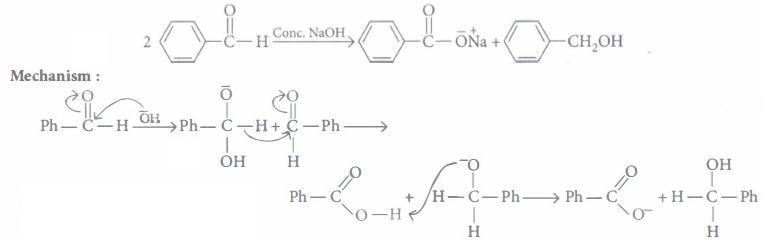
When an aldehyde with no a-hydrogen reacts with concentrated aqueous NaOH, half the aldehyde is converted to carboxylic acid salt and other half is converted to an alcohol. In other words, half of the reactant is oxidized
and other half is reduced. This reaction is known as Cannizzaro reaction

The following questions are multiple choice questions. Choose the most appropriate answer:
  1. A mixture of benzaldehyde and formaldehyde on heating with aqueous NaOH solution gives:
  1. Benzyl alcohol and sodium formate.
  2. Sodium benzoate and methyl alcohol.
  3. Sodium benzoate and sodium formate.
  4. Benzyl alcohol and methyl alcohol.
  1. Which of the following compounds will undergo Cannizzaro reaction?
  1. CH3CHO
  2. CH3COCH3
  3. C6H5CHO
  4. C6H5CH2CHO
  1. Trichloroacetaldehyde is subjected to Cannizzaro's reaction by using NaOH. The mixture of the products contains sodium trichloroacetate ion and another compound. The other compounds is:
  1. 2, 2, 2-trichloroethanol
  2. Trichloromethanol
  3. 2, 2, 2-trichloropropanol
  4. Chloroform
  1. Which of the following reaction will not result in the formation of carbon-carbon bonds?
  1. Cannizzaro reaction
  2. Wurtz reaction
  3. Reimer- Tiemann reaction
  4. Friedel - Crafts acylation
Read the passage given below and answer the following questions:
Iron forms many complexes in its +2 and +3 oxidation states such as [Fe(H2O)6]2+ (A); [Fe(CN)6]4- (B); [Fe(H2O)6]3+ (C); [Fe(CN)6]3- (D), etc., They exhibit, different magnetic properties and undergo different hybridisation of iron.
The following questions are multiple choice questions. Choose the most appropriate answer:
  1. Which of the following statements is correct?
  1. (B) is paramagnetic while (C) is diamagnetic.
  2. Both (B) and (D) are outer orbital complexe.
  3. Both (A) and (C) are paramagnetic.
  4. (A) is outer orbital complex and (C) is inner orbital complex.
  1. The complex having maximum magnetic moment is:
  1. (A)
  2. (B)
  3. (C)
  4. (D)
  1. Which of the following does not represent correct configuration of the d-orbitals in the given complexes?
  1. $\text{(A)}:\text{t}^4_{2\text{g}}\text{e}^2_\text{g}$
  2. $\text{(B)}:\text{t}^6_{2\text{g}}\text{e}^0_\text{g}$
  3. $\text{(C)}:\text{t}^4_{2\text{g}}\text{e}^1_\text{g}$
  4. $\text{(D)}:\text{t}^5_{2\text{g}}\text{e}^0_\text{g}$
  1. The spin only magnetic moment of complexes (A), (B), (C) and (D) are respectively (in BM).
  1. $2\sqrt{6},0,\sqrt{35},\sqrt{3}$
  2. $0,2\sqrt{6},\sqrt{35},\sqrt{3}$
  3. $\sqrt{15,}2\sqrt{6},\sqrt{3},0$
  4. $\sqrt{3},\sqrt{8},0,\sqrt{15}$
  1. Which of the given complexes are outer orbital complexes?
  1. (A) and (B) only
  2. (B) and (C) only
  3. (A) and (C) only
  4. (B) and (D) only
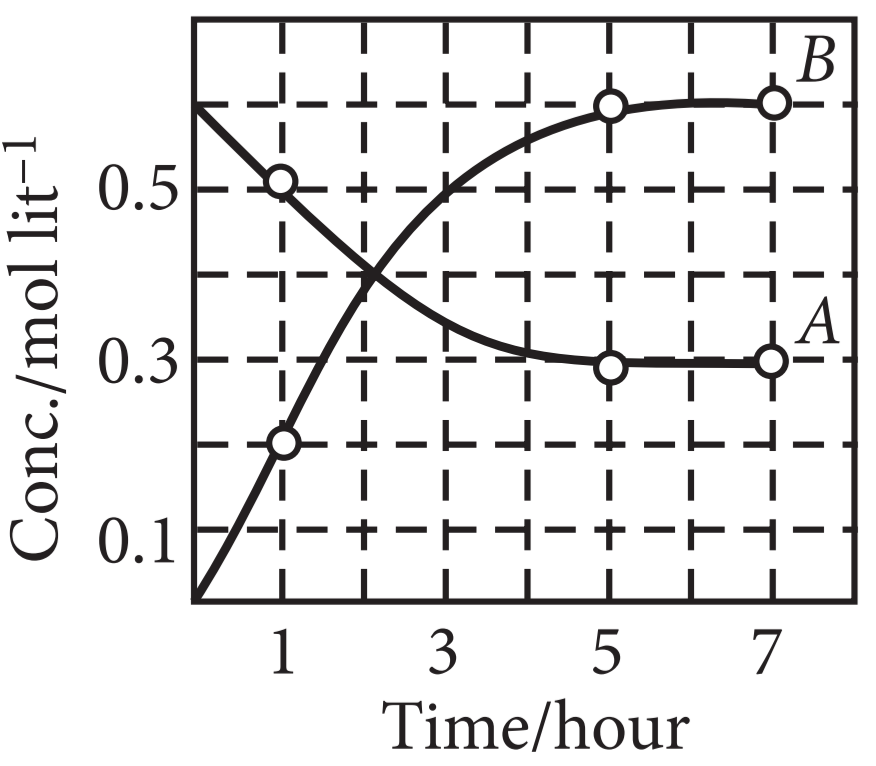
The progress of the reaction, $\text{A}\rightleftharpoons\text{nB}$ with time is represented in the following figure:

The following questions are multiple choice questions. Choose the most appropriate answer:
  1. What is the value of n?
  1. 1
  2. 2
  3. 3
  4. 4
  1. Find the value of the equilibrium constant.
  1. 0.6M
  2. 1.2M
  3. 0.3M
  4. 2.4M
  1. The initial rate of conversion of A will be:
  1. 0.1 mol L-1hr-1
  2. 0.2 mol L-1hr-1
  3. 0.4 mol L-1hr-1
  4. 0.8 mol L-1hr-1
  1. For the reaction, if $\frac{\text{d}[\text{B}]}{\text{dt}}=2\times10^{-4},$ value of $-\frac{\text{d}[\text{A}]}{\text{dt}}$ will be:
  1. 2 × 10-4
  2. 10-4
  3. 4 × 10-4
  4. 0.5 × 10⁻⁴
  1. Which factor has no effect on rate of reaction?
  1. Temperature.
  2. Nature of reactant.
  3. Concentration of reactant.
  4. Molecularity.