Question
Read the passage given below and answer the following questions: Boiling point or freezing point of liquid solution would be affected by the dissolved solids in the liquid phase. A soluble solid in solution has the effect of raising its boiling point and depressing its freezing point. The addition of non-volatile substances to a solvent decreases the vapor pressure and the added solute particles affect the formation of pure solvent crystals. According to many researches the decrease in freezing point directly correlated to the concentration of solutes dissolved in the solvent. This phenomenon is expressed as freezing point depression and it is useful for several applications such as freeze concentration of liquid food and to find the molar mass of an unknown solute in the solution. Freeze concentration is a high quality liquid food concentration method where water is removed by forming ice crystals. This is done by cooling the liquid food below the freezing point of the solution. The freezing point depression is referred as a colligative property and it is proportional to the molar concentration of the solution (m), along with vapor pressure lowering, boiling point elevation, and osmotic pressure. These are physical characteristics of solutions that depend only on the identity of the solvent and the concentration of the solute. The characters are not depending on the solute’s identity.
  1. When a non volatile solid is added to pure water it will:
  1. boil above 100°C and freeze above 0°C
  2. boil below 100°C and freeze above 0°C
  3. boil above 100°C and freeze below 0°C
  4. boil below 100°C and freeze below 0°C
  1. Colligative properties are:
  1. dependent only on the concentration of the solute and independent of the solvent’s and solute’s identity.
  2. dependent only on the identity of the solute and the concentration of the solute and independent of the solvent's identity.
  3. dependent on the identity of the solvent and solute and thus on the concentration of the solute.
  4. dependent only on the identity of the solvent and the concentration of the solute and independent of the solute’s identity.
  1. Assume three samples of juices A, B and C have glucose as the only sugar present in them. The concentration of sample A, B and C are 0.1M, 5M and 0.2 M respectively. Freezing point will be highest for the fruit juice:
  1. A
  2. B
  3. C
  4. All have same freezing point
  1. Identify which of the following is a colligative property:
  1. freezing point
  2. boiling point
  3. osmotic pressure
  4. all of the above

Answer

  1. (b) boil below 100°C and freeze above 0°C
  2. (d) dependent only on the identity of the solvent and the concentration of the solute and independent of the solute’s identity.
  3. (a) A
  4. (c) osmotic pressure

Need a full question paper?

Generate a complete, print-ready paper with questions like this in minutes — across 16+ boards, with answer keys.

Start Generating Free

Similar questions

The following reaction, $\text{A}_{(\text{g})}\xrightarrow{\ \ \triangle\ \ \ }\text{P}_{(\text{g})}+\text{Q}_{(\text{g})}+\text{R}_{(\text{g})},$ follows first order kinetics. The half$-$life period of this reaction is $69.3s$ at $500^\circ C$. The gas $A$ is enclosed in a container at $500^\circ C$ and at a pressure of $0.4$ atm.
The following questions are multiple choice questions. Choose the most appropriate answer :
  1. The rate constant for the reaction is :
  1. $0.4s^{-1}$
  2. $0.02s^{-1}$
  3. $0.01s^{-1}$
  4. $0.3s^{-1}$
  1. The pressure of the gas $A$ after $230$ s will be :
  1. $0.04$ atm
  2. $0.36$ atm
  3. $0.4$ atm
  4. $0.036$ atm
  1. The total pressure of the system after $230$ swill be:
  1. $2.15$ atm
  2. $1.12$ atm
  3. $0.4$ atm
  4. $3.08$ atm
  1. The plot ofln$[A]$ vs twill be:
  1. Linear with slope $= k$
  2. Linear with intercept $= In[A]_0$
  3. Linear with slope $= In[A]_0$
  4. Linear with intercept $= [A]_0$
  1. Which of the following is not an example of first order reaction?
  1. $\text{C}_2\text{H}_{4(\text{g})}+\text{H}_{2(\text{g})}\rightarrow\text{C}_2\text{H}_{6(\text{g})}$
  2. $2\text{N}_2\text{O}_{5(\text{g})}\rightarrow4\text{NO}_{2(\text{g})}+\text{O}_{2(\text{g})}$
  3. $2\text{N}\text{H}_{3(\text{g})}\xrightarrow[\triangle]{\text{pt}}\text{N}_{2(\text{g})}+3\text{H}_{2(\text{g})}$
  4. $2\text{N}_2\text{O}_{(\text{g})}\xrightarrow{\ \ \triangle\ \ }2\text{N}_{2(\text{g})}+\text{O}_{2(\text{g})}$
Read the passage given below and answer the following questions: Lucas test is a test to differentiate between primary, secondary and tertiary alcohols. This test consists of treating an alcohol with Lucas' reagent, and turbidity, due to the formation of insoluble alkyl chloride, is observed. Lucas test is based on the difference in reacting of three classes of alcohols with hydrogen chloride via $S_N1$ reaction. The different reactivity reflects the differing ease of formation of the corresponding carbocations. In these questions $($Q. No. $i-iv),$ a statement of assertion followed by a statement ofreason is given. Choose the correct answer out of the following choices.
  1. Assertion and reason both are correct statements and reason is correct explanation for assertion.
  2. Assertion and reason both are correct statements but reason is not correct explanation for assertion.
  3. Assertion is correct statement but reason is wrong statement.
  4. Assertion is wrong statement but reason is correct statement.
  1. Assertion: Equimolar mixture of cone. $\ce{HCI}$ and anhydrous $\ce{ZnCl_2}$ is called Lucas' reagent.
Reason: Lucas' reagent can be used to distinguish between methanol and ethanol.
  1. Assertion: $2-$Methyl$-2-$butanol gives no turbidity with Lucas' reagent at room temperature.
Reason: It is a $3^\circ$ alcohol.
  1. Assertion: Tertiary alcohols react fastest with Lucas' reagent by $S_N1$ mechanism.
Reason: $3^\circ$ carbocation is most stable.
  1. Assertion: Amongst the compounds, $\ce{H2C = CHCH_2OH (I), C_6H_5OH (II), CH_3CH_2CH_2OH (III)}$ and $\ce{(CH_3)_3COH (IV),}$ only $\ce{(IV)}$ reacts with Lucas' reagent at room temperature.
Reason: Tertiary alcohol gives turbidity immediately with Lucas' reagent.
  1. Assertion: Lucas test can be used to distinguish between $1-$propanol and $2-$propanol.
Reason: Lucas test is based upon the difference in reactivity of primary, secondary and tertiary alcohols with cone. $\ce{HCI}$ and anhyd. $\ce{ZnCl_2.}$
What is the most suitable pKa value of the substituted propylamine formed with substituent "X" with electronegativity 3.0
(i)10.67 (ii)10.08 (iii) 10.15 (iv)11.10
Read the passage given below and answer the following questions:
A compound $(X)$ containing $C, H$ and $O$ is unreactive towards sodium. It also does not react with Schiff s reagent. On refluxing with an excess of hydroiodic acid, $(X)$ yields only one organic product $( Y).$ On hydrolysis, $(Y)$ yields a new compound $(Z)$ which can be converted into $(Y)$ by reaction with red phosphorus and iodine. The compound $(Z)$ on oxidation with potassium permanganate gives a carboxylic acid. The equivalent weight of this acid is $60.$
The following questions are multiple choice questions. Choose the most appropriate answer:
  1. The compound $(X)$ is an:
  1. Acid.
  2. Aldehyde.
  3. Alcohol.
  4. Ether.
  1. The $\text{IUPAC}$ name of the acid formed is:
  1. Methanoic acid.
  2. Ethanoic acid.
  3. Propanoic acid.
  4. Butanoic acid.
  1. Compound $(Y)$ is:
  1. Ethyl iodide.
  2. Methyl iodide.
  3. Propyl iodide.
  4. Mixture of $(a)$ and $(b).$
  1. Compound $(Z)$ is:
  1. Methanol.
  2. Ethanol.
  3. Propanol.
  4. Butanol.
  1. Compound $(X)$ on treatment with excess of $Cl_2$ in presence of tight gives:
  1. $\propto-$ Chlorodiethyl ether.
  2. $\propto,\propto\ '-$ Dichlorodiethyl ether.
  3. Perchlorodiethyl ether.
  4. None of these.
Read the passage given below and answer the following questions:
The amines are basic in nature due to the presence of a lone pair of electron on $N-$atom of the $-NH_2$ group, which it can donate to electron deficient compounds. Aliphatic amines are stronger bases than $NH_3$ because of the $+I$ effect of the alkyl groups. Greater the number of alkyl groups attached to $N-$atom, higher is the electron density on it and more will be the basicity. Thus, the order of basic nature of amines is expected to be $3^\circ > 2^\circ > 1^\circ ,$ however the observed order is $2^\circ > 1^\circ > 3^\circ .$ This is explained on the basis of crowding on $N-$atom of the amine by alkyl groups which hinders the approach and bonding by a proton, consequently, the electron pair which is present on $N$ is unavailable for donation and hence $3^\circ$ amines are the weakest bases.
Aromatic amines are weaker bases than ammonia and aliphatic amines. Electron-donating groups such as $-\ce{CH_3, -OCH_3,}$ etc. increase the basicity while electron-withdrawing substitutes such as $\ce{-NO_2, -CN,}$ halogens, etc. decrease the basicity of amines. The effect of these substituents is more at $p$ than at $m-$positions.
The following questions are multiple choice questions. Choose the most appropriate answer:
  1. Which one of the following is the strongest base in aqueous solution?
  1. Methyl amine.
  2. Tri methyl amine.
  3. Aniline.
  4. Dimethyl amine.
  1. Which order ofbasicity is correct?
  1. Aniline $>$ $m-$toluidine $> o-$toluidine
  2. Aniline $> o-$toluidine $> m-$toluidine
  3. $o-$toluidine $>$ aniline $> m-$toluidine
  4. $o-$toluidine $<$ aniline $< m-$toluidine
  1. What is the decreasing order of basicity of primary, secondary and tertiary ethylamines and $NH_3$?
  1. $\ce{NH_3 > C_2H_5NH_2 > (C_2H_5)_2NH > (C_2H_5)_3N}$
  2. $\ce{(C_2H_5)_3N > (C_2H_5)_2NH_{ }> C_2H_5NH_2 > NH_3}$
  3. $\ce{(C_2H_5)_2NH > C_2H_5NH_2> (C_2H_5)_3N > NH_3}$
  4. $\ce{(C_2H_5)_2NH > (C_2H_5)_3N > C_2H_5NH_2 > NH_3​​​​​​​}$
  1. The order of basic strength among the following amines in benzene solution is:
  1. $\ce{CH_3NH_2 > (CH_3)_3N > (CH_3)_2NH}$
  2. $\ce{(CH_3)_3N > (CH_3)_2NH > CH_3NH_2​​​​​​​}$
  3. $\ce {CH_3NH_2 > (CH_3)_2NH > (CH_3)_3N}$
  4. $\ce{(CH_3)_3N > CH_3NH_2 > (CH_3)_2NH}$
  1. Choose the correct statement.
  1. Methylamine is slightly acidic.
  2. Methylamine is less basic than ammonia.
  3. Methylamine is a stronger base than ammonia.
  4. Methylamine forms salts with alkalies.
Electrical work done in unit time is equal to electrical potential multiplied by total charge passed. ln order to obtain maximum work from a cell, the charge has to be passed reversibly. The reversible work done by a cell is equal to decrease in its Gibb's energy. Hence, Gibb's energy of reaction is given by $\Delta\text{G}=\text{nFE}_\text{cell}$ Hence, Eis the emfof the cell and $nF$ is the amount of energy. In these questions $(Q$. No. $i-Iv),$ a statement of assertion followed by a statement ofreason is given. Choose the correct answer out of the following choices.
  1. Assertion and reason both are correct statements and reason is correct explanation for assertion.
  2. Assertion and reason both are correct statements but reason is not correct explanation for assertion.
  3. Assertion is correct statement but reason is wrong statement.
  4. Assertion is wrong statement but reason is correct statement.
  1. Assertion : $\Delta\text{G}^\circ=-\text{nFE}^\circ$
Reason : $E^\circ$ ​​​​​​​ should be positive for a spontaneous reaction.
  1. Assertion : An electrochemical cell can be set up only if the red ox reaction is spontaneous.
Reason : A reaction is spontaneous if free energy change is negative.
  1. Assertion : For an electrochemical cell, $\Delta\text{G}<0$ and $\text{E}_\text{cell}>0.$
Reason : The given cell is non $-$ spontaneous.
  1. Assertion : Current stops flowing when $E_\text{cell} = 0$.
Reason : Equilibrium of the cell reaction is attained.
  1. Assertion :$ E_\text{cell}$ should have a positive value for the cell to function.
Reason : $E_\text{cell} = E_\text{cathode} - E_\text{anode}$
Read the passage given below and answer the following questions :
Valence bond theory considers the bonding between the metal ion and the ligands as purely covalent. On the other hand, crystal field theory considers the metal$-$ligand bond to be ionic arising from electrostatic interaction between the metal ion and the ligands. In coordination compounds, the interaction between the ligand and the metal ion causes the five $d-$orbitals to split$-$up. This is called crystal field splitting and the energy difference between the two sets of energy level is called crystal field splitting energy. The crystal field splitting energy $(\Delta_0)$ depends upon the nature of the ligand. The actual configuration of complexes is divided by the relative values of $\Delta_0$ and $P\ ($pairing energy$)$.
If $\Delta_0<\text{P},$ then complex will be high spin.
If $\Delta_0>\text{P},$ then complex will be low spin
The following questions are multiple choice questions. Choose the most appropriate answer :
  1. Which of the following ligand has lowest $\Delta_0$ value?
  1. $CN^-$
  2. $CO$
  3. $F^-$
  4. $NH_3$
  1. The crystal field splitting energy for octahedral $(\Delta_0)$ and tetrahedral $(\Delta_t)$ complex is related as :
  1. $\Delta_\text{t}=\frac{1}{2}\Delta_0$
  2. $\Delta_\text{t}=\frac{4}{9}\Delta_0$
  3. $\Delta_\text{t}=\frac{3}{5}\Delta_0$
  4. $\Delta_\text{t}=\frac{2}{5}\Delta_0$
  1. On the basis of crystal field theory, the electronic configuration of $d_4$ in two situations : $(i)\ t.0 > P$ and $(ii)\ t.0$
  $(i)$ $(ii)$
$(a)$ $\text{t}^4_{2\text{g}}\text{e}^0_\text{g}$ $\text{t}^3_{2\text{g}}\text{e}^1_\text{g}$
$(b)$ $\text{t}^3_{2\text{g}}\text{e}^1_\text{g}$ $\text{t}^4_{2\text{g}}\text{e}^0_\text{g}$
$(c)$ $\text{t}^3_{2\text{g}}\text{e}^1_\text{g}$ $\text{t}^3_{2\text{g}}\text{e}^1_\text{g}$
$(d)$ $\text{t}^4_{2\text{g}}\text{e}^0_\text{g}$ $\text{t}^4_{2\text{g}}\text{e}^0_\text{g}$
  1. Using crystal field theory, calculate magnetic moment of central metal ion of $[FeF_6]^{4-}.$
  1. $1.79B.M.$
  2. $2.83B.M.$
  3. $3.85B.M.$
  4. $4.9B.M.$
  1. Electronic configuration of $d-$orbitals in $[Ti(H_2O)_6]^{3+}$ ion in an octahedral crystal field is:
  1. $\text{t}^1_{2\text{g}}\text{e}^0_\text{g}$
  2. $\text{t}^2_{2\text{g}}\text{e}^0_\text{g}$
  3. $\text{t}^0_{2\text{g}}\text{e}^1_\text{g}$
  4. $\text{t}^1_{2\text{g}}\text{e}^1_\text{g}$
Read the passage given below and answer the following questions:
Amines are basic in nature. The basic strength of amines can be expressed by their dissociation constant, $K_b$ or $pK_b.$
$\text{RNH}_2+\text{H}_2\text{O}\rightleftharpoons\text{RNH}^+_3+\text{OH}^-$
$\text{k}_\text{b}=\frac{[\text{RNH}^+_3][\text{OH}^-]}{[\text{RNH}_2]}\text{and}\text{ pk}_\text{b}=-\log\text{k}_\text{b}$
Greater the $K_b$ value or smaller the $pK_b$ value, more is the basic strength of a mine. Aryl amines such as aniline are less basic than aliphatic amines due to the involvement of lone pair of electrons on $N-$atom with the resonance in benzene. In derivatives of aniline, the electron releasing groups increase the basic strength while electron withdrawing groups decrease the basic strength. The base weakening effect of electron withdrawing group and base strengthening effect of electron releasing group is more marked at $p-$position than at $m-$position. $a-$Substituted aniline is less basic than aniline due to ortho effect and is probable due to combination of electronic and steric effect.
The following questions are multiple choice questions. Choose the most appropriate answer:
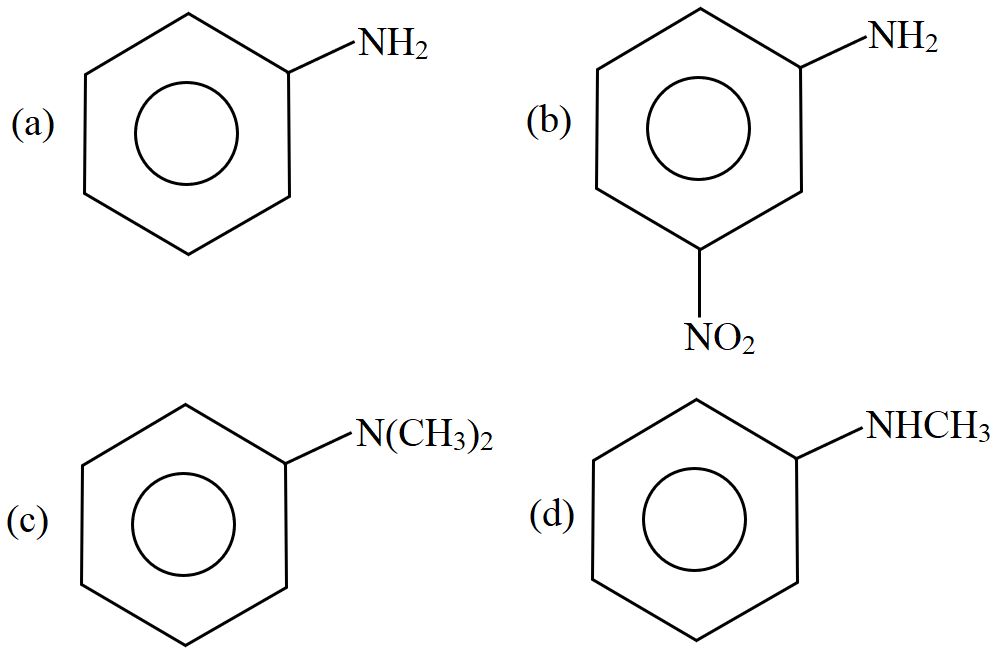
  1. Which of the following has lowest $pK_b$ value?
  1. The strongest base among the following is:
  1. $\ce{C_6H_5NH_2}$
  2. $\ce{p-NO_2 - C_6H_4NH_2}$
  3. $\ce{m-NO_2 - C_6H_4NH_2}$
  4. $\ce{C_6H_5CH_2NH_2}$
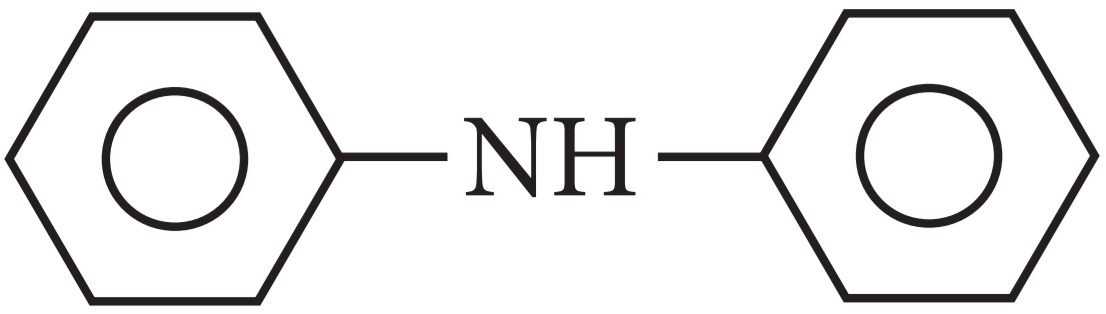
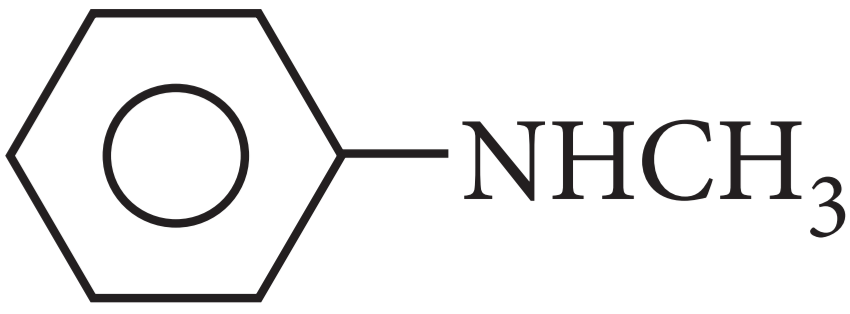
  1. Maximum $pK_b$ value of:
  1.  
  1.  
  1. $\ce{(CH_3CH_2)_2NH}$
  2. $\ce{(CH_3)_2NH}$
  1.  The order of basic strength among the following amines in benzene solution is:
  1. Methylamine is more basic than $NH_3.$
  2. Amines form hydrogen bonds.
  3. Ethylamine has higher boiling point than propane.
  4. Dimethylamine is less basic than methylamine.
  1. $\ce{CH_3CH_2NH_2}$ contains a basic $-NH_2$ group, but $\ce{CH_3CONH_2}$ does not because:
  1. Acetamide is amphoteric in character.
  2. In ethylamine the electron pair on $N-$atom is delocalised by resonance.
  3. In ethylamine there is no resonance while in acetamide the lone pair of electrons on $N-$ atom is delocalised and is less available for protonation.
  4. None of these.
Dependence of the rate of reaction on the concentration of reactants, temperature, and other factors is the most general method for weeding out unsuitable reaction mechanisms. The term mechanism means all the individual collisional or elementary processes involving molecules $($atoms, radicals, and ions included$)$ that take place simultaneously or consecutively to produce the observed overall reaction. For example, when hydrogen gas reacts with bromine, the rate of the reaction was found to be proportional to the concentration of $H_2$ and to the square root of the concentration of $Br_2.$ Furthermore, the rate was inhibited by increasing the concentration of $HBr$ as the reaction proceeded. These observations are not consistent with a mechanism involving bimolecular collisions of a single molecule of each kind. The currently accepted mechanism is considerably more complicated, involving the dissociation of bromine molecules into atoms followed by reactions between atoms and molecules:
It is clear from this example that the mechanism cannot be predicted from the overall stoichiometry.
$($source: Moore, J. W., Pearson, $R. G. (1981).$ Kinetics and mechanism. John Wiley Sons.$)$
$(a).$ Predict the expression for the rate of reaction and order for the following:
$H_2 + Br_2 \rightarrow 2 HBr$
What are the units of rate constant for the above reaction?
$(b).$ How will the rate of reaction be affected if the concentration of $Br_2$ is tripled?
Read the passage given below and answer the following questions:
Metal carbonyl is an example of coordination compounds in which carbon monoxide $(CO)$ acts as ligand. These are also called homoleptic carbonyls. These compounds contain both $\sigma$ and $\pi$ character. Some carbonyls have metal$-$metal bonds. The reactivity of metal carbonyls is due to $(i)$ the metal centre and $(ii)$ the $CO$ ligands. $CO$ is capable of accepting an appreciable amount of electron density from the metal atom into their empty $\pi$ or $\pi-\text{orbital}.$ These types of ligands are called $\pi-\text{accepter}$ or $\pi-\text{acid}$ ligands. These interactions increases the $\Delta_0$ value.
The following questions are multiple choice questions. Choose the most appropriate answer:
  1. What is the oxidation state of metal in $\ce{[Mn_2(CO)_{10}]}?$
  1. $+1$
  2. $-1$
  3. $+2$
  4. $0$
  1. Among the following metal carbonyls, the $C-O$ bond order is lowest in:
  1. $\ce{[Mn(CO)_6]^+}$
  2. $\ce{[Fe(CO)_5]}$
  3. $\ce{[Cr(CO)_6]}$
  4. $\ce{[V(CO)_6]^-}$
  1. Which of the following can be reduced easily?
  1. $\ce{V(CO)_6}$
  2. $\ce{Mo(CO)_6}$
  3. $\ce{[Co(CO)_4]^-}$
  4. $\ce{Fe(CO)_5}$
  1. The oxidation state of cobalt in $\ce{K[Co(CO)_4]}$ is:
  1. $+1$
  2. $+3$
  3. $-1$
  4. $0$
  1. Structure of decacarbonyl manganese is:
  1. Trigonal bipyramidial
  2. Octahedral
  3. Tetrahedral
  4. Square pyramidal