Question
Describe detailed information on classification of carbohydrates.

Answer

Carbohydrates are classified on the basis of their behaviour on hydrolysis. They have been broadly divided into following 3 groups
(i) Monosaccharide compounds :
"A carbohydrate that can not be hydrolysed further to give simpler unit of polyhydroxy aldehyde or ketone is called a monosaccharide."
About 20 monosaccharides are known to occur in nature. Some common examples are glucose, fructose, ribose, etc.
(ii) Oligosaccharide compounds :
"Carbohydrates that yield two to ten monosaccharide units, on hydrolysis are called oligosaccharides."
They are further classified as disaccharides, trisaccharides, tetrasaccharides, etc., depending upon the number of monosaccharides they provide on hydrolysis.
Amongst these the most common are disaccharides. The two monosaccharide units obtained on hydrolysis of a disaccharide may be same or different.
For example, one molecule of sucrose on hydrolysis gives one molecule of glucose and one molecule of fructose where as maltose gives two molecules of only glucose.
(iii) Polysaccharide compounds:
"Carbohydrate which yield a large number of monosaccharide units on hydrolysis are called polysaccharides."
Some common examples are starch, cellulose, glycogen, gums etc. Polysaccharides are not sweet in taste. Hence, they are also called non- sugars.
Need a full question paper?

Generate a complete, print-ready paper with questions like this in minutes — across 16+ boards, with answer keys.

Start Generating Free

Similar questions

Read the passage given below and answer the following questions:
Haloarenes are less reactive than haloalkanes. The low reactivity of haloarenes can be attributed to:
  • Resonance effect.
  • $sp^2$ hybridisation of $C - X$ bond.
  • Polarity of $C - X$ bond
  • Instability of phenyl cation $($formed by self$-$ionisation of haloarene$).$
  • Repulsion between the electron rich attacking nucleophiles and electron rich arenes.
Reactivity of haloarenes can be increased or decreased by the presence of certain groups at certain positions for example, nitro $(-NO_{^2})$ group at o/ p positions increases the reactivity of haloarenes towards nucleophilc substitution reactions.
The following questions are multiple choice questions Choose the most appropriate answer:
  1. Aryl halides are less reactive towards nucleophilic substitution reaction as compared to alkyl halides due to
  1. The formation of less stable carbonium ion.
  2. Resonance stabilisation.
  3. Larger carbon$-$halogen bond.
  4. Inductive effect.
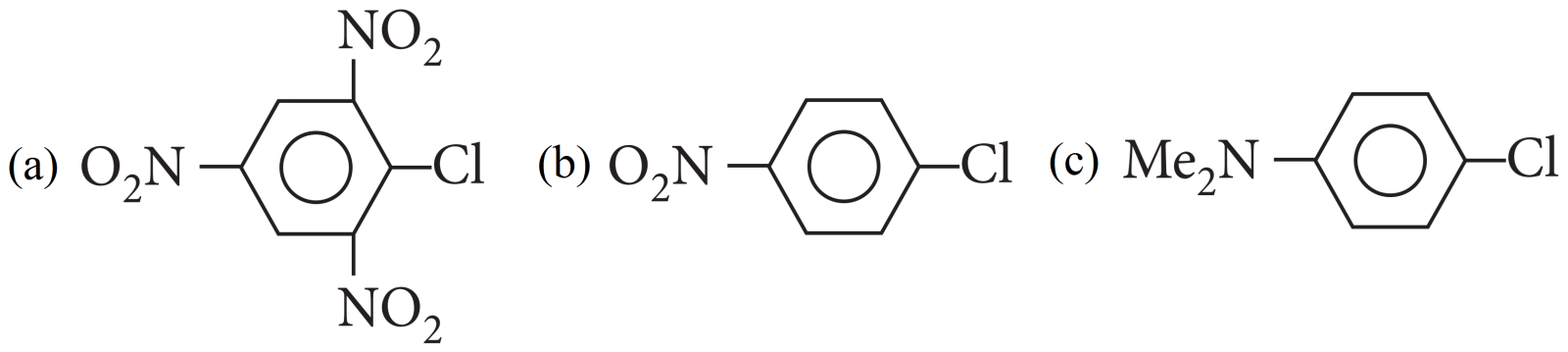
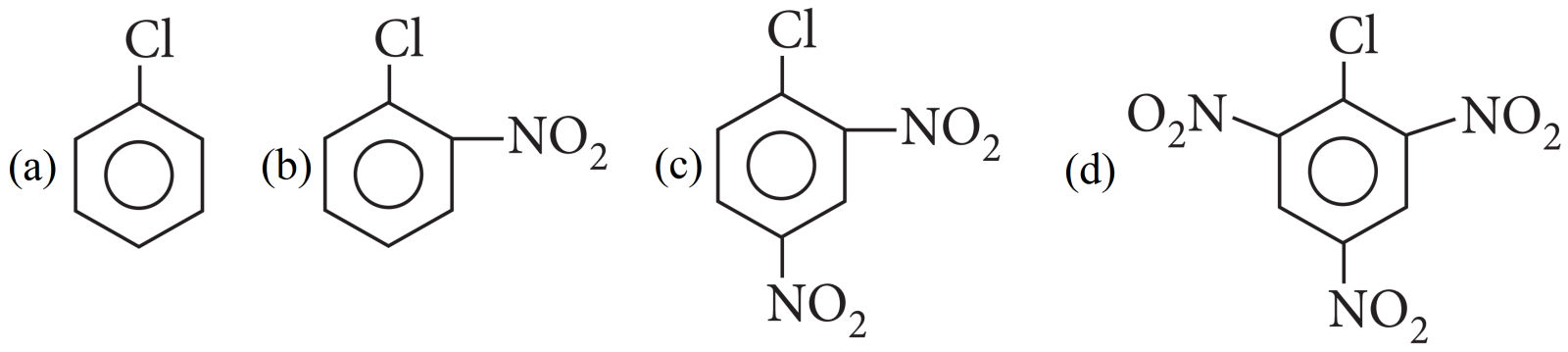
  1. Which of the following aryl halides is the most reactive towards nucleophilic substitution?
  1. Which one of the following will react fastest with aqueous $\text{NaOH}$?
  1. Which chloro derivative of benzene among the followings would undergo hydrolysis most readily with aqueous sodium hydroxide to furnish the corresponding hydroxy derivative?
  1. $\ce{C_6H_5Cl}$
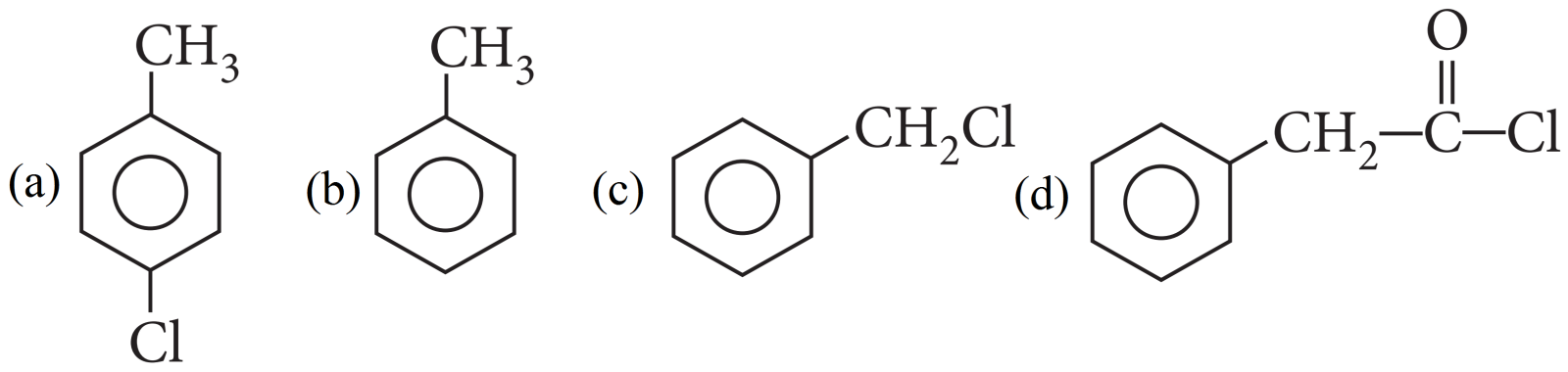
  1. The reactivity of the compounds $\ce{(i)\ MeBr, (ii)\ PhCH_2Br, (iii)\ MeCI, (iv)\ p-MeOC_6H_4Br}$ decreases as:
  1. $\ce{(i) > (ii) > (iii) > (iv)}$
  2. $\ce{(iv) > (ii) > (i) > (iii)}$
  3. $\ce{(iv) > (iii) > (i) > (ii)}$
  4. $\ce{(ii) > (i) > (iii) > (iv)}$
Read the passage given below and answer the following questions: Ligands are atoms or ions which can donate electrons to the central atoms. Ligands can be monodentate, bidentate or polydentate as well. Few ligands can coordinate with the central atom through more than one site, these are called ambidentate ligands. When a di- or polydentate ligand uses its two or more donor atoms to bind a single metal ion, it is said to be a chelating ligand. In these questions $(Q. No. i-iv),$ a statement of assertion followed by a statement ofreason is given. Choose the correct answer out of the following choices.
  1. Assertion and reason both are correct statements and reason is correct explanation for assertion.
  2. Assertion and reason both are correct statements but reason is not correct explanation for assertion.
  3. Assertion is correct statement but reason is wrong statement.
  4. Assertion is wrong statement but reason is correct statement.
The following questions are multiple choice questions. Choose the most appropriate answer:
  1. Assertion: Glycinate ion is an example of monodentate ligand.
Reason: Glycinate contains $N $ and $O$ as donor atoms.
  1. Assertion: $EDTA$ forms complex with divalent metals of 3d-series in the ratio of $1 : 1.$
Reason: $EDTA$ has $4 - COOH$ groups.
  1. Assertion: Oxalate ion is a bidentate ligan.
Reason: Oxalate ion has two donor atoms.
  1. Assertion: A chelating ligand must possess two or more lone pairs at such a distance that it may form suitable strain free $5 $ and $6$ membered rings with the metal ion.
Reason: $H_2N - NH_2$ is a chelating ligand.
  1. Assertion: In Zeise's salt coordination number of $Pt$ is five.
Reason: Ethene is a monodentate ligand.
Write detailed note on: Starch
Read the passage given below and answer the following questions:
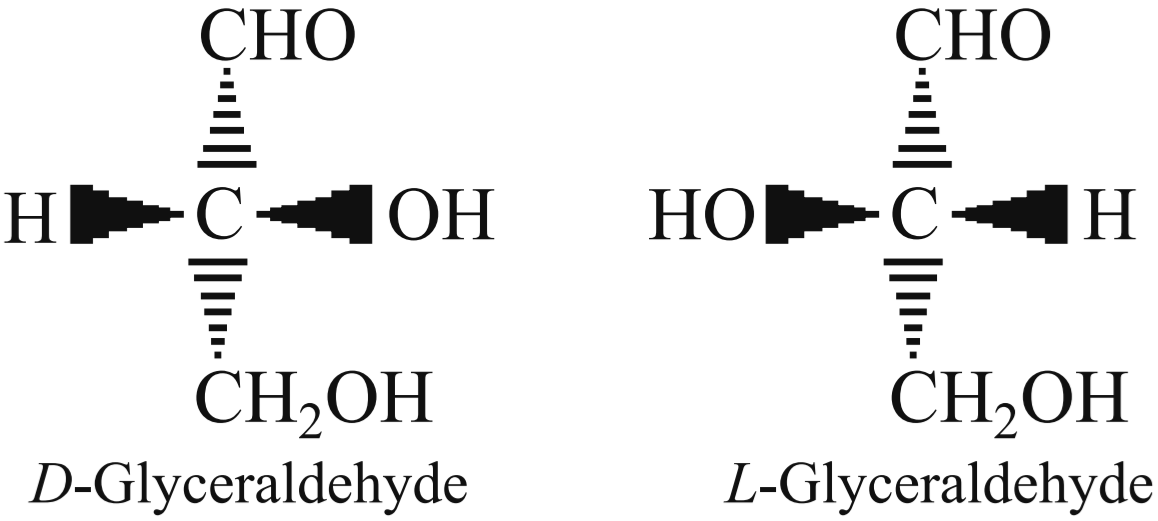
Carbohydrates can exist in either of two conformations, as determined by the orientation of the hydroxyl group about the asymmetric carbon farthest from the carbonyl.

By convention, a monosaccharide is said to have $D-$configuration if the hydroxyl group attached to the asymmetric carbon atom adjacent to the $-\ce{CH_2OH}$ group is on the right hand side irrespective of the positions of the other hydroxyl groups. On the other hand, the molecule is assigned $L-$configuration if the $-OH$ group attached to the carbon adjacent to the $- \ce{CH_2OH}$ group is on the left hand side.
The following questions are multiple choice questions. Choose the most appropriate answer:
  1. $D-$Glyceraldehyde and $L-$Glyceraldehyde are:
  1. Epimers.
  2. Enantiomers.
  3. Anomers.
  4. Conformational diasteriomers.
  1. Which of the following monosaccharides, is the majority found in the human body?
  1. $D-$type.
  2. $L-$type.
  3. Both of these.
  4. None of these.
  1. The two functional groups present in a typical carbohydrate are:
  1. $-\ce{OH}$ and $-\ce{COOH}$
  2. $-\ce{CHO}$ and $-\ce{COOH}$
  3. $ > \ce{C= O}$ and $-\ce{OH}$
  4. $-\ce{OH}$ and $-\ce{CHO}$
  1. Monosaccharides contain:
  1. Always six carbon atoms.
  2. Always five carbon atoms.
  3. Always four carbon atoms.
  4. May contain $3$ to $7$ carbon atoms.
  1. The correct corresponding order of names of four aldoses with configuration given below respectively, is:
  1. $L-$erythrose, $L-$threose, $L-$erythrose, $D-$threose.
  2. $D-$threose, $D-$erythrose, $L-$threose, $L-$erythrose.
  3. $L-$erythrose, $L-$threose, $D-$erythrose, $D-$threose.
  4. $D-$erythrose, $D-$threose, $L-$erythrose, $L-$threose.

Read the passage given below and answer the following questions:
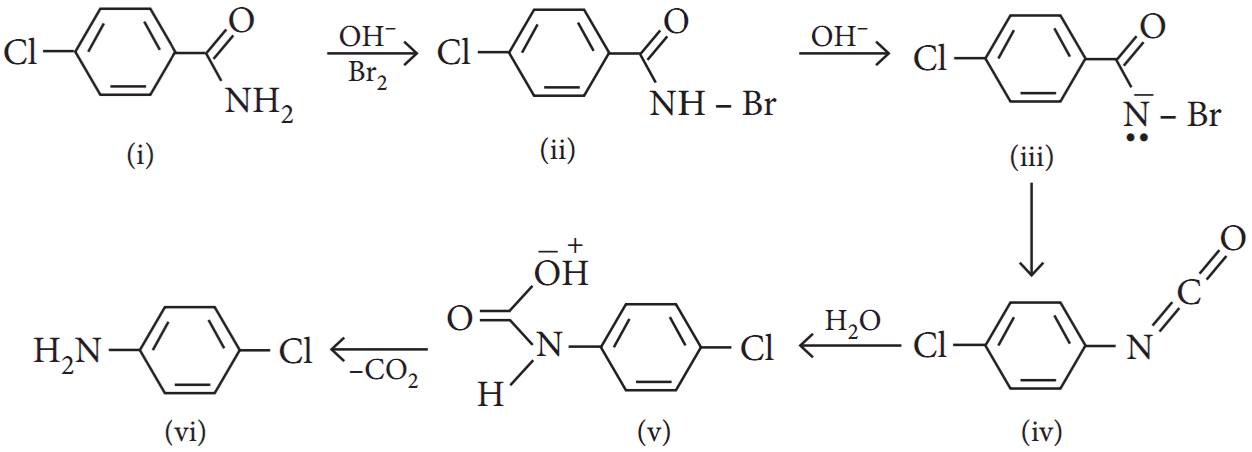
$\ce{RCONH_2}$ is converted into $\ce{RNH_2}$ by means of Hoffmann bromamide degradation. During the reaction amide is treated with $\ce{Br_2}$ and alkali to get amine. This reaction is used to descend the series in which carbon atom is removed as carbonate ion $(\text{CO}^{2-}_3)$ Hoffmann bromide degradation reaction can be written as:

The following questions are multiple choice questions. Choose the most appropriate answer:
  1. Hoffmann bromamide degradation is used for the preparation of
  1. Primary amines.
  2. Secondary amines.
  3. Tertiary amines.
  4. Secondary aromatic amines.
  1. Which is the rate determining step in Hoffmann bromamide degradation?
  1. Formation of $(i)$
  2. Formation of $(ii)$
  3. Formation of $(iii)$
  4. Formation of $(iv).$
  1. Which of the following are used for the conversion of $(i)$ to $(ii)?$
  1. $\ce{KBr}$
  2. $\ce{KBr + CH_3ONa}$
  3. $\ce{KBr + KOH}$
  4. $\ce{Br_2 + KOH}$
  1. Identify Bin the following reaction.
$\text{R}-\text{C}\equiv\text{N}\xrightarrow[\text{(Partially hydrolysis) }]{\text{Cone. HCI}}\text{A}\xrightarrow{\frac{\text{Br}_2}{\text{KOH}}}\text{B}$
  1. $\ce{RCONH_2}$
  2. $\ce{RNH_2}$
  3. $\ce{RNHBr}$
  4. $\ce{R = N = C = O}$
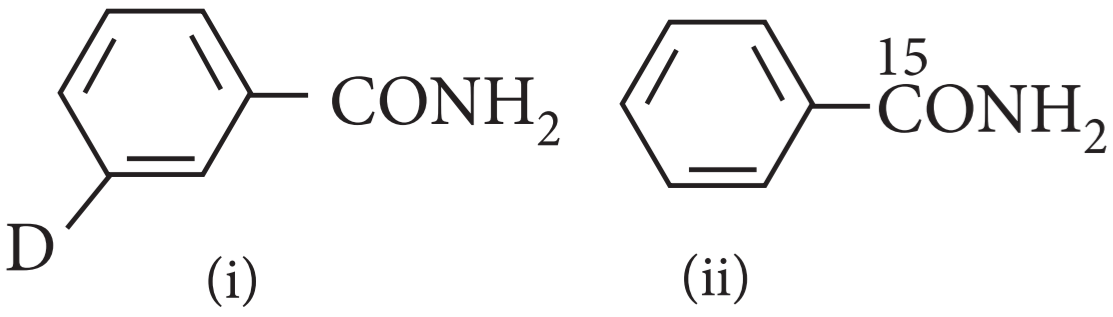
  1. What are the constituent amines formed when the mixture of $(i)$ and $(ii)$ undergoes Hoffmann bromamide degradation?
 
Read the passage given below and answer the following questions: The phenomenon of the flow of solvent through a semipermeable membrane from pure solvent to the solution is called osmosis. Sometimes a pressure is applied to stop the process of osmosis, this is known as osmotic pressure. It is denoted by $\pi.$ Osmotic pressure is expressed as : $\pi=\text{CRT}$ Since, osmotic pressure depends upon the molar concentration of solution, therefore it is a colligative property. A statement of assertion followed by a statement of reason is given. Choose the correct answer out of the following choices.
  1. Assertion and reason both are correct statements and reason is correct explanation for assertion.
  2. Assertion and reason both are correct statements but reason is not correct explanation for assertion.
  3. Assertion is correct statement but reason is wrong statement.
  4. Assertion is wrong statement but reason is correct statement.
  1. Assertion: If red blood cells were removed from the body and placed in pure water, pressure inside the cells increases.
Reason: The concentration of salt content in the cells increases.
  1. Assertion: The osmotic pressure of a solution obtained by mixing 100mL of 3.4% solution of urea and 100mL of 1.6% solution of cane sugar at 293K is 7.46 bar.
Reason: The total osmotic pressure will be equal to the sum of partial osmotic pressures.
  1. Assertion: When a solution is separated from the pure solvent by a semipermeable membrane, the solvent molecules pass through it from pure solvent side to the solution side.
Reason: Diffusion of solvent occurs from a region of high concentration to a region of low concentration solution.
  1. Assertion: Two solutions having same osmotic pressure at a given temperature are called isotonic solutions.
Reason: Osmotic pressure is not a colligative property.
  1. Assertion: The preservation of meat by salting and fruits by adding sugar protects against bacterial action.
Reason: A bacterium on salted meat or candid fruit loses water due to osmosis shrivels and ultimately dies.
Decrease in concentration of reactant or increase in concentration of product per unit time is called rate of reaction. lt is of two types :
  1. Instantaneous rate of reaction : Rate of change of concentration of reactant or product at a particular time is called instantaneous rate of reaction.
$\text{r}_\text{inst.}=\frac{\text{dC}}{\text{dt}}$
where$, dC =$ infinitely small change in concentration
$dt =$ infinitely small change in time.
  1. Average rate of reaction : Ratio of change in concentration and time required for the change is average rate of reaction.
$\text{r}_\text{av}=\frac{\triangle\text{x}}{\triangle\text{t}}=\frac{\text{Change in concentration}}{\text{Time required for the change}}$
For a reaction of the type$, m_1A + m_2B \rightarrow n_1C + n_2D$
Rate of reaction is given as
$\frac{1}{\text{m}_1}\frac{\text{d[A]}}{\text{dt}}=-\frac{1}{\text{m}_2}\frac{\text{d[B]}}{\text{dt}}=+\frac{1}{\text{n}_1}\frac{\text{d[C]}}{\text{dt}}=+\frac{1}{\text{n}_2}\frac{\text{d[D]}}{\text{dt}}$
In these questions $(Q.$ No. $i-iv),$ a statement of assertion followed by a statement ofreason is given. Choose the correct answer out of the following choices.
  1. Assertion and reason both are correct statements and reason is correct explanation for assertion.
  2. Assertion and reason both are correct statements but reason is not correct explanation for assertion.
  3. Assertion is correct statement but reason is wrong statement.
  4. Assertion is wrong statement but reason is correct statement.
  1. Assertion: The kinetics of the reaction, $\text{mA}+\text{nB}+\text{pC}\rightarrow\text{m}'\text{ X}+\text{n}'\text{ Y}+\text{p}'\text{ Z}$ obey the rate expression as $\frac{\text{dx}}{\text{dt}}=\text{k}[\text{A}]^\text{m}[\text{B}]^\text{n}.$
Reason: The rate of the reaction does not depend upon the concentration of $C$.
  1. Assertion : Instantaneous rate of reaction is equal to $\frac{\text{dx}}{\text{dt}}.$
Reason : lt is the rate of reaction at any particular instant of time.
  1. Assertion : For the reaction, $\text{RCl}+\text{NaOH}\rightarrow\text{ROH}+\text{NaCl},$ the rate of reaction is reduced to half on reducing the concentration of $\ce{RCl}$ to half.
Reason : The rate of reaction is represented by $\ce{k[RCl}].$
  1. Assertion : ln rate law, unlike in the expression for equilibrium constants, the exponents for concentrations do not necessarily match the stoichiometric coefficients.
Reason: It is the mechanism and not the balanced chemical equation for the overall change that governs the reaction rate.
  1. Assertion : ln a reaction$, 2A + B \rightarrow A_2B,$ the reactant $B$ will disappear at twice the rate as $A$ will decrease.
Reason: The rate of disappearance of reactant will be $-\frac{1}{2}\frac{\text{d[A]}}{\text{dt}}=-\frac{\text{d[B]}}{\text{dt}}$
Read the passage given below and answer the following questions: Carbohydrates are polyhydroxy aldehydes and ketones and those compounds which on hydrolysis give such compounds are also carbohydrates. The carbohydrates which are not hydrolysed are called monosaccharides. Monosaccharides with aldehydic group are called aldose and those which free ketonic groups are called ketose. Carbohydrates are optically active. Number of optical isomers $= 2^n$ Where $n =$ numberofasymmetric carbons. Carbohydrates are mainlysynthesised by plants during photosynthesis. The monosaccharides give the characteristic reactions of alcohols and carbonyl group $($aldehydes and ketones$).$ It has been found that these monosaccharides exist in the form of cyclic structures. In cyctization, the $-OH$ groups $($generally $C_5$ or $C_4$ in aldohexoses and $C_5$ or $C_6$ in ketohexoses$)$ combine with the aldehyde or keto group. As a result, cyclic structures of five or six membered rings containing one oxygen atom are formed, e.g., glucose forms a ring structure. Glucose contains one aldehyde group, one $IO$ alcoholic group and four $2^\circ$ alcoholic groups in its open chain structure. The following questions are multiple choice questions. Choose the most appropriate answer:
  1. First member of ketos sugar is:
  1. Ketotriose.
  2. Ketotetrose.
  3. Ketopentose.
  4. Ketohexose.
  1. In $\ce{CH_2OHCHOHCHOHCHOHCHOHCHO,}$ the number of optical isomers will be:
  1. $16$
  2. $8$
  3. $32$
  4. $4$
  1. Some statements are given below:
  1. Glucose is aldohexose.
  2. Naturally occurring glucose is dextrorotatory.
  3. Glucose contains three chiral centres.
  4. Glucose contains one $1^\circ $ alcoholic group and four $2^\circ$ alcoholic groups.
Among the above, correct statements are:
  1. $1$ and $2$ only
  2. $3$ and $4$ only
  3. $1, 2$ and $4$ only
  4. $1, 2, 3$ and $4$
  1. Two hexoses fonn the same osazone, find the correct statement about these hexoses.
  1. Both of them must be aldoses.
  2. They are epimers at $C-3.$
  3. The carbon atoms $I$ and $2$ in both have the same configuration.
  4. The carbon atoms $3, 4$ and $5$ in both have the same configuration.
  1. Which of the following reactions of glucose can be explained only by its cyclic structure?
  1. Glucose forms cyanohydrin with $\text{HCN}.$
  2. Glucose reacts with hydroxylamine to form an oxime.
  3. Pentaacetate of glucose does not react with hydroxylamine.
  4. Glucose is oxidised by nitric acid to gluconic acid.
Read the passage given below and answer the following questions: For understanding the structure and bonding in transition metal complexes, the magnetic properties are very helpful. Low spin complexes are generally diamagnetic because of pairing of electrons, whereas high spin complexes are usually paramagnetic because of presence of unpaired electrons. Larger the number of unpaired electrons, stronger will be the paramagnetism. However magnetic behaviour of a complex can be confirmed from magnetic moment measurement. Magnetic moment $\mu=\sqrt{\text{n(n+2)}}\text{B.M.}$ where $n =$ number of unpaired electrons. Greater the number of unpaired electrons, more will be the magnetic moment. In these questions $(Q$. No. $i-iv),$ a statement of assertion followed by a statement ofreason is given. Choose the correct answer out of the following choices.
  1. Assertion and reason both are correct statements and reason is correct explanation for assertion.
  2. Assertion and reason both are correct statements but reason is not correct explanation for assertion.
  3. Assertion is correct statement but reason is wrong statement.
  4. Assertion is wrong statement but reason is correct statement.
The following questions are multiple choice questions. Choose the most appropriate answer:
  1. Assertion : Both $\ce{[Cr(H_2O)_6]^{2+}}$ and $\ce{[Fe(H_2O)_6]^{2+}}$ have same magnetic moment.
Reason : Number of unpaired electrons in $Cr^{2+}$ and $Fe^{2+}$ are same.
  1. Assertion : $\ce{ [Fe(H_2O)_5NO]SO_4}$ is paramagnetic.
Reason : The $Fe$ in $\ce{[Fe(H_2O)_5NO]SO_4}$ has three unpaired electrons.
  1. Assertion : $\ce{[Co(en)_3]^{3+}}$ is paramagnetic.
Reason : It is an inner orbital complex.
  1. Assertion : $\ce{[Ni(CO)_4]}$ is diamagnetic and tetrahedral in shape.
Reason : $ \ce{[Ni(CO)_4]} $ contains no unpaired electrons and involves $\text{dsp}^2$ hybridisation.
  1. Assertion : $\ce{[Ni(CN)_4]^{2-}​​​​​​​}$ is diamagnetic complex.
Reason : It involves $\text{dsp}^2$ hybridisation and there is no unpaired electron.
Read the passage given below and answer the following questions: Williamson's synthesis is used for the preparation of symmetrical as well as unsymmerical ether. It is $S_N2$ reaction mechanism. In Williamson's synthesis, $1^\circ$ alkyl halide are used for preparation of ethers because $2^\circ$ and $3^\circ$ alkyl halide give alkene. Ethers are cleaved by hydrogen halides to alcohol and alkyl halide where alkyl halide is corresponding to that alkyl which has less number of carbon atom $($it is because of less steric hindrance$).$ In polar media unsymmetrical ether like tertiary butyl ethyl ether gives ethyl alcohol and tertiary butyl halide as reaction proceeds via carbocation. In these questions $(Q.$ No. $i-iv),$ a statement of assertion followed by a statement of reason is given. Choose the correct answer out of the following choices.
  1. Assertion and reason both are correct statements and reason is correct explanation for assertion.
  2. Assertion and reason both are correct statements but reason is not correct explanation for assertion.
  3. Assertion is correct statement but reason is wrong statement.
  4. Assertion is wrong statement but reason is correct statement.
  1. Assertion: Rate of reaction of alkyl halide in Williamson's synthesis reaction is $\ce{1^\circ RX > 2^\circ RX > 3^\circ RX}.$
Reason: It is a type of bimolecular substitution reaction $(S_N2).$
  1. Assertion: $T-$Butyl methyl ether is not prepared by the reaction of $t-$butyl bromide with sodium methoxide.
Reason: Sodium methoxide is a weak nucleophile.
  1. Assertion: Williamson's synthesis method cannot be used for preparing diphenyl ether.
Reason: Aryl halides do not undergo nucleophilic substitution easily.
  1. Assertion: When isopropyl bromide is treated with sodium isopropoxide, di$-$isopropyl ether is obtained as a major product.
Reason: With secondary alkyl halides, both substitution and elimination occur.
  1. Assertion: Both symmetrical and unsymmetrical ethers can be prepared by Williamson's synthesis.
Reason: Williamson's synthesis is an example of nucleophilic substitution reaction.