Question
Read the passage given below and answer the following questions:
Carbohydrates can exist in either of two conformations, as determined by the orientation of the hydroxyl group about the asymmetric carbon farthest from the carbonyl.
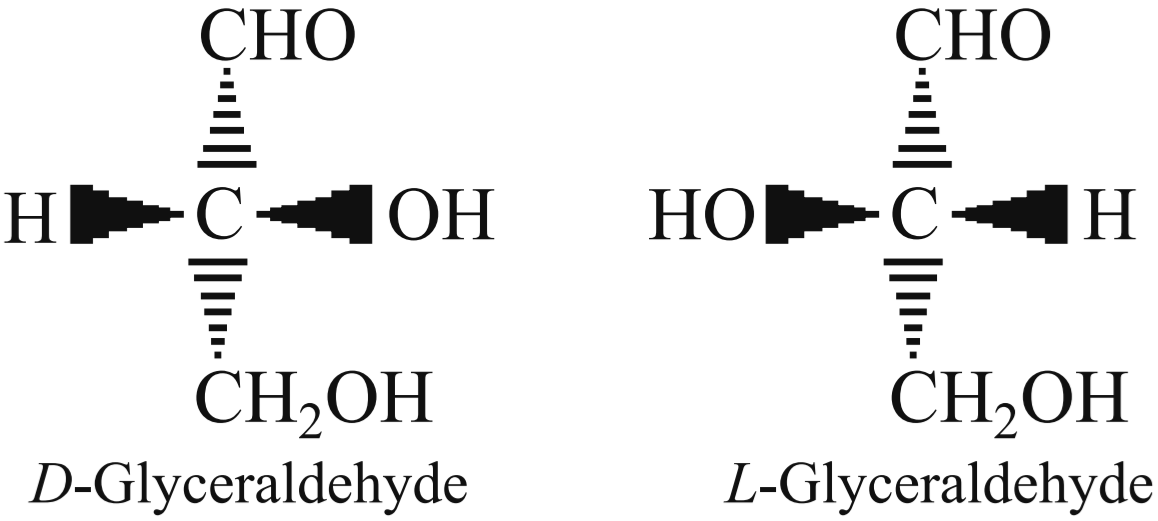
By convention, a monosaccharide is said to have $D-$configuration if the hydroxyl group attached to the asymmetric carbon atom adjacent to the $-\ce{CH_2OH}$ group is on the right hand side irrespective of the positions of the other hydroxyl groups. On the other hand, the molecule is assigned $L-$configuration if the $-OH$ group attached to the carbon adjacent to the $- \ce{CH_2OH}$ group is on the left hand side.
The following questions are multiple choice questions. Choose the most appropriate answer:

  1. $D-$Glyceraldehyde and $L-$Glyceraldehyde are:
  1. Epimers.
  2. Enantiomers.
  3. Anomers.
  4. Conformational diasteriomers.
  1. Which of the following monosaccharides, is the majority found in the human body?
  1. $D-$type.
  2. $L-$type.
  3. Both of these.
  4. None of these.
  1. The two functional groups present in a typical carbohydrate are:
  1. $-\ce{OH}$ and $-\ce{COOH}$
  2. $-\ce{CHO}$ and $-\ce{COOH}$
  3. $ > \ce{C= O}$ and $-\ce{OH}$
  4. $-\ce{OH}$ and $-\ce{CHO}$
  1. Monosaccharides contain:
  1. Always six carbon atoms.
  2. Always five carbon atoms.
  3. Always four carbon atoms.
  4. May contain $3$ to $7$ carbon atoms.
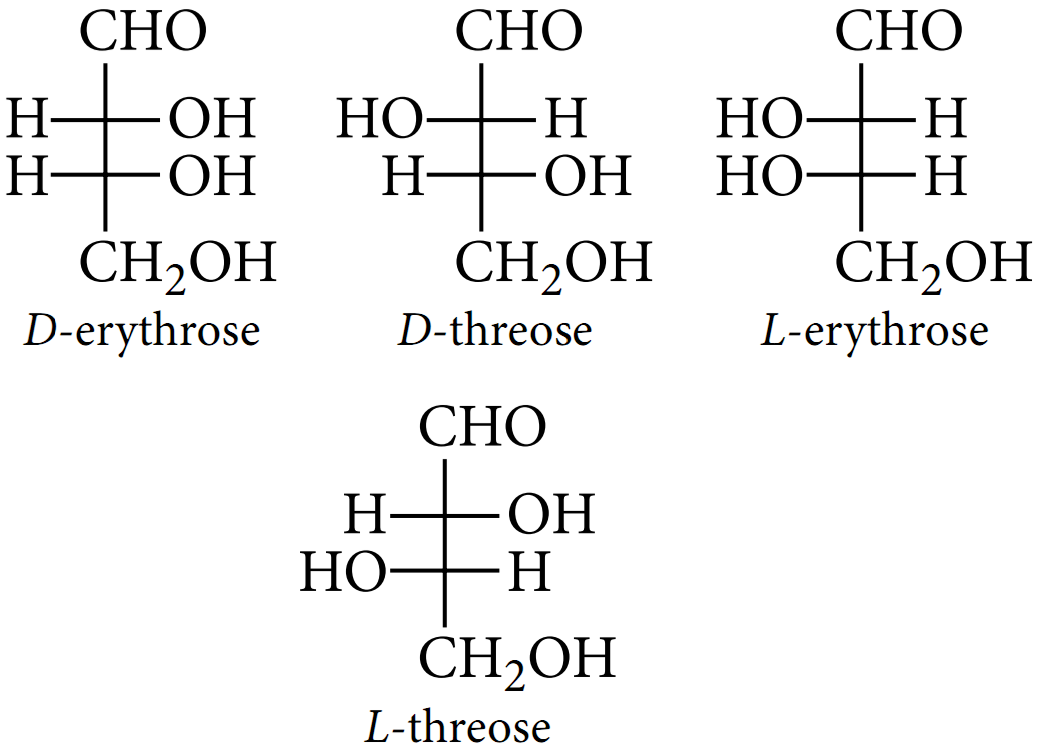
  1. The correct corresponding order of names of four aldoses with configuration given below respectively, is:
  1. $L-$erythrose, $L-$threose, $L-$erythrose, $D-$threose.
  2. $D-$threose, $D-$erythrose, $L-$threose, $L-$erythrose.
  3. $L-$erythrose, $L-$threose, $D-$erythrose, $D-$threose.
  4. $D-$erythrose, $D-$threose, $L-$erythrose, $L-$threose.
Answer

  1. $(b)$ Enantiomers.
  1. $(a) D-$type.
  1. $\ce{(c) > C= O}$ and $-\ce{OH}$
Carbohydrates are essentially polyhydroxy aldehydes and polyhydroxy ketones.
Thus, the two functional groups present are $ >C =O ($aldehyde or ketone$)$ and $-OH.$
  1. $(d)$ May contain $3$ to $7$ carbon atoms.
  1. $(d) D-$erythrose, $D-$threose, $L-$erythrose, $L-$threose.
Need a full question paper?

Generate a complete, print-ready paper with questions like this in minutes — across 16+ boards, with answer keys.

Start Generating Free

Similar questions

For a first order reaction$, A \rightarrow$ Products$, \text{k}=\frac{2.303}{\text{t}}\log\frac{\text{a}}{\text{a}-\text{x}},$ where a is the initial concentration of $A$ and $(a - x)$ is the concentration of $A$ after time $t. k$ is rate constant. Its value is constant at constant temperature for a reaction. The time in which half of the reactant is consumed is called half$-$life period. Half$-$life period of a first order reaction is constant. Its value is independent of initial concentration or any other external conditions.In these questions $(Q.$ No. $i-iv),$ a statement of assertion followed by a statement ofreason is given. Choose the correct answer out of the following choices.
  1. Assertion and reason both are correct statements and reason is correct explanation for assertion.
  2. Assertion and reason both are correct statements but reason is not correct explanation for assertion.
  3. Assertion is correct statement but reason is wrong statement.
  4. Assertion is wrong statement but reason is correct statement.
  1. Assertion : Rate of reaction doubles when concentration of reactant is doubled if it is a first order reaction.
Reason : Rate constant also doubles.
  1. Assertion : For the first order reaction, half$-$life period is expressed as $\text{t}_\frac{1}{2}=\frac{2.303}{\text{k}}\log2.$
Reason : The half$-$life time of a first order reaction is not always constant and it depends upon the initial concentration of reactants.
  1. Reason : The half$-$life time of a first order reaction is not always constant and it depends upon the initial concentration of reactants.
Reason : Acid only acts as a catalyst whereas alkali acts as one of the reactants.
  1. Assertion : For a first order reaction, the concentration of the reactant decreases exponentially with time.
Reason : Rate of reaction at any time depends upon the concentration of the reactant at that time.
  1. Assertion : Half$-$life period for a first order reaction is independent of initial concentration of the reactant.
Reason : For a first order reaction, $\text{t}_\frac{1}{2}=\frac{0.693}{\text{k}},$ where $k$ is rate constant.
Standard electrode potentials are used for various processes :
  • It is used to measure relative strengths of various oxidants and reductants.
  • It is used to calculate standard cell potential.
  • It is used to predict possible reactions.
A set of half$-$reactions $($in acidic medium$)$ along with their standard reduction potential$, E^\circ\ ($in volt$)$ values are given below :
$\ce{I_2 + 2e^- \rightarrow 2I^- ; E^\circ = 0.54 V}$
$\ce{Cl_2 + 2e^- \rightarrow 2Cl^- ; E^\circ = 1.36 V}$
$\ce{Mn^{3+} +e^- \rightarrow Mn^{2+}; E^\circ = 1.50 V}$
$\ce{Fe^{3+} + e^- \rightarrow Fe^{2+}; E^\circ = 0.77 V}$
$\ce{O2 + 4H^+ + 4e^- \rightarrow 2H2O ; E^\circ = 1.23 V}$
The following questions are multiple choice questions. Choose the most appropriate answer :
  1. Which of the following statements is correct?
  1. $Cl^-$ is oxidised by $\ce{O_2}$.
  2. $Fe^{2+}$ is oxidised by iodine.
  3. $I^-$ is oxidised by chlorine.
  4. $Mn^{2+}$ is oxidised by chlorine.
  1. $Mn^{3+}$ is not stable in acidic medium, while $Fe^{3+}$ is stable because :
  1. $\ce{O2}$ oxidises $Mn^{2+}$ to $Mn^{3+}$
  2. $\ce{O2}$ oxidises both $Mn^{2+}$ to $Mn^{3+}$ and $Fe^{2+}$ to $Fe^{3+}$
  3. $Fe^{3+}$ oxidises $\ce{H2O}$ to $\ce{O2}$
  4. $Mn^{3+}$ oxidises $\ce{H2O}$ to $\ce{O2}$
  1. The strongest reducing agent in the aqueous solution is :
  1. $I^-$
  2. $Cl^-$
  3. $Mn^{2+}$
  4. $Fe^{2+}$
  1. The emf for the following reaction is :
$\text{I}_2+\text{KCl}\rightleftharpoons2\text{KI}+\text{Cl}_2$
  1. $-0.82 V$
  2. $+0.82 V$
  3. $-0.73 V$
  4. $+0.73 V$
  1. Which of the following statements is correct for the following reaction?
$Fe^{3+} + Mn^{2+} \rightarrow Fe^{2+ }+ Mn^{3+}$
  1. The emf of the cell is positive.
  2. $Fe^{3+}$ oxidises $Mn^{2+}$.
  3. The reaction does not occur.
  4. All are correct.

Read the passage given below and answer the following questions:
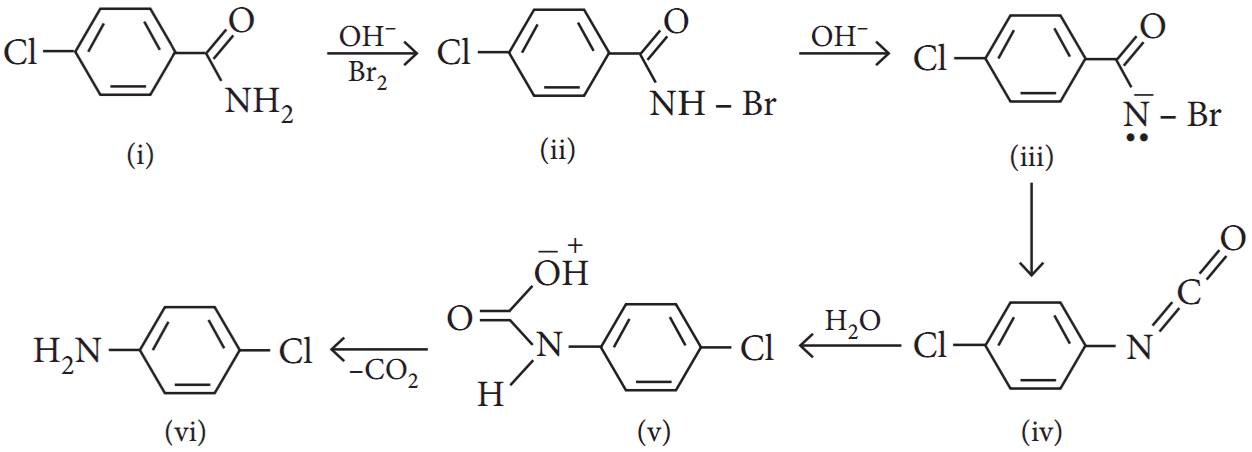
$\ce{RCONH_2}$ is converted into $\ce{RNH_2}$ by means of Hoffmann bromamide degradation. During the reaction amide is treated with $\ce{Br_2}$ and alkali to get amine. This reaction is used to descend the series in which carbon atom is removed as carbonate ion $(\text{CO}^{2-}_3)$ Hoffmann bromide degradation reaction can be written as:

The following questions are multiple choice questions. Choose the most appropriate answer:
  1. Hoffmann bromamide degradation is used for the preparation of
  1. Primary amines.
  2. Secondary amines.
  3. Tertiary amines.
  4. Secondary aromatic amines.
  1. Which is the rate determining step in Hoffmann bromamide degradation?
  1. Formation of $(i)$
  2. Formation of $(ii)$
  3. Formation of $(iii)$
  4. Formation of $(iv).$
  1. Which of the following are used for the conversion of $(i)$ to $(ii)?$
  1. $\ce{KBr}$
  2. $\ce{KBr + CH_3ONa}$
  3. $\ce{KBr + KOH}$
  4. $\ce{Br_2 + KOH}$
  1. Identify Bin the following reaction.
$\text{R}-\text{C}\equiv\text{N}\xrightarrow[\text{(Partially hydrolysis) }]{\text{Cone. HCI}}\text{A}\xrightarrow{\frac{\text{Br}_2}{\text{KOH}}}\text{B}$
  1. $\ce{RCONH_2}$
  2. $\ce{RNH_2}$
  3. $\ce{RNHBr}$
  4. $\ce{R = N = C = O}$
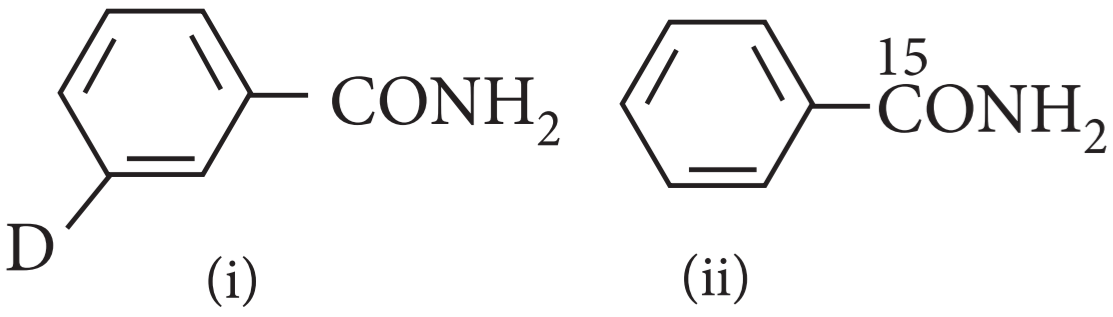
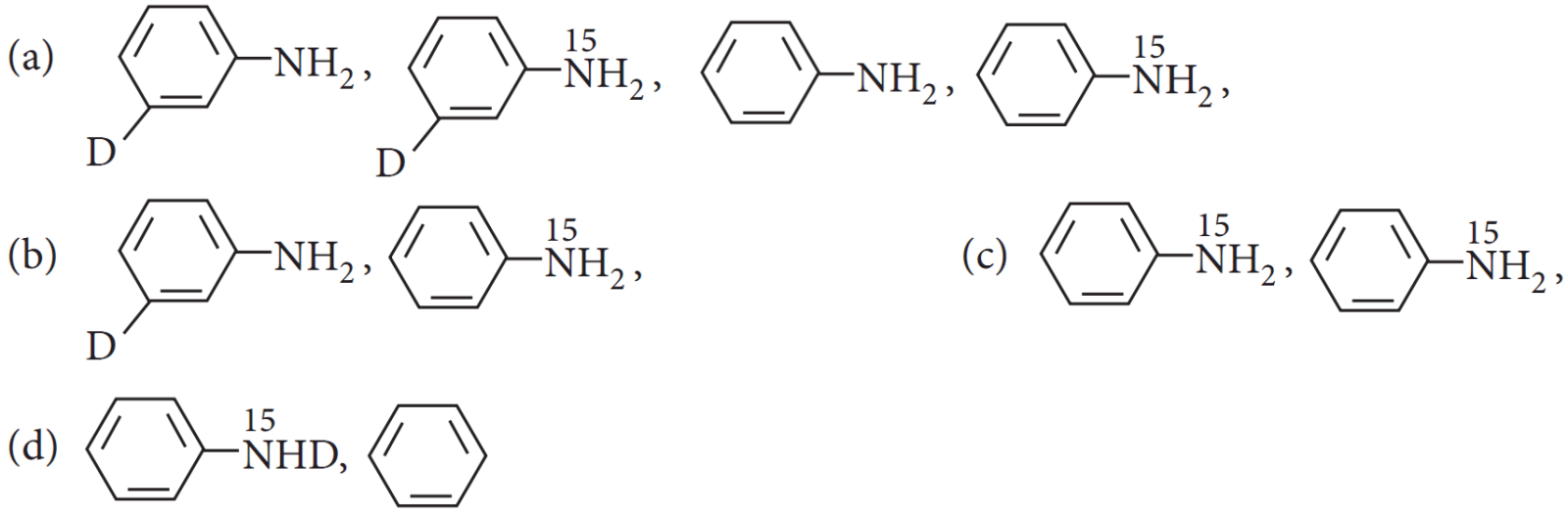
  1. What are the constituent amines formed when the mixture of $(i)$ and $(ii)$ undergoes Hoffmann bromamide degradation?
 
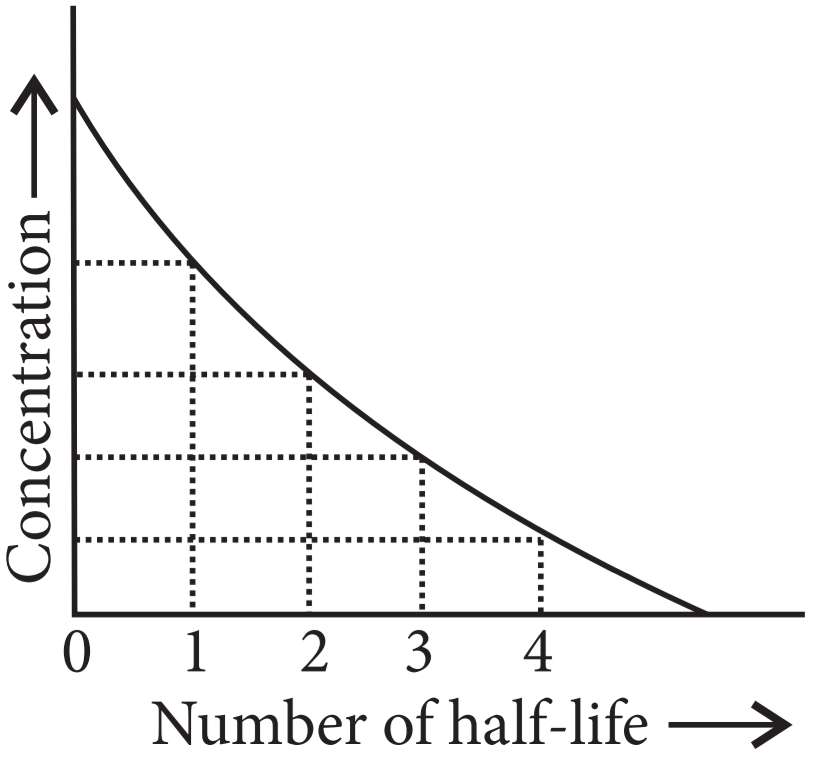
The half$-$life of a reaction is the time required for the concentration of reactant to decrease by half, i.e.,

$[\text{A}]_\text{t}=\frac{1}{2}[\text{A}]$
For first order reaction,
$\text{t}_\frac{1}{2}=\frac{0.693}{\text{k}}$
this means $\text{t}\frac{1}{2}$ is independent of initial concentration. Figure shows that typical variation of concentration of reactant exhibiting first order kinetics. It may be noted that though the major portion of the first order kinetics may be over in a finite time, but the reaction will never cease as the concentration of reactant will be zero only at infinite time.
The following questions are multiple choice questions. Choose the most appropriate answer:
  1. A first order reaction has a rate constant $k = 3.01 \times 10^{-3} /s$. How long it will take to decompose half of the reactant?
  1. $2.303s$
  2. $23.03s$
  3. $230.3s$
  4. $2303s$
  1. The rate constant for a first order reaction is $7.0 \times 10^{-4} s^{-1}$. If initial concentration ofreactant is $0.080 M,$ what is the half life of reaction?
  1. $990s$
  2. $79.2s$
  3. $12375s$
  4. $10.10 \times 10^{-4}s$
  1. For the half$-$life period of a first order reaction, which one of the following statements is generally false?
  1. It is independent of initial concentration.
  2. It is independent of temperature.
  3. It decreases with the introduction of a catalyst.
  4. None of these.
  1. The rate of a first order reaction is $0.04\ mol\  L^{-1} s^{-1}$ at $10$ minutes and $0.03\ mol\ L^{-1}\ s^{-1}$ at $20$ minutes after initiation. The half$-$life of the reaction is :
  1. $4.408$ min
  2. $44.086$ min
  3. $24.086$ min
  4. $2.408$ min
  1. The plot of $\text{t}_\frac{1}{2}$ vs initial concentration $[A]_0$ for a first order reaction is given by :
The following reaction, $\text{A}_{(\text{g})}\xrightarrow{\ \ \triangle\ \ \ }\text{P}_{(\text{g})}+\text{Q}_{(\text{g})}+\text{R}_{(\text{g})},$ follows first order kinetics. The half$-$life period of this reaction is $69.3s$ at $500^\circ C$. The gas $A$ is enclosed in a container at $500^\circ C$ and at a pressure of $0.4$ atm.
The following questions are multiple choice questions. Choose the most appropriate answer :
  1. The rate constant for the reaction is :
  1. $0.4s^{-1}$
  2. $0.02s^{-1}$
  3. $0.01s^{-1}$
  4. $0.3s^{-1}$
  1. The pressure of the gas $A$ after $230$ s will be :
  1. $0.04$ atm
  2. $0.36$ atm
  3. $0.4$ atm
  4. $0.036$ atm
  1. The total pressure of the system after $230$ swill be:
  1. $2.15$ atm
  2. $1.12$ atm
  3. $0.4$ atm
  4. $3.08$ atm
  1. The plot ofln$[A]$ vs twill be:
  1. Linear with slope $= k$
  2. Linear with intercept $= In[A]_0$
  3. Linear with slope $= In[A]_0$
  4. Linear with intercept $= [A]_0$
  1. Which of the following is not an example of first order reaction?
  1. $\text{C}_2\text{H}_{4(\text{g})}+\text{H}_{2(\text{g})}\rightarrow\text{C}_2\text{H}_{6(\text{g})}$
  2. $2\text{N}_2\text{O}_{5(\text{g})}\rightarrow4\text{NO}_{2(\text{g})}+\text{O}_{2(\text{g})}$
  3. $2\text{N}\text{H}_{3(\text{g})}\xrightarrow[\triangle]{\text{pt}}\text{N}_{2(\text{g})}+3\text{H}_{2(\text{g})}$
  4. $2\text{N}_2\text{O}_{(\text{g})}\xrightarrow{\ \ \triangle\ \ }2\text{N}_{2(\text{g})}+\text{O}_{2(\text{g})}$
Read the passage given below and answer the following questions:
Metal carbonyl is an example of coordination compounds in which carbon monoxide $(CO)$ acts as ligand. These are also called homoleptic carbonyls. These compounds contain both $\sigma$ and $\pi$ character. Some carbonyls have metal$-$metal bonds. The reactivity of metal carbonyls is due to $(i)$ the metal centre and $(ii)$ the $CO$ ligands. $CO$ is capable of accepting an appreciable amount of electron density from the metal atom into their empty $\pi$ or $\pi-\text{orbital}.$ These types of ligands are called $\pi-\text{accepter}$ or $\pi-\text{acid}$ ligands. These interactions increases the $\Delta_0$ value.
The following questions are multiple choice questions. Choose the most appropriate answer:
  1. What is the oxidation state of metal in $\ce{[Mn_2(CO)_{10}]}?$
  1. $+1$
  2. $-1$
  3. $+2$
  4. $0$
  1. Among the following metal carbonyls, the $C-O$ bond order is lowest in:
  1. $\ce{[Mn(CO)_6]^+}$
  2. $\ce{[Fe(CO)_5]}$
  3. $\ce{[Cr(CO)_6]}$
  4. $\ce{[V(CO)_6]^-}$
  1. Which of the following can be reduced easily?
  1. $\ce{V(CO)_6}$
  2. $\ce{Mo(CO)_6}$
  3. $\ce{[Co(CO)_4]^-}$
  4. $\ce{Fe(CO)_5}$
  1. The oxidation state of cobalt in $\ce{K[Co(CO)_4]}$ is:
  1. $+1$
  2. $+3$
  3. $-1$
  4. $0$
  1. Structure of decacarbonyl manganese is:
  1. Trigonal bipyramidial
  2. Octahedral
  3. Tetrahedral
  4. Square pyramidal
What is the most suitable pKa value of the substituted propylamine formed with substituent "X" with electronegativity 3.0
(i)10.67 (ii)10.08 (iii) 10.15 (iv)11.10
Read the passage given below and answer the following questions:
A mixture of two aromatic compounds $(A)$ and $(B)$ was separated by dissolving in chloroform followed by extraction with aqueous $\ce{KOH}$ solution. The organic layer containing compound $(A),$ when heated with alcoholic solution of $\ce{KOH}$ produce $\ce{C_7H_5N (C)}$ associated with unpleasant odour.
The following questions are multiple choice questions. Choose the most appropriate answer:
  1. What is $A?$
  1. $\ce{C_6H_5NH_2}$
  2. $\ce{C_6H_5CH_3}$
  3. $\ce{C_6H_5CH_3}$
  4. None of these.
  1. The reaction of $(A)$ with alcoholic solution of $\ce{KOH}$ to produce $(C)$ of unpleasant odour is called:
  1. Sandmeyer reaction.
  2. Carbylamine reaction.
  3. Ullmann reaction.
  4. Reimer$-$Tiemann reaction..
  1. The alkaline aqueous layer $(B)$ when heated with chloroform and then acidified give a mixture of isomeric compounds of molecular formula $\ce{C_7H_6O_2. (B)}$ is:
  1. $\ce{C_6H_5CHO}$
  2. $\ce{C_6H_5COOH}$
  3. $\ce{C_6H_5CH_3}$
  4. $\ce{C_6H_5OH}$
  1. In the chemical reaction,
  2. $\ce{CH_3CH_2NH_2 + CHCl_3 + 3KOH \rightarrow (A)+ (B) + 3H_2O,}$
  1. $\ce{C_2H_5NC}$ and $\ce{KCl}$
  2. $\ce{C_2H_5CN}$ and $\ce{KCl}$
  3. $\ce{CH_3CH_2CONH_2}$ and $\ce{KCl}$
  4. $\ce{C_2H_5NC}$ and $\ce{K_2CO_3}$
  1. Direct nitration of an aromatic compound $(A)$ is not feasible because:
  1. The reaction cannot be stopped at the mononitration stage.
  2. A mixture of $o, m$ and $p-$nitroaniline is always obtained.
  3. Nitric acid oxidises most of the aromatic compound to give oxidation products along with only a small amount of nitrated products.
  4. All of the above.
Explain the D and L notation method of spatial arrangement with respect to glucose.
Read the passage given below and answer the following questions: Amines are produced when an alcoholic solution of ammonia and an alkyl or a benzyl halide is heated in a sealed tube at 373K. This reaction is called ammonolysis and usually gives a mixture of primary, secondary and tertiary amines along with some quarternary ammonium salts. This reaction is an example of nucleophilic substitution reaction in which ammonia acts as a nucleophile due to the presence of a lone pair of electrons on the nitrogen atom. However this method cannot be used for the preparation of aryl amines. One of the most convenient methods for the preparation of aryl amines is reduction of nitro compounds. Aryl amines can also be prepared by reduction of nitrites or Gabriel phthalimide synthesis. A statement of assertion followed by a statement of reason is given. Choose the correct answer out of the following choices.
  1. Assertion and reason both are correct statements and reason is correct explanation for assertion.
  2. Assertion and reason both are correct statements but reason is not correct explanation for assertion.
  3. Assertion is correct statement but reason is wrong statement.
  4. Assertion is wrong statement but reason is correct statement.
  1. Assertion: Ammonolysis of alkyl halides only produces 2° amines.
Reason: Ammonolysis of alkyl halides involves the reaction between alkyl halides and alcoholic ammonia.
  1. Assertion: Gabriel-phthalimide reaction can be used to prepare both aryl and alkyl primary amines.
Reason: Aryl halides are more reactive alkyl halides towards nucleophilic substitution reactions.
  1. Assertion: Anunonolysis method cannot be used for the preparation of aryl amines.
Reason: Aryl halides are much less reactive than alkyl halides towards nucleophilic substitution reaction.
  1. Assertion: Ammonolysis can be used to prepare pure primary amines.
Reason: Ammonolysis of haloalkanes lead to multiple ammonium salts.
  1. Assertion: Aromatic 1º amines can not be prepared by Gabriel phthalimide synthesis.
Reason: Aryl halides do not undergo nucleophilic substitution with anion formed by phthalimide.