Question
Read the passage given below and answer the following questions: Amines are produced when an alcoholic solution of ammonia and an alkyl or a benzyl halide is heated in a sealed tube at 373K. This reaction is called ammonolysis and usually gives a mixture of primary, secondary and tertiary amines along with some quarternary ammonium salts. This reaction is an example of nucleophilic substitution reaction in which ammonia acts as a nucleophile due to the presence of a lone pair of electrons on the nitrogen atom. However this method cannot be used for the preparation of aryl amines. One of the most convenient methods for the preparation of aryl amines is reduction of nitro compounds. Aryl amines can also be prepared by reduction of nitrites or Gabriel phthalimide synthesis. A statement of assertion followed by a statement of reason is given. Choose the correct answer out of the following choices.
  1. Assertion and reason both are correct statements and reason is correct explanation for assertion.
  2. Assertion and reason both are correct statements but reason is not correct explanation for assertion.
  3. Assertion is correct statement but reason is wrong statement.
  4. Assertion is wrong statement but reason is correct statement.
  1. Assertion: Ammonolysis of alkyl halides only produces 2° amines.
Reason: Ammonolysis of alkyl halides involves the reaction between alkyl halides and alcoholic ammonia.
  1. Assertion: Gabriel-phthalimide reaction can be used to prepare both aryl and alkyl primary amines.
Reason: Aryl halides are more reactive alkyl halides towards nucleophilic substitution reactions.
  1. Assertion: Anunonolysis method cannot be used for the preparation of aryl amines.
Reason: Aryl halides are much less reactive than alkyl halides towards nucleophilic substitution reaction.
  1. Assertion: Ammonolysis can be used to prepare pure primary amines.
Reason: Ammonolysis of haloalkanes lead to multiple ammonium salts.
  1. Assertion: Aromatic 1º amines can not be prepared by Gabriel phthalimide synthesis.
Reason: Aryl halides do not undergo nucleophilic substitution with anion formed by phthalimide.

Answer

  1. (d) Assertion is wrong statement but reason is correct statement.
Explanation:
Reaction can be used to prepare 1º, 2º, 3º amines and finally quaternary ammonium salts.
  1. (c) Assertion is correct statement but reason is wrong statement.
Explanation:
Aryl halides are less reactive than aralkyl halides towards nucleophilic substitution reactions.
  1. (a) Assertion and reason both are correct statements and reason is correct explanation for assertion.
  1. (d) Assertion is wrong statement but reason is correct statement.
Explanation:
Ammonolysis cannot be used to prepare pure primary amines. This method usually gives a mixture of primary, secondary and tertiary amines along with some quaternary ammonium salts.
  1. (a) Assertion and reason both are correct statements and reason is correct explanation for assertion.

Need a full question paper?

Generate a complete, print-ready paper with questions like this in minutes — across 16+ boards, with answer keys.

Start Generating Free

Similar questions

Read the passage given below and answer the following questions:
When haloalkanes with $\beta-$hydrogen atom are boiled with alcoholic solution of $\text{KOH}$, they undergo elimination of hydrogen halide resulting in the formation of alkenes. These reactions are called $\beta-$elimination reactions or dehydrohalogenation reactions. These reactions follow Saytzeff's rule. Substitution and elimination reactions often compete with each other. Mostly bases behave as nucleophiles and therefore can engage in substitution or elimination reactions depending upon the alkyl halide and the reaction conditions.
The following questions are multiple choice questions. Choose the most appropriate answer:
  1. Among the following the most reactive towards alcoholic $\text{KOH}$ is:
  1. $\ce{CH_2 = CHBr}$
  2. $\ce{CH_3COCH_2CH_2Br}$
  3. $\ce{CH_3CH2Br}$
  4. $\ce{CH_3CH_2CH_2Br}$
  1. The general reaction, $\text{R}-\text{X}\xrightarrow{\text{aq.OH}^-}\text{ROH}+\text{X}^-,$ is expected to follow decreasing order of reactivity as in:
  1. $\ce{t-BuI > t-BuBr > t-BuCI > t-BuF}$
  2. $\ce{t-BuF > t-BuCI > t-BuBr > t-BuI}$
  3. $\ce{t-BuBr > t-BuCI > t-BuI > t-BuF}$
  4. $\ce{t-BuF > t-BuCI > t-BuI > t-BuBr}$
  1. Reaction of $t-$butyl bromide with sodium methoxide produces:
  1. Sodium $t-$butoxide.
  2. $t-$butyl methyl ether.
  3. Iso$-$butane.
  4. Iso$-$butylene.
  1. In the elimination reactions, the reactivity of alkyl halides follows the sequence:
  1. $\ce{R - F > R - CI > R - Br > R - I}$
  2. $\ce{R - I > R - Br > R - Cl > R - F}$
  3. $\ce{R - I > R - F > R - Br > R - CI}$
  4. $\ce{R - F > R - I > R - Br > R - CI}$
  1. The ease of dehydrohalogenation of alkyl halide with alcoholic $\text{KOH}$ is:
  1. $3^\circ < 2^\circ < 1^\circ$
  2. $3^\circ > 2^\circ > 1^\circ$
  3. $3^\circ < 2^\circ > 1^\circ$
  4. $3^\circ > 2^\circ < 1^\circ$
Read the passage given below and answer the following questions:
The solubility of gases increases with increase of pressure. William Henry made a systematic investigation of the solubility of a gas in a liquid. According to Henry's law "the mass of a gas dissolved per unit volume of the solvent at constant temperature is directly proportional to the pressure of the gas in equilibrium with the solution". Dalton during the same period also concluded independently that the solubility of a gas in a ti quid solution depends upon the partial pressure of the gas. If we use the mole fraction of gas in the solution as a measure of its solubility, then Henry's law can be modified as "the partial pressure of the gas in the vapour phase is directly proportional to the mole fraction of the gas in the solution"
The following questions are multiple choice questions. Choose the most appropriate answer:
  1. Henry's law constant for the solubility of methane in benzene at $298K$ is $4.27 \times 10^5\ mm\ Hg$. The solubility of methane in benzene at $298K$ under $760\ mm\ Hg$ is :
  1. $4.27 \times 10^{-5}$
  2. $1.78 \times 10^{-3}$
  3. $4.27 \times 10^{-3}$
  4. $1.78 \times 10^{-5}$
  1. The partial pressure of ethane over a saturated solution containing $6.56 \times 10^{-2}g$ of ethane is $I$ bar. If the solution contains $5.00 \times 10^{-2}g$ of ethane then what will be the partial pressure $($in bar$)$ of the gas?
  1. $0.762$
  2. $1.312$
  3. $3.81$
  4. $5.0$
  1. $K_H\ (K$ bar$)$ values for $\ce{Ar(g), CO2(g), HCHO(g)}$ and $\ce{CH4(g)}$ are $40.39, 1.67, 1.83 \times 10^{-5}$ and $0.413$ respectively. Arrange these gases in the order of their increasing solubility. Arrange these gases in the order of their increasing solubility.
  1. $\ce{HCHO < CH4 < CO2 < Ar}$
  2. $\ce{HCHO < CO2 < CH4 < Ar}$
  3. $\ce{Ar < CO2 < CH4 < HCHO}$
  4. $\ce{Ar < CH4 < CO2 < HCHO}$
  1. When a gas is bubbled through water at $298K,$ a very dilute solution of the gas is obtained. Henry's law constant for the gas at $298K$ is $150k$ bar. If the gas exerts a partial pressure of $2$ bar, the number of millimoles of the gas dissolved in $IL$ of water is :
  1. $0.55$
  2. $0.87$
  3. $0.37$
  4. $0.66$
  1. Which of the following statements is correct?
  1. $K_H$ increases with increase of temperature.
  2. $K_H$ decreases with increase of temperature.
  3. $K_H$ remains constant with increase of temperature.
  4. $K_H$ first increases then decreases, with increase of temperature.
Read the passage given below and answer the following questions:
The amines are basic in nature due to the presence of a lone pair of electron on $N-$atom of the $-NH_2$ group, which it can donate to electron deficient compounds. Aliphatic amines are stronger bases than $NH_3$ because of the $+I$ effect of the alkyl groups. Greater the number of alkyl groups attached to $N-$atom, higher is the electron density on it and more will be the basicity. Thus, the order of basic nature of amines is expected to be $3^\circ > 2^\circ > 1^\circ ,$ however the observed order is $2^\circ > 1^\circ > 3^\circ .$ This is explained on the basis of crowding on $N-$atom of the amine by alkyl groups which hinders the approach and bonding by a proton, consequently, the electron pair which is present on $N$ is unavailable for donation and hence $3^\circ$ amines are the weakest bases.
Aromatic amines are weaker bases than ammonia and aliphatic amines. Electron-donating groups such as $-\ce{CH_3, -OCH_3,}$ etc. increase the basicity while electron-withdrawing substitutes such as $\ce{-NO_2, -CN,}$ halogens, etc. decrease the basicity of amines. The effect of these substituents is more at $p$ than at $m-$positions.
The following questions are multiple choice questions. Choose the most appropriate answer:
  1. Which one of the following is the strongest base in aqueous solution?
  1. Methyl amine.
  2. Tri methyl amine.
  3. Aniline.
  4. Dimethyl amine.
  1. Which order ofbasicity is correct?
  1. Aniline $>$ $m-$toluidine $> o-$toluidine
  2. Aniline $> o-$toluidine $> m-$toluidine
  3. $o-$toluidine $>$ aniline $> m-$toluidine
  4. $o-$toluidine $<$ aniline $< m-$toluidine
  1. What is the decreasing order of basicity of primary, secondary and tertiary ethylamines and $NH_3$?
  1. $\ce{NH_3 > C_2H_5NH_2 > (C_2H_5)_2NH > (C_2H_5)_3N}$
  2. $\ce{(C_2H_5)_3N > (C_2H_5)_2NH_{ }> C_2H_5NH_2 > NH_3}$
  3. $\ce{(C_2H_5)_2NH > C_2H_5NH_2> (C_2H_5)_3N > NH_3}$
  4. $\ce{(C_2H_5)_2NH > (C_2H_5)_3N > C_2H_5NH_2 > NH_3​​​​​​​}$
  1. The order of basic strength among the following amines in benzene solution is:
  1. $\ce{CH_3NH_2 > (CH_3)_3N > (CH_3)_2NH}$
  2. $\ce{(CH_3)_3N > (CH_3)_2NH > CH_3NH_2​​​​​​​}$
  3. $\ce {CH_3NH_2 > (CH_3)_2NH > (CH_3)_3N}$
  4. $\ce{(CH_3)_3N > CH_3NH_2 > (CH_3)_2NH}$
  1. Choose the correct statement.
  1. Methylamine is slightly acidic.
  2. Methylamine is less basic than ammonia.
  3. Methylamine is a stronger base than ammonia.
  4. Methylamine forms salts with alkalies.
Read the passage given below and answer the following questions:
Nucleophilic substitution reactions are of two types; substitution nucleophilic bimolecular $(S_N2)$ and substitution nucleophilic unimolecular $(S_N1)$ depending on molecules taking part in determining the rate of reaction. Reactivity of alkyl halide towards $S_N1$ and $S_N2$ reactions depends on various factors such as steric hindrance, stability of intermediate or transition state, and polarity of solvent. $S_N2$ reaction mechanism is favoured mostly by primary alkyl halide then secondary and then tertiary. This order is reversed in case of $S_N1$ reactions.
The following questions are multiple choice questions. Choose the most appropriate answer:
  1. Which of the following is most reactive towards nucleophilic substitution reaction?
  1. $\ce{C_6H_5Cl}$
  2. $\ce{CH_2 = CHCl}$
  3. $\ce{ClCH_2CH = CH_2}$
  4. $\ce{CH_3CH = CHCl}$
  1. Isopropyl chloride undergoes hydrolysis by:
  1. $S_N1$ mechanism.
  2. $S_N2$ mechanism.
  3. $S_N1$ and $S_N2$ mechanism.
  4. Neither $S_N1$ nor $S_N2$ mechanism.
  1. The most reactive nucleophile among the following is:
  1. $\ce{CH_3O^-}$
  2. $\ce{C_6H_5O^-}$
  3. $\ce{(CH_3)_2CHO^-}$
  4. $\ce{(CH_3)_3CO^-}$
  1. Tertiary alkyl halides are practically inert to substitution by $S_N2$ mechanism because of:
  1. Insolubility.
  2. Instability.
  3. Inductive effect.
  4. Stearic hindrance.
  1. Which of the following is the correct order of decreasing $S_N2$ reactivity?
  1. $\ce{RCH_2X > R_2CHX > R_3CX}$
  2. $\ce{R_3CX > R_2CHX > RCH_2X}$
  3. $\ce{R_2CHX > R_3CX > RCH_2X}$
  4. $\ce{RCH_2X > R_3CX > R_2CHX}$
Read the passage given below and answer the following questions:
Haloarenes are less reactive than haloalkanes. The low reactivity of haloarenes can be attributed to:
  • Resonance effect.
  • $sp^2$ hybridisation of $C - X$ bond.
  • Polarity of $C - X$ bond
  • Instability of phenyl cation $($formed by self$-$ionisation of haloarene$).$
  • Repulsion between the electron rich attacking nucleophiles and electron rich arenes.
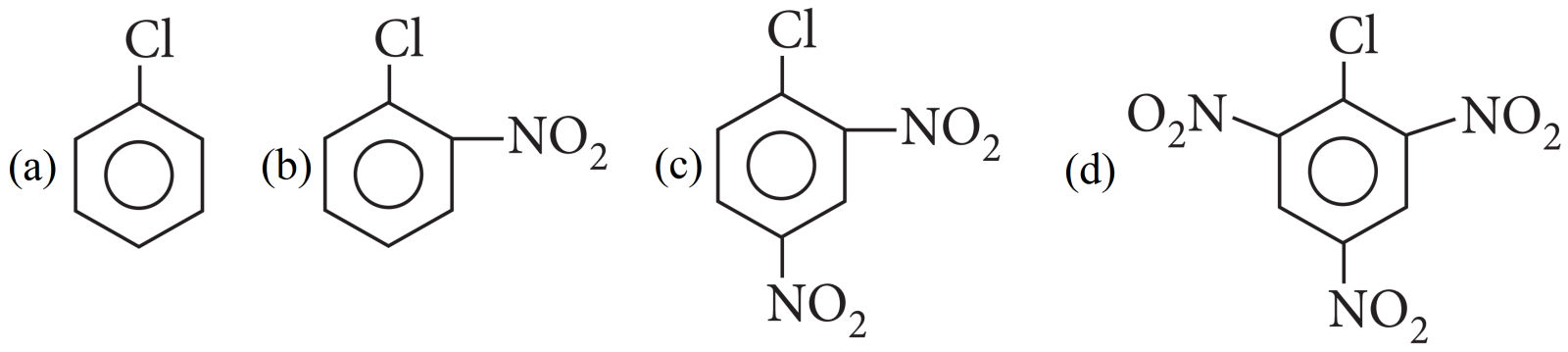
Reactivity of haloarenes can be increased or decreased by the presence of certain groups at certain positions for example, nitro $(-NO_{^2})$ group at o/ p positions increases the reactivity of haloarenes towards nucleophilc substitution reactions.
The following questions are multiple choice questions Choose the most appropriate answer:
  1. Aryl halides are less reactive towards nucleophilic substitution reaction as compared to alkyl halides due to
  1. The formation of less stable carbonium ion.
  2. Resonance stabilisation.
  3. Larger carbon$-$halogen bond.
  4. Inductive effect.
  1. Which of the following aryl halides is the most reactive towards nucleophilic substitution?
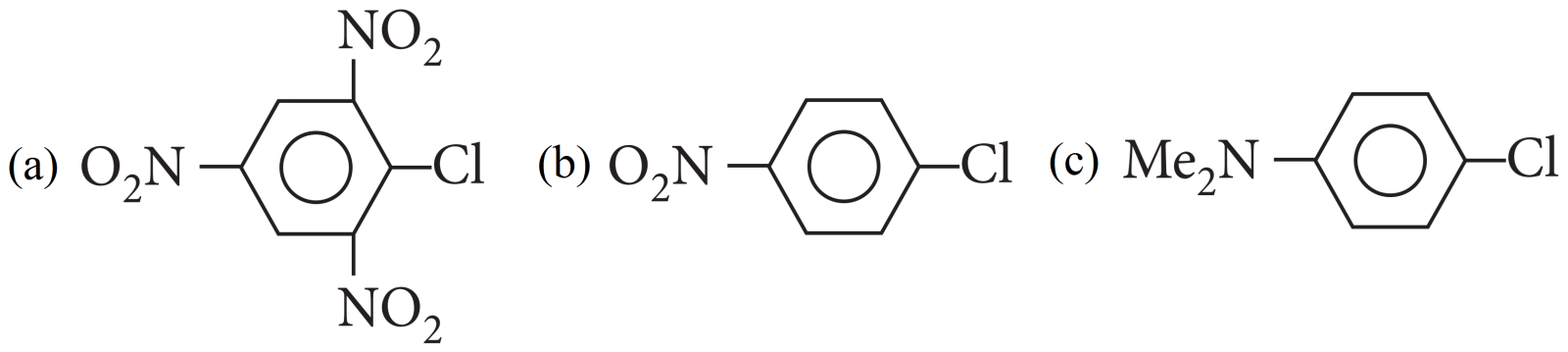
  1. Which one of the following will react fastest with aqueous $\text{NaOH}$?
  1. Which chloro derivative of benzene among the followings would undergo hydrolysis most readily with aqueous sodium hydroxide to furnish the corresponding hydroxy derivative?
  1. $\ce{C_6H_5Cl}$
  1. The reactivity of the compounds $\ce{(i)\ MeBr, (ii)\ PhCH_2Br, (iii)\ MeCI, (iv)\ p-MeOC_6H_4Br}$ decreases as:
  1. $\ce{(i) > (ii) > (iii) > (iv)}$
  2. $\ce{(iv) > (ii) > (i) > (iii)}$
  3. $\ce{(iv) > (iii) > (i) > (ii)}$
  4. $\ce{(ii) > (i) > (iii) > (iv)}$
Read the passage given below and answer the following questions:
The concentration of a solute is very important in studying chemical reactions because it determines how often molecules collide in solution and thus indirectly determine the rate of reactions and the conditions at equilibrium. There are several ways to express the amount of solute present in a solution. The concentration of a solution is a measure of the amount of solute that has been dissolved in a given amount of solvent or solution. Concentration can be expressed in terms of molarity, molality, parts per million, mass percentage, volume percentage, etc.
The following questions are multiple choice questions. Choose the most appropriate answer:
  1. A solution is prepared using aqueous $Kl$ which is turned out to be $20\%$ w/w Density of $Kl$ is $1.202 g/mL$ the molality of the given solution and mole fraction of solute are respectively.
  1. $1.95m, 0.120$
  2. $1.5m, 0.0263$
  3. $2.5m, 0.0569$
  4. $3.0m, 0.0352$
  1. The molarity $($in mol $L^{-1})$ of the given solution will be.
  1. $1.56$
  2. $1.89$
  3. $0.263$
  4. $1.44$
  1. Which of the following is correct relationship between mole fraction and molality?
  1. $\text{x}_2=\frac{\text{mM}_1}{1+\text{mM}_1}$
  2. $\text{x}_2=\frac{\text{mM}_1}{1-\text{mM}_1}$
  3. $\text{x}_2=\frac{1+\text{mM}_1}{\text{mM}_1}$
  4. $\text{x}_2=\frac{1-\text{mM}_1}{\text{mM}_1}$
  1. Which of the following is temperature dependent?
  1. Molarity
  2. Molality
  3. Mole fraction
  4. Mass percentage
  1. Which of the following is true for an aqueous solution of the solute in terms of concentration?
  1. $1M = 1m$
  2. $1M > 1m$
  3. $1M < 1m$
  4. Cannot be predicted
What is the most suitable pKa value of the substituted propylamine formed with substituent "X" with electronegativity 3.0
(i)10.67 (ii)10.08 (iii) 10.15 (iv)11.10
The potential of each electrode is known as electrode potential. Standard electrode potential is the potential when concentration of each species taking part in electrode reaction is unity and the reaction is taking place at $298K$. By convention, the standard electrode potential of hydrogen $\text{(SHE)}$ is $0.0V$. The electrode potential value for each electrode process is a measure of relative tendency of the active species in the process to remain in the oxidised/ reduced form. The negative electrode potential means that the redox couple is stronger reducing agent than $\frac{\text{H}^+}{\text{H}_2}$ couple. A positive electrode potential means that the redox couple is a weaker reducing agent than the $\frac{\text{H}^+}{\text{H}_2}$ couple. Metals which have higher positive value of standard reduction potential form the oxides of greater thermal stability. In these questions $(Q$. No. $i-iv),$ a statement of assertion followed by a statement ofreason is given. Choose the correct answer out of the following choices.
  1. Assertion and reason both are correct statements and reason is correct explanation for assertion.
  2. Assertion and reason both are correct statements but reason is not correct explanation for assertion.
  3. Assertion is correct statement but reason is wrong statement.
  4. Assertion is wrong statement but reason is correct statement.
  1. Assertion : An electrochemical cell can be set $-$ up only if the redox reaction is spontaneous.
Reason : A reaction is spontaneous if the free energy change is negative.
  1. Assertion : The standard electrode potential of hydrogen is $0.0V.$
Reason : It is by convention.
  1. Assertion : The more negative is the standard reduction potential, greater is its ability to displace $H_2 $ from acid.
Reason : Strength of reducing agent increases with the increase in negative value of the standard reduction potential.
  1. Assertion : The negative value of standard reduction potential means that reduction takes place on this electrode with reference to hydrogen electrode.
Reason : The standard electrode potential of a half cell has a fixed value.
  1. Assertion : The absolute value of electrode potential cannot be determined experimentally.
Reason : The electrode potential values are generally determined with respect to $\text{SHE}$.
For a first order reaction$, A \rightarrow$ Products$, \text{k}=\frac{2.303}{\text{t}}\log\frac{\text{a}}{\text{a}-\text{x}},$ where a is the initial concentration of $A$ and $(a - x)$ is the concentration of $A$ after time $t. k$ is rate constant. Its value is constant at constant temperature for a reaction. The time in which half of the reactant is consumed is called half$-$life period. Half$-$life period of a first order reaction is constant. Its value is independent of initial concentration or any other external conditions.In these questions $(Q.$ No. $i-iv),$ a statement of assertion followed by a statement ofreason is given. Choose the correct answer out of the following choices.
  1. Assertion and reason both are correct statements and reason is correct explanation for assertion.
  2. Assertion and reason both are correct statements but reason is not correct explanation for assertion.
  3. Assertion is correct statement but reason is wrong statement.
  4. Assertion is wrong statement but reason is correct statement.
  1. Assertion : Rate of reaction doubles when concentration of reactant is doubled if it is a first order reaction.
Reason : Rate constant also doubles.
  1. Assertion : For the first order reaction, half$-$life period is expressed as $\text{t}_\frac{1}{2}=\frac{2.303}{\text{k}}\log2.$
Reason : The half$-$life time of a first order reaction is not always constant and it depends upon the initial concentration of reactants.
  1. Reason : The half$-$life time of a first order reaction is not always constant and it depends upon the initial concentration of reactants.
Reason : Acid only acts as a catalyst whereas alkali acts as one of the reactants.
  1. Assertion : For a first order reaction, the concentration of the reactant decreases exponentially with time.
Reason : Rate of reaction at any time depends upon the concentration of the reactant at that time.
  1. Assertion : Half$-$life period for a first order reaction is independent of initial concentration of the reactant.
Reason : For a first order reaction, $\text{t}_\frac{1}{2}=\frac{0.693}{\text{k}},$ where $k$ is rate constant.
Read the passage given below and answer the following questions:
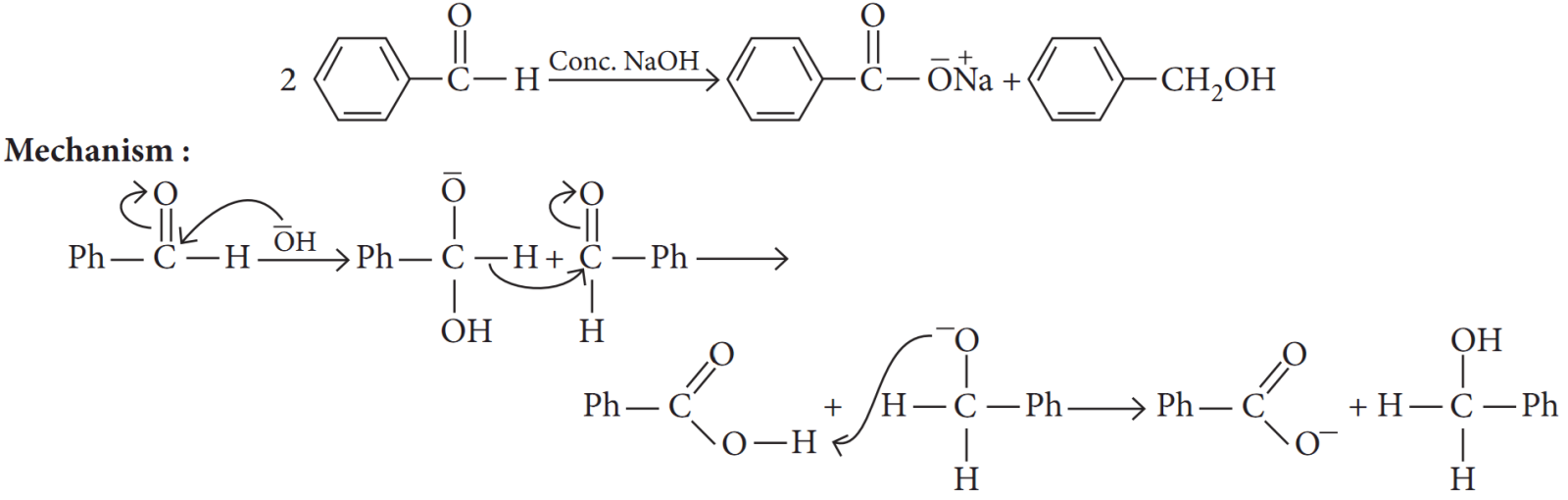
When an aldehyde with no et $-$ hydrogen reacts with concentrated aqueous $\ce{NaOH},$ half the aldehyde is converted to carboxylic acid salt and other half is converted to an alcohol. In other words, half of the reactant is oxidized and other half is reduced. This reaction is known as Cannizzaro reaction.

The following questions are multiple choice questions. Choose the most appropriate answer:
  1. A mixture of benzaldehyde and formaldehyde on heating with aqueous $\ce{NaOH}$ solution gives:
  1. Benzyl alcohol and sodium formate.
  2. Sodium benzoate and methyl alcohol.
  3. Sodium benzoate and sodium formate.
  4. Benzyl alcohol and methyl alcohol.
  1. Which of the following compounds will undergo Cannizzaro reaction?
  1. $\ce{CH_3CHO}$
  2. $\ce{CH_3COCH_3}$
  3. $\ce{C_6H_5CHO}$
  4. $\ce{C_6H_5CH_2CHO}$
  1. Trichloroacetaldehyde is subjected to Cannizzaro's reaction by using $\ce{NaOH}$. The mixture of the products contains sodium trichloroacetate ion and another compound. The other compounds is:
  1. $2, 2, 2-$ trichloroethanol.
  2. Trichloromethanol.
  3. $2, 2, 2-$ trichloropropanol.
  4. Chloroform.
  1. In Cannizzaro reaction given below:
$2\text{PhCHO}\xrightarrow{\stackrel{-}{\hbox{ OH}}}\text{PhCH}_2+\text{OH}+\text{PhCO}_2^-$ the slowest step is:
  1. The attack $^-OH$ at the carboxyl group.
  2. The transfer of hydride to the carbonyl group.
  3. The abstraction of proton from the carboxylic group.
  4. The deprotonation of $\ce{PhCH_2OH}.$
  1. Which of the following reaction will not result in the formation of carbon $-$ carbon bonds?
  1. Cannizzaro reaction.
  2. Wurtz reaction.
  3. Reimer $-$Tiemann reaction.
  4. Friedel $-$ Crafts' acylation.