Question
Read the passage given below and answer the following questions:
Coordination compounds are formulated and named according to the IUPAC system.
Few rules for naming coordination compounds are:
  1. In ionic complex, the cation is named first and then the anion.
  2. In the coordination entity, the ligands are named first and then the central metal ion.
  3. When more than one type of ligands are present, they are named in alphabetical order of preference without any consideration of charge.
The following questions are multiple choice questions. Choose the most appropriate answer:
  1. The IUPAC name of the complex $[Pt(NH_3)_3Br(NO_2)Cl]Cl$ is:
  1. Triamminechlorobromonitroplatinum (IV) chloride.
  2. Triamminebromonitrochloroplatinum (IV) chloride.
  3. Triamminebromidochloridonitroplatinum (IV) chloride.
  4. Triamminenitrochlorobromoplatinum (IV) chloride.
  1. The IUPAC name of $[Ni(CO)_4]$ is:
  1. Tetracarbonylnickel (II).
  2. Tetracarbonylnickel (0).
  3. Tetracarbonylnickelate (II).
  4. Tetracarbonylnickelate (0).
  1. As per IUPAC nomenclature, the name of the complex $[Co(H_2O)_4(NH_3)_2]Cl_3$ is:
  1. Tetraaquadiamminecobalt (II) chloride.
  2. Tetraaquadiamminecobalt (III) chloride.
  3. Diamminetetraaquacobalt (II) chloride.
  4. Diamminetetraaquacobalt (III) chloride.
  1. Which of the following represents correct formula of dichloridobis(ethane -1, 2-diamine)cobalt (III) ion?
  1. $[CoCl_2(en)]^{2+}$
  2. $[CoCl_2(en)_2]^{2+}$
  3. $[CoCl_2(en)]^+$
  4. $[CoCl_2(en)_2]^+$
  1. Correct formula of pentaamminenitro$-O-$cobalt (III) sulphate is:
  1. $[Co(NO_2)(NH_3)_5]SO_4$
  2. $[Co(ONO)(NH_3)_5]SO_4$
  3. $[Co(NO_2)(NH_3)_4](SO_4)_2$
  4. $[Co(ONO)(NH_3)_4](SO_4)_2$

Answer

  1. (c) Triamminebromidochloridonitroplatinum (IV) chloride.
Explanation:

Ligands are named in alphabetical order irrespective of their charge.
  1. (b) Tetracarbonylnickel $(0).$
  2. (d) Diamminetetraaquacobalt $(III)$ chloride.
  3. (d) $[CoCl_2(en)_2]^+$
  4. (b) $[Co(ONO)(NH_3)_5]SO_4$
Explanation:

Ligand $\text{NO}_2^-$ is ambidentate ligand as it can donate electrons through either nitrogen $(NO_2)$ or oxygen (ONO).

Need a full question paper?

Generate a complete, print-ready paper with questions like this in minutes — across 16+ boards, with answer keys.

Start Generating Free

Similar questions


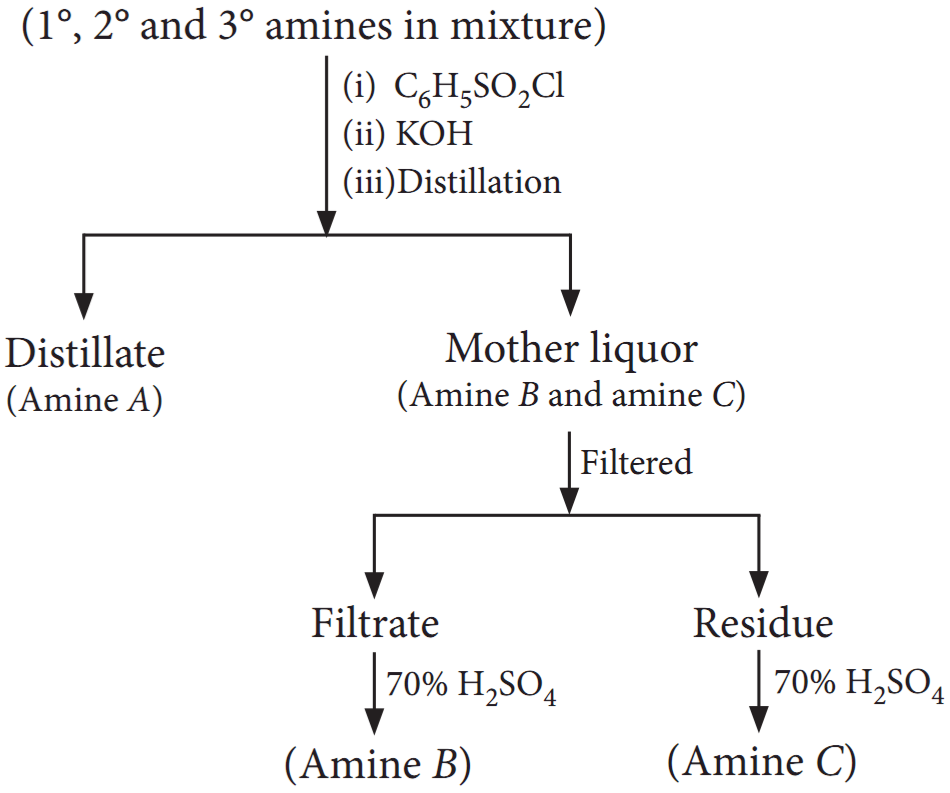
When the mixture contains the three amine salts (1º, 2º and 3º) along with quaternary salt, it is distilled with KOH solution. The three amines distill, leaving the quaternary salt unchanged in the solution. Then the mixture of amines is separated by fractional distillation, Hinsberg's method and Hoffmann's method.

The following questions are multiple choice questions. Choose the most appropriate answer:
  1. Hinsberg reagent is:
  1. Aliphatic sulphonyl chloride.
  2. Phthalamide.
  3. Aromatic sulphonyl chloride.
  4. Anhydrous ZnCl2 + cone. HCI.
  1. Primary amine with Hinsberg's reagent forms:
  1. N-alkyl benzene sulphonamide soluble in KOH solution.
  2. N-alkyl benzene sulphonamide insoluble in KOH solution.
  3. N, N-alkyl benzene sulphonamide soluble in KOH solution.
  4. N, N-alkyl benzene sulphonamide insoluble in KOH solution.
  1. Secondary amine with Hinsberg's reagent forms:
  1. N-alkyl benzene sulphonamide soluble in KOH solution.
  2. N-alkyl benzene sulphonamide insoluble in KOH solution.
  3. N,N-dialkyl benzene sulphonamide soluble in KOH solution.
  4. N,N-dialkyl benzene sulphonamide insoluble in KOH solution.
  1. To separate amines in a mixture Hoffmann's method is used. The Hoffman n's reagent is:
  1. Benzenesulphonyl chloride.
  2. Diethyl oxalate.
  3. Benzeneisocyanide.
  4. P-toulenesulphonic acid.
  1. 3º amines with Hinsberg's reagent give:
  1. No reaction.
  2. Product which is same as that of 1° amine.
  3. Product which is same as that of 2° amine.
  4. Products which is a quaternary salt.

Read the passage given below and answer the following questions:
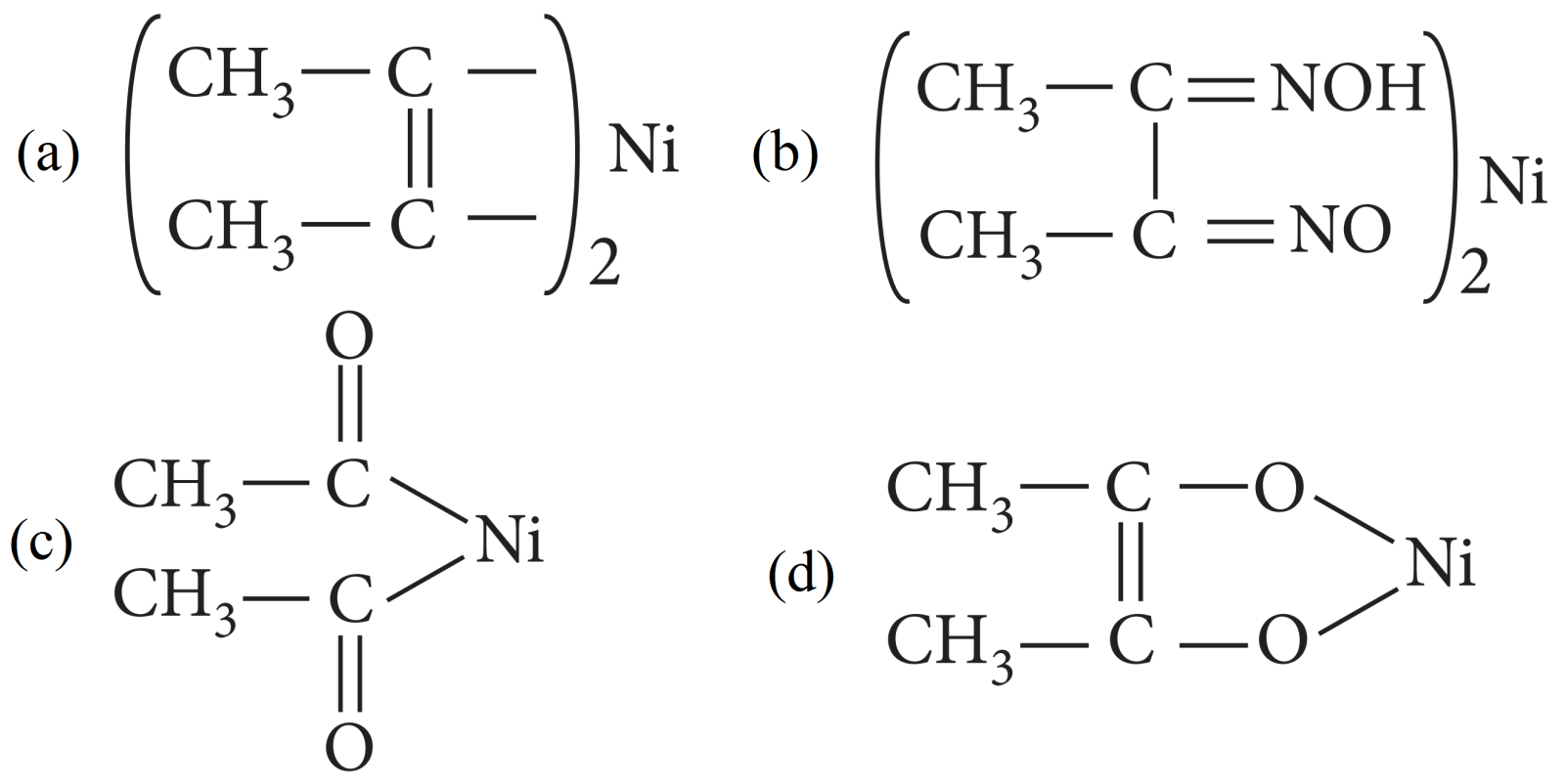
The molecular compounds which are formed from the combination of two or more simple stable compounds and retain their identity in the solid as well as in the dissolved state are called coordination compounds. Their properties are completely different from the constituents. ln coordination compounds, the central metal atom or ion is linked to a number ofions or neutral molecules, called ligands, by coordinate bonds. For example, Dimethylglyoxime (dmg) is a bid en date ligand chelating large amounts of metals. When dimethyl glyoxime is added to alcoholic solution of $NiCl_2$ and ammonium hydroxide is slowly added to it, a rosy red precipitate of a complex is formed.
The following questions are multiple choice questions. Choose the most appropriate answer:
  1. The structure of the complex is:
  1. Oxidation number of Ni in the given complex is:
  1. $+3$
  2. $+1$
  3. $+2$
  4. $Zero$
  1. Hybridisation and structure of the complex is:
  1. $Sp^3$​​​​​​​, tetrahedral.
  2. $dsp^2$​​​​​​​, square planar.
  3. $Sp^3$​​​​​​​, square planar.
  4. $Sp^3d$, trigonal bipyramidal.
  1. Which of the following is true about this complex?
  1. It is paramagnetic, containing $2$ unpaired electrons.
  2. It is paramagnetic, containing $1$ unpaired electron.
  3. It is paramagnetic, containing $4$ unpaired electrons.
  4. It is diamagnetic with no unpaired electron.
  1. Which one will give test for $Fe^{3+}$​​​​​​​ ions in the solution?
  1. $[Fe(CN)_6]^{3-}$
  2. $[Fe(CN)_6]^{2-}$
  3. $(NH_4)_2SO_4·FeSO_4·6H_2O$
  4. $Fe_2(S0_4)_3$​​​​​​​
Write detailed note on: Starch
Read the passage given below and answer the following questions:
In ideally ionic structures, the coordination numbers of the ions are determined by electrostatic considerations. Cations surround themselves with as many anions as possible, and vice versa. This maximizes the attractions between neighbouring ions of opposite charge and hence maximizes the lattice energy of the crystal. This requirement led to the formulation of the radius ratio rule for ionic structures, in which the ions and the structure adopted for a particular compound depend on the relative sizes of the ions. Thus, for the stable ionic crystalline structures, there is definite radius ratio limit for a cation to fit perfectly in the lattice of anions, called radius ratio rule. This depends upon the ratio of radii of two types of ions $\frac{\text{r}_+}{r}$This ratio for coordination numbers $3, 4, 6$ and $8$ are respectively $0.155 - 0.225, 0.225 - 0.414, 0.414 - 0.732$ and $0.732 - 1.000$. The coordination number of ionic solids also depends upon temperature and pressure. On applying high pressure, coordination number increases. On the other hand, on applying high temperature, it decreases.
The following questions are multiple choice questions. Choose the most appropriate answer:
  1. The ionic radii of $K^+,Rb^+$ and $Br-$ are $137, 148$ and $195$pm. The coordination number of cation in RbBr and KBr structures are respectively.
  1. $8, 6$
  2. $6, 4$
  3. $6, 8$
  4. $4, 6$
  1. For a coordination number $4,$ the maximum limiting radius ratio is.
  1. $0.414$
  2. $0.732$
  3. $0.225$
  4. $0.155$
  1. If the radius of $Na^+$ ion is 95 pm and that of $Cl^-$ ion is $181$  pm, the coordination number of $Na^+$ ion is.
  1. $6$
  2. $4$
  3. $8$
  4. $12$
  1. Which is not the correct statement for ionic solids, in which positive and negative ions are held by strong electrostatic attractive forces?
  1. The radius ratio $\frac{\text{r}_+}{r}$ increases as coordination number increases.
  2. As the difference in size of ions increases, coordination number increases.
  3. When coordination number is eight, $\frac{\text{r}_+}{r}$ ratio lies between $0.225$ to $0.414.$
  4. In ionic solid of the type AX (ZnS, wurtzite), the coordination number of $Zn^2$ and $S^2$- respectively are $4 $and $4.$
  1. If the pressure of CsCl is increased, then its coordination number will.
  1. Increase
  2. Remain the same
  3. Decrease
  4. None of these.
In these questions, a statement of assertion followed by a statement of reason is given. Choose the correct answer out of the following choices.
Assertion: There is no interface between gases.
Reason: The shape and volume of gases are not definite.
The potential of each electrode is known as electrode potential. Standard electrode potential is the potential when concentration of each species taking part in electrode reaction is unity and the reaction is taking place at 298K. By convention, the standard electrode potential of hydrogen (SHE) is $0.0V.$ The electrode potential value for each electrode process is a measure of relative tendency of the active species in the process to remain in the oxidised/ reduced form. The negative electrode potential means that the redox couple is stronger reducing agent than $\frac{\text{H}^+}{\text{H}_2}$ couple. A positive electrode potential means that the redox couple is a weaker reducing agent than the $\frac{\text{H}^+}{\text{H}_2}$ couple. Metals which have higher positive value of standard reduction potential form the oxides of greater thermal stability.
In these questions (Q. No. i-iv), a statement of assertion followed by a statement ofreason is given. Choose the correct answer out of the following choices.
  1. Assertion and reason both are correct statements and reason is correct explanation for assertion.
  2. Assertion and reason both are correct statements but reason is not correct explanation for assertion.
  3. Assertion is correct statement but reason is wrong statement.
  4. Assertion is wrong statement but reason is correct statement.
  1. Assertion: An electrochemical cell can be set-up only if the redox reaction is spontaneous.
Reason: A reaction is spontaneous if the free energy change is negative.
  1. Assertion: The standard electrode potential of hydrogen is $0.0V.$
Reason: It is by convention.
  1. Assertion: The more negative is the standard reduction potential, greater is its ability to displace $H_2$ from acid.
Reason: Strength of reducing agent increases with the increase in negative value of the standard reduction potential.
  1. Assertion: The negative value of standard reduction potential means that reduction takes place on this electrode with reference to hydrogen electrode.
Reason: The standard electrode potential of a half cell has a fixed value.
  1. Assertion: The absolute value of electrode potential cannot be determined experimentally.
Reason: The electrode potential values are generally determined with respect to SHE.
Read the passage given below and answer the following questions:
The concentration of a solute is very important in studying chemical reactions because it determines how often molecules collide in solution and thus indirectly determine the rate of reactions and the conditions at equilibrium. There are several ways to express the amount of solute present in a solution. The concentration of a solution is a measure of the amount of solute that has been dissolved in a given amount of solvent or solution. Concentration can be expressed in terms of molarity, molality, parts per million, mass percentage, volume percentage, etc.
The following questions are multiple choice questions. Choose the most appropriate answer:
  1. A solution is prepared using aqueous Kl which is turned out to be $20\%$ w/w Density of Kl is $1.202$ g/mL the molality of the given solution and mole fraction of solute are respectively.
  1. $1.95m, 0.120$
  2. $1.5m, 0.0263$
  3. $2.5m, 0.0569$
  4. $3.0m, 0.0352$
  1. The molarity $($in $mol\ L^{-1})$ of the given solution will be.
  1. $1.56$
  2. $1.89$
  3. $0.263$
  4. $1.44$
  1. Which of the following is correct relationship between mole fraction and molality?
  1. $\text{x}_2=\frac{\text{mM}_1}{1+\text{mM}_1}$
  2. $\text{x}_2=\frac{\text{mM}_1}{1-\text{mM}_1}$
  3. $\text{x}_2=\frac{1+\text{mM}_1}{\text{mM}_1}$
  4. $\text{x}_2=\frac{1-\text{mM}_1}{\text{mM}_1}$
  1. Which of the following is temperature dependent?
  1. Molarity
  2. Molality
  3. Mole fraction
  4. Mass percentage
  1. Which of the following is true for an aqueous solution of the solute in terms of concentration?
  1. $1M = 1m$
  2. $1M > 1m$
  3. $1M < 1m$
  4. Cannot be predicted

Read the passage given below and answer the following questions:
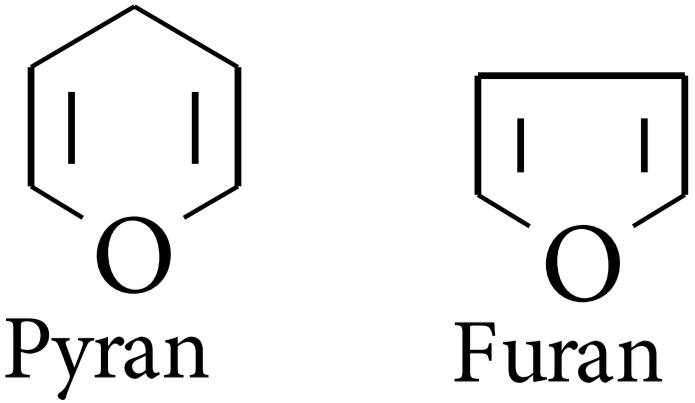
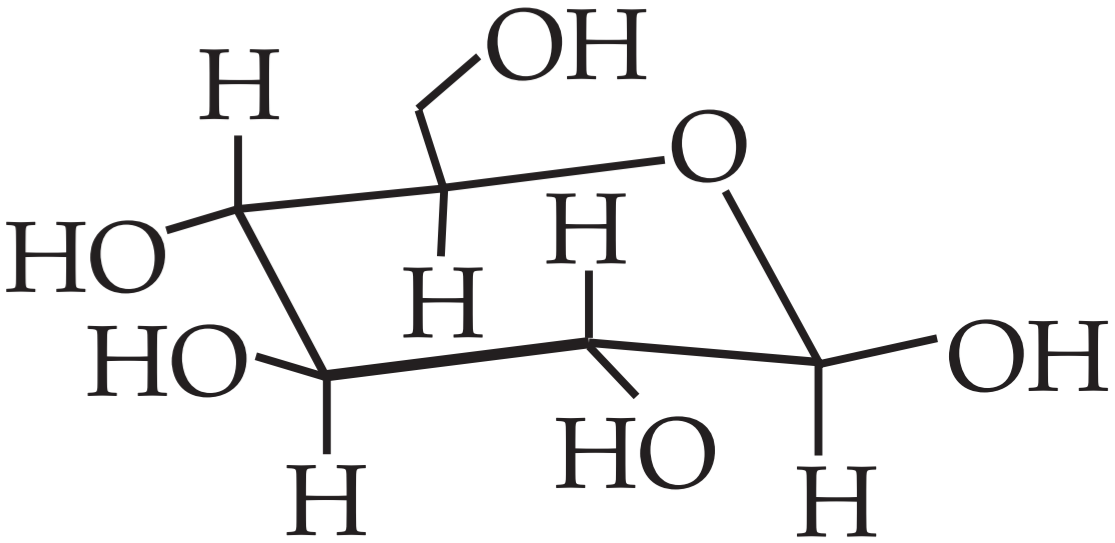
Pentose and hexose undergo intramolecular hemiacetal or hemiketal formation due to combination of the –OH group with the carbonyl group. The actual structure is either of five or six membered ring containing an oxygen atom. In the free state all pentoses and hexoses exist in pyranose form (resembling pyran). However,inthe combined state some of them exist as five membered cyclic structures, called furanose (resembling furan).

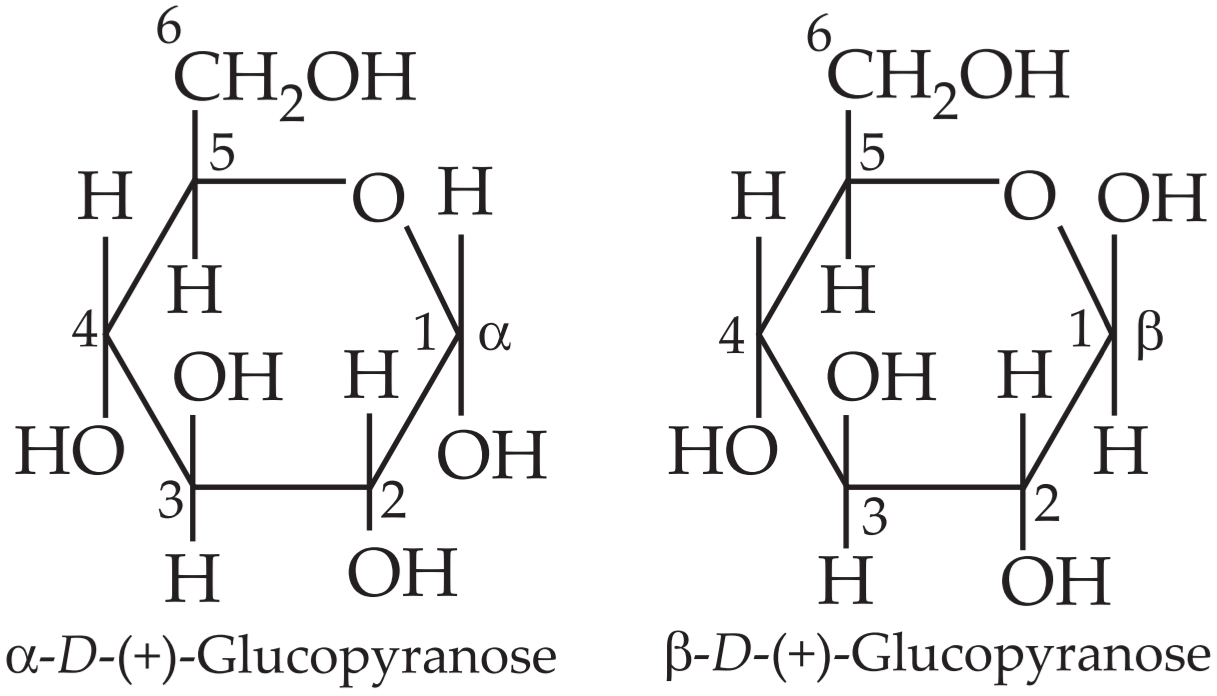
The cyclic structure of glucose is represented by Haworth structure:

$\alpha$ and $\beta$ D-glucose have different configuration at anomeric (C-1) carbon atom, hence are called anomers and the C-1 carbon atom is called anomeric carbon (glycosidic carbon).
The six membered cyclic structure of glucose is called pyranose structure.
The following questionsare multiple choice questions. Choose the most appropriate answer:
  1. $\alpha$ D(+)-glucose and $\beta$ D(+)glucose are:
  1. Enantiomers.
  2. Conformers.
  3. Epimers.
  4. Anomers.
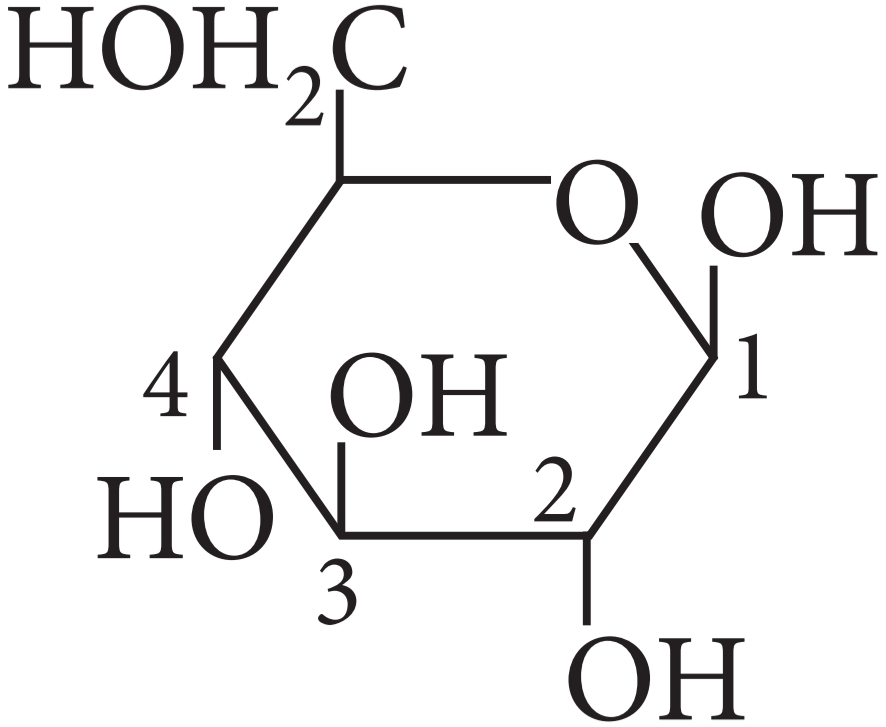
  1. The following carbohydrate is:
  1. A ketohexose.
  2. An aldohexose.
  3. An n-furanose.
  4. An $\alpha$-pyranose.
  1. In the following structure, anomeric carbon is:
  1. C-1
  2. C-2
  3. C-3
  4. C-4
  1. The term anomers of glucose refers to:
  1. Isomers of glucose that differ in configurations at carbons one and four (C-1 and C-4).
  2. A mixture of (D)-glucose and (L)-glucose.
  3. Enantiomers of glucose.
  4. Isomers of glucose that differ in configuration at carbon one (C-1).
  1. What percentage of $\beta$-D-(+) glucopyranose is found at equilibrium in the aqueous solution?
  1. 50%
  2. $\approx100%$
  3. 36%
  4. 64%
Read the passage given below and answer the following questions:
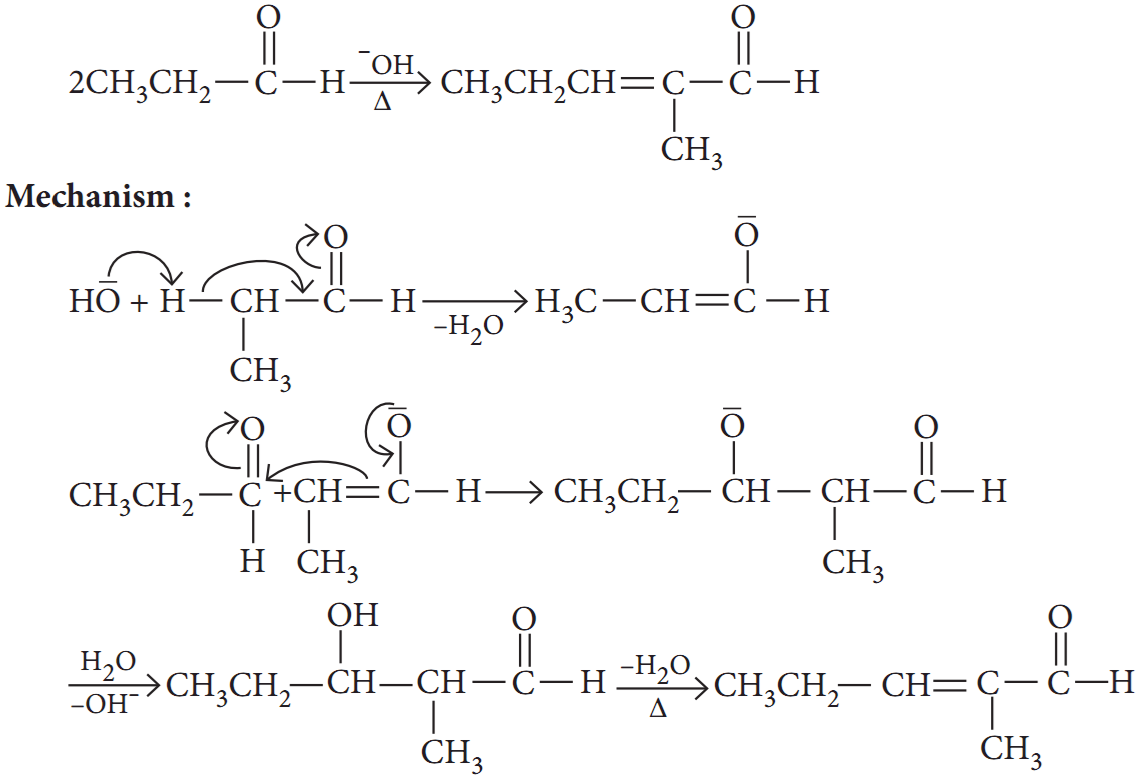
The addition reaction of enol or enolate to the carbonyl functional group of aldehyde or ketone is known as aldol addition. The $\beta-$ hydroxyaldehyde or $\beta-$hydroxyketone so obtained undergo dehydration in second step to produce a conjugated enone. The first part of reaction is an addition reaction and the second part is an elimination reaction. Carbonyl compound having $\propto-$hydrogen undergoes aldol condensation reaction.

The following questions are multiple choice questions. Choose the most appropriate answer:
  1. Condensation reaction is the reverse of which of the following reaction?
  1. Lock and key hypothesis.
  2. Oxidation.
  3. Hydrolysis.
  4. Glycogen formation.
  1. Which of the following compounds would be the main product of an aldol condensation of acetaldehyde and acetone?
  1. $CH_3CH = CHCHO$
  2. $CH_3CH = CHCOCH_3$
  3. $(CH_3)_2C = CHCHO$
  4. $(CH_3)_2C = CHCOCH_3$
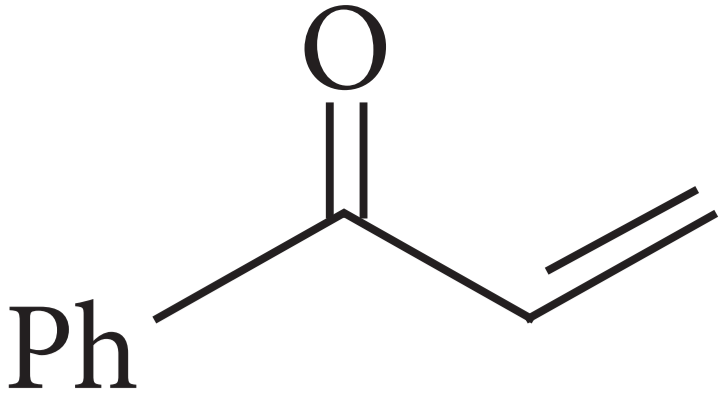
  1. Which combination of carbonyl compounds gives phenyl vinyl ketone by an aldol condensation?
  1. Acetophenone and Formaldehyde.
  2. Acetophenone and acetaldehyde.
  3. Benzaldehyde and acetaldehyde.
  4. Benzaldehyde and acetone.
  1. Which of the following will undergo aldol condensation?
  1. $HCHO$
  2. $CH_3CH_2OH$
  3. $C_6H_5CHO$
  4. $CH_3CH_2CHO$
  1. Which of the following does not undergo aldol condensation?
  1. $CH_3CHO$
  2. $CH_3CH_2CHO$
  3. $CH_3COCH_3$
  4. $C_3H_2CHO$
Read the passage given below and answer the following questions: Lucas test is a test to differentiate between primary, secondary and tertiary alcohols. This test consists of treating an alcohol with Lucas' reagent, and turbidity, due to the formation of insoluble alkyl chloride, is observed. Lucas test is based on the difference in reacting of three classes of alcohols with hydrogen chloride via $S_N1$ reaction. The different reactivity reflects the differing ease of formation of the corresponding carbocations. In these questions $(Q.$ No. $i-iv),$ a statement of assertion followed by a statement ofreason is given. Choose the correct answer out of the following choices.
  1. Assertion and reason both are correct statements and reason is correct explanation for assertion.
  2. Assertion and reason both are correct statements but reason is not correct explanation for assertion.
  3. Assertion is correct statement but reason is wrong statement.
  4. Assertion is wrong statement but reason is correct statement.
  1. Assertion: Equimolar mixture of cone. $HCI$ and anhydrous $ZnCl_2$ is called Lucas' reagent.
Reason: Lucas' reagent can be used to distinguish between methanol and ethanol.
  1. Assertion: $2-$Methyl$-2-$butanol gives no turbidity with Lucas' reagent at room temperature.
Reason: It is a $3^\circ$ alcohol.
  1. Assertion: Tertiary alcohols react fastest with Lucas' reagent by $S_N1$ mechanism.
Reason: $3^\circ$ carbocation is most stable.
  1. Assertion: Amongst the compounds, $H2C = CHCH_2OH (I), C_6H_5OH (II), CH_3CH_2CH_2OH (III)$ and $(CH_3)_3COH (IV),$ only $(IV)$ reacts with Lucas' reagent at room temperature.
Reason: Tertiary alcohol gives turbidity immediately with Lucas' reagent.
  1. Assertion: Lucas test can be used to distinguish between $1-$propanol and $2-$propanol.
Reason: Lucas test is based upon the difference in reactivity of primary, secondary and tertiary alcohols with cone. HCI and anhyd. $ZnCl_2.$