Question
Read the passage given below and answer the following questions: For understanding the structure and bonding in transition metal complexes, the magnetic properties are very helpful. Low spin complexes are generally diamagnetic because of pairing of electrons, whereas high spin complexes are usually paramagnetic because of presence of unpaired electrons. Larger the number of unpaired electrons, stronger will be the paramagnetism. However magnetic behaviour of a complex can be confirmed from magnetic moment measurement. Magnetic moment $\mu=\sqrt{\text{n(n+2)}}\text{B.M.}$ where n = number of unpaired electrons. Greater the number of unpaired electrons, more will be the magnetic moment. In these questions (Q. No. i-iv), a statement of assertion followed by a statement ofreason is given. Choose the correct answer out of the following choices.
- Assertion and reason both are correct statements and reason is correct explanation for assertion.
- Assertion and reason both are correct statements but reason is not correct explanation for assertion.
- Assertion is correct statement but reason is wrong statement.
- Assertion is wrong statement but reason is correct statement.
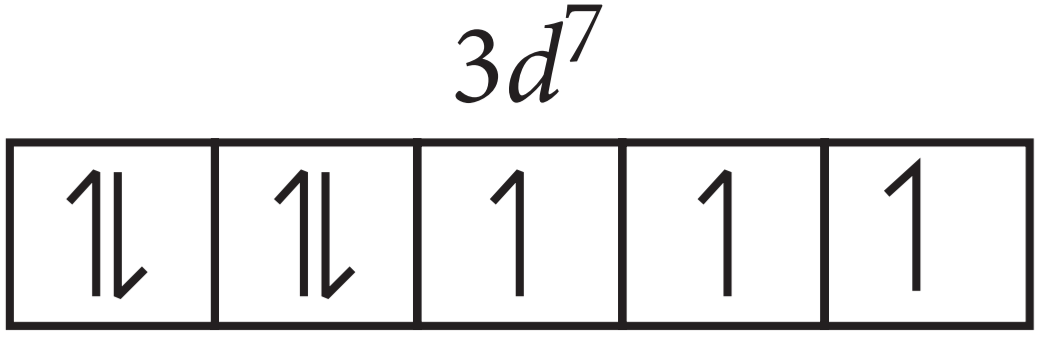
- Assertion: Both $[Cr(H_2O)_6]^{2+}$ and $[Fe(H_2O)_6]^{2+}$ have same magnetic moment.
- Assertion: $[Fe(H_2O)_5NO]SO_4$ is paramagnetic.
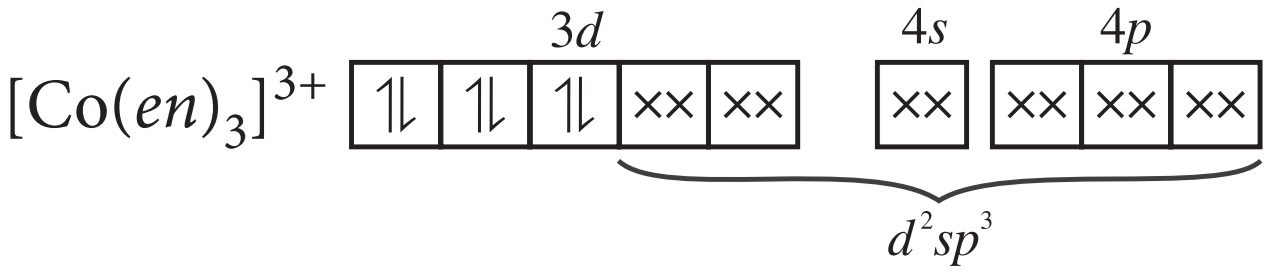
- Assertion: $[Co(en)_3]^{3+}$ is paramagnetic.
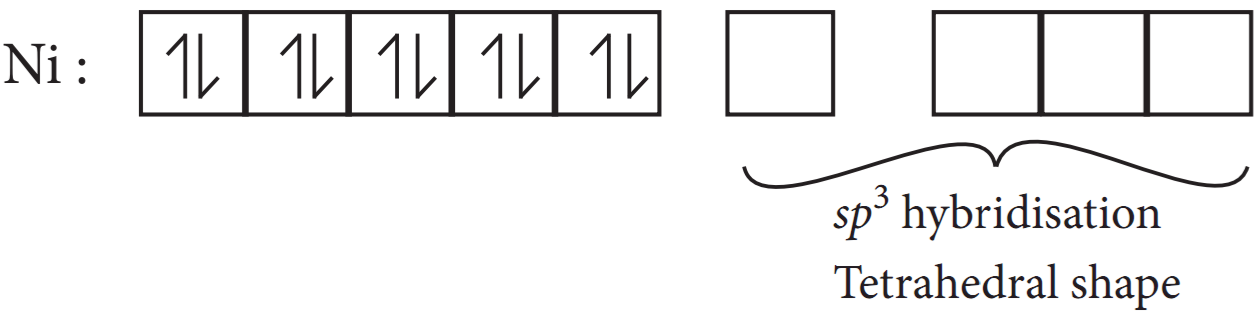
- Assertion: $[Ni(CO)_4]$ is diamagnetic and tetrahedral in shape.
- Assertion: $[Ni(CN)_4]^{2-}$ is diamagnetic complex.