Question
Read the passage given below and answer the following questions from 1 to 5.
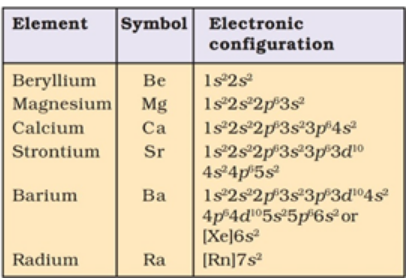
Alkaline earth elements have two electrons in the s - orbital of the valence shell. Their general electronic configuration may be represented as [noble gas] $ns^2$. Like alkali metals, the compounds of these elements are also predominantly ionic.
The atomic and ionic radii of the alkaline earth metals are smaller than those of the corresponding alkali metals in the same periods. This is due to the increased nuclear charge in these elements. Within the group, the atomic and ionic radii increase with increase in atomic number.
The alkaline earth metals have low ionization enthalpies due to fairly large size of the atoms. Since the atomic size increases down the group, their ionization enthalpy decreases. The first ionisation enthalpies of the alkaline earth metals are higher than those of the corresponding Group 1 metals. This is due to their small size as compared to the corresponding alkali metals. It is interesting to note that the second ionisation enthalpies of the alkaline earth metals are smaller than those of the corresponding alkali metals.
Like alkali metal ions, the hydration enthalpies of alkaline earth metal ions decrease with increase in ionic size down the group. $Be^{2+}> Mg^2+ > Ca^{2+} > Sr^{2+} > Ba^{2+}$ The hydration enthalpies of alkaline earth metal ions are larger than those of alkali metal ions. Thus, compounds of alkaline earth metals are more extensively hydrated than those of alkali metals, e.g., $MgCl_2$ and $CaCl_2$ exist as $MgCl_{2.}6H_2O$ and $CaCl_2· 6H_2O$ while NaCl and KCl do not form such hydrates.
The alkaline earth metals, in general, are silvery white, lustrous and relatively soft but harder than the alkali metals. Beryllium and magnesium appear to be somewhat greyish. The melting and boiling points of these metals are higher than the corresponding alkali metals due to smaller sizes. The trend is, however, not systematic. Because of the low ionisation enthalpies, they are strongly electropositive in nature. The electropositive character increases down the group from Be to Ba. Calcium, strontium and barium impart characteristic brick red, crimson and apple green colours respectively to the flame. In flame the electrons are excited to higher energy levels and when they drop back to the ground state, energy is emitted in the form of visible light. The electrons in beryllium and magnesium are too strongly bound to get excited by flame. Hence, these elements do not impart any colour to the flame. The flame test for Ca, Sr and Ba is helpful in their detection in qualitative analysis and estimation by flame photometry. The alkaline earth metals like those of alkali metals have high electrical and thermal conductivities which are typical characteristics of metals.
Chemical Properties- The alkaline earth metals are less reactive than the alkali metals. The reactivity of these elements increases on going down the group.
i) Reactivity towards air and water: Beryllium and magnesium are kinetically inert to oxygen and water because of the formation of an oxide film on their surface. Magnesium is more electropositive and burns with dazzling brilliance in air to give $MgO$ and $Mg_3N_2$. Calcium, strontium and barium are readily attacked by air to form the oxide and nitride.
ii) Reactivity towards the halogens: All the alkaline earth metals combine with halogen at elevated temperatures forming their halides.
$M+X_2\rightarrow Mx_2(x=F, Cl, Br, l)$
iii) Reactivity towards hydrogen: All the elements except beryllium combine with hydrogen upon heating to form their hydrides, $MH_2. BeH_2$, however, can be prepared by the reaction of $BeCl_2$ with $LiAlH_4$
2 $BeCl_2+ LiAlH_4\rightarrow 2BeH_2+ LiCl+AlCl_3$
iv) Reactivity towards acids: The alkaline earth metals readily react with acids liberating dihydrogen. $M + 2HCl \rightarrow MCl_2 + H_2$
v) Reducing nature: Like alkali metals, the alkaline earth metals are strong reducing agents. This is indicated by large negative values of their reduction potentials. However their reducing power is less than those of their corresponding alkali metals. Beryllium has less negative value compared to other alkaline earth metals
vi) Solutions in liquid ammonia: Like alkali metals, the alkaline earth metals dissolve in liquid ammonia to give deep blue black solutions forming ammoniated ions.
$\text{M}+(\text{x+y})\text{NH}_3\rightarrow \big[\text{M}(\text{NH}_3)\text{X}\big]^{2+}+2\big[\text{e}(\text{NH}_3)\text{y}\big]^-$
From these solutions, the ammoniates, $\big[\text{M}(\text{NH}_3)6\big]^{2+}$can be recovered.
Beryllium is used in the manufacture of alloys. Copper - beryllium alloys are used in the preparation of high strength springs. Metallic beryllium is used for making windows of X-ray tubes. Magnesium forms alloys with aluminium, zinc, manganese and tin. Magnesium-aluminium alloys being light in mass are used in air-craft construction. Magnesium (powder and ribbon) is used in flash powders and bulbs, incendiary bombs and signals. A suspension of magnesium hydroxide in water (called milk of magnesia) is used as antacid in medicine. Magnesium carbonate is an ingredient of toothpaste. Calcium is used in the extraction of metals from oxides which are difficult to reduce with carbon. Calcium and barium metals, owing to their reactivity with oxygen and nitrogen at elevated temperatures, have often been used to remove air from vacuum tubes. Radium salts are used in radiotherapy, for example, in the treatment of cancer.
Alkaline earth elements have two electrons in the s - orbital of the valence shell. Their general electronic configuration may be represented as [noble gas] $ns^2$. Like alkali metals, the compounds of these elements are also predominantly ionic.
The atomic and ionic radii of the alkaline earth metals are smaller than those of the corresponding alkali metals in the same periods. This is due to the increased nuclear charge in these elements. Within the group, the atomic and ionic radii increase with increase in atomic number.
The alkaline earth metals have low ionization enthalpies due to fairly large size of the atoms. Since the atomic size increases down the group, their ionization enthalpy decreases. The first ionisation enthalpies of the alkaline earth metals are higher than those of the corresponding Group 1 metals. This is due to their small size as compared to the corresponding alkali metals. It is interesting to note that the second ionisation enthalpies of the alkaline earth metals are smaller than those of the corresponding alkali metals.
Like alkali metal ions, the hydration enthalpies of alkaline earth metal ions decrease with increase in ionic size down the group. $Be^{2+}> Mg^2+ > Ca^{2+} > Sr^{2+} > Ba^{2+}$ The hydration enthalpies of alkaline earth metal ions are larger than those of alkali metal ions. Thus, compounds of alkaline earth metals are more extensively hydrated than those of alkali metals, e.g., $MgCl_2$ and $CaCl_2$ exist as $MgCl_{2.}6H_2O$ and $CaCl_2· 6H_2O$ while NaCl and KCl do not form such hydrates.
The alkaline earth metals, in general, are silvery white, lustrous and relatively soft but harder than the alkali metals. Beryllium and magnesium appear to be somewhat greyish. The melting and boiling points of these metals are higher than the corresponding alkali metals due to smaller sizes. The trend is, however, not systematic. Because of the low ionisation enthalpies, they are strongly electropositive in nature. The electropositive character increases down the group from Be to Ba. Calcium, strontium and barium impart characteristic brick red, crimson and apple green colours respectively to the flame. In flame the electrons are excited to higher energy levels and when they drop back to the ground state, energy is emitted in the form of visible light. The electrons in beryllium and magnesium are too strongly bound to get excited by flame. Hence, these elements do not impart any colour to the flame. The flame test for Ca, Sr and Ba is helpful in their detection in qualitative analysis and estimation by flame photometry. The alkaline earth metals like those of alkali metals have high electrical and thermal conductivities which are typical characteristics of metals.
Chemical Properties- The alkaline earth metals are less reactive than the alkali metals. The reactivity of these elements increases on going down the group.
i) Reactivity towards air and water: Beryllium and magnesium are kinetically inert to oxygen and water because of the formation of an oxide film on their surface. Magnesium is more electropositive and burns with dazzling brilliance in air to give $MgO$ and $Mg_3N_2$. Calcium, strontium and barium are readily attacked by air to form the oxide and nitride.
ii) Reactivity towards the halogens: All the alkaline earth metals combine with halogen at elevated temperatures forming their halides.
$M+X_2\rightarrow Mx_2(x=F, Cl, Br, l)$
iii) Reactivity towards hydrogen: All the elements except beryllium combine with hydrogen upon heating to form their hydrides, $MH_2. BeH_2$, however, can be prepared by the reaction of $BeCl_2$ with $LiAlH_4$
2 $BeCl_2+ LiAlH_4\rightarrow 2BeH_2+ LiCl+AlCl_3$
iv) Reactivity towards acids: The alkaline earth metals readily react with acids liberating dihydrogen. $M + 2HCl \rightarrow MCl_2 + H_2$
v) Reducing nature: Like alkali metals, the alkaline earth metals are strong reducing agents. This is indicated by large negative values of their reduction potentials. However their reducing power is less than those of their corresponding alkali metals. Beryllium has less negative value compared to other alkaline earth metals
vi) Solutions in liquid ammonia: Like alkali metals, the alkaline earth metals dissolve in liquid ammonia to give deep blue black solutions forming ammoniated ions.
$\text{M}+(\text{x+y})\text{NH}_3\rightarrow \big[\text{M}(\text{NH}_3)\text{X}\big]^{2+}+2\big[\text{e}(\text{NH}_3)\text{y}\big]^-$
From these solutions, the ammoniates, $\big[\text{M}(\text{NH}_3)6\big]^{2+}$can be recovered.
Beryllium is used in the manufacture of alloys. Copper - beryllium alloys are used in the preparation of high strength springs. Metallic beryllium is used for making windows of X-ray tubes. Magnesium forms alloys with aluminium, zinc, manganese and tin. Magnesium-aluminium alloys being light in mass are used in air-craft construction. Magnesium (powder and ribbon) is used in flash powders and bulbs, incendiary bombs and signals. A suspension of magnesium hydroxide in water (called milk of magnesia) is used as antacid in medicine. Magnesium carbonate is an ingredient of toothpaste. Calcium is used in the extraction of metals from oxides which are difficult to reduce with carbon. Calcium and barium metals, owing to their reactivity with oxygen and nitrogen at elevated temperatures, have often been used to remove air from vacuum tubes. Radium salts are used in radiotherapy, for example, in the treatment of cancer.
- The atomic and ionic radii of the alkaline earth metals are … than those of the corresponding alkali metals in the same periods.
- smaller
- bigger
- different
- None of above
- Within the group, the atomic and ionic radii of alkaline earth metals … with … in atomic number.
- increase, decrease
- increase, increase
- decrease, increase
- decrease, decrease
- Alkaline earth elements have … electrons in the s -orbital of the valence shell.
- Zero
- One
- Two
- Three
- Ionization enthalpy …. down the group of alkaline earth metals.
- first increases then decreases
- first decreases then increases
- increase
- decreases
- The hydration enthalpies of alkaline earth metal ions … with … in ionic size down the group.
- increase, decrease
- increase, increase
- decrease, increase
- decrease, decrease