Question
Read the passage given below and answer the following questions from 1 to 5.
F Wohler synthesised an organic compound, urea from an inorganic compound, ammonium cyanate.
The knowledge of fundamental concepts of molecular structure helps in understanding and predicting the properties of organic compounds. You have already learnt theories of valency and molecular structure. Also, you already know that tetravalence of carbon and the formation of covalent bonds by it are explained in terms of its electronic configuration and the hybridisation of s and p orbitals. It may be recalled that formation and the shapes of molecules like methane $(CH_4)$, ethene $(C_2H_4)$, ethyne $(C_2H_2)$ are explained in terms of the use of $sp^3, sp^2$ and sp hybrid orbitals by carbon atoms in the respective molecules. Hybridisation influences the bond length and bond enthalpy (strength) in compounds. The sp hybrid orbital contains more s character and hence it is closer to its nucleus and forms shorter and stronger bonds than the sp3 hybrid orbital.The sp2 hybrid orbital is intermediate in s character between sp and sp3 and, hence, the length and enthalpy of the bonds it forms, are also intermediate between them. The change in hybridisation affects the electronegativity of carbon. The greater the s character of the hybrid orbitals, the greater is the electronegativity. Thus, a carbon atom having an sp hybrid orbital with 50% s character is more electronegative than that possessing sp2 or sp3 hybridised orbitals. This relative electronegativity is reflected in several physical and chemical properties of the molecules concerned, about which you will learn in later units.
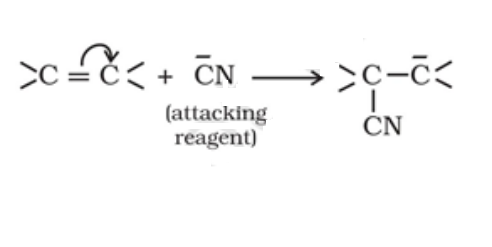
Characteristic Features of π Bonds In a π (pi) bond formation, parallel orientation of the two p orbitals on adjacent atoms is necessary for a proper sideways overlap. Thus, in $H_2C=CH_2$ molecule all the atoms must be in the same plane. The p orbitals are mutually parallel and both the p orbitals are perpendicular to the plane of the molecule. Rotation of one $CH_2$ fragment with respect to other interferes with maximum overlap of p orbitals and, therefore, such rotation about carbon-carbon double bond (C=C) is restricted. The electron charge cloud of the π bond is located above and below the plane of bonding atoms. This results in the electrons being easily available to the attacking reagents. In general, π bonds provide the most reactive centres in the molecules containing multiple bonds.
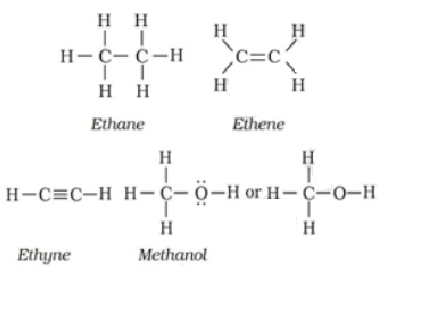
Structures of organic compounds are represented in several ways. The Lewis structure or dot structure, dash structure, condensed structure and bond line structural formulas are some of the specific types. The Lewis structures, however, can be simplified by representing the two-electron covalent bond by a dash (–). Such a structural formula focuses on the electrons involved in bond formation. A single dash represents a single bond, double dash is used for double bond and a triple dash represents triple bond. Lone- pairs of electrons on heteroatoms (e.g., oxygen, nitrogen, sulphur, halogens etc.) may or may not be shown. Thus, ethane $(C_2H_6)$, ethene $(C_2H_4)$, ethyne $(C_2H_2)$ and methanol $(CH_3OH)$ can be represented by the following structural formulas. Such structural representations are called complete structural formulas.
These structural formulas can be further abbreviated by omitting some or all of the dashes representing covalent bonds and by indicating the number of identical groups attached to an atom by a subscript. The resulting expression of the compound is called a condensed structural formula. Thus, ethane, ethene, ethyne and methanol can be written as:
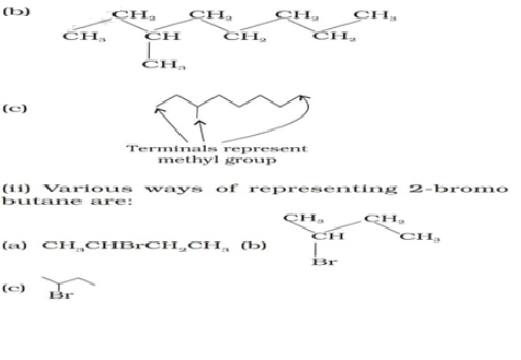
Similarly, $CH_3CH_2CH_2CH_2CH_2CH_2CH_2CH_3$ can be further condensed to $CH_3(CH_2)_6CH_3$. For further simplification, organic chemists use another way of representing the structures, in which only lines are used. In this bond-line structural representation of organic compounds, carbon and hydrogen atoms are not shown and the lines representing carbon-carbon bonds are drawn in a zig-zag fashion. The only atoms specifically written are oxygen, chlorine, nitrogen etc. The terminals denote methyl $(–CH_3)$ groups (unless indicated otherwise by a functional group), while the line junctions denote carbon atoms bonded to appropriate number of hydrogens required to satisfy the valency of the carbon atoms. Some of the examples are represented as follows: (i) 3-Methyloctane can be represented in various forms as:
F Wohler synthesised an organic compound, urea from an inorganic compound, ammonium cyanate.
The knowledge of fundamental concepts of molecular structure helps in understanding and predicting the properties of organic compounds. You have already learnt theories of valency and molecular structure. Also, you already know that tetravalence of carbon and the formation of covalent bonds by it are explained in terms of its electronic configuration and the hybridisation of s and p orbitals. It may be recalled that formation and the shapes of molecules like methane $(CH_4)$, ethene $(C_2H_4)$, ethyne $(C_2H_2)$ are explained in terms of the use of $sp^3, sp^2$ and sp hybrid orbitals by carbon atoms in the respective molecules. Hybridisation influences the bond length and bond enthalpy (strength) in compounds. The sp hybrid orbital contains more s character and hence it is closer to its nucleus and forms shorter and stronger bonds than the sp3 hybrid orbital.The sp2 hybrid orbital is intermediate in s character between sp and sp3 and, hence, the length and enthalpy of the bonds it forms, are also intermediate between them. The change in hybridisation affects the electronegativity of carbon. The greater the s character of the hybrid orbitals, the greater is the electronegativity. Thus, a carbon atom having an sp hybrid orbital with 50% s character is more electronegative than that possessing sp2 or sp3 hybridised orbitals. This relative electronegativity is reflected in several physical and chemical properties of the molecules concerned, about which you will learn in later units.
Characteristic Features of π Bonds In a π (pi) bond formation, parallel orientation of the two p orbitals on adjacent atoms is necessary for a proper sideways overlap. Thus, in $H_2C=CH_2$ molecule all the atoms must be in the same plane. The p orbitals are mutually parallel and both the p orbitals are perpendicular to the plane of the molecule. Rotation of one $CH_2$ fragment with respect to other interferes with maximum overlap of p orbitals and, therefore, such rotation about carbon-carbon double bond (C=C) is restricted. The electron charge cloud of the π bond is located above and below the plane of bonding atoms. This results in the electrons being easily available to the attacking reagents. In general, π bonds provide the most reactive centres in the molecules containing multiple bonds.
Structures of organic compounds are represented in several ways. The Lewis structure or dot structure, dash structure, condensed structure and bond line structural formulas are some of the specific types. The Lewis structures, however, can be simplified by representing the two-electron covalent bond by a dash (–). Such a structural formula focuses on the electrons involved in bond formation. A single dash represents a single bond, double dash is used for double bond and a triple dash represents triple bond. Lone- pairs of electrons on heteroatoms (e.g., oxygen, nitrogen, sulphur, halogens etc.) may or may not be shown. Thus, ethane $(C_2H_6)$, ethene $(C_2H_4)$, ethyne $(C_2H_2)$ and methanol $(CH_3OH)$ can be represented by the following structural formulas. Such structural representations are called complete structural formulas.
These structural formulas can be further abbreviated by omitting some or all of the dashes representing covalent bonds and by indicating the number of identical groups attached to an atom by a subscript. The resulting expression of the compound is called a condensed structural formula. Thus, ethane, ethene, ethyne and methanol can be written as:
Similarly, $CH_3CH_2CH_2CH_2CH_2CH_2CH_2CH_3$ can be further condensed to $CH_3(CH_2)_6CH_3$. For further simplification, organic chemists use another way of representing the structures, in which only lines are used. In this bond-line structural representation of organic compounds, carbon and hydrogen atoms are not shown and the lines representing carbon-carbon bonds are drawn in a zig-zag fashion. The only atoms specifically written are oxygen, chlorine, nitrogen etc. The terminals denote methyl $(–CH_3)$ groups (unless indicated otherwise by a functional group), while the line junctions denote carbon atoms bonded to appropriate number of hydrogens required to satisfy the valency of the carbon atoms. Some of the examples are represented as follows: (i) 3-Methyloctane can be represented in various forms as:
- … synthesised an organic compound, urea from an inorganic compound, ammonium cyanate.
- Wohler
- Adams
- Roger
- William Evans
- Dot structure is also known as …
- Zig zag structure
- Lewis structure
- Line structure
- Bond line structure
- Terminals in zigzig structure denotes … Group.
- Bromyl
- Propyl
- Methyl
- Pentyl
- Triple dash represents …
- Single bond
- Double bond
- Triple bond
- Equivalent bond
- Lewis structures representing the two-electron covalent bond by …
- .
- :
- ?
- –