Question
The s-Block Elements The elements of Group 1 (alkali metals) and Group 2 (alkaline earth metals) which have ns1and ns2 outermost electronic configuration belong to the s-Block Elements. They are all reactive metals with low ionization enthalpies. They lose the outermost electron(s) readily to form 1+ ion (in the case of alkali metals) or 2+ ion (in the case of alkaline earth metals). The metallic character and the reactivity increase as we go down the group. Because of high reactivity they are never found pure in nature. The compounds of the s-block elements, with the exception of those of lithium and beryllium are predominantly ionic. The p-Block Elements comprise those belonging to Group 13 to 18 and these together with the s-Block Elements are called the Representative Elements or Main Group Elements. The outermost electronic configuration varies from ns2np1 to ns2np6 in each period. At the end of each period is a noble gas element with a closed valence shell ns2np6 configuration. All the orbitals in the valence shell of the noble gases are completely filled by electrons and it is very difficult to alter this stable arrangement by the addition or removal of electrons. The noble gases thus exhibit very low chemical reactivity. Preceding the noble gas family are two chemically important groups of non-metals. They are the halogens (Group 17) and the chalcogens (Group 16).The non-metallic character increases as we move from left to right across a period and metallic character increases as we go down the group. These are the elements of Group 3 to 12 in the centre of the Periodic Table. These are characterised by the filling of inner d orbitals by electrons and are therefore referred to as d-Block Elements. These elements have the general outer electronic configuration (n-1)d1-10ns0-2 . They are all metals. They mostly form coloured ions, exhibit variable valence (oxidation states), paramagnetism and oftenly used as catalysts. However, Zn, Cd and Hg which have the electronic configuration, (n-1) d10ns2 do not show most of the properties of transition elements. In a way, transition metals form a bridge between the chemically active metals of s-block elements and the less active elements of Groups 13 and 14 and thus take their familiar name “Transition Elements”.The two rows of elements at the bottom of the Periodic Table, called the Lanthanoids, Ce(Z = 58) – Lu(Z = 71) and Actinoids, Th(Z = 90) – Lr (Z = 103) are characterised by the outer electronic configuration (n-2)f 1-14 (n-1)d 0–1ns2 . The last electron added to each element is filled in f- orbital. These two series of elements are hence called the Inner- Transition Elements (f-Block Elements). They are all metals. Within each series, the properties of the elements are quite similar. The chemistry of the early actinoids is more complicated than the corresponding lanthanoids, due to the large number of oxidation states possible for these actinoid elements. Actinoid elements are radioactive. Many of the actinoid elements have been made only in nanogram quantities or even less by nuclear reactions and their chemistry is not fully studied. The elements after uranium are called Transuranium Elements. The elements can be divided into Metals and Non-Metals. In contrast, non-metals are located at the top right hand side of the Periodic Table. The elements become more metallic as we go down a group; the non- metallic character increases as one goes from left to right across the Periodic Table. Periodic Table show properties that are characteristic of both metals and non- metals. These elements are called Semi-metals or Metalloids.
  1. Alkali metal and alkaline earth metal belongs to ..
  1. S – block
  2. P – block
  3. D – block
  4. F – block
  1. The metallic character and the reactivity … as we go down the group.
  1. Decreases
  2. Increases
  3. Remains Constant
  4. None of Above
  1. Group … Elements known as chalcogens.
  1. 12
  2. 14
  3. 16
  4. 18
  1. Elements Ce(Z = 58) to Lu(Z = 71) are known as:
  1. Halogens
  2. Chalcogens
  3. Actinoids
  4. Lanthenoids
  1. The elements after uranium are called … Elements.
  1. Halogens
  2. Chalcogens
  3. Actinoids
  4. Transuranium

Answer

  1. (a) S – block
  1. (b) Increases
  1. (c) 16
  1. (d) Lanthenoids
  1. (d) Transuranium

Need a full question paper?

Generate a complete, print-ready paper with questions like this in minutes — across 16+ boards, with answer keys.

Start Generating Free

Similar questions

The French physicist, de Broglie, in 1924proposed that matter, like radiation, shouldalso exhibit dual behaviour i.e., both particleand wavelike properties. This means that justas the photon has momentum as well aswavelength, electrons should also havemomentum as well as wavelength, de Broglie,from this analogy, gave the following relationbetween wavelength $(\lambda)$ and momentum (p) ofa material particle
$\lambda=\frac{\text{h}}{\text{mv}}=\frac{\text{h}}{\text{p}}$
where m is the mass of the particle, v itsvelocity and p its momentum.
Werner Heisenberg a German physicist in1927, stated uncertainty principle which is theconsequence of dual behaviour of matter andradiation. It states that it is impossible todetermine simultaneously, the exact position and exact momentum (or velocity)of an electron.Mathematically, it can be given as inequation
$\triangle\text{x}\times\triangle\text{p}_{\text{x}}\geq\frac{\text{h}}{4\pi}$
or $\triangle\text{x}\times\triangle(\text{mv}_{\text{x}})\geq\frac{\text{h}}{4\pi}$
or $\triangle\text{x}\times\triangle(\text{v}_{\text{x}})\geq\frac{\text{h}}{4\pi\text{m}}$
where $\triangle\text{x}$ is the uncertainty in position and $\triangle\text{px}(\text{or}\triangle\text{vx})$ is the uncertainty in momentum (orvelocity) of the particle.
One of the important implications of theHeisenberg Uncertainty Principle is that itrules out existence of definite paths ortrajectories of electrons and other similarparticles. The effect of Heisenberg Uncertainty Principle is significant only for motion of microscopic objects and is negligible for that of macroscopic objects. It, therefore, means that theprecise statements of the position andmomentum of electrons have to bereplaced by the statements of probability,that the electron has at a given positionand momentum. This is what happens inthe quantum mechanical model of atom. In Bohr model, anelectron is regarded as a charged particlemovingin well defined circular orbits aboutthe nucleus. The wave character of the electronis not considered in Bohr model. Further, anorbit is a clearly defined path and this pathcan completely be defined only if both theposition and the velocity of the electron areknown exactly at the same time. This is notpossible according to the Heisenberguncertainty principle. Bohr model of thehydrogen atom, therefore, not only ignoresdual behaviour of matter but also contradictsHeisenberg uncertainty principle. The structure of the atom was needed which could account for wave-particle duality of matter and be consistent with Heisenberg uncertainty Principle. This came with the advent of Quantum mechanics. This is mainly becauseof the fact thatclassical mechanics ignores theconcept of dual behaviour of matter especiallyfor sub-atomic particles and the uncertaintyprinciple. The branch of science that takes intoaccount this dual behaviour of matter is calledquantum mechanics.Quantum mechanics is a theoreticalscience that deals with the study of the motionsof the microscopic objects that have bothobservable wave like and particle likeproperties.When Schrödinger equation is solved forhydrogen atom, the solution gives the possibleenergy levels the electron can occupy and thecorresponding wave function(s) $\psi$ of theelectron associated with each energy level. A large number of orbitals are possible in anatom. Qualitatively these orbitals can bedistinguished by their size, shape andorientation. An orbital of smaller size meansthere is more chance of finding the electron nearthe nucleus. Similarly shape and orientationmean that there is more probability of findingthe electron along certain directions thanalong others. Atomic orbitals are preciselydistinguished by what are known as quantumnumbers. Each orbital is designated by threequantum numbers labelled as n, l and $m_1$.
The principal quantum number ‘n’ isa positive integer with value of n = 1,2,3…….The principal quantum number determines thesize and to large extent the energy of theorbital. Azimuthal quantum number. ‘l’ is alsoknown as orbital angular momentum orsubsidiary quantum number. It defines thethree-dimensional shape of the orbital.. For agiven value of n, l can have n values rangingfrom 0 to n – 1, that is, for a given value of n,the possible value of l are : l = 0, 1, 2, ……….(n–1)
Magnetic orbital quantum number. ‘mlgives information about the spatialorientation of the orbital with respect tostandard set of co-ordinate axis. For anysub-shell (defined by ‘l’ value) 2l+1 valuesof ml are possible and these values are givenbuy :ml = – l, – (l –1), – (l–2)… 0,1… (l –2), (l–1)..
In 1925, George Uhlenbeck and SamuelGoudsmit proposed the presence of the fourthquantum number known as the electronspin quantum number (ms). electron has, besides charge and mass,intrinsic spin angular quantum number. Spinangular momentum of the electron — a vectorquantity, can have two orientations relative tothe chosen axis. These two orientations aredistinguished by the spin quantum numbersms which can take the values of $+½ or –½$.These are called the two spin states of theelectron and are normally represented by twoarrows, ↑ (spin up) and ↓ (spin down).the four quantum numbersprovide the following information :
  1. n defines the shell, determines the size ofthe orbital and also to a large extent theenergy of the orbital.
  2. There are n subshells in the n the shell. Lidentifies the subshell and determines the shape of the orbital (see section 2.6.2).There are (2l+1) orbitals of each type in asubshell, that is, one s orbital (l = 0), threep orbitals (l = 1) and five d orbitals (l = 2)per subshell. To some extent l alsodetermines the energy of the orbital in amulti-electron atom.
  3. ml designates the orientation of the orbital.For a given value of l, mlhas (2l+1) values,the same as the number of orbitals persubshell. It means that the number oforbitals is equal to the number of ways inwhich they are oriented.
  4. ms refers to orientation of the spin of the electron.
  1. Uncertainty principle was given by:
  1. Werner Heisenberg
  2. George Uhlenbeck
  3. Samuel Goudsmit
  4. De Broglie
  1. Quantum mechanics is a theoretical science that deals with the study of the motions of the ….. objects.
  1. Macroscopic
  2. Microscopic
  3. Laparoscopic
  4. All the above
  1. The principal quantum number …
  1. l
  2. m
  3. n
  4. p
  1. …is also known as orbital angular momentum or subsidiary quantum number.
  1. Principal quantum number
  2. Electron spin quantum number
  3. Magnetic orbital quantum number.
  4. Azimuthal quantum number
  1. George Uhlenbeck and Samuel Goudsmit proposed the presence of the fourth quantum number known as the …
  1. Principal quantum number
  2. Electron spin quantum number
  3. Magnetic orbital quantum number.
  4. Azimuthal quantum number
Read the passage given below and answer the following questions from 1 to 5.
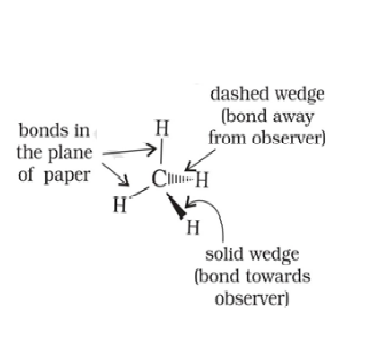
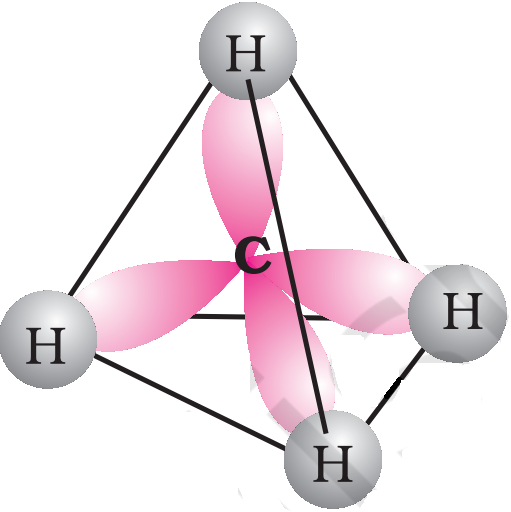
The three-dimensional (3-D) structure of organic molecules can be represented on paper by using certain conventions. For example, by using solid ( ) and dashed ( ) wedge formula, the 3-D image of a molecule from a two-dimensional picture can be perceived. In these formulas the solid-wedge is used to indicate a bond projecting out of the plane of paper, towards the observer. The dashed-wedge is used to depict the bond projecting out of the plane of the paper and away from the observer. Wedges are shown in such a way that the broad end of the wedge is towards the observer. The bonds lying in plane of the paper are depicted by using a normal line (—). 3-D representation of methane molecule on paper has been shown in Figure.

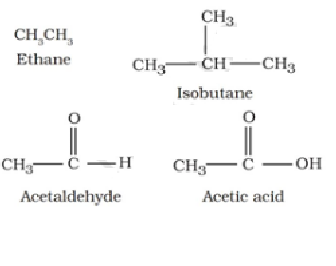
A cyclic or open chain componds these compounds are also called as aliphatic componds and consist of staright or branched chain componds for example:

Cyclic or closed chain or ring compounds
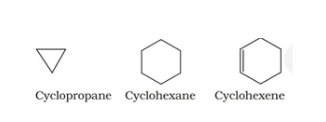
a) Alicyclic compounds Alicyclic (aliphatic cyclic) compounds contain carbon atoms joined in the form of a ring (homocyclic).

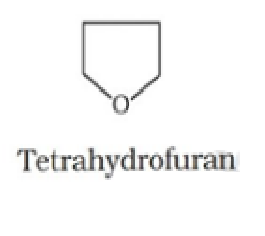
Someetimes atoms other than carbon are also present in the ring (heterocylic). Tetrahydrofuran given below is an example of this types of compound:

These exhibit some of the properties similar to those of aliphatic compounds.
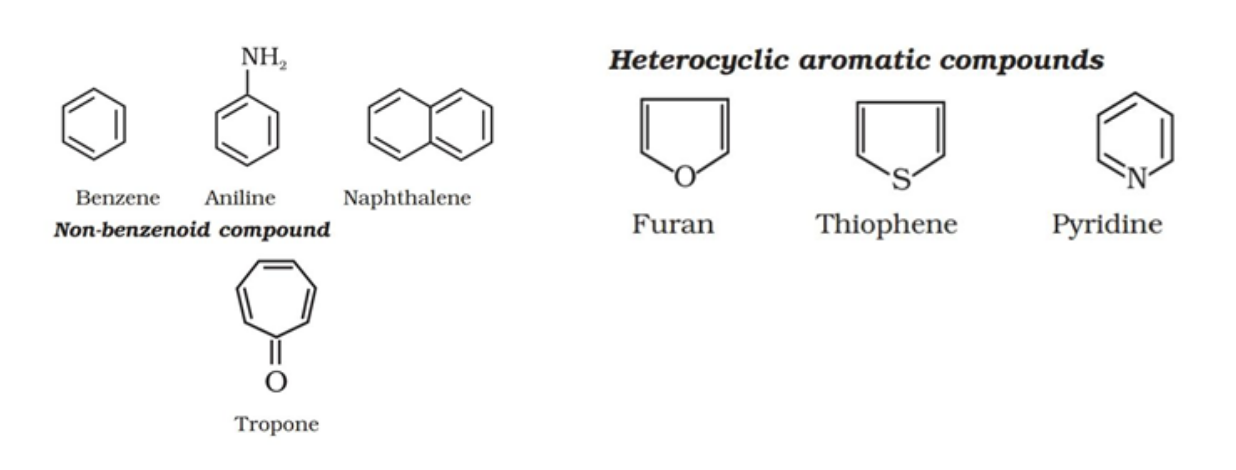
b) Aromatic compounds Aromatic compounds are special types of compounds. These include benzene and other related ring compounds (benzenoid). Like alicyclic compounds, aromatic comounds may also have hetero atom in the ring. Such compounds are called hetrocyclic aromatic compounds. Some of the examples of various types of aromatic compounds are:
Benzenoid aromatic compounds .

Organic compounds can also be classified on the basis of functional groups, into families or homologous series.
Functional Group The functional group is an atom or a group of atoms joined to the carbon chain which is responsible for the characteristic chemical properties of the organic compounds. The examples are hydroxyl group (–OH), aldehyde group (–CHO) and carboxylic acid group (–COOH) etc.
Homologous Series A group or a series of organic compounds each containing a characteristic functional group forms a homologous series and the members of the series are called homologues. The members of a homologous series can be represented by general molecular formula and the successive members differ from each other in molecular formula by a $–CH^2$ unit. There are a number of homologous series of organic compounds. Some of these are alkanes, alkenes, alkynes, haloalkanes, alkanols, alkanals, alkanones, alkanoic acids, amines etc. It is also possible that a compound contains two or more identical or different functional groups. This gives rise to polyfunctional compounds.
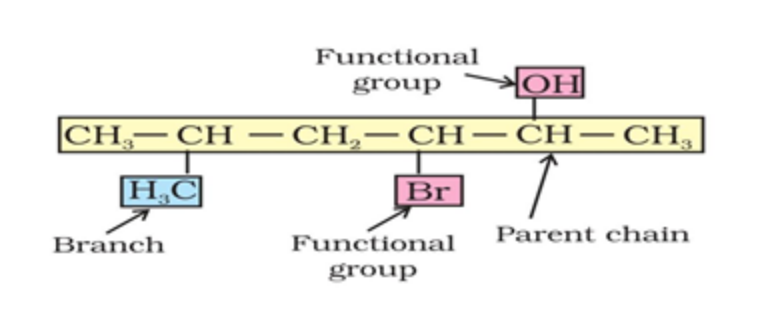
A systematic name of an organic compound is generally derived by identifying the parent hydrocarbon and the functional group(s) attached to it. See the example given below.

By further using prefixes and suffixes, the parent name can be modified to obtain the actual name. Compounds containing carbon and hydrogen only are called hydrocarbons. A hydrocarbon is termed saturated if it contains only carbon-carbon single bonds.
The IUPAC name for a homologous series of such compounds is alkane. Paraffin (Latin: little affinity) was the earlier name given to these compounds. Unsaturated hydrocarbons are those, which contain at least one carbon- carbon double or triple bond. IUPAC Nomenclature of Alkanes Straight chain hydrocarbons: The names of such compounds are based on their chain structure, and end with suffix ‘-ane’ and carry a prefix indicating the number of carbon atoms present in the chain (except from $CH_4$ to $C_4H_{10}$, where the prefixes are derived from trivial names). The IUPAC names of some straight chain saturated hydrocarbons are given in Table. The alkanes in table differ from each other by merely the number of $– CH_2$ groups in the chain. They are homologues of alkane series.
Name Molecular formula Name Molecular Formula
Methane $CH_4$ Heptane $C_7H_{16}$
Ethane $C_2H_6$ Octane $C_8H_{18}$
Propane $C_3H_8$ Nonane $C_9H_{20}$
Butane $C_4H_{10}$ Decane $C_{10}H_{22}$
Pentane $C_5H_{12}$ Icosane $C_{20}H_{42}$
Hexane $C_6H_{14}$ Triacontane $C_{30}H_{62}$
  1. IUPAC is an acronym for …
  1. International Union of Pure and Applied Chemistry
  2. International units of proteins and carbohydrates
  3. International understandings on physical aspects of chemistry
  4. Iodine under packings
  1. In homologous series, the successive members differ from each other in molecular formula by a … unit.
  1. $CH_3$
  2. $CH_2$
  3. $CH$
  4. $CH_4$
  1. A hydrocarbon is termed saturated if it contains only carbon-carbon … bonds.
  1. Triple
  2. Double
  3. Single
  4. Zero
  1. From ….., where the prefixes are derived from… trivial names.
  1. $CH_4$ to $C_2H_6$
  2. $CH_4$ to $C_3H_8$
  3. $CH_4$ to $C_6H_{14}$
  4. $CH_4$ to $C_4H_{10}$
  1. Molecular formula of octane is …
  1. $C_4H_{10}$
  2. $C_6H_{14}$
  3. $C_2H_6$
  4. $C_8H_{18}$
Once an organic compound is extracted from a natural source or synthesised in the laboratory, it is essential to purify it. Various methods used for the purification of organic compounds are based on the nature of the compound and the impurity present in it. Finally, the purity of a compound is ascertained by determining its melting or boiling point. This is one of the most commonly used techniques for the purification of solid organic compounds. In crystallisation Impurities, which impart colour to the solution are removed by adsorbing over activated charcoal. In distillation Liquids having different boiling points vaporise at different temperatures. The vapours are cooled and the liquids so formed are collected separately. Steam Distillation is applied to separate substances which are steam volatile and are immiscible with water. Distillation under reduced pressure: This method is used to purify liquids having very high boiling points.

1. Which method can be used to separate two compounds with different solubilities in a solvent?
OR
Why chloroform and aniline are easily separated by the technique of distillation?
2. Distillation method is used to separate which type of substance?
3. Which technique is used to separate aniline from aniline water mixture?
The phenomenon of the existence of two or more compounds possessing the same molecular formula but different properties is known as isomerism. Such compounds are called isomers. Compounds having the same molecular formula but different structures (manners in which atoms are linked) are classified as structural isomers. Structural isomers are classified as chain isomer, position isomer, functional group isomer. Meristematic arises due to different alkyl chains on either side of the functional group in the molecule and stereoisomerism and can be classified as geometrical and optical isomerism. Hyperconjugation is a general stabilising interaction. It involves delocalisation of $\sigma$ electrons of the C-H bond of an alkyl group directly attached to an atom of an unsaturated system or to an atom with an unshared p orbital. This type of overlap stabilises the carbocation because electron density from the adjacent $\sigma$ bond helps in dispersing the positive charge.

1. Why Isopentane, pentane and Neopentane are chain isomers?
OR
Why hyperconjugation is a permanent effect?
2. The molecular formula $C _3 H _8 O$ represents which isomer?
3. What type of isomerism is shown by Methoxypropane and ethoxyethane?
There are many observable patterns in thephysical and chemical properties of elementsas we descend in a group or move across aperiod in the Periodic Table.Atomic Radius the determination of the atomic sizecannot be precise. In other words, there is no practical way by which the size of an individualatom can be measured. However, an estimateof the atomic size can be made by knowing thedistance between the atoms in the combinedstate. One practical approach to estimate thesize of an atom of a non-metallic element is tomeasure the distance between two atoms whenthey are bound together by a single bond in acovalent molecule and from this value, the“Covalent Radius” For metals, we define theterm “Metallic Radius” which is taken as halfthe internuclear distance separating the metalcores in the metallic crystal. Atomic Radius to refer to both covalent ormetallic radius depending on whether theelement is a non-metal or a metal. Atomic radiican be measured by X-ray or otherspectroscopic methods. The atomic size generallydecreases across a period. It is because within the period the outerelectrons are in the same valence shell and theeffective nuclear charge increases as the atomicnumber increases resulting in the increasedattraction of electrons to the nucleus.Note that the atomic radii of noble gasesAre not considered here. Being monoatomic,Their (non-bonded radii) values are very large.In fact radii of noble gases should be comparednot with the covalent radii but with the van derWaals radii of other elements. The removal of an electron from an atom resultsin the formation of a cation, whereas gain ofan electron leads to an anion. The ionic radiican be estimated by measuring the distancesbetween cations and anions in ionic crystals.In general, the ionic radii of elements exhibitthe same trend as the atomic radii. A cation issmaller than its parent atom because it hasfewer electrons while its nuclear charge remainsthe same. The size of an anion will be largerthan that of the parent atom because theaddition of one or more electrons would resultin increased repulsion among the electronsand a decrease in effective nuclear charge. When we find some atoms and ions whichcontain the same number of electrons, we callthem isoelectronic species. For example,$O2–, F–, Na+$ and $Mg2+$ have the same number ofelectrons (10). Their radii would be differentbecause of their different nuclear charges.A quantitative measure of the tendency of anelement to lose electron is given by itsIonization Enthalpy. It represents the energyrequired to remove an electron from an isolatedgaseous atom (X) in its ground state. The ionization enthalpy is expressed inunits of kJ mol–1. We can define the secondionization enthalpy as the energy required toremove the second most loosely boundelectron The first ionization enthalpies of elementshaving atomic numbers up to 60 are plotted then The periodicity of the graph is quitestriking. You will find maxima at the noble gaseswhich have closed electron shells and verystable electron configurations. On the otherhand, minima occur at the alkali metals andtheir low ionization enthalpies can be correlated with their high reactivity. In addition, you willnotice two trends the first ionization enthalpygenerally increases as we go across a periodand decreases as we descend in a group. Electron Gain Enthalpy. when an electron is added to a neutral gaseousatom (x) to convert it into a negative ion, theenthalpy change accompanying the process isdefined as the electron gain enthalpy (∆egh).Electron gain enthalpy provides a measure ofthe ease with which an atom adds an electronto form anion. electron gain enthalpies have largenegative values toward the upper right of theperiodic table preceding the noble gases.The variation in electron gain enthalpies ofelements is less systematic than for ionizationenthalpies. As a general rule, electron gainenthalpy becomes more negative with increasein the atomic number across a period. Theeffective nuclear charge increases from left toright across a period and consequently it willbe easier to add an electron to a smaller atomsince the added electron on an average wouldbe closer to the positively charged nucleus. ElectronegativityA qualitative measure of the ability of an atomin a chemical compound to attract sharedelectrons to itself is called electronegativity.Unlike ionization enthalpy and electron gainenthalpy, it is not a measureable quantity.However, a number of numerical scales ofelectronegativity of elements viz., Pauling scale,Mulliken-Jaffe scale, Allred-Rochow scale havebeen developed. The one which is the most widely used is the Pauling scale. Electronegativity generallyincreases across a period from leftto right (say from lithium tofluorine) and decrease down a group(say from fluorine to astatine) inthe periodic table. Non-metallic elements have strong tendencyto gain electrons. Therefore, electronegativityis directly related to that non-metallicproperties of elements. It can be furtherextended to say that the electronegativity isinversely related to the metallic properties of elements. Thus, the increase inelectronegativities across a period isaccompanied by an increase in non-metallicproperties (or decrease in metallic properties)of elements. Similarly, the decrease inelectronegativity down a group is accompanied by a decrease in non-metallic properties (orincrease in metallic properties) of elements.
  1. The atomic size generally … across a period.
  1. Increases
  2. Decreases
  3. Remains Constant
  4. None of above
  1. The ionization enthalpy is expressed in units of ….
  1. $kJ mol^{–1}$
  2. $mole kJ^{-1}$
  3. $mole kJ$
  4. $-kJ mol^{-1}$
  1. Which of the following is/are numerical scales of electronegativity of elements.
  1. Pauling scale
  2. Mulliken-Jaffe scale
  3. Allred-Rochow scale
  4. All the above
  1. The … in electronegativity down a group is accompanied by a … in non-metallic properties.
  1. Increase, Decrease
  2. Decrease, Increase
  3. Decrease, Decrease
  4. Increase , Increase
  1. Electronegativity generally … across a period from left to right and … down a group in the periodic table.
  1. Increase, Decrease
  2. Decrease, Increase
  3. Decrease, Decrease
  4. Increase, Increase
Read the passage given below and answer the following questions from 1 to 5.
Alkenes are unsaturated hydrocarbons containing at least one double bond. What should be the general formula of alkenes? If there is one double bond between two carbon atoms in alkenes, they must possess two hydrogen atoms less than alkanes. Hence, general formula for alkenes is $C_nH_{2n}$. Alkenes are also known as olefins (oil forming) since the first member, ethylene or ethene $(C_2H_4)$ was found to form an oily liquid on reaction with chlorine.
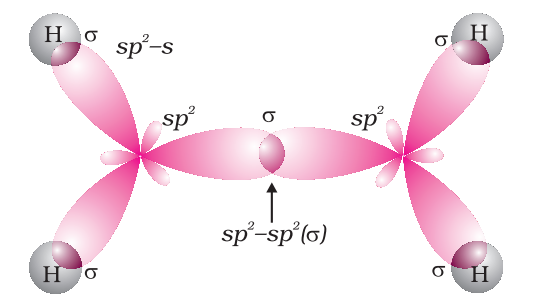
Structure of Double Bond Carbon-carbon double bond in alkenes consists of one strong sigma $(\sigma)$ bond (bond enthalpy about $397\ kJ\ mol^{–1)}$ due to head-on overlapping of $sp^2$ hybridised orbitals and one weak pi $\pi$ bond (bond enthalpy about $284\ kJ\ mol^{–1})$ obtained by lateral or sideways overlapping of the two 2p orbitals of the two carbon atoms. The double bond is shorter in bond length (134 pm) than the C–C single bond (154 pm). You have already read that the pi $(\pi)$ bond is a weaker bond due to poor sideways overlapping between the two 2p orbitals. Thus, the presence of the pi $(\pi)$bond makes alkenes behave as sources of loosely held mobile electrons. Therefore, alkenes are easily attacked by reagents or compounds which are in search of electrons. Such reagents are called electrophilic reagents. The presence of weaker$(\pi)$-bond makes alkenes unstable molecules in comparison to alkanes and thus, alkenes can be changed into single bond compounds by combining with the electrophilic reagents. Strength of the double bond (bond enthalpy, $681\ kJ\ mol^{–1}$) is greater than that of a carbon-carbon single bond in ethane (bond enthalpy, $348\ kJ\ mol^{–1}$). Orbital diagrams of ethene molecule are shown in Figure.

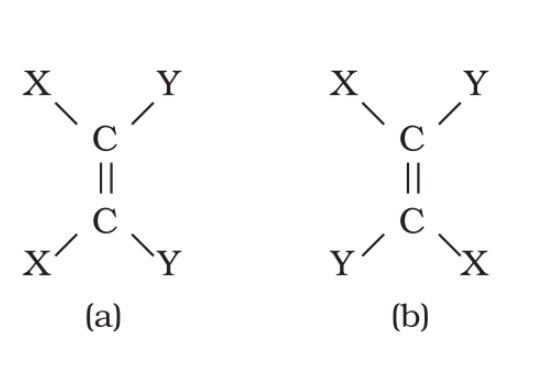
Geometrical isomerism: Doubly bonded Carbon atoms have to satisfy the remaining two Valences by joining with two atoms or groups. If the two atoms or groups attached to each Carbon atom are different, they can be Represented by YX C = C XY like structure. YX C = C XY can be represented in space in the Following two ways:

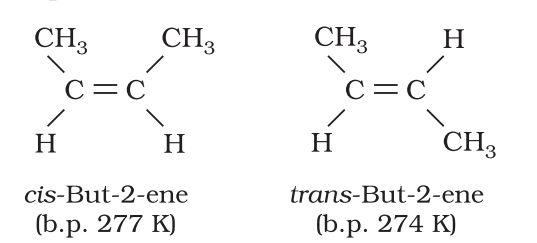
In (a), the two identical atoms i.e., both the X or both the Y lie on the same side of the Double bond but in (b) the two X or two Y lie Across the double bond or on the opposite Sides of the double bond. This results in Different geometry of (a) and (b) i.e. disposition Of atoms or groups in space in the two Arrangements is different. Therefore, they are Stereoisomers. They would have the same Geometry if atoms or groups around C = C bond Can be rotated but rotation around C = C bond Is not free. It is restricted. For understanding This concept, take two pieces of strong Cardboards and join them with the help of two Nails. Hold one cardboard in your one hand And try to rotate the other. Can you really rotate The other cardboard ? The answer is no. The Rotation is restricted. This illustrates that the Restricted rotation of atoms or groups around The doubly bonded carbon atoms gives rise to Different geometries of such compounds. The Stereoisomers of this type are called Geometrical isomers. The isomer of the type (a), in which two identical atoms or groups lie On the same side of the double bond is called Cis isomer and the other isomer of the type (b), in which identical atoms or groups lie on The opposite sides of the double bond is called Trans isomer. Thus cis and trans isomers Have the same structure but have different Configuration (arrangement of atoms or groups In space). Due to different arrangement of Atoms or groups in space, these isomers differ In their properties like melting point, boiling Point, dipole moment, solubility etc. Geometrical or cis-trans isomers of but-2-ene Are represented below:

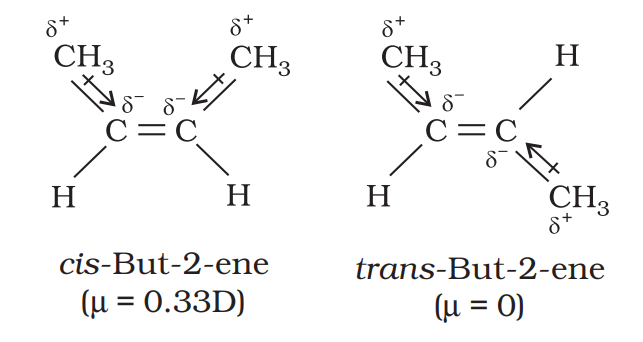
Cis form of alkene is found to be more polar Than the trans form. For example, dipole Moment of cis - but - 2-ene is 0.33 Debye, Whereas, dipole moment of the trans form Is almost zero or it can be said that trans - but - 2 -ene is non-polar. This can be understood by drawing geometries of the two forms as given below from which it is clear that in the trans - but - 2 -ene, the two methyl groups are in opposite directions, Therefore, dipole moments of $C - CH_3$ bonds cancel, thus making the trans form non-polar.

In the case of solids, it is observed that the trans isomer has higher melting point than the cis form. Geometrical or cis-trans isomerism is also shown by alkenes of the types XYC = CXZ and XYC = CZW
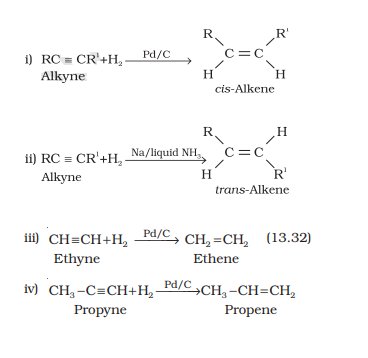
Preparation – From alkynes: Alkynes on partial reduction with calculated amount of dihydrogen in the presence of palladised charcoal partially deactivated with poisons like sulphur
compounds or quinoline give alkenes. Partially deactivated palladised charcoal is known as Lindlar’s catalyst. Alkenes thus obtained are having cis geometry. However, alkynes on reduction with sodium in liquid ammonia form trans alkenes.

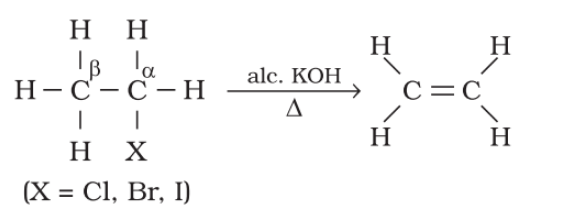
From alkyl halides: Alkyl halides (R-X) on heating with alcoholic potash (potassium hydroxide dissolved in alcohol, say, ethanol) eliminate one molecule of halogen acid to form alkenes. This reaction is known as dehydrohalogenation i.e., removal of halogen acid. This is example of $\beta-$elimination reaction, since hydrogen atom is eliminated from the $\beta$ carbon atom (carbon atom next to the carbon to which halogen is attached).

Nature of halogen atom and the alkyl group determine rate of the reaction. It is observed that for halogens, the rate is: iodine > bromine > chlorine, while for alkyl groups it is: tert > secondary > primary.
Physical properties Alkenes as a class resemble alkanes in physical properties, except in types of isomerism and difference in polar nature. The first three members are gases, the next fourteen are liquids and the higher ones are solids. Ethene is a colourless gas with a faint sweet smell. All other alkenes are colourless and odourless, insoluble in water but fairly soluble in non- polar solvents like benzene, petroleum ether. They show a regular increase in boiling point with increase in size i.e., every $–CH_2$ group added increases boiling point by 20–30 K. Like alkanes, straight chain alkenes have higher boiling point than isomeric branched chain compounds.
  1. The first three members of alkenes are …?
  1. Gases
  2. Liquids
  3. Solids
  4. None of above
  1. General formula for alkenes is ….?
  1. $C_nH_{2n+1}$
  2. $C_nH_{2n}$
  3. $C_nH_{2n-1}$
  4. $C_nH_{2n+2}$
  1. The colour of ethene gas is …?
  1. Red
  2. White
  3. Pale Green
  4. None of above
  1. The bond length of carbon carbon double bond is … pm ?
  1. 154
  2. 143
  3. 134
  4. 120
  1. Alkenes are also knows as …?
  1. Olefines
  2. Paraffines
  3. Oleofines
  4. Paracetofines
Read the passage given below and answer the following questions from $1$ to $5$.
The term ‘hydrocarbon’ is self-explanatory which means compounds of carbon and hydrogen only. Hydrocarbons play a key role in our daily life. You must be familiar with the terms ‘LPG’ and ‘CNG’ used as fuels. LPG is the abbreviated form of liquified petroleum gas whereas CNG stands for compressed natural gas. Another term ‘LNG’ (liquified natural gas) is also in news these days. This is also a fuel and is obtained by liquifaction of natural gas. Petrol, diesel and kerosene oil are obtained by the fractional distillation of petroleum found under the earth’s crust. Coal gas is obtained by the destructive distillation of coal. Natural gas is found in upper strata during drilling of oil wells. The gas after compression is known as compressed natural gas. LPG is used as a domestic fuel with the least pollution. Kerosene oil is also used as a domestic fuel but it causes some pollution. Automobiles need fuels like petrol, diesel and CNG. Petrol and CNG operated automobiles cause less pollution. All these fuels contain mixture of hydrocarbons, which are sources of energy. Hydrocarbons are also used for the manufacture of polymers like polythene, polypropene, polystyrene etc. Higher hydrocarbons are used as solvents for paints. They are also used as the starting materials for manufacture of many dyes and drugs. Thus, you can well understand the importance of hydrocarbons in your daily life. In this unit, you will learn more about hydrocarbons.
Classification Hydrocarbons are of different types. Depending upon the types of carbon-carbon bonds present, they can be classified into three main categories – (i) saturated
(ii) unsaturated and
(iii) aromatic hydrocarbons. Saturated hydrocarbons contain carbon-carbon and carbon-hydrogen single bonds. If different carbon atoms are joined together to form open chain of carbon atoms with single bonds, they are termed as alkanes. On the other hand, if carbon atoms form a closed chain or a ring, they are termed as cycloalkanes. Unsaturated hydrocarbons contain carbon-carbon multiple bonds – double bonds, triple bonds or both. Aromatic hydrocarbons are a special type of cyclic compounds. You can construct a large number of models of such molecules of both types (open chain and close chain) keeping in mind that carbon is tetravalent and hydrogen is monovalent. For making models of alkanes, you can use toothpicks for bonds and plasticine balls for atoms. For alkenes, alkynes and aromatic hydrocarbons, spring models can be constructed.
Alkanes As already mentioned, alkanes are saturated open chain hydrocarbons containing carbon – carbon single bonds. Methane $(CH_4)$ is the first member of this family. Methane is a gas found in coal mines and marshy places. If replace one hydrogen atom of methane by carbon and join the required number of hydrogens to satisfy the tetravalence of the other carbon atom,it get $C_2H_6$. This hydrocarbon with molecular formula $C_2H_6$ is known as ethane. Thus it can consider $C_2H_6$ as derived from $CH_4$ by replacing one hydrogen atom by $-CH_3$ group. Go on constructing alkanes by doing this theoretical exercise i.e., replacing hydrogen atom by $–CH_3$ group. The next molecules will be $C_3H_8, C_4H_{10} …$

These hydrocarbons are inert under normal conditions as they do not react with acids, bases and other reagents. Hence, they were earlier known as paraffins (latin: parum, little; affinis, affinity). the general formula for alkanes is $C_nH_2n + 2$. It represents any particular homologue when n is given appropriate value. methane has a tetrahedral structure, in which carbon atom lies at the centre and the four hydrogen atoms lie at the four corners of a regular tetrahedron. All H-C-H bond angles are of $109.5^\circ$ .
In alkanes, tetrahedra are joined together in which C-C and C-H bond lengths are 154 pm and 112 pm respectively. We have already read that C–C and C–H $\sigma$ bonds are formed by head-on overlapping of sp 3 hybrid orbitals of carbon and 1s orbitals of hydrogen atoms.
Difference in properties is due to difference in their structures, they are known as structural isomers. structural isomers which differ in chain of carbon atoms are known as chain isomers.
Preparation- Petroleum and natural gas are the main sources of alkanes. However, alkanes can be prepared by following methods:

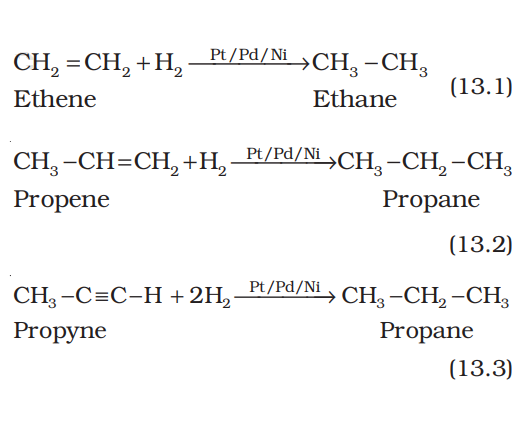
1) From unsaturated hydrocarbons Dihydrogen gas adds to alkenes and alkynes in the presence of finely divided catalysts like platinum, palladium or nickel to form alkanes. This process is called hydrogenation. These metals adsorb dihydrogen gas on their surfaces and activate the hydrogen – hydrogen bond. Platinum and palladium catalyse the reaction at room temperature but relatively higher temperature and pressure are required with nickel catalysts.
2) From alkyl halides
i) Alkyl halides (except fluorides) on reduction with zinc and dilute hydrochloric acid give alkanes.

ii) Alkyl halides on treatment with sodium metal in dry ethereal (free from moisture) solution give higher alkanes. This reaction is known as Wurtz reaction and is used for the preparation of higher alkanes containing even number of carbon atoms.
  1. Which of the following catalyst is used for hydrogenation…
  1. platinum
  2. palladium
  3. nickel
  4. All the above
  1. LPG stands for ….
  1. Liquid Pressure Gas
  2. Liquefied Petroleum Gas
  3. Liquid Platinum Gas
  4. Liquid Processed Gas
  1. Difference in properties is due to difference in their structures, they are known as …. isomers.
  1. Functional
  2. Positional
  3. Structural
  4. Chain
  1. Structural isomers which differ in chain of carbon atoms are known as… isomers.
  1. Functional
  2. Positional
  3. Structural
  4. Chain
  1. CNG Stands for ..
  1. Compressed Natural Gas
  2. Condensed Natural Gas
  3. Compressed Neutral Gas
  4. Compressed Neutral Gallium
Read the passage given below and answer the following questions from 1 to 5.
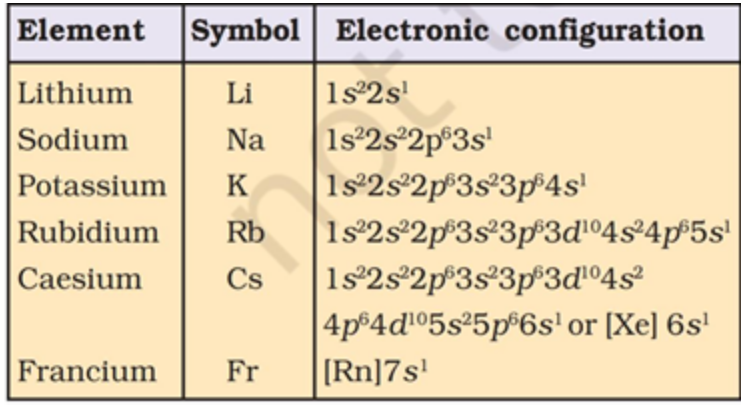
The s-block elements of the Periodic Table are those in which the last electron enters the outermost s-orbital. as the s-orbital can accommodate only two electrons, two Groups (1 & 2) belong to the s-block of the Periodic Table. Group 1 of the Periodic Table consists of the elements: Lithium, sodium, potassium, rubidium, caesium and Francium. They are collectively known as the alkali metals. These are so called because they form hydroxides on Reaction with water which are strongly alkaline in nature. The elements of Group 2 include beryllium, magnesium, Calcium, strontium, barium and radium. These elements With the exception of beryllium are commonly known as The alkaline earth metals. These are so called because their Oxides and hydroxides are alkaline in nature and these Metal oxides are found in the earth’s crust. The general electronic configuration of s-block elements is [noble gas] ns1 for alkali metals and [noble gas] $ns^2$ for Alkaline earth metals.

All the alkali metals have one valence electron, ns1 outside the noble gas core. The loosely held s-electron in the outermost Valence shell of these elements makes them the Most electropositive metals. They readily lose Electron to give monovalent M+ Ions. The monovalent ions (M+) are smaller than the parent atom. Hence they Are never found in free state in nature.
The alkali metal atoms have the largest sizes In a particular period of the periodic table. With increase in atomic number, the atom becomes Larger. the atomic and ionic Radii of alkali metals increase on moving down the group i.e., they increase in size while going From Li to Cs.
The ionization enthalpies of the alkali metals Are considerably low and decrease down the Group from Li to Cs. this is because the effect of increasing size outweighs the increasing Nuclear charge, and the outermost electron is very well screened from the nuclear charge.
The hydration enthalpies of alkali metal ions Decrease with increase in ionic sizes. $Li^+ > Na^+ > K^+ > Rb^+ > Cs^+ > Li^+$ Has maximum degree of hydration and For this reason lithium salts are mostly Hydrated, e.g., $LiCl·2H_2O$.
All the alkali metals are silvery white, soft and Light metals. Because of the large size, these Elements have low density which increases down The group from Li to Cs. However, potassium is Lighter than sodium. The melting and boiling Points of the alkali metals are low indicating Weak metallic bonding due to the presence of Only a single valence electron in them. The alkali Metals and their salts impart characteristic Colour to an oxidizing flame. This is because the Heat from the flame excites the outermost orbital Electron to a higher energy level. When the excited Electron comes back to the ground state . Alkali metals can therefore, be detected by The respective flame tests and can be Determined by flame photometry or atomic Absorption spectroscopy. These elements when Irradiated with light, the light energy absorbed May be sufficient to make an atom lose electron. This property makes caesium and potassium Useful as electrodes in photoelectric cells.
The alkali metals are highly reactive due to Their large size and low ionization enthalpy. The Reactivity of these metals increases down the Group.
Reactivity towards air: The alkali metals Tarnish in dry air due to the formation of Their oxides which in turn react with Moisture to form hydroxides. They burn Vigorously in oxygen forming oxides. Lithium forms monoxide, sodium forms Peroxide, the other metals form Superoxide. The superoxide $O^{2–}$ Ion is Stable only in the presence of large cations Such as K, Rb, Cs.
Reactivity towards water: The alkali Metals react with water to form hydroxide And dihydrogen.
$2\text{M}+2\text{H}_2\text{O}\rightarrow2\text{M}^++2\text{OH}^-+\text{H}_2$
(M = analkali metal)
Reactivity towards dihydrogen: The Alkali metals react with dihydrogen at About 673K (lithium at 1073K) to form Hydrides. All the alkali metal hydrides are Ionic solids with high melting points.
Reactivity towards halogens: The alkali Metals readily react vigorously with Halogens to form ionic halides, $M^+X^–$ .
Reducing nature: The alkali metals are Strong reducing agents, lithium being the Most and sodium the least powerful.
Solutions in liquid ammonia: The alkali Metals dissolve in liquid ammonia giving Deep blue solutions which are conducting in nature.
  1. The general electronic configuration of s-block elements is … for alkali metals.
  1. [noble gas] $ns^1$
  2. [noble gas] $ns^2$
  3. [noble gas] $ns^1np^1$
  4. [noble gas] $ns^1np^2$
  1. The general electronic configuration of s-block elements is … for alkaline earth metals.
  1. noble gas] $ns^1$
  2. [noble gas] $ns^2$
  3. [noble gas] $ns^1np^1$
  4. [noble gas] $ns^1np^2$
  1. The atomic and ionic Radii of alkali metals … on moving down the group.
  1. constant
  2. decrease
  3. increase
  4. All the above
  1. The hydration enthalpies of alkali metal ions … with … in ionic sizes.
  1. increase, decrease
  2. increase, increase
  3. decrease, decrease
  4. decrease, increase
  1. Which of the following element is strong reducing agent?
  1. Lithium
  2. Sodium
  3. Fluorine
  4. Helium
Read the passage given below and answer the following questions from (i) to (v).
Arrhenius Concept of Acids and Bases According to Arrhenius theory, acids are substances that dissociates in water to give hydrogen ions $H ^{+}{ }_{(a q)}$ and bases are substances that produce hydroxyl ions $OH ^{-}{ }_{( aq )}$. The ionization of an acid $HX { }_{\text {(aq) }}$ can be represented by the following equations:
$HX_{(aq)} \rightarrow H^{+}{ }_{(aq)}+X_{(aq)}^{-}$
or
$HX_{(aq)}+H_2 O(l) \rightarrow H_3 O^{+}{ }_{(aq)}+X_{(aq)}^{-}$
A bare proton, $H ^{+}$is very reactive and cannot exist freely in aqueous solutions. Thus, it bonds to the oxygen atom of a solvent water molecule to give trigonal pyramidal hydronium ion, $H _3 O ^{+}\left\{\left[ H \left( H _2 O \right)\right]^{+}\right\}$(see box). In this chapter we shall use $H ^{+}{ }_{( aq )}$ and $H _3 O ^{+}{ }_{( aq )}$ interchangeably to mean the same i.e., a hydrated proton. Similarly, a base molecule like MOH ionizes in aqueous solution according to the equation:
$MOH_{(aq)} \rightarrow M^{+}{ }_{(aq)}+OH^{-}(aq)$
The hydroxyl ion also exists in the hydrated form in the aqueous solution. Arrhenius concept of acid and base, however, suffers from the limitation of being applicable only to aqueous solutions and also, does not account for the basicity of substances like, ammonia which do not possess a hydroxyl group.
The Brönsted-Lowry Acids and Bases The Danish chemist, Johannes Brönsted and the English chemist, Thomas M. Lowry gave a more general definition of acids and bases. According to Brönsted-Lowry theory, acid is a substance that is capable of donating a hydrogen ion $H ^{+}$and bases are substances capable of accepting a hydrogen ion, $H ^{+}$. In short, acids are proton donors and bases are proton acceptors. Consider the example of dissolution of $NH _3$ in $H _2 O$ represented by the following equation:

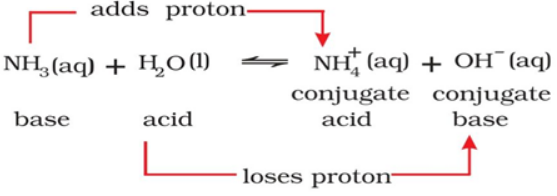
Hydronium and Hydroxyl lons Hydrogen ion by itself is a bare proton with very small size ( $\sim 10-15 m$ radius) and intense electric field, binds itself with the water molecule at one of the two available lone pairs on it giving $H _3 O ^{+}$. This species has been detected in many compounds (e.g., $H _3 O ^{+} Cl -$ ) in the solid state. In aqueous solution the hydronium ion is further hydrated to give species like $H _5 O _2^{+}, H7O3^{+}$and $H _9 4^{+}$. Similarly the hydroxyl ion is hydrated to give several ionic species like, $H _5 O 3$ - and H 7 O 4 - etc. The basic solution is formed due to the presence of hydroxyl ions. In this reaction, water molecule acts as proton donor and ammonia molecule acts as proton acceptor and are thus, called Lowry-Brönsted acid and base, respectively. In the reverse reaction, $H ^{+}$is transferred from $NH _4^{+}$to $OH ^{-}$. In this case, $NH _4^{+}$acts as a Bronsted acid while $OH ^{-}$acted as a Brönsted base. The acid-base pair that differs only by one proton is called a conjugate acid-base pair. Therefore, OH - is called the conjugate base of an acid $H _2 O$ and $NH _4{ }^{+}$is called conjugate acid of the base $NH _3$. f Brönsted acid is a strong acid then its conjugate base is a weak base and vice- versa. It may be noted that conjugate acid has one extra proton and each conjugate base has one less proton. Consider the example of ionization of hydrochloric acid in water. $HCl _{( aq )}$ acts as an acid by donating a proton to $H _2 O$ molecule which acts as a base.

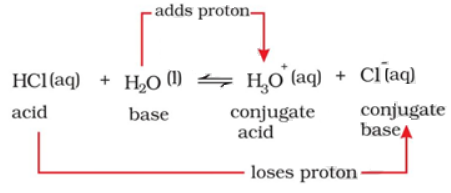
It can be seen in the above equation, that water acts as a base because it accepts the proton. The species $H _3 O ^{+}$is produced when water accepts a proton from HCl . Therefore, Cl - is a conjugate base of HCl and HCl is the conjugate acid of base $Cl -$. Similarly, $H _2 O$ is a conjugate base of an acid $H _3 O ^{+}$and $H _3 O ^{+}$is a conjugate acid of base $H _2 O$. It is interesting to observe the dual role of water as an acid and a base. In case of reaction with HCl water acts as a base while in case of ammonia it acts as an acid by donating a proton.
Lewis Acids and Bases G.N. Lewis in 1923 defined an acid as a species which accepts electron pair and base which donates an electron pair. As far as bases are concerned, there is not much difference between Brönsted-Lowry and Lewis concepts, as the base provides a lone pair in both the cases. However, in Lewis concept many acids do not have proton. A typical example is reaction of electron deficient species $BF _3$ with $NH _3 . BF _3$ does not have a proton but still acts as an acid and reacts with $NH _3$ by accepting its lone pair of electrons. The reaction can be represented by, $BF _3+: NH _3 \rightarrow BF _3: NH _3$
Electron deficient species like $AlCl _3, Co ^{3+}, Mg ^{2+}$, etc. can act as Lewis acids while species like $H _2 O , NH _3, OH ^{-}$etc. which can donate a pair of electrons, can act as Lewis bases.
The pH Scale Hydronium ion concentration in molarity is more conveniently expressed on a logarithmic scale known as the pH scale. The pH of a solution is defined as the negative logarithm to base 10 of the activity ( $a _{ H }{ }^{+}$) of hydrogen ion. In dilute solutions ( $<0.01 M$ ), activity of hydrogen ion $\left( H ^{+}\right)$is equal in magnitude to molarity represented by $\left[ H ^{+}\right]$. It should be noted that activity has no units and is defined as:
$\text{a}=\frac{[\text{H}^+]}{\text{mol}\text{L}^{–1}}$
From the definition of pH, the following can be written,
$\text{pH}={–\log\text{a}_\text{H}^+=\frac{-\log[\text{H}^+]}{\text{mol}\text{L}^{–1}}}$
Thus, an acidic solution of HCl (10–2M) will have a pH = 2. Similarly, a basic solution of NaOH having $[OH^–] =10^{–4}​​​​​​​$​​​​​​​M and [ $H_3O^+] = 10^{–10}M$ will have a $pH = 10. At 25 ^\circ C$, pure water has a concentration of hydrogen ions,$ [H^+] = 10^{–7} M.$ Hence, the pH of pure water is given as:
$pH = –\log(10^{–7}) = 7$
Acidic solutions possess a concentration of hydrogen ions, $[H^+] > 10^{–7}​​​​​​​$​​​​​​​M, while basic solutions possess a concentration of hydrogen ions,$ [H^+] < 10^{–7}​​​​​​​$M. thus, we can summarise that
Acidic solution has pH < 7
Basic solution has pH > 7
Neutral solution has pH = 7
Now again, consider the equation at 298K
$Kw = [H_3O^+][OH^–] = 10^{–14}​​​​​​​$​​​​​​​
Taking negative logarithm on both sides of equation, we obtain
$–\log Kw = – \log{[ H_3O^+ ][OH– ]}$
$= – \log[H_3O^+] – \log[OH–]$
$= – log10^{–14}$
$pKw = pH + pOH = 14$
Note that although Kw may change with temperature the variations in pH with temperature are so small that we often ignore it. pKw is a very important quantity for aqueous solutions and controls the relative concentrations of hydrogen and hydroxyl ions as their product is a constant. It should be noted that as the pH scale is logarithmic, a change in pH by just one unit also means change in $\left[ H ^{+}\right]$by a factor of 10 . Similarly, when the hydrogen ion concentration, $\left[ H ^{+}\right]$changes by a factor of 100 , the value of pH changes by 2 units. Now you can realise why the change in pH with temperature is often ignored. Ionization Constants of Weak Acids Consider a weak acid HX that is partially ionized in the aqueous solution. The equilibrium can be expressed by::
$HX_{(aq)}+H_2O(l) \rightarrow H_3O^+_{(aq)} + X^–_{(aq)}​​​​​​​$
Initial concentration (M)
c 0 0
Let α be the extent of ionization Change (M) -cα +cα +cα Equilibrium concentration (M) c-cα cα cα Here, c = initial concentration of the undissociated acid, HX at time, t = 0. α = extent up to which HX is ionized into ions. Using these notations, we can derive the equilibrium constant for the above discussed acid- dissociation equilibrium:
$\text{Ka}=\frac{\text{c}^2\alpha^2}{\text{c}(1-\alpha)}=\frac{\text{c}\alpha^2}{1-\alpha}$
Ka is called the dissociation or ionization constant of acid HX. It can be represented alternatively in terms of molar concentration as follows,
$\text{Ka}=\frac{[\text{H}^+][\text{X}^–]}{[\text{HX}]}$
At a given temperature T, Ka is a measure of the strength of the acid HX i.e., larger the value of Ka, the stronger is the acid. Ka is a dimensionless quantity with the understanding that the standard state concentration of all species is 1M.
  1. … is a substance that is capable of donating a hydrogen ion $H^+.$
  1. Acid
  2. Base
  3. Neutral substances
  4. Alkaline
  1. … are proton acceptors.
  1. Acids
  2. Bases
  3. Neutral substances
  4. All the above
  1. According to …bases are substances that produce hydroxyl ions $OH^–.$
  1. Johannes Brönsted
  2. Thomas M. Lowry
  3. Arrhenius
  4. G. N. Lewis
  1. Brönsted acid is a strong acid then its conjugate base is a … base.
  1. Strong
  2. Medium
  3. Non
  4. Weak
  1. According to … an acid as a species which accepts electron pair.
  1. Johannes Brönsted
  2. Thomas M. Lowry
  3. Arrhenius
  4. G. N. Lewis
Read the passage given below and answer the following questions from 1 to 5. Since the isotopes have the same electronic Configuration, they have almost the same Chemical properties.The only difference is in Their rates of reactions, mainly due to their Different enthalpy of bond dissociation . However, in physical properties these Isotopes differ considerably due to their large Mass differences. There are a number of methods for preparing Dihydrogen from metals and metal hydrides. 1.) Laboratory Preparation of Dihydrogen – It is usually prepared by the reaction of Granulated zinc with dilute hydrochloric. $Zn + 2H + \rightarrow Zn_2+ + H_2$ It can also be prepared by the reaction of Zinc with aqueous alkali. $Zn + 2NaOH \rightarrow Na_2ZnO_2 + H_2$ Commercial Production of Dihydrogen – The commonly used processes are outlined Below: i) Electrolysis of acidified water using Platinum electrodes gives hydrogen. ii) High purity (> 99.95%) dihydrogen is Obtained by electrolysing warm aqueous Barium hydroxide solution between nickel iii) It is obtained as a by product in the Manufacture of sodium hydroxide and Chlorine by the electrolysis of brine Solution. During electrolysis, the reactions That take place are: at anode: $2\text{CI}(\text{aq})\rightarrow\text{CI}_2(\text{g})+2\bar{\text{e}}$ at cathode: $2\text{H}_2\text{O}(\text{l})+2\text{e}\rightarrow\text{H}_2(\text{g})+2\text{O}\bar{\text{H}}(\text{aq})$ The overall reaction is $2\text{Na }(\text {aq})+2\text{C}\bar{\text{I}}(\text{aq})+2\text{H}_2\text{O}(\text{l})$ $\text{CI}_2(\text{g})+\text{H}_2(\text{g})+2\text{Na}^+(\text{aq})+2\text{O}\bar{\text{H}}(\text{aq})$ That take place are: iv) Reaction of steam on hydrocarbons or coke At high temperatures in the presence of Catalyst yields hydrogen.

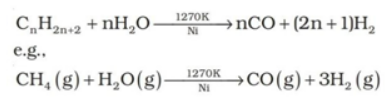
 The mixture of $CO$ and $H_2$ is called water Gas. As this mixture of $CO$ and $H_2$ is used for The synthesis of methanol and a number of Hydrocarbons, it is also called synthesis gas Or ‘syngas’. Nowadays ‘syngas’ is produced From sewage, saw-dust, scrap wood, Newspapers etc. The process of producing ‘syngas’ from coal is called ‘coal gasification’. The production of dihydrogen can be Increased by reacting carbon monoxide of Syngas mixtures with steam in the presence of Iron chromate as catalyst. This is called water-gas shift reaction. Carbon dioxide is removed by scrubbing with Sodium arsenite solution. Presently ~77% of the industrial Dihydrogen is produced from petro-chemicals, 18% from coal, 4% from electrolysis of aqueous Solutions and 1% from other sources. Physical Properties Dihydrogen is a colourless, odourless, Tasteless, combustible gas. It is lighter than Air and insoluble in water. Its other physical Properties are alongwith those of deuterium. The chemical behaviour of dihydrogen (and for That matter any molecule) is determined, to a Large extent, by bond dissociation enthalpy. The H–H bond dissociation enthalpy is the Highest for a single bond between two atoms Of any element. What inferences would you Draw from this fact ? It is because of this factor That the dissociation of dihydrogen into its Atoms is only~0.081% around 2000K which Increases to 95.5% at 5000K. Also, it is Relatively inert at room temperature due to the high H–H bond enthalpy. Thus, the atomic Hydrogen is produced at a high temperature In an electric arc or under ultraviolet Radiations. Since its orbital is incomplete with 1s1 Electronic configuration, it does combine With almost all the elements. It accomplishes Reactions by
i) loss of the only electron to Give H+, ii) gain of an electron to form H–, and iii) Sharing electrons to form a single covalent bond. The chemistry of dihydrogen can be Illustrated by the following reactions: Reaction with halogens: It reacts with Halogens, $X_2$ to give hydrogen halides, $\text{H}_2(\text{g})+\text{x}_2(\text{g})\rightarrow2\text{HX}(\text{g})(\text{x}=\text{F.CI.Br.I})$ While the reaction with fluorine occurs even in The dark, with iodine it requires a catalyst. Reaction with dioxygen: It reacts with Dioxygen to form water. The reaction is highly Exothermic. $2\text{H}_2(\text{g})+\text{O}_2(\text{g})\xrightarrow{\text{catalyst or beading}}2\text{H}_2\text{O}(\text{l}):$ $\triangle\text{H}^-=-285.9\text{kj}\text{mol}^-1$ This is the method for the manufacture of Ammonia by the Haber process. Reactions with metals: With many metals it Combines at a high temperature to yield the Corresponding hydrides $H_2$ (g) + 2M (g) → 2 MH (s); Where M is an alkali metal Reactions with metal ions and metal Oxides: It reduces some metal ions in aqueous Solution and oxides of metals (less active than Iron) into corresponding metals. $\text{H}_2(\text{g})+\text{Pd}^{2+}\text{(aq)}\rightarrow\text{Pd}(\text{s})+2\text{H}^+(\text{aq})$ $\text{y}\text{H}_2(\text{g})+\text{M}_\text{x}\text{O}_\text{y}(\text{S})\rightarrow\text{xM}(\text{s})+\text{y}\text{H}_2\text{O}\text{(l)}$ Reactions with organic compounds: It Reacts with many organic compounds in the Presence of catalysts to give useful Hydrogenated products of commercial Importance. For example: Hydrogenation of vegetable oils using Nickel as catalyst gives edible fats (margarine and vanaspati ghee) Hydroformylation of olefins yields Aldehydes which further undergo Reduction to give alcohols. $\text{H}_2+\text{CO}+\text{RCH}=\text{CH}_2\rightarrow\text{RCH}_2\text{CH}_2\text{CHO}$ $\text{H}_2+\text{RCH}_2\text{CH}_2\text{CHO}\rightarrow\text{RCH}_2\text{CH}_2\text{CH}_2\text{OH}$
  1. The mixture of CO and H2 is called …
  1. water Gas
  2. Dry ice
  3. Dry carbon
  4. Dry hydrogen
  1. Which of the following is not physical property of Dihydrogen.
  1. colourless
  2. Highest dissociation enthalpy
  3. odourless
  4. Tasteless
  1. Dihydrogen is reacts with dioxygen to get ….
  1. $H_2O_2$
  2. $2H_2O_2$
  3. $2H_2O$
  4. $H_2O$
  1. High purity dihydrogen is obtained by electrolysing warm aqueous barium hydroxide solution between… electrodes.
  1. Chromium
  2. Copper
  3. Platinum
  4. Nickel