Question
Read the passage given below and answer the following questions from 1 to 5.
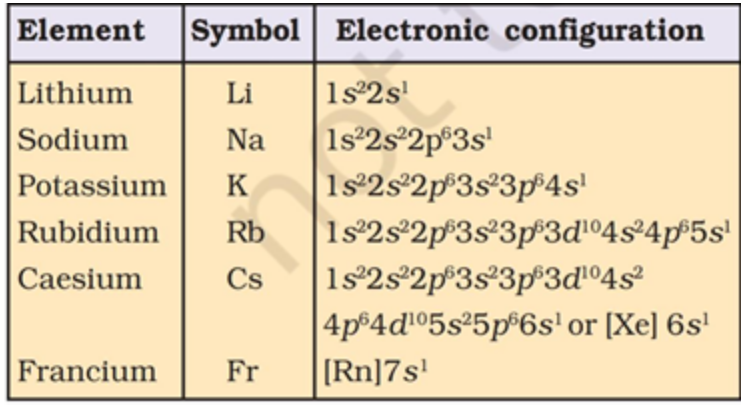
Hydrogen has the simplest atomic structure among all the elements around us in Nature. In atomic form it consists of only one proton and one electron. However, in elemental form it exists as a diatomic $(H_2)$ molecule and is called dihydrogen. It forms more compounds than any other element. Do you know that the global concern related to energy can be overcome to a great extent by the use of hydrogen as a source of energy? In fact, hydrogen is of great industrial importance as you will learn in this unit. Hydrogen is the first element in the periodic table. However, its placement in the periodic table has been a subject of discussion in the past. As you know by now that the elements in the periodic table are arranged according to their electronic configurations. Hydrogen has electronic configuration $1s^1$. On one hand, its electronic configuration is similar to the outer electronic configuration $(ns^1)$ of alkali metals , which belong to the first group of the periodic table. On the other hand, like halogens (with $ns^2 np^5$ configuration belonging to the seventeenth group of the periodic table), it is short by one electron to the corresponding noble gas configuration, helium $(1s^2)$. Hydrogen, therefore, has resemblance to alkali metals, which lose one electron to form unipositive ions, as well as with halogens, which gain one electron to form uninegative ion. Like alkali metals, hydrogen forms oxides, halides and sulphides. However, unlike alkali metals, it has a very high ionization enthalpy and does not possess metallic characteristics under normal conditions. In fact, in terms of ionization enthalpy, hydrogen resembles more with halogens, $\triangle _iH$ of Li is $520\ kJ\ mol^{–1}$, F is $1680\ kJ\ mol^{–1}$and that of H is $1312\ kJ\ mol^{–1}$. Like halogens, it forms a diatomic molecule, combines with elements to form hydrides and a large number of covalent compounds. However, in terms of reactivity, it is very low as compared to halogens.
Inspite of the fact that hydrogen, to a certain extent resembles both with alkali metals and halogens, it differs from them as well. Now the pertinent question arises as where should it be placed in the periodic table? Loss of the electron from hydrogen atom results in nucleus $(H^+) of ~1.5 \times 10^{–3}\ pm$ size. This is extremely small as compared to normal atomic and ionic sizes of 50 to 200pm. As a consequence, $H^+$ does not exist freely and is always associated with other atoms or molecules. Thus, it is unique in behaviour and is, therefore, best placed separately in the periodic table. Occurrence – Dihydrogen $H^2$ is the most abundant element in the universe $(70 \%$ of the total mass of the universe) and is the principal element in the solar atmosphere. The giant planets Jupiter and Saturn consist mostly of hydrogen. However, due to its light nature, it is much less abundant (0.15% by mass) in the earth’s atmosphere. Of course, in the combined form it constitutes $15.4 \%$ of the earth’s crust and the oceans. In the combined form besides in water, it occurs in plant and animal tissues, carbohydrates, proteins, hydrides including hydrocarbons and many other compounds.
Hydrogen has three isotopes: protium, 1H, deuterium, 2H or D and tritium, 3H or T. These isotopes differ from one another in respect of the presence of neutrons. Ordinary hydrogen, protium, has no neutrons, deuterium (also known as heavy hydrogen) has one and tritium has two neutrons in the nucleus. In the year 1934, an American scientist, Harold C. Urey, got Nobel Prize for separating hydrogen isotope of mass number 2 by physical methods. The predominant form is protium. Terrestrial hydrogen contains 0.0156% of deuterium mostly in the form of HD. The tritium concentration is about one atom per 1018 atoms of protium. Of these isotopes, only tritium is radioactive and emits low energy $\beta\text{ -particles}(\text{t}\frac{1}{2}12.33\text{ years})$
Hydrogen has the simplest atomic structure among all the elements around us in Nature. In atomic form it consists of only one proton and one electron. However, in elemental form it exists as a diatomic $(H_2)$ molecule and is called dihydrogen. It forms more compounds than any other element. Do you know that the global concern related to energy can be overcome to a great extent by the use of hydrogen as a source of energy? In fact, hydrogen is of great industrial importance as you will learn in this unit. Hydrogen is the first element in the periodic table. However, its placement in the periodic table has been a subject of discussion in the past. As you know by now that the elements in the periodic table are arranged according to their electronic configurations. Hydrogen has electronic configuration $1s^1$. On one hand, its electronic configuration is similar to the outer electronic configuration $(ns^1)$ of alkali metals , which belong to the first group of the periodic table. On the other hand, like halogens (with $ns^2 np^5$ configuration belonging to the seventeenth group of the periodic table), it is short by one electron to the corresponding noble gas configuration, helium $(1s^2)$. Hydrogen, therefore, has resemblance to alkali metals, which lose one electron to form unipositive ions, as well as with halogens, which gain one electron to form uninegative ion. Like alkali metals, hydrogen forms oxides, halides and sulphides. However, unlike alkali metals, it has a very high ionization enthalpy and does not possess metallic characteristics under normal conditions. In fact, in terms of ionization enthalpy, hydrogen resembles more with halogens, $\triangle _iH$ of Li is $520\ kJ\ mol^{–1}$, F is $1680\ kJ\ mol^{–1}$and that of H is $1312\ kJ\ mol^{–1}$. Like halogens, it forms a diatomic molecule, combines with elements to form hydrides and a large number of covalent compounds. However, in terms of reactivity, it is very low as compared to halogens.
Inspite of the fact that hydrogen, to a certain extent resembles both with alkali metals and halogens, it differs from them as well. Now the pertinent question arises as where should it be placed in the periodic table? Loss of the electron from hydrogen atom results in nucleus $(H^+) of ~1.5 \times 10^{–3}\ pm$ size. This is extremely small as compared to normal atomic and ionic sizes of 50 to 200pm. As a consequence, $H^+$ does not exist freely and is always associated with other atoms or molecules. Thus, it is unique in behaviour and is, therefore, best placed separately in the periodic table. Occurrence – Dihydrogen $H^2$ is the most abundant element in the universe $(70 \%$ of the total mass of the universe) and is the principal element in the solar atmosphere. The giant planets Jupiter and Saturn consist mostly of hydrogen. However, due to its light nature, it is much less abundant (0.15% by mass) in the earth’s atmosphere. Of course, in the combined form it constitutes $15.4 \%$ of the earth’s crust and the oceans. In the combined form besides in water, it occurs in plant and animal tissues, carbohydrates, proteins, hydrides including hydrocarbons and many other compounds.
Hydrogen has three isotopes: protium, 1H, deuterium, 2H or D and tritium, 3H or T. These isotopes differ from one another in respect of the presence of neutrons. Ordinary hydrogen, protium, has no neutrons, deuterium (also known as heavy hydrogen) has one and tritium has two neutrons in the nucleus. In the year 1934, an American scientist, Harold C. Urey, got Nobel Prize for separating hydrogen isotope of mass number 2 by physical methods. The predominant form is protium. Terrestrial hydrogen contains 0.0156% of deuterium mostly in the form of HD. The tritium concentration is about one atom per 1018 atoms of protium. Of these isotopes, only tritium is radioactive and emits low energy $\beta\text{ -particles}(\text{t}\frac{1}{2}12.33\text{ years})$
- Hydrogen has electronic configuration ..
- $1s^1$
- $1s^2$
- $2s^1$
- $2s^2$
- Ionisation enthalpy of hydrogen is ..
- $520\ kJ\ mol^{–1}$
- $1312\ kJ\ mol^{–1}$
- $1249\ kJ\ mol^{–1}$
- $950\ kJ\ mol^{–1}$
- Hydrogen has … Isotopes.
- 1
- 2
- 3
- 4
- got Nobel Prize for separating hydrogen isotope of mass number 2 by physical methods.
- Nyholm
- Gillespie
- Heitler
- Harold C. Urey
- tritium is radioactive and emits low energy…. particles.
- $\alpha$
- $\beta$
- $\gamma$
- $\sigma$