Question

The orbital wave function or $\psi$ for an electronin an atom has no physical meaning. It issimply a mathematical function of thecoordinates of the electron. However, fordifferent orbitals the plots of correspondingwave functions as a function of r (the distancefrom the nucleus) are different. According to the German physicist, MaxBorn, the square of the wave function(i.e.,$\psi^2$) at a point gives the probability densityof the electron at that point. Boundary surface diagrams of constantprobability density for different orbitals give afairly good representation of the shapes of theorbitals. In this representation, a boundarysurface or contour surface is drawn in spacefor an orbital on which the value of probabilitydensity $\mid\psi\mid2$ is constant. In principle manysuch boundary surfaces may be possible.However, for a given orbital, only thatboundary surface diagram of constantprobability density* is taken to be goodrepresentation of the shape of the orbital whichencloses a region or volume in which theprobability of finding the electron is very high,say, 90%.
In hydrogen atom, electron has the same energy when it is in the2s orbital as when it is present in 2p orbital.The orbitals having the same energy are calleddegenerate. The 1s orbital in a hydrogenatom, as said earlier, corresponds to the moststable condition and is called the ground stateand an electron residing in this orbital is moststrongly held by the nucleus.
An electron inthe 2s, 2p or higher orbitals in a hydrogen atomis in excited state.The filling of electrons into the orbitals ofdifferent atoms takes place according to theaufbau principle which is based on the Pauli’sexclusion principle, the Hund’s rule ofmaximum multiplicity and the relativeenergies of the orbitals. Theaufbausprinciple states : In the ground state of theatoms, the orbitals are filled in order oftheir increasing energies. In other words,electrons first occupy the lowest energy orbitalavailable to them and enter into higher energyorbitals only after the lower energy orbitals arefilled.The number of electrons to be filled in variousorbitals is restricted by the exclusion principle,given by the Austrian scientist Wolfgang Pauli(1926). According to this principle : No twoelectrons in an atom can have the sameset of four quantum numbers. Pauliexclusion principle can also be stated as : “Onlytwo electrons may exist in the same orbitaland these electrons must have oppositespin.” This means that the two electrons canhave the same value of three quantum numbersn, l and $m_l$, but must have the opposite spinquantum number.Hund’s Rule of Maximum Multiplicity rule deals with the filling of electrons into the orbitals belonging to the same subshell. It states : pairing ofelectrons in the orbitals belonging to thesame subshell (p, d or f) does not take placeuntil each orbital belonging to thatsubshell has got one electron each i.e., itis singly occupied.
The distribution of electrons into orbitals of anatom is called its electronic configuration.If one keeps in mind the basic rules whichgovern the filling of different atomic orbitals,the electronic configurations of different atomscan be written very easily.The electronic configuration of differentatoms can be represented in two ways. Forexample :
  1. $s^a p^bd^c$​​​​​​​…… notation
  2. Orbital diagram
  1. …at a point gives the probability density of the electron at that point.
  1. $\psi\times2$
  2. $-\psi^2$
  3. $\psi$
  4. $\psi^2$
  1. Only …. electrons may exist in the same orbital and these electrons must have opposite spin.
  1. One
  2. Two
  3. Three
  4. Four
  1. …deals with the filling of electrons into the orbitals belonging to the same subshell.
  1. Hund’s Rule of Maximum Multiplicity rule
  2. Pauli’s exclusion principle
  3. Aufbau principle
  4. Werner Heisenberg
  1. Electrons first occupy the …. energy orbital available to them and enter into … energy orbitals.
  1. Lowest, Higher
  2. Higher, Lowest
  3. Middle, Higher
  4. Higher, Middle

Answer

  1. (d) $\psi^2$
  1. (b) Two
  1. (a) Hund’s Rule of Maximum Multiplicity rule
  1. (a)Lowest, Higher

Need a full question paper?

Generate a complete, print-ready paper with questions like this in minutes — across 16+ boards, with answer keys.

Start Generating Free

Similar questions

Read the passage given below and answer the following questions from 1 to 5.
F Wohler synthesised an organic compound, urea from an inorganic compound, ammonium cyanate.
The knowledge of fundamental concepts of molecular structure helps in understanding and predicting the properties of organic compounds. You have already learnt theories of valency and molecular structure. Also, you already know that tetravalence of carbon and the formation of covalent bonds by it are explained in terms of its electronic configuration and the hybridisation of s and p orbitals. It may be recalled that formation and the shapes of molecules like methane $(CH_4)$, ethene $(C_2H_4)$, ethyne $(C_2H_2)$ are explained in terms of the use of $sp^3, sp^2$ and sp hybrid orbitals by carbon atoms in the respective molecules. Hybridisation influences the bond length and bond enthalpy (strength) in compounds. The sp hybrid orbital contains more s character and hence it is closer to its nucleus and forms shorter and stronger bonds than the sp3 hybrid orbital.The sp2 hybrid orbital is intermediate in s character between sp and sp3 and, hence, the length and enthalpy of the bonds it forms, are also intermediate between them. The change in hybridisation affects the electronegativity of carbon. The greater the s character of the hybrid orbitals, the greater is the electronegativity. Thus, a carbon atom having an sp hybrid orbital with 50% s character is more electronegative than that possessing sp2 or sp3 hybridised orbitals. This relative electronegativity is reflected in several physical and chemical properties of the molecules concerned, about which you will learn in later units.
Characteristic Features of π Bonds In a π (pi) bond formation, parallel orientation of the two p orbitals on adjacent atoms is necessary for a proper sideways overlap. Thus, in $H_2C=CH_2$ molecule all the atoms must be in the same plane. The p orbitals are mutually parallel and both the p orbitals are perpendicular to the plane of the molecule. Rotation of one $CH_2$ fragment with respect to other interferes with maximum overlap of p orbitals and, therefore, such rotation about carbon-carbon double bond (C=C) is restricted. The electron charge cloud of the π bond is located above and below the plane of bonding atoms. This results in the electrons being easily available to the attacking reagents. In general, π bonds provide the most reactive centres in the molecules containing multiple bonds.

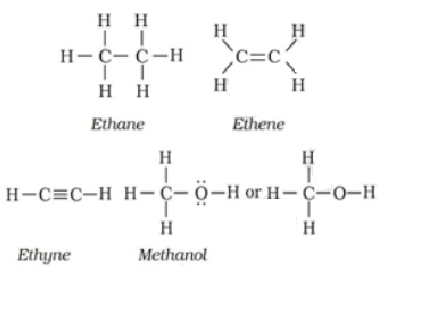
Structures of organic compounds are represented in several ways. The Lewis structure or dot structure, dash structure, condensed structure and bond line structural formulas are some of the specific types. The Lewis structures, however, can be simplified by representing the two-electron covalent bond by a dash (–). Such a structural formula focuses on the electrons involved in bond formation. A single dash represents a single bond, double dash is used for double bond and a triple dash represents triple bond. Lone- pairs of electrons on heteroatoms (e.g., oxygen, nitrogen, sulphur, halogens etc.) may or may not be shown. Thus, ethane $(C_2H_6)$, ethene $(C_2H_4)$, ethyne $(C_2H_2)$ and methanol $(CH_3OH)$ can be represented by the following structural formulas. Such structural representations are called complete structural formulas.
These structural formulas can be further abbreviated by omitting some or all of the dashes representing covalent bonds and by indicating the number of identical groups attached to an atom by a subscript. The resulting expression of the compound is called a condensed structural formula. Thus, ethane, ethene, ethyne and methanol can be written as:

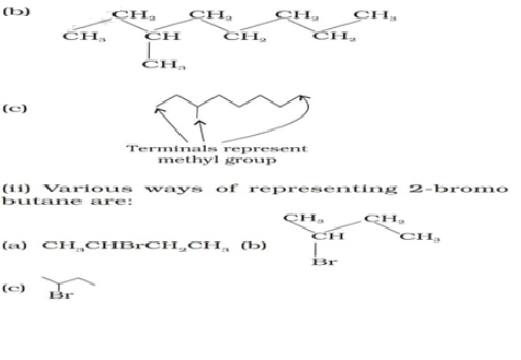
Similarly, $CH_3CH_2CH_2CH_2CH_2CH_2CH_2CH_3$ can be further condensed to $CH_3(CH_2)_6CH_3$. For further simplification, organic chemists use another way of representing the structures, in which only lines are used. In this bond-line structural representation of organic compounds, carbon and hydrogen atoms are not shown and the lines representing carbon-carbon bonds are drawn in a zig-zag fashion. The only atoms specifically written are oxygen, chlorine, nitrogen etc. The terminals denote methyl $(–CH_3)$ groups (unless indicated otherwise by a functional group), while the line junctions denote carbon atoms bonded to appropriate number of hydrogens required to satisfy the valency of the carbon atoms. Some of the examples are represented as follows: (i) 3-Methyloctane can be represented in various forms as:
  1. … synthesised an organic compound, urea from an inorganic compound, ammonium cyanate.
  1. Wohler
  2. Adams
  3. Roger
  4. William Evans
  1. Dot structure is also known as …
  1. Zig zag structure
  2. Lewis structure
  3. Line structure
  4. Bond line structure
  1. Terminals in zigzig structure denotes … Group.
  1. Bromyl
  2. Propyl
  3. Methyl
  4. Pentyl
  1. Triple dash represents …
  1. Single bond
  2. Double bond
  3. Triple bond
  4. Equivalent bond
  1. Lewis structures representing the two-electron covalent bond by …
  1. .
  2. :
  3. ?
Read the passage given below and answer the following questions from (i) to (v).
The covalent bond may be classified into twotypes depending upon the types ofoverlapping:(i) Sigma(σ) bond, and (ii) pi($\pi$) bond
  1. Sigma(σ) bond: This type of covalent bondis formed by the end to end (head-on)overlap of bonding orbitals along theinternuclear axis. This is called as headon overlap or axial overlap. This can beformed by any one of the following typesof combinations of atomic orbitals.
s-s overlapping: In this case, there isoverlap of two half filled s-orbitals alongthe internuclear axis.

s-p overlapping: This type of overlapoccurs between half filled s-orbitals of oneatom and half filled p-orbitals of anotheratom.

p–p overlapping: This type of overlaptakes place between half filled p-orbitalsof the two approaching atoms.
  1. pi($\pi$) bond: In the formation of $\pi$ bondthe atomic orbitals overlap in such a waythat their axes remain parallel to each otherand perpendicular to the internuclear axis.The orbitals formed due to sidewiseoverlapping consists of two saucer type charged clouds above and below the planeof the participating atoms.
Basically the strength of a bond depends uponthe extent of overlapping. In case of sigma bond,the overlapping of orbitals takes place to alarger extent. Hence, it is stronger as comparedto the pi bond where the extent of overlappingoccurs to a smaller extent. Further, it isimportant to note that in the formation ofmultiple bonds between two atoms of amolecule, pi bond(s) is formed in addition to asigma bond. In order to explain the characteristicgeometrical shapes of polyatomic moleculeslike $CH_4,NH_3$ and $H_2O$ etc., Pauling introducedthe concept of hybridisation. According to himthe atomic orbitals combine to form new set ofequivalent orbitals known as hybrid orbitals.Unlike pure orbitals, the hybrid orbitals areused in bond formation. The phenomenon isknown as hybridisation which can be definedas the process of intermixing of the orbitals ofslightly different energies so as to redistributetheir energies, resulting in the formation of newset of orbitals of equivalent energies and shape.For example when one 2s and three 2p-orbitalsof carbon hybridise, there is the formation offour new $sp_3$ hybrid orbitals. Salient features of hybridisation: The mainfeatures of hybridisation are as under:
  1. The number of hybrid orbitals is equal tothe number of the atomic orbitals that gethybridised.
  2. The hybridised orbitals are alwaysequivalent in energy and shape.
  3. The hybrid orbitals are more effective informing stable bonds than the pure atomicorbitals.
  4. These hybrid orbitals are directed in spacein some preferred direction to haveminimum repulsion between electronpairs and thus a stable arrangement.Therefore, the type of hybridisationindicates the geometry of the molecules. Important conditions for hybridisation
  5. The orbitals present in the valence shell of the atom are hybridised.
  6. The orbitals undergoing hybridisation should have almost equal energy.
  7. Promotion of electron is not essential condition prior to hybridisation.
  8. It is not necessary that only half filled orbitals participate in hybridisation.
some cases, even filled orbitals of valence shell take part in hybridisation.
There are various types of hybridisationinvolving s, p and d orbitals. The differenttypes of hybridisation are as under:
some cases, even filled orbitals of valence shell take part in hybridisation.
There are various types of hybridisationinvolving $s , p$ and d orbitals. The differenttypes of hybridisation are as under:
1. sp hybridisation: This type ofhybridisation involves the mixing of one $s$ andone $p$ orbital resulting in the formation of twoequivalent $s p$ hybrid orbitals. The suitableorbitals for sp hybridisation are $s$ and pz , ifthe hybrid orbitals are to lie along the $z$-axis. Example of molecule having sphybridisationBeCl2: The ground state electronicconfiguration of Be is $1 s^2 2 s^2$. In the exited stateone of the 2 s -electrons is promoted to vacant 2 p orbital to account for its bivalency.One 2 s and one 2 p -orbital gets hybridised toform two sp hybridised orbitals.
2. sp2 hybridisation: In this hybridisationthere is involvement of one s and twop-orbitals in order to form three equivalent sp2hybridised orbitals. For example, in BCI 3 molecule, the ground state electronicconfiguration of central boron atom is $1 s^2 2 s^2 2 p^1$. In the excited state, one of the 2 selectrons is promoted to vacant $2 p$ orbital as a result boron has three unpaired electrons. These three orbitals (one 2 s and two 2 p )hybridise to form three sp2 hybrid orbitals.
3. $sp ^3$ hybridisation: This type ofhybridisation can be explained by taking theexample of $CH _4$ molecule in which there ismixing of one $s$-orbital and three p -orbitals ofthe valence shell to form four $sp ^3$ hybrid orbitalof equivalent energies and shape. There is $25 \% s$-character and $75 \% p$-character in each $sp ^3$ hybrid orbital. The four $sp ^3$ hybrid orbitals soformed are directed towards the four cornersof the tetrahedron. The angle between $sp ^3$ hybrid orbital is $109.5^{\circ}$.
  1. ....ntroduced the concept of hybridisation.
  1. Pauling
  2. Lewis
  3. Nyholm
  4. Gillespie
  1. Which of the following is an example of sp3 hybridization?
  1. BeCl2
  2. Ch4
  3. BCl3
  4. C2H4
  1. The angle between sp3 hybrid orbital is ….
  1. $5^\circ$
  2. $9^\circ$
  3. $109.5^\circ$
  4. $120^\circ$
  1. A sigma bond is formed by the overlapping of …
  1. s−s,
  2. s−p
  3. p−p
  4. All the above
  1. When one 2s and three 2p-orbitals of carbon hybridise, there is the formation of four new … hybrid orbitals.
  1. sp3
  2. sp2
  3. sp
  4. None of above
Read the passage given below and answer the following questions from 1 to 5. Uses of Dihydrogen:
  • The largest single use of dihydrogen is in the synthesis of ammonia which is used in the manufacture of nitric acid and nitrogenous
  • Dihydrogen is used in the manufacture of vanaspati fat by the hydrogenation of polyunsaturated vegetable oils like soyabean, cotton seeds
  • It is used in the manufacture of bulk organic chemicals, particularly
  • It is widely used for the manufacture of metal
  • It is used for the preparation of hydrogen chloride, a highly useful
  • In metallurgical processes, it is used to reduce heavy metal oxides to
  • Atomic hydrogen and oxy-hydrogen torches find use for cutting and welding purposes. Atomic hydrogen atoms (produced by dissociation of dihydrogen with the help of an electric arc) are allowed to recombine on the surface to be welded to generate the temperature of 4000
  • It is used as a rocket fuel in space
  • Dihydrogen is used in fuel cells for generating electrical energy. It has many advantages over the conventional fossil fuels and electric It does not produce any pollution and releases greater energy per unit mass of fuel in comparison to gasoline and other fuels.
Dihydrogen, under certain reaction conditions, combines with almost all elements, except noble gases, to form binary compounds, called hydrides. If ‘E’ is the symbol of an element then hydride can be expressed as EHx $($e.g., Mg $H_2)$ or EmHn $($e.g.,$B_2H_6)$. The hydrides are classified into three categories:
  • Ionic or saline or saltlike hydrides
  • Covalent or molecular hydrides
  • Metallic or non-stoichiometric hydrides
Ionic or Saline Hydrides are stoichiometric compounds of dihydrogen formed with most of the s-block elements which are highly electropositive in character. However, significant covalent character is found in the lighter metal hydrides such as LiH, $BeH_2$ and $MgH_2$. In fact Be $H_2$ and Mg $H_2$ are polymeric in structure. The ionic hydrides are crystalline, non-volatile and non- conducting in solid state. However, their melts conduct electricity and on electrolysis liberate dihydrogen gas at anode, which confirms the existence of $H^{–} ion$. Covalent or Molecular Hydride Dihydrogen forms molecular compounds with most of the p-block elements. Most familiar examples are $CH_4, NH_3, H_2O$ and $HF.$ For convenience hydrogen compounds of non- metals have also been considered as hydrides. Being covalent, they are volatile compounds. Molecular hydrides are further classified according to the relative numbers of electrons and bonds in their Lewis structure into:
  • electron-deficient,
  • electron-precise, and
  • electron-rich
An electron-deficient hydride, as the name suggests, has too few electrons for writing its conventional Lewis structure. Diborane $(B_2H_6)$ is an example. In fact all elements of group 13 will form electron-deficient compounds. They act as Lewis acids i.e., electron acceptors. Electron-precise compounds have the required number of electrons to write their conventional Lewis structures. All elements of group 14 form such compounds (e.g., $CH_4$) which are tetrahedral in geometry. Electron-rich hydrides have excess electrons which are present as lone pairs. Elements of group 15-17 form such compounds. (NH3 has 1 - lone pair, $H_2O – 2$ and $HF –3$ lone pairs). What do you expect from the behaviour of such compounds ? They will behave as Lewis bases i.e., electron donors. The presence of lone pairs on highly electronegative atoms like N, O and F in hydrides results in hydrogen bond formation between the molecules. This leads to the association of molecules. Metallic or Non-stoichiometric (or Interstitial ) Hydrides are formed by many d- block and f-block elements. However, the metals of group 7, 8 and 9 do not form hydride. Even from group 6, only chromium forms CrH. These hydrides conduct heat and electricity though not as efficiently as their parent metals do. Unlike saline hydrides, they are almost always non- stoichiometric, being deficient in hydrogen. For example, $La H_{2.87}, Yb H_{2.55}, TiH1_{.5–1.8}, ZrH_{1.3–1.75}$, etc. In such hydrides, the law of constant composition does not hold good. Earlier it was thought that in these hydrides, hydrogen occupies interstices in the metal lattice producing distortion without any change in its type. Consequently, they were termed as interstitial hydrides. However, recent studies have shown that except for hydrides of Ni, Pd, Ce and Ac, other hydrides of this class have lattice different from that of the parent metal. The property of absorption of hydrogen on transition metals is widely used in catalytic reduction / hydrogenation reactions for the preparation of large number of compounds. Some of the metals (e.g., Pd, Pt) can accommodate a very large volume of hydrogen and, therefore, can be used as its storage media. This property has high potential for hydrogen storage and as a source of energy. A major part of all living organisms is made up of water. Human body has about 65% and some plants have as much as 95% water. It is a crucial compound for the survival of all life forms. It is a solvent of great importance. The distribution of water over the earth’s surface is not uniform.​​​​​​​
  1. Dihydrogen, under certain reaction conditions, combines with almost all elements, except …
  1. Noble gases
  2. Halogens
  3. Alkali metals
  4. Alkaline earth metal
  1. Covalent or Molecular Hydride Dihydrogen forms molecular compounds with most of the p-block elements. Most familiar example is:
  1. $CH_4$
  2. $NH_3$
  3. $H_2O$
  4. All the above
  1. All elements of group 14 form such compounds have … geometry.
  1. pyramidal
  2. tetrahedral
  3. bilateral
  4. spherical
  1. From group 6, only … forms hydride.
  1. molybdenum
  2. tungsten
  3. chromium
  4. seaborgium
  1. Which of the following hydride is/ are deficient in hydrogen.
  1. $La H_2._{87}$
  2. $Yb H_2._{55}$
  3. TiH5–1.8
  4. All of above
Read the passage given below and answer the following questions from (i) to (v).
When covalent bond is formed betweentwo similar atoms, for example in $H _2, O _2, Cl _2, N_2 Or F _2$, the shared pair of electrons is equally Attracted by the two atoms. As a result electronPair is situated exactly between the twoldentical nuclei. The bond so formed is calledNonpolar covalent bond. As a result of polarisation, the moleculePossesses the dipole moment which can be defined as the productof the magnitude of the charge and theDistance between the centres of positive andNegative charge. It is usually designated by aGreek letter ' $\mu$ '. Mathematically, it is expressedAs follows :Dipole moment $(\mu)=$ charge $( Q ) \times$ distance ofSeparationDipole moment is usually expressed inDebye units (D). The conversion factor is $1 D =3.33564 \times 10^{-30} C$ mWhere C is coulomb and m is meter. Just as all the covalent bonds haveSome partial ionic character, the ionicBonds also have partial covalentCharacter. The partial covalent character of ionic bonds was discussed by Fajans in terms of the following rules:
- The smaller the size of the cation and theLarger the size of the anion, the greater theCovalent character of an ionic bond.
- The greater the charge on the cation, theGreater the covalent character of the ionic bond.
- For cations of the same size and charge, The one, with electronic configuration( $n -1) d ^0 n s ^0$, typical of transition metals, isMore polarising than the one with a nobleGas configuration, ns2 np6, typical of alkali and alkaline earth metal cations.

Sidgwick and Powell in 1940, proposed a simple theoryBased on the repulsive interactions of theElectron pairs in the valence shell of the atoms.It was further developed and redefined byNyholm and Gillespie (1957).The main postulates of VSEPR theory areAs follows:
- The shape of a molecule depends uponThe number of valence shell electron pairs(bonded or nonbonded) around the centralAtom.
- Pairs of electrons in the valence shell repelone another since their electron clouds arenegatively charged.
- These pairs of electrons tend to occupySuch positions in space that minimiseRepulsion and thus maximise distanceBetween them.
- The valence shell is taken as a sphere withThe electron pairs localising on theSpherical surface at maximum distanceFrom one another.
- A multiple bond is treated as if it is a singleElectron pair and the two or three electronPairs of a multiple bond are treated as aSingle super pair.
- Where two or more resonance structuresCan represent a molecule, the VSEPRModel is applicable to any such structure.
 The arrangement of electron pairs and the atoms around the central atom can be : linear,Trigonal planar, tetrahedral, trigonal-Bipyramidal and octahedral. Valence bond theory was introduced byHeitler and London (1927) and developedFurther by Pauling and others. A discussionOf the valence bond theory is based on the knowledge of atomic orbitals, electronicConfigurations of elements.partialmerging of atomic orbitals is called overlappingof atomic orbitals which results in the pairingof electrons. The extent of overlap decides thestrength of a covalent bond. according toorbital overlap concept, the formation of acovalent bond between two atoms results bypairing of electrons present in the valence shellhaving opposite spins. When orbitals of two atoms come close to formbond, their overlap may be positive, negativeor zero depending upon the sign anddirection of orientation of amplitude of orbitalwave function in space. Positive andnegative sign on boundary surface diagramsin the show the sign (phase) of orbitalwave function and are not related to charge.Orbitals forming bond should have same sign(phase) and orientation in space. This is calledpositive overlap. The criterion of overlap, as the main factorfor the formation of covalent bonds appliesuniformly to the homonuclear/heteronucleardiatomic molecules and polyatomic molecules.
  1. Dipole moment is usually expressed in….
  1. Debye
  2. Centimeter
  3. Columbs
  4. Ergs
  1. 1D = .....
  1. $33564\times 10^{–28}Cm$
  2. $3.3564\times 10^{–30}Cm$
  3. $33564\times 10^{–32}Cm$
  4. $33564\times 10^{–34}Cm$
  1. Valence bond theory was introduced by ….
  1. Pauling and lewis
  2. Nyholm and Gillespie
  3. Heitler and London
  4. Sidgwick and Powell
  1. Pair is situated exactly between the two Identical nuclei the bond so formed is called …. covalent bond.
  1. Unipolar
  2. Bipolar
  3. Polar
  4. Nonpolar
  1. Pairs of electrons in the valence shell … one another since their electron clouds are negatively charged.
  1. Attract
  2. Repel
  3. Both a) & b)
  4. None if above
Covalent molecules formed by heteroatoms bound to have some ionic character. The ionic character is due to shifting of the electron pair towards A or B in the molecule AB . Hence, atoms acquire small and equal charge but opposite in sign. Such a bond which has some ionic character is described as a polar covalent bond. Polar covalent molecules can exhibit a dipole moment. The dipole moment is equal to the product of charge separation, q and the bond length, d for the bond. The unit of dipole moment is Debye. One Debye is equal to $10^{-18}$ esu cm.
The dipole moment is a vector quantity. It has both magnitude and direction. Hence, the dipole moment of molecules depends upon the relative orientation of the bond dipole, but not the polarity of bonds alone. The symmetrical structure shows a zero dipole moment. Thus, a dipole moment help to predict the geometry of the molecules. Dipole moment values can be used to distinguish between cis- and trans-isomers; ortho-, meta- and para-forms of a substance, etc. The percentage of ionic character of a bond can be calculated by the application of the following formula:
$
\% \text { ionic character }=\frac{\text { Experimental value dipole moment }}{\text { Theoretical value of dipole moment }} \times 100
$
Image
ii. A diatomic molecule has a dipole moment of 1.2 D . If the bond length is $1.0 \times 10^{-8} cm$, what fraction of charge does exist on each atom? (1)
iii. The dipole moment of $NF _3$ is very much less that of $NH _3$. Why? (2)
OR
A covalent molecule, $x-y$, is found to have a dipole moment of $1.5 \times 10^{-29} cm$ and a bond length 150 pm . What will be the percentage of ionic character of the bond? (2)
In order to explain the characteristic geometrical shapes of polyatomic molecules, Pauling introduced the concept of hybridisation. The orbitals undergoing hybridisation should have nearly the same energy. There are various type of hybridisations involving s, p and d-type of orbitals. The type of hybridisation gives the characteristic shape of the molecule or ion.

1. Why all the orbitals in a set of hybridised orbitals have the same shape and energy?
2. Out of $XeF _2$ and $SF _2$ which molecule has the same shape as $NO _2^{+}$ion?
3. Out of $XeF _4$ and $XeF _2$ which molecule doesn't have the same type of hybridisation as P (Phosphorus) has in $PF _5$ ?
OR
Unsaturated compounds undergo additional reactions. Why?
The ionic character of metallic halides tends toward covalent nature as per Fajan's rule. Such covalent halides behave as non-metal in their higher oxidation states. The property to hydrolyse to give oxy-acids of the element and corresponding hydro halogen acid for most non-metallic elements proceeds exceptionally in the way, keeping oxidation number of element and halide sam in oxo-acids.
Non-polar halides are immiscible in water, as they do not show hydrolysis, but halides of some elements with empty d-orbital undergo hydrolysis. Stability of halides of the higher state is governed by the inert-pair effect.

1. How does halide undergo hydrolysis to give oxy-acids of underlined element $PCl _3$ ?
2. Out of $NCl _3$ and $BCl _3$ undergoes hydrolysis to form oxy-acids? Write the chemical reaction for the correct answer.
3. Out of $PbCl _4, PbF _4, PbI _4$ and $PbBr _4$ which one doesn't exist?
OR
Non-Polar halides are immiscible in water. Why?
Read the passage given below and answer the following questions from (i) to (v).

The attractive force which holds variousconstituents (atoms, ions, etc.) together in differentchemical species is called a chemical bond. In order to explain the formation of chemicalbond in terms of electrons, a number ofattempts were made, but it was only in 1916 when Kössel and Lewis succeededindependently in giving a satisfactoryexplanation. They were the first to providesome logical explanation of valence which wasbased on the inertness of noble gases. Lewis postulated that atoms achieve thestable octet when they are linked bychemical bonds. In the formation of amolecule, only the outer shell electrons takepart in chemical combination and they areknown as valence electrons. The inner shellelectrons are well protected and are generallynot involved in the combination process.G.N. Lewis, an American chemist introducedsimple notations to represent valenceelectrons in an atom. These notations arecalled Lewis symbols. For example, the Lewissymbols for the elements of second period areas under:
The bond formed, as a result of theelectrostatic attraction between thepositive and negative ions was termed as the electrovalent bond. The electrovalenceis thus equal to the number of unitcharge(s) on the ion.
Kössel and Lewis in 1916 developed animportant theory of chemical combinationbetween atoms known as electronic theoryof chemical bonding. According to this,atoms can combine either by transfer ofvalence electrons from one atom to another(gaining or losing) or by sharing of valenceelectrons in order to have an octet in theirvalence shells. This is known as octet rule. when two atoms share oneelectron pair they are said to be joined bya single covalent bond. In many compoundswe have multiple bonds between atoms. Theformation of multiple bonds envisagessharing of more than one electron pairbetween two atoms. If two atoms share twopairs of electrons, the covalent bondbetween them is called a double bond. Forexample, in the carbon dioxide molecule, wehave two double bonds between the carbonand oxygen atoms. Similarly in ethenemolecule the two carbon atoms are joined bya double bond. The Lewis dot structures provide a pictureof bonding in molecules and ions in termsof the shared pairs of electrons and theoctet rule. The Lewis dotstructures can be written by adopting thefollowing steps:
- The total number of electrons required forwriting the structures are obtained byadding the valence electrons of thecombining atoms. For example, in the $CH _4$ molecule there are eight valence electronsavailable for bonding.
- For anions, each negative charge wouldmean addition of one electron. Forcations, each positive charge would result in subtraction of one electron from the totalnumber of valence electrons. For example,for the $CO _3{ }^{2-}$ ion, the two negative chargesindicate that there are two additionalelectrons than those provided by theneutral atoms.
- Knowing the chemical symbols of thecombining atoms and having knowledgeof the skeletal structure of the compound, it is easyto distribute the total number of electronsas bonding shared pairs between theatoms in proportion to the total bonds.
- In general the least electronegative atomoccupies the central position in themolecule/ion. For example in the $NF _3$ andCO ${ }_3{ }^{2-}$, nitrogen and carbon are the centralatoms whereas fluorine and oxygenoccupy the terminal positions.
- After accounting for the shared pairs ofelectrons for single bonds, the remainingelectron pairs are either utilized for multiplebonding or remain as the lone pairs. Thebasic requirement being that each bondedatom gets an octet of electrons.
i. ... postulated that atoms achieve the stable octet when they are linked by chemical bonds.
  1. … postulated that atoms achieve the stable octet when they are linked by chemical bonds.
  1. Lewis
  2. Debye
  3. Charles
  4. Sidgwick
  1. … in 1916 developed an important theory of chemical combination between atoms known as electronic theory of chemical bonding.
  1. Kössel
  2. Lewis
  3. Both a) & b)
  4. Sidgwick
  1. In the formation of a molecule, only the outer shell electrons take part in chemical combination and they are known as …
  1. Backscattered electrons
  2. Valence electrons
  3. Primary electrons
  4. Secondary electrons
  1. In the $CH_4$​​​​​​​ molecule there are … valence electrons available for bonding.
  1. 4
  2. 6
  3. 8
  4. 10
  1. The type of bond between atoms in a molecule of CO2 is:
  1. Ionic bond
  2. Metallic bond
  3. Hydrogen bond
  4. Covalent bond.
Read the passage given below and answer the following questions from 1 to 5.
A reagent that brings an electron pair to the reactive site is called a nucleophile (Nu:) i.e., nucleus seeking and the reaction is then called nucleophilic. A reagent that takes away an electron pair from reactive site is called electrophile (E+) i.e., electron seeking and the reaction is called electrophilic.
Electron Displacement Effects in Covalent Bonds The electron displacement in an organic molecule may take place either in the ground state under the influence of an atom or a substituent group or in the presence of an appropriate attacking reagent. The electron displacements due to the influence of an atom or a substituent group present in the molecule cause permanent polarlisation of the bond. Inductive effect and resonance effects are examples of this type of electron displacements. Temporary electron displacement effects are seen in a molecule when a reagent approaches to attack it. This type of electron displacement is called electrometric effect or polarisability effect.
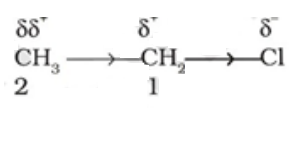
Inductive Effect When a covalent bond is formed between atoms of different electronegativity, the electron density is more towards the more electronegative atom of the bond. Such a shift of electron density results in a polar covalent bond. Bond polarity leads to various electronic effects in organic compounds. Let us consider cholorethane $(CH_3CH_2Cl)$ in which the C–Cl bond is a polar covalent bond. It is polarised in such a way that the carbon-1 gains some positive charge $(\delta+)$ and the chlorine some negative charge $(\delta-)$ The fractional electronic charges on the two atoms in a polar covalent bond are denoted by symbol (delta) and the shift of electron density is shown by an arrow that points from$(\delta+)$ to $(\delta-)$ end of the polar bond.

In turn carbon-1, which has developed partial positive charge $(\delta+)$draws some electron density towards it from the adjacent C-C bond. Consequently, some positive charge$(\delta\delta+)$develops on carbon-2 also, where $(\delta\delta+)$ symbolises relatively smaller positive charge as compared to that on carbon – 1. In other words, the polar C – Cl bond induces polarity in the adjacent bonds. Such polarisation of σ- bond caused by the polarisation of adjacent $σ-$bond is referred to as the inductive effect.
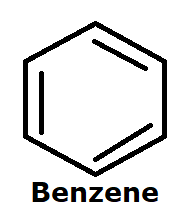
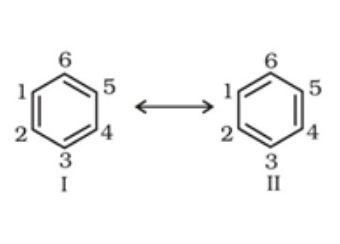
Resonance Structure There are many organic molecules whose behaviour cannot be explained by a single Lewis structure. An example is that of benzene. Its cyclic structure containing alternating C–C single and C=C double bonds shown is inadequate for explaining its characteristic properties.

As per the above representation, benzene should exhibit two different bond lengths, due to C–C single and C=C double bonds. However, as determined experimentally benzene has a uniform C–C bond distances of 139 pm, a value intermediate between the C–C single(154 pm) and C=C double (134 pm) bonds. Thus, the structure of benzene cannot be represented adequately by the above structure. Further, benzene can be represented equally well by the energetically identical structures I and II.

Therefore, according to the resonance theory the actual structure of benzene cannot be adequately represented by any of these structures, rather it is a hybrid of the two structures (I and II) called resonance structures. The resonance structures (canonical structures or contributing structures) are hypothetical and individually do not represent any real molecule. They contribute to the actual structure in proportion to their stability.
Resonance Effect The resonance effect is defined as ‘the polarity produced in the molecule by the interaction of two π-bonds or between a π-bond and lone pair of electrons present on an adjacent atom’. The effect is transmitted through the chain. There are two types of resonance or mesomeric effect designated as R or M effect. (i) Positive Resonance Effect (+R effect) In this effect, the transfer of electrons is away from an atom or substituent group attached to the conjugated system. This electron displacement makes certain positions in the molecule of high electron densities. This effect in aniline is shown as : (ii) Negative Resonance Effect (- R effect) This effect is observed when the transfer of Electrons is towards the atom or substituent Group attached to the conjugated system. For Example in nitrobenzene this electron Displacement can be depicted as : The atoms or substituent groups, which represent +R or –R electron displacement effects are as follows: +R effect: – halogen, –OH, –OR, –OCOR, –NH2, –NHR, –NR2, –NHCOR, – R effect: $– COOH, –CHO, > C = O, – CN, – NO_2$ The presence of alternate single and double bonds in an open chain or cyclic system is termed as a conjugated system. These systems often show abnormal behaviour. The examples are 1,3- butadiene, aniline and nitrobenzene etc. In such systems, the π-electrons are delocalised and the system develops polarity.
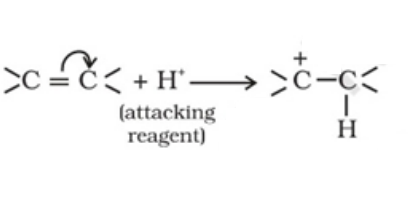
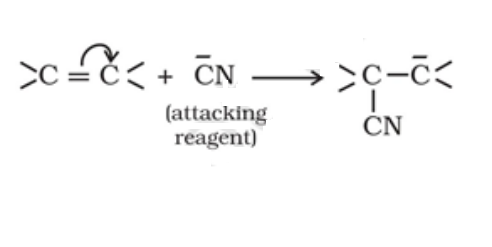
Electromeric Effect (E effect) It is a temporary effect. The organic compounds having a multiple bond (a double or triple bond) show this effect in the presence of an attacking reagent only. It is defined as the complete transfer of a shared pair of π-electrons to one of the atoms joined by a multiple bond on the demand of an attacking reagent. The effect is annulled as soon as the attacking reagent is removed from the domain of the reaction. It is represented by E and the shifting of the electrons is shown by a curved arrow ( ). There are two distinct types of electromeric effect.
a) Positive Electrometric Effect (+E effect)- In this effect the π−electrons of the multiple bond are transferred to that atom to which the reagent gets attached. For example

b) Negative Electromeric Effect (–E effect) -In this effect the $\pi-$ electrons of the multiple bond are transferred to that atom to which the attacking reagent does not get attached. For example: When inductive and electromeric effects operate in opposite directions, the electomeric effect predominates.
  1. A reagent that brings an electron pair to the reactive site is called a …
  1. nucleophile
  2. electrophile
  3. amphoteric
  4. amphophillic
  1. A reagent that takes away an electron pair from reactive site is called ..
  1. nucleophile
  2. electrophile
  3. amphoteric
  4. amphophillic
  1. The … effect is defined as the polarity produced in the molecule by the interaction of two π-bonds or between a π-bond and lone pair of electrons present on an adjacent atom.
  1. hindrance
  2. inductive
  3. resonance
  4. hyperconjunction
  1. –OH group, represent … electron displacement effect.
  1. M+
  2. M-
  3. R-
  4. R+
  1. – COOH group, represent … electron displacement effect.
  1. M+
  2. M-
  3. R-
  4. R+
Read the passage given below and answer the following questions from (i) to (v).
The first concreteexplanation for the phenomenon of the blackbody radiation was given byMax Planck in 1900.An ideal body, which emits and absorbs radiations of allfrequencies uniformly, is called a black bodyand the radiation emitted by such a body is called black body radiation. Max Planck arrived at a satisfactory relationshipbymaking an assumption that absorption andemmission of radiation arises from oscillatori.e., atoms in the wall of black body.He suggested that atoms andmolecules could emit or absorb energy onlyin discrete quantities and not in a continuousmanner. He gave the name quantum to thesmallest quantity of energy that can be emitted or absorbed in the form of electromagnetic radiation. The energy (E) of aquantum of radiation is proportionalto its frequency (ν) and is expressed byequation .
$E = hυ.$
The proportionality constant, ‘h’ is knownas Planck’s constant and has the value6.$626\times 10^{–34}$ Js.In 1887, H. Hertz performed a very interestingexperiment in which electrons (or electriccurrent) were ejected when certain metals (forexample potassium, rubidium, caesium etc.)were exposed to a beam of light. The phenomenon is calledPhotoelectric effect. The results observed inthis experiment were:
  1. The electrons are ejected from the metalsurface as soon as the beam of light strikesthe surface, i.e., there is no time lagbetween the striking of light beam and theejection of electrons from the metal surface.
  2. The number of electrons ejected is proportional to the intensity or brightness of light.
  3. For each metal, there is a characteristicminimum frequency,ν0(also known asthreshold frequency) below which photoelectric effect is not observed. At afrequency $ν >ν_0$, the ejected electrons comeout with certain kinetic energy. The kineticenergies of these electrons increase withthe increase of frequency of the light used.
The particle nature of light posed a dilemmafor scientists. Theonly way to resolve the dilemma was to acceptthe idea that light possesses both particle andwave-like properties, i.e., light has dualbehaviour. Depending on the experiment, wefind that light behaves either as a wave or as astream of particles. Whenever radiationinteracts with matter, it displays particle likeproperties in contrast to the wavelike properties (interference and diffraction), whichit exhibits when it propagates. This conceptwas totally alien to the way the scientiststhought about matter and radiation and it tookthem a long time to become convincedof itsvalidity.
The study of emission or absorption spectra is referred to as spectroscopy.The emission spectra of atoms inthe gas phase, on the other hand, do not showa continuous spread of wavelength from redto violet, rather they emit light only at specificwavelengths with dark spaces between them.Such spectra are called line spectra or atomicspectra.The Swedishspectroscopist, Johannes Rydberg, noted that
all series of lines in the hydrogen spectrumcould be described by the following expression:
$\bar{\text{v}}=109,677\big(\frac{1}{\text{n}^2_1}-\frac{1}{\text{n}^2_2}\big)\text{cm}^{-1}$
The value $109,677 cm^{–1}$​​​​​​​ is called theRydberg constant for hydrogen. The first fiveseries of lines that correspond to $n_1= 1, 2, 3,4, 5$ are known as Lyman, Balmer, Paschen,Bracket and Pfund series, respectively.Neils Bohr (1913) was the first to explainquantitatively the general features of thestructure of hydrogen atom and its spectrum.He used Planck’s concept of quantisation ofenergy. Though the theory is not the modernquantum mechanics, it can still be used to rationalize many points in the atomic structureand spectra. Bohr’s model for hydrogen atomis based on the following postulates:
  1. The electron in the hydrogen atom canmove around the nucleus in a circular pathof fixed radius and energy. These paths arecalled orbits, stationary states or allowedenergy states. These orbits are arrangedconcentrically around the nucleus.
  2. The energy of an electron in the orbit doesnot change with time. However, theelectron will move from a lower stationarystate to a higher stationary state whenrequired amount of energy is absorbedby the electron or energy is emitted when electron moves from higher stationarystate to lower stationary state. The energychange does not takeplace in a continuous manner.
  3. The frequency of radiation absorbed oremitted when transition occurs between two stationary states that differ in energyby $\triangle\text{E},$ is given by:
$\text{v}=\frac{\triangle\text{E}}{\text{h}}=\frac{\text{E}_2-\text{E}_1}{\text{h}}$

Where E1 and E2 are the energies of the lower and higher allowed energy statesrespectively. This expression is commonly known as Bohr’s frequency rule.
  1. The angular momentum of an electron isquantised. In a given stationary state itcan be expressed as in equation
$\text{m}_{\text{e}}\text{vr}=\text{n}.\frac{\text{h}}{2\pi}\text{n}=1,2,3.....$
  1. The first concrete explanation for the phenomenon of the black body radiation was given by ….in 1900.
  1. Max Planck
  2. De Broglie
  3. Albert Einstein,
  4. Niels Bohr
  1. Which of the following equation is Planck’s equation?
  1. $E= mc^2​​​​​​​$
  2. $E = hυ$
  3. $E= hc^2​​​​​​​$
  4. $E= vc^2.$
  1. What is nature of light?
  1. Wave
  2. Particle
  3. Wave and Particle
  4. None of above
  1. The value …. is called theRydberg constant for hydrogen.
  1. $109,674cm^{–1}​​​​​​​$
  2. $109,675cm^{–1}​​​​​​​$
  3. $109,676cm^{–1}​​​​​​​$
  4. $109,677cm^{–1}$​​​​​​​
  1. …was the first to explain quantitatively the general features of the structure of hydrogen atom and its spectrum.
  1. Max Planck
  2. De Broglie
  3. Albert Einstein,
  4. Niels Bohr