Question
Read the passage given below and answer the following questions from 1 to 5.
Oxidation state and trends in chemical Reactivity Due to small size of boron, the sum of its first Three ionization enthalpies is very high. This Prevents it to form +3 ions and forces it to form Only covalent compounds. But as we move from B to Al, the sum of the first three ionisation Enthalpies of Al considerably decreases, and Is therefore able to form $Al^{3+}$ ions. In fact, Aluminium is a highly electropositive metal. However, down the group, due to poor Shielding effect of intervening d and f orbitals, The increased effective nuclear charge holds ns Electrons tightly (responsible for inert pair Effect) and thereby, restricting their Participation in bonding. As a result of this, Only p-orbital electron may be involved in Bonding. In fact in Ga, In and Tl, both +1 and +3 oxidation states are observed. The relative Stability of +1 oxidation state progressively Increases for heavier elements: A l< Ga < In< Tl. In Thallium +1 oxidation state is predominant whereas the +3 oxidation state is highly Oxidising in character. The compounds in +1 oxidation state, as expected from energy Considerations, are more ionic than those in +3 oxidation state.
Important trends and anomalous properties of boron – certain important trends can be observed in the chemical behaviour of group 13 elements. The tri-chlorides, bromides and iodides of all these elements being covalent in nature are hydrolysed in water. Species like tetrahedral $[M(OH)_4]^–$ and octahedral $[M(H_2O)6]^{3+}$, except in boron, exist in aqueous medium. The monomeric trihalides, being electron deficient, are strong Lewis acids. Boron trifluoride easily reacts with Lewis bases such as $NH_3$ to complete octet around boron. It is due to the absence of d orbitals that the maximum covalence of B is 4. Since the d orbitals are available with Al and other elements, the maximum covalence can be expected beyond 4. Most of the other metal halides (e.g., $AlCl_3$) are dimerised through halogen bridging (e.g., $Al2Cl_6$). The metal species completes its octet by accepting electrons from halogen in these halogen bridged molecules.
i) Reactivity towards air Boron is unreactive in crystalline form. Aluminium forms a very thin oxide layer on The surface which protects the metal from Further attack. Amorphous boron and Aluminium metal on heating in air form $B_2O_3$ And $Al_2O_3$ respectively. With dinitrogen at high Temperature they form nitrides. The nature of these oxides varies down the Group. Boron trioxide is acidic and reacts with Basic (metallic) oxides forming metal borates. Aluminium and gallium oxides are amphoteric And those of indium and thallium are basic in Their properties.
ii) Reactivity towards acids and alkalies Boron does not react with acids and alkalies Even at moderate temperature; but aluminium Dissolves in mineral acids and aqueous alkalies And thus shows amphoteric character. Aluminium dissolves in dilute HCl and Liberates dihydrogen.
$2Al(s) + 6HCl (aq) \rightarrow 2Al_3^+ (aq) + 6Cl^– (aq) + 3H_2 (g)$
However, concentrated nitric acid renders Aluminium passive by forming a protective Oxide layer on the surface. Aluminium also reacts with aqueous alkali And liberates dihydrogen.
$2Al (s) + 2NaOH(aq) + 6H_2O(l) \rightarrow 2 Na+ [Al(OH)_4]^– (aq) + 3H_2(g)$
Sodium Tetrahydroxoaluminate(III).
iii) Reactivity towards halogens These elements react with halogens to form Trihalides (except TlI3). $2E(s) + 3 X_2 (g) \rightarrow 2EX_3 (s) (X = F, Cl, Br, I)$
Borax- It is the most important compound of boron. It is a white crystalline solid of formula $Na_2B_4O_7⋅10H_2O$. In fact it contains the Tetranuclear units and correct Formula; therefore, is $Na2 [B4O5 (OH) 4].8H2O$. Borax dissolves in water to give an alkaline Solution.
$Na_2B_4O7 + 7H_2O \rightarrow 2NaOH + 4H_3BO_3$
On heating, borax first loses water Molecules and swells up. On further heating it Turns into a transparent liquid, which solidifies Into glass like material known as borax Bead. $Na_2B_4O_7.10H_2O \rightarrow Na^2B_4O_7\rightarrow 2NaBO_2+ B2O_3​​​​​​​$
Metaborate Boric Anhydride The metaborates of many transition metals Have characteristic colours and, therefore, Borax bead test can be used to identify them In the laboratory. For example, when borax is Heated in a Bunsen burner flame with CoO on A loop of platinum wire, a blue coloured Co(BO2) 2 bead is formed.
Orthoboric acid, $H_3BO_3$ is a white crystalline Solid, with soapy touch. It is sparingly soluble In water but highly soluble in hot water. It can Be prepared by acidifying an aqueous solution Of borax.
$Na_2B_4O_7 + 2HCl + 5H_2O \rightarrow 2NaCl + 4B(OH)_3​​​​​​​$
It is also formed by the hydrolysis (reaction With water or dilute acid) of most boron Compounds (halides, hydrides, etc.). It has a layer structure in which planar $BO_3$ units are Joined by hydrogen.
  1. Boron is … in crystalline form.
  1. unreactive
  2. highly reactive
  3. less reactive
  4. only (a) or (c)
  1. Orthoboric acid is …
  1. Amorphous
  2. Crystalline
  3. Polyamorphous
  4. None of above
  1. Aluminium and gallium oxides are … in their properties.
  1. acidic
  2. Basic
  3. amphoteric
  4. None of above
  1. Indium and thallium are … in their properties.
  1. acidic
  2. Alkali
  3. amphoteric
  4. basic
  1. Aluminium is a highly … metal.
  1. electronegative
  2. Neutral
  3. electropositive
  4. None of above

Answer

  1. (a) unreactive
  2. (b) crystalline
  3. (c) amphoteric
  4. (d) basic
  5. (c) electropositive

Need a full question paper?

Generate a complete, print-ready paper with questions like this in minutes — across 16+ boards, with answer keys.

Start Generating Free

Similar questions

Read the passage given below and answer the following questions from 1 to 5.
F Wohler synthesised an organic compound, urea from an inorganic compound, ammonium cyanate.
The knowledge of fundamental concepts of molecular structure helps in understanding and predicting the properties of organic compounds. You have already learnt theories of valency and molecular structure. Also, you already know that tetravalence of carbon and the formation of covalent bonds by it are explained in terms of its electronic configuration and the hybridisation of s and p orbitals. It may be recalled that formation and the shapes of molecules like methane $(CH_4)$, ethene $(C_2H_4)$, ethyne $(C_2H_2)$ are explained in terms of the use of $sp^3, sp^2$ and sp hybrid orbitals by carbon atoms in the respective molecules. Hybridisation influences the bond length and bond enthalpy (strength) in compounds. The sp hybrid orbital contains more s character and hence it is closer to its nucleus and forms shorter and stronger bonds than the sp3 hybrid orbital.The sp2 hybrid orbital is intermediate in s character between sp and sp3 and, hence, the length and enthalpy of the bonds it forms, are also intermediate between them. The change in hybridisation affects the electronegativity of carbon. The greater the s character of the hybrid orbitals, the greater is the electronegativity. Thus, a carbon atom having an sp hybrid orbital with 50% s character is more electronegative than that possessing sp2 or sp3 hybridised orbitals. This relative electronegativity is reflected in several physical and chemical properties of the molecules concerned, about which you will learn in later units.
Characteristic Features of π Bonds In a π (pi) bond formation, parallel orientation of the two p orbitals on adjacent atoms is necessary for a proper sideways overlap. Thus, in $H_2C=CH_2$ molecule all the atoms must be in the same plane. The p orbitals are mutually parallel and both the p orbitals are perpendicular to the plane of the molecule. Rotation of one $CH_2$ fragment with respect to other interferes with maximum overlap of p orbitals and, therefore, such rotation about carbon-carbon double bond (C=C) is restricted. The electron charge cloud of the π bond is located above and below the plane of bonding atoms. This results in the electrons being easily available to the attacking reagents. In general, π bonds provide the most reactive centres in the molecules containing multiple bonds.

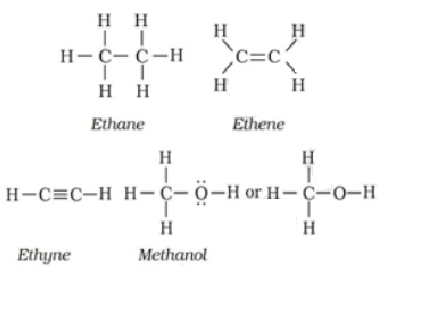
Structures of organic compounds are represented in several ways. The Lewis structure or dot structure, dash structure, condensed structure and bond line structural formulas are some of the specific types. The Lewis structures, however, can be simplified by representing the two-electron covalent bond by a dash (–). Such a structural formula focuses on the electrons involved in bond formation. A single dash represents a single bond, double dash is used for double bond and a triple dash represents triple bond. Lone- pairs of electrons on heteroatoms (e.g., oxygen, nitrogen, sulphur, halogens etc.) may or may not be shown. Thus, ethane $(C_2H_6)$, ethene $(C_2H_4)$, ethyne $(C_2H_2)$ and methanol $(CH_3OH)$ can be represented by the following structural formulas. Such structural representations are called complete structural formulas.
These structural formulas can be further abbreviated by omitting some or all of the dashes representing covalent bonds and by indicating the number of identical groups attached to an atom by a subscript. The resulting expression of the compound is called a condensed structural formula. Thus, ethane, ethene, ethyne and methanol can be written as:

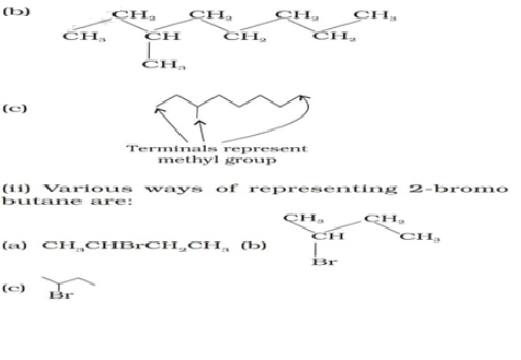
Similarly, $CH_3CH_2CH_2CH_2CH_2CH_2CH_2CH_3$ can be further condensed to $CH_3(CH_2)_6CH_3$. For further simplification, organic chemists use another way of representing the structures, in which only lines are used. In this bond-line structural representation of organic compounds, carbon and hydrogen atoms are not shown and the lines representing carbon-carbon bonds are drawn in a zig-zag fashion. The only atoms specifically written are oxygen, chlorine, nitrogen etc. The terminals denote methyl $(–CH_3)$ groups (unless indicated otherwise by a functional group), while the line junctions denote carbon atoms bonded to appropriate number of hydrogens required to satisfy the valency of the carbon atoms. Some of the examples are represented as follows: (i) 3-Methyloctane can be represented in various forms as:
  1. … synthesised an organic compound, urea from an inorganic compound, ammonium cyanate.
  1. Wohler
  2. Adams
  3. Roger
  4. William Evans
  1. Dot structure is also known as …
  1. Zig zag structure
  2. Lewis structure
  3. Line structure
  4. Bond line structure
  1. Terminals in zigzig structure denotes … Group.
  1. Bromyl
  2. Propyl
  3. Methyl
  4. Pentyl
  1. Triple dash represents …
  1. Single bond
  2. Double bond
  3. Triple bond
  4. Equivalent bond
  1. Lewis structures representing the two-electron covalent bond by …
  1. .
  2. :
  3. ?
There are many observable patterns in thephysical and chemical properties of elementsas we descend in a group or move across aperiod in the Periodic Table.Atomic Radius the determination of the atomic sizecannot be precise. In other words, there is no practical way by which the size of an individualatom can be measured. However, an estimateof the atomic size can be made by knowing thedistance between the atoms in the combinedstate. One practical approach to estimate thesize of an atom of a non-metallic element is tomeasure the distance between two atoms whenthey are bound together by a single bond in acovalent molecule and from this value, the“Covalent Radius” For metals, we define theterm “Metallic Radius” which is taken as halfthe internuclear distance separating the metalcores in the metallic crystal. Atomic Radius to refer to both covalent ormetallic radius depending on whether theelement is a non-metal or a metal. Atomic radiican be measured by X-ray or otherspectroscopic methods. The atomic size generallydecreases across a period. It is because within the period the outerelectrons are in the same valence shell and theeffective nuclear charge increases as the atomicnumber increases resulting in the increasedattraction of electrons to the nucleus.Note that the atomic radii of noble gasesAre not considered here. Being monoatomic,Their (non-bonded radii) values are very large.In fact radii of noble gases should be comparednot with the covalent radii but with the van derWaals radii of other elements. The removal of an electron from an atom resultsin the formation of a cation, whereas gain ofan electron leads to an anion. The ionic radiican be estimated by measuring the distancesbetween cations and anions in ionic crystals.In general, the ionic radii of elements exhibitthe same trend as the atomic radii. A cation issmaller than its parent atom because it hasfewer electrons while its nuclear charge remainsthe same. The size of an anion will be largerthan that of the parent atom because theaddition of one or more electrons would resultin increased repulsion among the electronsand a decrease in effective nuclear charge. When we find some atoms and ions whichcontain the same number of electrons, we callthem isoelectronic species. For example,$O2–, F–, Na+$ and $Mg2+$ have the same number ofelectrons (10). Their radii would be differentbecause of their different nuclear charges.A quantitative measure of the tendency of anelement to lose electron is given by itsIonization Enthalpy. It represents the energyrequired to remove an electron from an isolatedgaseous atom (X) in its ground state. The ionization enthalpy is expressed inunits of kJ mol–1. We can define the secondionization enthalpy as the energy required toremove the second most loosely boundelectron The first ionization enthalpies of elementshaving atomic numbers up to 60 are plotted then The periodicity of the graph is quitestriking. You will find maxima at the noble gaseswhich have closed electron shells and verystable electron configurations. On the otherhand, minima occur at the alkali metals andtheir low ionization enthalpies can be correlated with their high reactivity. In addition, you willnotice two trends the first ionization enthalpygenerally increases as we go across a periodand decreases as we descend in a group. Electron Gain Enthalpy. when an electron is added to a neutral gaseousatom (x) to convert it into a negative ion, theenthalpy change accompanying the process isdefined as the electron gain enthalpy (∆egh).Electron gain enthalpy provides a measure ofthe ease with which an atom adds an electronto form anion. electron gain enthalpies have largenegative values toward the upper right of theperiodic table preceding the noble gases.The variation in electron gain enthalpies ofelements is less systematic than for ionizationenthalpies. As a general rule, electron gainenthalpy becomes more negative with increasein the atomic number across a period. Theeffective nuclear charge increases from left toright across a period and consequently it willbe easier to add an electron to a smaller atomsince the added electron on an average wouldbe closer to the positively charged nucleus. ElectronegativityA qualitative measure of the ability of an atomin a chemical compound to attract sharedelectrons to itself is called electronegativity.Unlike ionization enthalpy and electron gainenthalpy, it is not a measureable quantity.However, a number of numerical scales ofelectronegativity of elements viz., Pauling scale,Mulliken-Jaffe scale, Allred-Rochow scale havebeen developed. The one which is the most widely used is the Pauling scale. Electronegativity generallyincreases across a period from leftto right (say from lithium tofluorine) and decrease down a group(say from fluorine to astatine) inthe periodic table. Non-metallic elements have strong tendencyto gain electrons. Therefore, electronegativityis directly related to that non-metallicproperties of elements. It can be furtherextended to say that the electronegativity isinversely related to the metallic properties of elements. Thus, the increase inelectronegativities across a period isaccompanied by an increase in non-metallicproperties (or decrease in metallic properties)of elements. Similarly, the decrease inelectronegativity down a group is accompanied by a decrease in non-metallic properties (orincrease in metallic properties) of elements.
  1. The atomic size generally … across a period.
  1. Increases
  2. Decreases
  3. Remains Constant
  4. None of above
  1. The ionization enthalpy is expressed in units of ….
  1. $kJ mol^{–1}$
  2. $mole kJ^{-1}$
  3. $mole kJ$
  4. $-kJ mol^{-1}$
  1. Which of the following is/are numerical scales of electronegativity of elements.
  1. Pauling scale
  2. Mulliken-Jaffe scale
  3. Allred-Rochow scale
  4. All the above
  1. The … in electronegativity down a group is accompanied by a … in non-metallic properties.
  1. Increase, Decrease
  2. Decrease, Increase
  3. Decrease, Decrease
  4. Increase , Increase
  1. Electronegativity generally … across a period from left to right and … down a group in the periodic table.
  1. Increase, Decrease
  2. Decrease, Increase
  3. Decrease, Decrease
  4. Increase, Increase
Read the passage given below and answer the following questions from (i) to (v).
The first concreteexplanation for the phenomenon of the blackbody radiation was given byMax Planck in 1900.An ideal body, which emits and absorbs radiations of allfrequencies uniformly, is called a black bodyand the radiation emitted by such a body is called black body radiation. Max Planck arrived at a satisfactory relationshipbymaking an assumption that absorption andemmission of radiation arises from oscillatori.e., atoms in the wall of black body.He suggested that atoms andmolecules could emit or absorb energy onlyin discrete quantities and not in a continuousmanner. He gave the name quantum to thesmallest quantity of energy that can be emitted or absorbed in the form of electromagnetic radiation. The energy (E) of aquantum of radiation is proportionalto its frequency (ν) and is expressed byequation .
$E = hυ.$
The proportionality constant, ‘h’ is knownas Planck’s constant and has the value6.$626\times 10^{–34}$ Js.In 1887, H. Hertz performed a very interestingexperiment in which electrons (or electriccurrent) were ejected when certain metals (forexample potassium, rubidium, caesium etc.)were exposed to a beam of light. The phenomenon is calledPhotoelectric effect. The results observed inthis experiment were:
  1. The electrons are ejected from the metalsurface as soon as the beam of light strikesthe surface, i.e., there is no time lagbetween the striking of light beam and theejection of electrons from the metal surface.
  2. The number of electrons ejected is proportional to the intensity or brightness of light.
  3. For each metal, there is a characteristicminimum frequency,ν0(also known asthreshold frequency) below which photoelectric effect is not observed. At afrequency $ν >ν_0$, the ejected electrons comeout with certain kinetic energy. The kineticenergies of these electrons increase withthe increase of frequency of the light used.
The particle nature of light posed a dilemmafor scientists. Theonly way to resolve the dilemma was to acceptthe idea that light possesses both particle andwave-like properties, i.e., light has dualbehaviour. Depending on the experiment, wefind that light behaves either as a wave or as astream of particles. Whenever radiationinteracts with matter, it displays particle likeproperties in contrast to the wavelike properties (interference and diffraction), whichit exhibits when it propagates. This conceptwas totally alien to the way the scientiststhought about matter and radiation and it tookthem a long time to become convincedof itsvalidity.
The study of emission or absorption spectra is referred to as spectroscopy.The emission spectra of atoms inthe gas phase, on the other hand, do not showa continuous spread of wavelength from redto violet, rather they emit light only at specificwavelengths with dark spaces between them.Such spectra are called line spectra or atomicspectra.The Swedishspectroscopist, Johannes Rydberg, noted that
all series of lines in the hydrogen spectrumcould be described by the following expression:
$\bar{\text{v}}=109,677\big(\frac{1}{\text{n}^2_1}-\frac{1}{\text{n}^2_2}\big)\text{cm}^{-1}$
The value $109,677 cm^{–1}$​​​​​​​ is called theRydberg constant for hydrogen. The first fiveseries of lines that correspond to $n_1= 1, 2, 3,4, 5$ are known as Lyman, Balmer, Paschen,Bracket and Pfund series, respectively.Neils Bohr (1913) was the first to explainquantitatively the general features of thestructure of hydrogen atom and its spectrum.He used Planck’s concept of quantisation ofenergy. Though the theory is not the modernquantum mechanics, it can still be used to rationalize many points in the atomic structureand spectra. Bohr’s model for hydrogen atomis based on the following postulates:
  1. The electron in the hydrogen atom canmove around the nucleus in a circular pathof fixed radius and energy. These paths arecalled orbits, stationary states or allowedenergy states. These orbits are arrangedconcentrically around the nucleus.
  2. The energy of an electron in the orbit doesnot change with time. However, theelectron will move from a lower stationarystate to a higher stationary state whenrequired amount of energy is absorbedby the electron or energy is emitted when electron moves from higher stationarystate to lower stationary state. The energychange does not takeplace in a continuous manner.
  3. The frequency of radiation absorbed oremitted when transition occurs between two stationary states that differ in energyby $\triangle\text{E},$ is given by:
$\text{v}=\frac{\triangle\text{E}}{\text{h}}=\frac{\text{E}_2-\text{E}_1}{\text{h}}$

Where E1 and E2 are the energies of the lower and higher allowed energy statesrespectively. This expression is commonly known as Bohr’s frequency rule.
  1. The angular momentum of an electron isquantised. In a given stationary state itcan be expressed as in equation
$\text{m}_{\text{e}}\text{vr}=\text{n}.\frac{\text{h}}{2\pi}\text{n}=1,2,3.....$
  1. The first concrete explanation for the phenomenon of the black body radiation was given by ….in 1900.
  1. Max Planck
  2. De Broglie
  3. Albert Einstein,
  4. Niels Bohr
  1. Which of the following equation is Planck’s equation?
  1. $E= mc^2​​​​​​​$
  2. $E = hυ$
  3. $E= hc^2​​​​​​​$
  4. $E= vc^2.$
  1. What is nature of light?
  1. Wave
  2. Particle
  3. Wave and Particle
  4. None of above
  1. The value …. is called theRydberg constant for hydrogen.
  1. $109,674cm^{–1}​​​​​​​$
  2. $109,675cm^{–1}​​​​​​​$
  3. $109,676cm^{–1}​​​​​​​$
  4. $109,677cm^{–1}$​​​​​​​
  1. …was the first to explain quantitatively the general features of the structure of hydrogen atom and its spectrum.
  1. Max Planck
  2. De Broglie
  3. Albert Einstein,
  4. Niels Bohr
When anions and cations approach each other, the valence shell of anions are pulled towards the cation nucleus and thus, the shape of the anion is deformed. The phenomenon of deformation of anion by a cation is known as polarization and the ability of the cation to polarize the anion is called as polarizing power of cation. Due to polarization, sharing of electrons occurs between two ions to some extent and the bond shows some covalent character.
The magnitude of polarization depends upon a number of factors.

1. Out of $AlCl _3$ and $AlI _3$ which halides show maximum polarization? (1)
2. Out of $AlCl _3$ and $CaCl _2$ which one is more covalent in nature? (1)
3. The non-aqueous solvent like ether is added to the mixture of $LiCl , NaCl$ and KCl . Which will be extracted into the ether? (2)
OR
Out of $CaF _2$ and $CaI _2$ which one has a minimum melting point? (2)
The s-Block Elements The elements of Group 1 (alkali metals) and Group 2 (alkaline earth metals) which have ns1and ns2 outermost electronic configuration belong to the s-Block Elements. They are all reactive metals with low ionization enthalpies. They lose the outermost electron(s) readily to form 1+ ion (in the case of alkali metals) or 2+ ion (in the case of alkaline earth metals). The metallic character and the reactivity increase as we go down the group. Because of high reactivity they are never found pure in nature. The compounds of the s-block elements, with the exception of those of lithium and beryllium are predominantly ionic. The p-Block Elements comprise those belonging to Group 13 to 18 and these together with the s-Block Elements are called the Representative Elements or Main Group Elements. The outermost electronic configuration varies from ns2np1 to ns2np6 in each period. At the end of each period is a noble gas element with a closed valence shell ns2np6 configuration. All the orbitals in the valence shell of the noble gases are completely filled by electrons and it is very difficult to alter this stable arrangement by the addition or removal of electrons. The noble gases thus exhibit very low chemical reactivity. Preceding the noble gas family are two chemically important groups of non-metals. They are the halogens (Group 17) and the chalcogens (Group 16).The non-metallic character increases as we move from left to right across a period and metallic character increases as we go down the group. These are the elements of Group 3 to 12 in the centre of the Periodic Table. These are characterised by the filling of inner d orbitals by electrons and are therefore referred to as d-Block Elements. These elements have the general outer electronic configuration (n-1)d1-10ns0-2 . They are all metals. They mostly form coloured ions, exhibit variable valence (oxidation states), paramagnetism and oftenly used as catalysts. However, Zn, Cd and Hg which have the electronic configuration, (n-1) d10ns2 do not show most of the properties of transition elements. In a way, transition metals form a bridge between the chemically active metals of s-block elements and the less active elements of Groups 13 and 14 and thus take their familiar name “Transition Elements”.The two rows of elements at the bottom of the Periodic Table, called the Lanthanoids, Ce(Z = 58) – Lu(Z = 71) and Actinoids, Th(Z = 90) – Lr (Z = 103) are characterised by the outer electronic configuration (n-2)f 1-14 (n-1)d 0–1ns2 . The last electron added to each element is filled in f- orbital. These two series of elements are hence called the Inner- Transition Elements (f-Block Elements). They are all metals. Within each series, the properties of the elements are quite similar. The chemistry of the early actinoids is more complicated than the corresponding lanthanoids, due to the large number of oxidation states possible for these actinoid elements. Actinoid elements are radioactive. Many of the actinoid elements have been made only in nanogram quantities or even less by nuclear reactions and their chemistry is not fully studied. The elements after uranium are called Transuranium Elements. The elements can be divided into Metals and Non-Metals. In contrast, non-metals are located at the top right hand side of the Periodic Table. The elements become more metallic as we go down a group; the non- metallic character increases as one goes from left to right across the Periodic Table. Periodic Table show properties that are characteristic of both metals and non- metals. These elements are called Semi-metals or Metalloids.
  1. Alkali metal and alkaline earth metal belongs to ..
  1. S – block
  2. P – block
  3. D – block
  4. F – block
  1. The metallic character and the reactivity … as we go down the group.
  1. Decreases
  2. Increases
  3. Remains Constant
  4. None of Above
  1. Group … Elements known as chalcogens.
  1. 12
  2. 14
  3. 16
  4. 18
  1. Elements Ce(Z = 58) to Lu(Z = 71) are known as:
  1. Halogens
  2. Chalcogens
  3. Actinoids
  4. Lanthenoids
  1. The elements after uranium are called … Elements.
  1. Halogens
  2. Chalcogens
  3. Actinoids
  4. Transuranium
Read the passage given below and answer the following questions from 1 to 5.
Alkynes– Like alkenes, alkynes are also unsaturated hydrocarbons. They contain at least one triple bond between two carbon atoms. The number of hydrogen atoms is still less in alkynes as compared to alkenes or alkanes. Their general formula is $C_nH_{2n–2}.$ The first stable member of alkyne series is ethyne which is popularly known as acetylene. Acetylene is used for arc welding purposes in the form of oxyacetylene flame obtained by mixing acetylene with oxygen gas. Alkynes are starting materials for a large number of organic compounds. Hence, it is interesting to study this class of organic compounds.
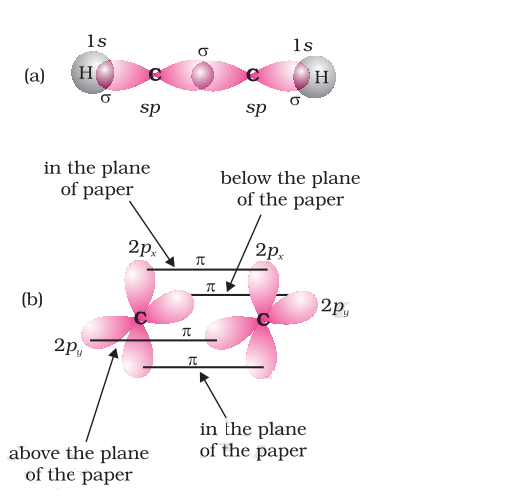
Structure of Triple Bond Ethyne is the simplest molecule of alkyne series. Structure of ethyne is shown in Figure. Each carbon atom of ethyne has two sp hybridised orbitals. Carbon-carbon sigma $(\sigma)$ bond is obtained by the head-on overlapping of the two sp hybridised orbitals of the two carbon atoms. The remaining sp hybridised orbital of each carbon atom undergoes overlapping along the internuclear axis with the 1s orbital of each of the two hydrogen atoms forming two C-H sigma bonds. H-C-C bond angle is of $180^\circ .$

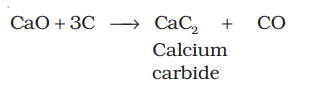
Each carbon has two unhybridised p orbitals which are perpendicular to each other as well as to the plane of the C C sigma bond. The $2 p$ orbitals of one carbon atom are parallel to the $2 p$ orbitals of the other carbon atom, which undergo lateral or sideways overlapping to form two pi ( $\pi$ ) bonds between two carbon atoms. Thus ethyne molecule consists of one $C - C \sigma$ bond, two $C - H \sigma$ bonds and two $C - C \pi$ bonds. The strength of $C \equiv C$ bond (bond enthalpy $823 kJ mol ^{-1}$ ) is more than those of $C = C$ bond (bond enthalpy $681 kJ mol ^{-1}$ ) and $C - C$ bond (bond enthalpy 348 kJ $mol ^{-1}$ ). The $C \equiv C$ bond length is shorter $(120 pm )$ than those of $C = C (133 pm )$ and $C - C (154 pm )$. Electron cloud between two carbon atoms is cylindrically symmetrical about the internuclear axis. Thus, ethyne is a linear molecule. Preparation - From calcium carbide: On industrial scale, ethyne is prepared by treating calcium carbide with water. Calcium carbide is prepared by heating quick lime with coke. Quick lime can be obtained by heating limestone as shown in the following reactions:

$\text{C}\text{aC}_2+2\text{H}_2\text{O}\rightarrow\text{Ca}(\text{OH})_2+\text{C}_2\text{H}_2$
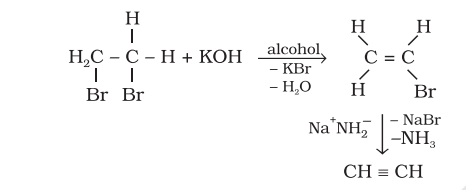
From vicinal dihalides: Vicinal dihalides on treatment with alcoholic potassium hydroxide undergo dehydrohalogenation. One molecule of hydrogen halide is eliminated to form alkenyl halide which on treatment with sodamide gives alkyne.


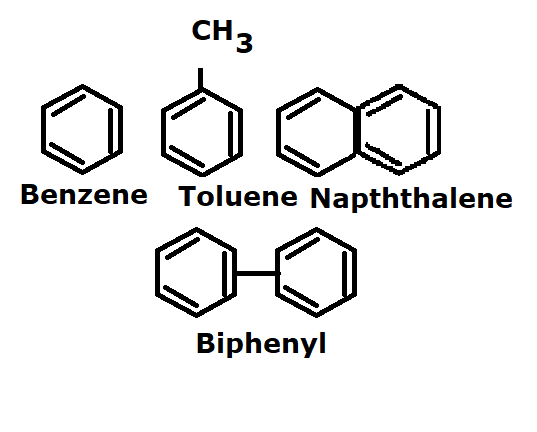
Aromatic hydrocarbon- These hydrocarbons are also known as ‘arenes’. Since most of them possess pleasant odour, the class of compounds was named as ‘aromatic compounds’. Most of such compounds were found to contain benzene ring. Benzene ring is highly unsaturated but in a majority of reactions of aromatic compounds, the unsaturation of benzene ring is retained. However, there are examples of aromatic hydrocarbons which do not contain a benzene ring but instead contain other highly unsaturated ring. Aromatic compounds containing benzene ring are known as benzenoids and those not containing a benzene ring are known as non-benzenoids. Some examples of arenes are given below:

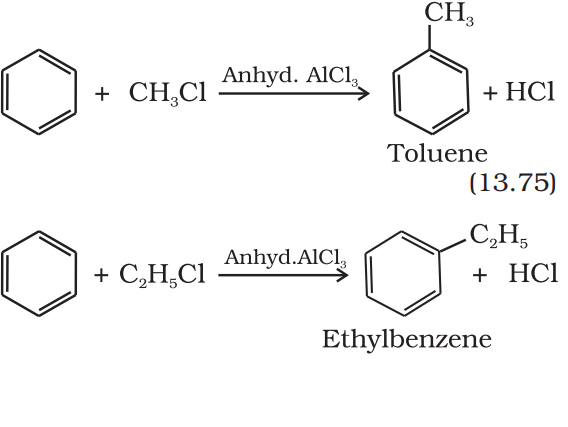
Friedel-Crafts alkylation reaction: When benzene is treated with an alkyl halide in the presence of anhydrous aluminium chloride, alkylbenene is formed.
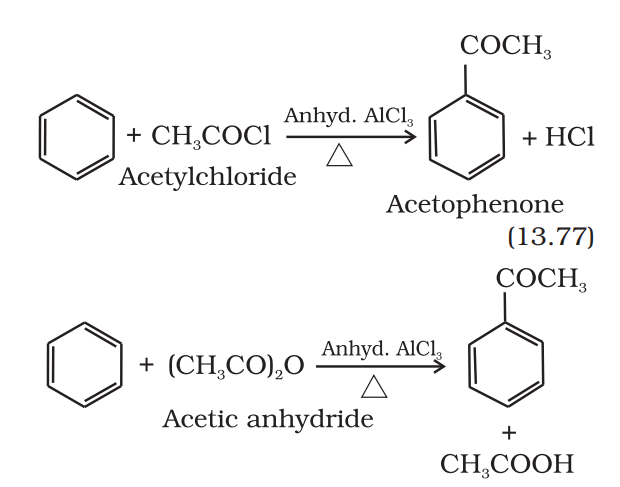
Friedel-Crafts acylation reaction: The reaction of benzene with an acyl halide or acid anhydride in the presence of Lewis acids ($AlCl_3$) yields acyl benzene.

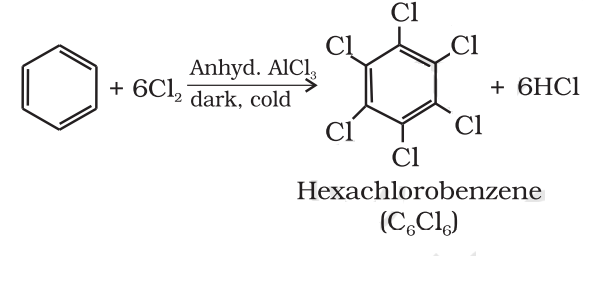
If excess of electrophilic reagent is used, further substitution reaction may take place in which other hydrogen atoms of benzene ring may also be successively replaced by the electrophile. For example, benzene on treatment with excess of chlorine in the presence of anhydrous $AlCl_3$​​​​​​​ can be chlorinated to hexachlorobenzene $(C_6Cl_6)​​​​​​​$​​​​​​​
  1. The general formula of Alkynes is …?
  1. $C_nH_{2n–2}$​​​​​​​
  2. $C_nH_{2n–2}$
  3. $C_nH_{2n–2}$
  4. $C_nH_{2n–2}$
  1. Calcium carbide is prepared by heating quick lime with …?
  1. Backing soda
  2. Coke
  3. Carbide
  4. Salt
  1. Vicinal dihalides on treatment with alcoholic potassium hydroxide undergo …?
  1. Dehydrogenation.
  2. Hydrohalogenation.
  3. Dehydrohalogenation
  4. Dehalogenation.
  1. The bond enthalpy of C ≡ C is …?
  1. 523 kJ mol
  2. 623 kJ mol
  3. 723 kJ mol
  4. 823 kJ mol
  1. The C ≡ C bond length is …?
  1. 1200 pm
  2. 620 pm
  3. 240 pm
  4. 120 pm
When anions and cations approach each other, the valence shell of anions are pulled towards the cation nucleus and thus, the shape of the anion is deformed. The phenomenon of deformation of anion by a cation is known as polarization and the ability of the cation to polarize the anion is called as polarizing power of cation. Due to polarization, sharing of electrons occurs between two ions to some extent and the bond shows some covalent character.
The magnitude of polarization depends upon a number of factors.

1. Out of $AlCl _3$ and $AlI _3$ which halides show maximum polarization?
2. Out of $AlCl _3$ and $CaCl _2$ which one is more covalent in nature?
3. The non-aqueous solvent like ether is added to the mixture of $LiCl , NaCl$ and KCl . Which will be extracted into the ether?
OR
Out of $CaF _2$ and $CaI _2$ which one has a minimum melting point?
Read the passage given below and answer the following questions from (i) to (v).
Chemical properties of a substance do not change withthe change of its physical state; but rate of chemicalreactions do depend upon the physical state. Many timesin calculations while dealing with data of experiments werequire knowledge of the state of matter. Therefore, itbecomes necessary for a chemist to know the physical laws which govern the behaviour of matter indifferent states. Intermolecular forces are the forces ofattraction and repulsion between interactingparticles (atoms and molecules). This termdoes not include the electrostatic forces thatexist between the two oppositely charged ionsand the forces that hold atoms of a moleculetogether i.e., covalent bonds.Attractive intermolecular forces are knownas van der Waals forces, in honour of Dutchscientist Johannes van der Waals (1837-1923) . van der Waals forces vary considerablyin magnitude and include dispersion forcesor London forces, dipole-dipole forces, anddipole-induced dipole forces. A particularlystrong type of dipole-dipole interaction ishydrogen bonding. Only a few elements canparticipate in hydrogen bond formation, therefore it is treated as a separatecategory.
Atoms and nonpolar molecules are electricallysymmetrical and have no dipole momentbecause their electronic charge cloud issymmetrically distributed. But a dipole maydevelop momentarily even in such atoms andmolecules. The temporary dipoles of two different atomattract each other. Similarly temporary dipolesare induced in molecules also. This force ofattraction was first proposed by the Germanphysicist Fritz London, and for this reasonforce of attraction between two temporary dipoles is known as London force. dispersion force forces are always attractive and interactionenergy is inversely proportional to the sixthpower of the distance between two interactingparticles (i.e.,$1/r ^6$ where r is the distancebetween two particles). These forces areimportant only at short distances (~500 pm)and their magnitude depends on thepolarisability of the particle.
Dipole-dipole forces act between the moleculespossessing permanent dipole. Ends of thedipoles possess “partial charges” and thesecharges are shown by Greek letter delta (δ).Partial charges are always less than the unitelectronic charge $(1.6\times 10^{–19} C)$. The polarmolecules interact with neighbouringmolecules. This interactionis stronger than the London forces but isweaker than ion-ion interaction because onlypartial charges are involved. The attractiveforce decreases with the increase of distancebetween the dipoles. As in the above case herealso, the interaction energy is inverselyproportional to distance between polarmolecules. Dipole-dipole interaction energybetween stationary polar molecules is proportional to $1/r^3$ and thatbetween rotating polar molecules is proportional to $1/r ^6$​​​​​​​, where r is the distancebetween polar molecules.
Dipole–Induced Dipole Forcesare type of attractive forces operate betweenthe polar molecules having permanent dipoleand the molecules lacking permanent dipole.Permanent dipole of the polar moleculeinduces dipole on the electrically neutralmolecule by deforming its electronic cloud. Thus an induced dipole is developedin the other molecule. In this case alsointeraction energy is proportional to $1/r ^6$​​​​​​​​​​​​​​ where r is the distance between twomolecules. Induced dipole moment dependsupon the dipole moment present in thepermanent dipole and the polarisability of theelectrically neutral molecule.
  1. Partial charges are always less than the unit electronic charge:
  1. $(1.6\times 10^{–19} C)$
  2. $(1.6\times 10^{–18} C)$
  3. $(1.6\times 10^{–17}C)$
  4. $(1.6\times 10^{–16} C)$
  1. Temporary dipoles are induced in molecules also. ,this force of attraction was first proposed by:
  1. Johannes van der Waals
  2. Fritz London
  3. Robert Boyle
  4. Joseph Lewis Gay Lussac
  1. Atoms and nonpolar molecules are electrically:
  1. Compositional
  2. Unsymmetrical
  3. Symmetrical
  4. All the above
  1. Partial Charges denoted by greek letter ….
  1. $\in$
  2. $\zeta$
  3. $\delta$
  4. $\eta$
  1. The attractive force … with the … of distance between the dipoles.
  1. Increase, increase
  2. Decrease, decrease
  3. Increase, decrease
  4. Decreases, increase
Read the passage given below and answer the following questions from $1$ to $5$. Lithium metal is used to make useful alloys, for example with lead to make ‘white metal’ Bearings for motor engines, with aluminium to make aircraft parts, and with magnesium to make armour plates. It is used in Thermonuclear reactions. Lithium is also used to make electrochemical cells. Sodium is used To make a Na/Pb alloy needed to make $PbEt_4$​​​​​​​ and $PbMe_4​​​​​​​$​​​​​​​. These organolead compounds were Earlier used as anti-knock additives to petrol, But nowadays vehicles use lead-free petrol. Liquid sodium metal is used as a coolant in Fast breeder nuclear reactors. Potassium has a vital role in biological systems. Potassium Chloride is used as a fertilizer. Potassium Hydroxide is used in the manufacture of soft Soap. It is also used as an excellent absorbent of carbon dioxide. Caesium is used in devising Photoelectric cells. Points of Difference between Lithium and other Alkali Metals –
i) Lithium is much harder. Its m.p. and b.p. are higher than the other alkali metals.
ii) Lithium is least reactive but the strongest Reducing agent among all the alkali metals. On combustion in air it forms mainly Monoxide, $Li_2O$ and the nitride, $Li_3N$ unlike Other alkali metals.
 iii) LiCl is deliquescent and crystallises as a Hydrate, LiCl.$2H_2O$ whereas other alkali Metal chlorides do not form hydrates.
iv) Lithium hydrogencarbonate is not Obtained in the solid form while all other Elements form solid hydrogencarbonate.
v) Lithium unlike other alkali metals forms No ethynide on reaction with ethyne.
vi) Lithium nitrate when heated gives lithium Oxide, $Li_2O$, whereas other alkali metal Nitrates decompose to give the Corresponding nitrite. $4\text{LiNO}_3\rightarrow2\text{L}\text{i}_2\text{O}+4\text{NO}_2+\text{O}_2$ $2\text{NaNO}_3\rightarrow2\text{NaNO}_2+\text{O}_2$ vii) LiF and $Li_2O$ are comparatively much less Soluble in water than the corresponding Compounds of other alkali metals. Sodium carbonate is generally prepared by Solvay Process. In this process, advantage is Taken of the low solubility of sodium Hydrogencarbonate whereby it gets Precipitated in the reaction of sodium chloride with ammonium hydrogencarbonate. The Latter is prepared by passing $CO_2​​​​​​​$​​​​​​​ to a Concentrated solution of sodium chloride Saturated with ammonia, where ammonium Carbonate followed by ammonium Hydrogencarbonate are formed. The equations For the complete process may be written as $2\text{NH}_3+\text{H}_2\text{O}+\text{CO}_2\rightarrow{\text{(NH}_4)_2}\text{CO}_3$ $(\text{NH}_4)_2\text{CO}_3+\text{H}_2\text{O}+\text{CO}_2\rightarrow2\text{NH}_4\text{HCO}_3$ $\text{NH}_4\text{HCO}_3+\text{NaCl}\rightarrow\text{NH}_4\text{Cl}+\text{NaHCO}_3$ Sodium hydrogencarbonate crystal Separates. these are heated to give sodium Carbonate. The most abundant source of sodium chloride is sea water which contains $2.7$ to $2.9 \%$ by Mass of the salt. In tropical countries like India, Common salt is generally obtained by Evaporation of sea water. Approximately $50$ Lakh tons of salt are produced annually in India by solar evaporation. Crude sodium Chloride, generally obtained by crystallisation Of brine solution, contains sodium sulphate, Calcium sulphate, calcium chloride and Magnesium chloride as impurities. Calcium Chloride, $CaCl_2$​​​​​​​, and magnesium chloride, $MgCl_2$​​​​​​​ are impurities because they are Deliquescent (absorb moisture easily from the Atmosphere). To obtain pure sodium chloride, The crude salt is dissolved in minimum amount Of water and filtered to remove insoluble Impurities. The solution is then saturated with Hydrogen chloride gas. Crystals of pure Sodium chloride separate out. Calcium and Magnesium chloride, being more soluble than Sodium chloride, remain in solution. Sodium Hydroxide (Caustic Soda), NaOH is generally prepared Commercially by the electrolysis of sodium Chloride in Castner-Kellner cell. A brine Solution is electrolysed using a mercury Cathode and a carbon anode. Sodium metal Discharged at the cathode combines with Mercury to form sodium amalgam. Chlorine Gas is evolved at the anode. Cathod: $\text{Na}^++\bar{\text{e}}\xrightarrow{\text{Hg}}\text{Na}-\text{amalgam}$ Anode: $\text{Cl}^-\rightarrow\frac{1}{2}\text{Cl}_2+\text{e}^-$ The amalgam is treated with water to give Sodium hydroxxide and hydrogen gas. $2$ Na - amalgam $+ 2H_2O \rightarrow 2NaOH + 2Hg + H_2$​​​​​​​
  1. NaOH Sodium hydroxide is generally prepared Commercially by the electrolysis of … in Castner-Kellner cell.
  1. $NaCl$
  2. $Na_2CO_3$
  3. $NaHCO_3$
  4. $NaNH_2$
  1. … is used in the manufacture of soft Soap.
  1. Sodium Hydroxide
  2. Potassium Hydroxide
  3. Aluminium hydroxide
  4. Beryllium hydroxide
  1. … is used in devising Photoelectric cells.
  1. Hydrogen
  2. Lithium
  3. Caesium
  4. Helium
  1. … compounds were Earlier used as anti-knock additives to petrol.
  1. Organomagnesium
  2. Organosilicon
  3. Organochloride
  4. Organolead
  1. The sodium amalgam is treated with water to gives ….
  1. $NaOH$
  2. $Na_2CO_3$
  3. $NaHCO_3$
  4. $NaNH_2$​​​​​​​
The phenomenon of the existence of two or more compounds possessing the same molecular formula but different properties is known as isomerism. Such compounds are called isomers. Compounds having the same molecular formula but different structures (manners in which atoms are linked) are classified as structural isomers. Structural isomers are classified as chain isomer, position isomer, functional group isomer. Meristematic arises due to different alkyl chains on either side of the functional group in the molecule and stereoisomerism and can be classified as geometrical and optical isomerism. Hyperconjugation is a general stabilising interaction. It involves delocalisation of $\sigma$ electrons of the C-H bond of an alkyl group directly attached to an atom of an unsaturated system or to an atom with an unshared p orbital. This type of overlap stabilises the carbocation because electron density from the adjacent $\sigma$ bond helps in dispersing the positive charge.

1. Why Isopentane, pentane and Neopentane are chain isomers?
OR
Why hyperconjugation is a permanent effect?
2. The molecular formula $C _3 H _8 O$ represents which isomer?
3. What type of isomerism is shown by Methoxypropane and ethoxyethane?