Question
A less obvious example of electron transfer is realised when hydrogen combines with oxygen to form water by the reaction: $2\text{H}_2(\text{g}) + \text{O}_2 (\text{g}) → 2\text{H}_2\text{O} (\text{l})$ Though not simple in its approach, yet we can visualise the H atom as going from a Neutral (zero) state in H2 to a positive state in H2O, the O atom goes from a zero state in O2 To a dinegative state in H2O. It is assumed that There is an electron transfer from H to O and Consequently H2 is oxidised and O2 is reduced. However, as we shall see later, the charge Transfer is only partial and is perhaps better Described as an electron shift rather than a Complete loss of electron by H and gain by O. Two examples of this class Of the reactions are: $\text{H}_2 (\text{s}) + \text{Cl}_2(\text{g}) → 2\text{HCl} (\text{g})$ And, $\text{CH}_4 (\text{g}) + 4\text{Cl}_2 (\text{g}) → \text{CCl}_4(\text{l}) + 4\text{HCl (g)}$ In order to keep track of electron shifts in Chemical reactions involving formation of Covalent compounds, a more practical method Of using oxidation number has been Developed. In this method, it is always Assumed that there is a complete transfer of Electron from a less electronegative atom to a More electonegative atom. For example, we Rewrite equations to show Charge on each of the atoms forming part of The reaction:
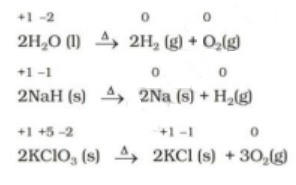
It may be emphasised that the assumption Of electron transfer is made for book-keeping Purpose only and it will become obvious at a Later stage in this unit that it leads to the simple Description of redox reactions. Oxidation number denotes the Oxidation state of an element in a Compound ascertained according to a set Of rules formulated on the basis that electron pair in a covalent bond belongs Entirely to more electronegative element. It is not always possible to remember or Make out easily in a compound/ ion, which Element is more electronegative than the other. Therefore, a set of rules has been formulated To determine the oxidation number of an Element in a compound/ion. We may at this stage, state the rules for the Calculation of oxidation number. These rules are: 1.) In elements, in the free or the uncombined State, each atom bears an oxidation Number of zero. Evidently each atom in $H _2, O _2, C _{12}, O _3, P _4, S_8, Na , Mg$, Al has the Oxidation number zero. 2.) For ions composed of only one atom, the Oxidation number is equal to the charge On the ion. Thus $Na +$ lon has an oxidation Number of $+1, Mg _2+$ ion +2 , $Fe _3+$ ion, $+3, Cl -$ Ion, $-1, O _2-$ ion, -2 ; and so on. In their Compounds all alkali metals have Oxidation number of +1 , and all alkaline Earth metals have an oxidation number of +2 . Aluminium is regarded to have an Oxidation number of +3 in all its Compounds. 3.) The oxidation number of oxygen in most Compounds is -2 . However, we come across Two kinds of exceptions here. One arises In the case of peroxides and superoxides, The compounds of oxygen in which oxygen Atoms are directly linked to each other. While in peroxides (e.g., $H _2 O _2, Na _2 O _2$ ), each Oxygen atom is assigned an oxidation Number of -1 , in superoxides (e.g., $K O _2, Rb O _2$ ) each oxygen atom is assigned an Oxidation number of $-(1 / 2)$. The second Exception appears rarely, i.e. when oxygen Is bonded to fluorine. In such compounds e.g., oxygen difluoride $\left( OF _2\right)$ and dioxygen difluoride $\left( O _2 F_2\right)$, the oxygen is assigned an oxidation number of +2 and +1 , respectively. The number assigned to oxygen will depend upon the bonding state of oxygen but this number would now be a positive figure only. 4.)The oxidation number of hydrogen is +1, Except when it is bonded to metals in binary Compounds (that is compounds containing Two elements). For example, in LiH, NaH, And $Ca H_2,$ its oxidation number is –1. 5.) In all its compounds, fluorine has an Oxidation number of –1. Other halogens (Cl, Br, and I) also have an oxidation number Of –1, when they occur as halide ions in Their compounds. Chlorine, bromine and Iodine when combined with oxygen, for Example in oxoacids and oxoanions, have Positive oxidation numbers. 6.) The algebraic sum of the oxidation number Of all the atoms in a compound must be Zero. In polyatomic ion, the algebraic sum Of all the oxidation numbers of atoms of The ion must equal the charge on the ion. Thus, the sum of oxidation number of three Oxygen atoms and one carbon atom in the Carbonate ion, $(CO_3) 2$– must equal –2. A term that is often used interchangeably With the oxidation number is the oxidation State. Thus in $CO_2,$the oxidation state of Carbon is +4 , that is also its oxidation number And similarly the oxidation state as well as Oxidation number of oxygen is -2 . This implies That the oxidation number denotes the Oxidation state of an element in a compound. The oxidation number/state of a metal in a Compound is sometimes presented according To the notation given by German chemist, Alfred Stock. It is popularly known as Stock Notation. According to this, the oxidation Number is expressed by putting a Roman Numeral representing the oxidation number In parenthesis after the symbol of the metal in The molecular formula. Thus aurous chloride And auric chloride are written as $Au ( I ) Cl$ and $Au ( III ) Cl _3$. Similarly, stannous chloride and Stannic chloride are written as $Sn ( II ) Cl _2$ and $Sn ( IV ) Cl _4$. This change in oxidation number Implies change in oxidation state, which in Turn helps to identify whether the species is Present in oxidised form or reduced form. Thus, $Hg _2( I ) Cl _2$ is the reduced form of $Hg ( II ) Cl _2$.
  1. H atom goes from a … state in $H_2$ to a positive state in $H_2O$ in water formation.
  1. Neutral
  2. Positive
  3. Negative
  4. All the above
  1. In oxidation number method, there is a complete transfer of electron from a …. electronegative atom to a … electonegative atom.
  1. more, less
  2. less, more
  3. non, more
  4. non, less
  1. Oxidation number of $Mg_2$ + ion is:
  1. -2
  2. -1
  3. +2
  4. +1
  1. In $Na2O_2$ each oxygen atom is assigned an oxidation number of …
  1. +1
  2. -2
  3. +2
  4. -1
  1. The algebraic sum of the oxidation number of all the atoms in a compound must be…
  1. 0
  2. 1
  3. 2
  4. -2

Answer

  1. (a) Neutral
  2. (b) less , more
  3. (c) +2
  4. (d) -1
  5. (a) 0

Need a full question paper?

Generate a complete, print-ready paper with questions like this in minutes — across 16+ boards, with answer keys.

Start Generating Free

Similar questions

Read the passage given below and answer the following questions from (i) to (v).
The first concreteexplanation for the phenomenon of the blackbody radiation was given byMax Planck in 1900.An ideal body, which emits and absorbs radiations of allfrequencies uniformly, is called a black bodyand the radiation emitted by such a body is called black body radiation. Max Planck arrived at a satisfactory relationshipbymaking an assumption that absorption andemmission of radiation arises from oscillatori.e., atoms in the wall of black body.He suggested that atoms andmolecules could emit or absorb energy onlyin discrete quantities and not in a continuousmanner. He gave the name quantum to thesmallest quantity of energy that can be emitted or absorbed in the form of electromagnetic radiation. The energy (E) of aquantum of radiation is proportionalto its frequency (ν) and is expressed byequation .
$E = hυ.$
The proportionality constant, ‘h’ is knownas Planck’s constant and has the value6.$626\times 10^{–34}$ Js.In 1887, H. Hertz performed a very interestingexperiment in which electrons (or electriccurrent) were ejected when certain metals (forexample potassium, rubidium, caesium etc.)were exposed to a beam of light. The phenomenon is calledPhotoelectric effect. The results observed inthis experiment were:
  1. The electrons are ejected from the metalsurface as soon as the beam of light strikesthe surface, i.e., there is no time lagbetween the striking of light beam and theejection of electrons from the metal surface.
  2. The number of electrons ejected is proportional to the intensity or brightness of light.
  3. For each metal, there is a characteristicminimum frequency,ν0(also known asthreshold frequency) below which photoelectric effect is not observed. At afrequency $ν >ν_0$, the ejected electrons comeout with certain kinetic energy. The kineticenergies of these electrons increase withthe increase of frequency of the light used.
The particle nature of light posed a dilemmafor scientists. Theonly way to resolve the dilemma was to acceptthe idea that light possesses both particle andwave-like properties, i.e., light has dualbehaviour. Depending on the experiment, wefind that light behaves either as a wave or as astream of particles. Whenever radiationinteracts with matter, it displays particle likeproperties in contrast to the wavelike properties (interference and diffraction), whichit exhibits when it propagates. This conceptwas totally alien to the way the scientiststhought about matter and radiation and it tookthem a long time to become convincedof itsvalidity.
The study of emission or absorption spectra is referred to as spectroscopy.The emission spectra of atoms inthe gas phase, on the other hand, do not showa continuous spread of wavelength from redto violet, rather they emit light only at specificwavelengths with dark spaces between them.Such spectra are called line spectra or atomicspectra.The Swedishspectroscopist, Johannes Rydberg, noted that
all series of lines in the hydrogen spectrumcould be described by the following expression:
$\bar{\text{v}}=109,677\big(\frac{1}{\text{n}^2_1}-\frac{1}{\text{n}^2_2}\big)\text{cm}^{-1}$
The value $109,677 cm^{–1}$​​​​​​​ is called theRydberg constant for hydrogen. The first fiveseries of lines that correspond to $n_1= 1, 2, 3,4, 5$ are known as Lyman, Balmer, Paschen,Bracket and Pfund series, respectively.Neils Bohr (1913) was the first to explainquantitatively the general features of thestructure of hydrogen atom and its spectrum.He used Planck’s concept of quantisation ofenergy. Though the theory is not the modernquantum mechanics, it can still be used to rationalize many points in the atomic structureand spectra. Bohr’s model for hydrogen atomis based on the following postulates:
  1. The electron in the hydrogen atom canmove around the nucleus in a circular pathof fixed radius and energy. These paths arecalled orbits, stationary states or allowedenergy states. These orbits are arrangedconcentrically around the nucleus.
  2. The energy of an electron in the orbit doesnot change with time. However, theelectron will move from a lower stationarystate to a higher stationary state whenrequired amount of energy is absorbedby the electron or energy is emitted when electron moves from higher stationarystate to lower stationary state. The energychange does not takeplace in a continuous manner.
  3. The frequency of radiation absorbed oremitted when transition occurs between two stationary states that differ in energyby $\triangle\text{E},$ is given by:
$\text{v}=\frac{\triangle\text{E}}{\text{h}}=\frac{\text{E}_2-\text{E}_1}{\text{h}}$

Where E1 and E2 are the energies of the lower and higher allowed energy statesrespectively. This expression is commonly known as Bohr’s frequency rule.
  1. The angular momentum of an electron isquantised. In a given stationary state itcan be expressed as in equation
$\text{m}_{\text{e}}\text{vr}=\text{n}.\frac{\text{h}}{2\pi}\text{n}=1,2,3.....$
  1. The first concrete explanation for the phenomenon of the black body radiation was given by ….in 1900.
  1. Max Planck
  2. De Broglie
  3. Albert Einstein,
  4. Niels Bohr
  1. Which of the following equation is Planck’s equation?
  1. $E= mc^2​​​​​​​$
  2. $E = hυ$
  3. $E= hc^2​​​​​​​$
  4. $E= vc^2.$
  1. What is nature of light?
  1. Wave
  2. Particle
  3. Wave and Particle
  4. None of above
  1. The value …. is called theRydberg constant for hydrogen.
  1. $109,674cm^{–1}​​​​​​​$
  2. $109,675cm^{–1}​​​​​​​$
  3. $109,676cm^{–1}​​​​​​​$
  4. $109,677cm^{–1}$​​​​​​​
  1. …was the first to explain quantitatively the general features of the structure of hydrogen atom and its spectrum.
  1. Max Planck
  2. De Broglie
  3. Albert Einstein,
  4. Niels Bohr
Read the passage given below and answer the following questions from (i) to (v).
The covalent bond may be classified into twotypes depending upon the types ofoverlapping:(i) Sigma(σ) bond, and (ii) pi($\pi$) bond
  1. Sigma(σ) bond: This type of covalent bondis formed by the end to end (head-on)overlap of bonding orbitals along theinternuclear axis. This is called as headon overlap or axial overlap. This can beformed by any one of the following typesof combinations of atomic orbitals.
s-s overlapping: In this case, there isoverlap of two half filled s-orbitals alongthe internuclear axis.

s-p overlapping: This type of overlapoccurs between half filled s-orbitals of oneatom and half filled p-orbitals of anotheratom.

p–p overlapping: This type of overlaptakes place between half filled p-orbitalsof the two approaching atoms.
  1. pi($\pi$) bond: In the formation of $\pi$ bondthe atomic orbitals overlap in such a waythat their axes remain parallel to each otherand perpendicular to the internuclear axis.The orbitals formed due to sidewiseoverlapping consists of two saucer type charged clouds above and below the planeof the participating atoms.
Basically the strength of a bond depends uponthe extent of overlapping. In case of sigma bond,the overlapping of orbitals takes place to alarger extent. Hence, it is stronger as comparedto the pi bond where the extent of overlappingoccurs to a smaller extent. Further, it isimportant to note that in the formation ofmultiple bonds between two atoms of amolecule, pi bond(s) is formed in addition to asigma bond. In order to explain the characteristicgeometrical shapes of polyatomic moleculeslike $CH_4,NH_3$ and $H_2O$ etc., Pauling introducedthe concept of hybridisation. According to himthe atomic orbitals combine to form new set ofequivalent orbitals known as hybrid orbitals.Unlike pure orbitals, the hybrid orbitals areused in bond formation. The phenomenon isknown as hybridisation which can be definedas the process of intermixing of the orbitals ofslightly different energies so as to redistributetheir energies, resulting in the formation of newset of orbitals of equivalent energies and shape.For example when one 2s and three 2p-orbitalsof carbon hybridise, there is the formation offour new $sp_3$ hybrid orbitals. Salient features of hybridisation: The mainfeatures of hybridisation are as under:
  1. The number of hybrid orbitals is equal tothe number of the atomic orbitals that gethybridised.
  2. The hybridised orbitals are alwaysequivalent in energy and shape.
  3. The hybrid orbitals are more effective informing stable bonds than the pure atomicorbitals.
  4. These hybrid orbitals are directed in spacein some preferred direction to haveminimum repulsion between electronpairs and thus a stable arrangement.Therefore, the type of hybridisationindicates the geometry of the molecules. Important conditions for hybridisation
  5. The orbitals present in the valence shell of the atom are hybridised.
  6. The orbitals undergoing hybridisation should have almost equal energy.
  7. Promotion of electron is not essential condition prior to hybridisation.
  8. It is not necessary that only half filled orbitals participate in hybridisation.
some cases, even filled orbitals of valence shell take part in hybridisation.
There are various types of hybridisationinvolving s, p and d orbitals. The differenttypes of hybridisation are as under:
some cases, even filled orbitals of valence shell take part in hybridisation.
There are various types of hybridisationinvolving $s , p$ and d orbitals. The differenttypes of hybridisation are as under:
1. sp hybridisation: This type ofhybridisation involves the mixing of one $s$ andone $p$ orbital resulting in the formation of twoequivalent $s p$ hybrid orbitals. The suitableorbitals for sp hybridisation are $s$ and pz , ifthe hybrid orbitals are to lie along the $z$-axis. Example of molecule having sphybridisationBeCl2: The ground state electronicconfiguration of Be is $1 s^2 2 s^2$. In the exited stateone of the 2 s -electrons is promoted to vacant 2 p orbital to account for its bivalency.One 2 s and one 2 p -orbital gets hybridised toform two sp hybridised orbitals.
2. sp2 hybridisation: In this hybridisationthere is involvement of one s and twop-orbitals in order to form three equivalent sp2hybridised orbitals. For example, in BCI 3 molecule, the ground state electronicconfiguration of central boron atom is $1 s^2 2 s^2 2 p^1$. In the excited state, one of the 2 selectrons is promoted to vacant $2 p$ orbital as a result boron has three unpaired electrons. These three orbitals (one 2 s and two 2 p )hybridise to form three sp2 hybrid orbitals.
3. $sp ^3$ hybridisation: This type ofhybridisation can be explained by taking theexample of $CH _4$ molecule in which there ismixing of one $s$-orbital and three p -orbitals ofthe valence shell to form four $sp ^3$ hybrid orbitalof equivalent energies and shape. There is $25 \% s$-character and $75 \% p$-character in each $sp ^3$ hybrid orbital. The four $sp ^3$ hybrid orbitals soformed are directed towards the four cornersof the tetrahedron. The angle between $sp ^3$ hybrid orbital is $109.5^{\circ}$.
  1. ....ntroduced the concept of hybridisation.
  1. Pauling
  2. Lewis
  3. Nyholm
  4. Gillespie
  1. Which of the following is an example of sp3 hybridization?
  1. BeCl2
  2. Ch4
  3. BCl3
  4. C2H4
  1. The angle between sp3 hybrid orbital is ….
  1. $5^\circ$
  2. $9^\circ$
  3. $109.5^\circ$
  4. $120^\circ$
  1. A sigma bond is formed by the overlapping of …
  1. s−s,
  2. s−p
  3. p−p
  4. All the above
  1. When one 2s and three 2p-orbitals of carbon hybridise, there is the formation of four new … hybrid orbitals.
  1. sp3
  2. sp2
  3. sp
  4. None of above
Read the passage given below and answer the following questions from (i) to (v).

The attractive force which holds variousconstituents (atoms, ions, etc.) together in differentchemical species is called a chemical bond. In order to explain the formation of chemicalbond in terms of electrons, a number ofattempts were made, but it was only in 1916 when Kössel and Lewis succeededindependently in giving a satisfactoryexplanation. They were the first to providesome logical explanation of valence which wasbased on the inertness of noble gases. Lewis postulated that atoms achieve thestable octet when they are linked bychemical bonds. In the formation of amolecule, only the outer shell electrons takepart in chemical combination and they areknown as valence electrons. The inner shellelectrons are well protected and are generallynot involved in the combination process.G.N. Lewis, an American chemist introducedsimple notations to represent valenceelectrons in an atom. These notations arecalled Lewis symbols. For example, the Lewissymbols for the elements of second period areas under:
The bond formed, as a result of theelectrostatic attraction between thepositive and negative ions was termed as the electrovalent bond. The electrovalenceis thus equal to the number of unitcharge(s) on the ion.
Kössel and Lewis in 1916 developed animportant theory of chemical combinationbetween atoms known as electronic theoryof chemical bonding. According to this,atoms can combine either by transfer ofvalence electrons from one atom to another(gaining or losing) or by sharing of valenceelectrons in order to have an octet in theirvalence shells. This is known as octet rule. when two atoms share oneelectron pair they are said to be joined bya single covalent bond. In many compoundswe have multiple bonds between atoms. Theformation of multiple bonds envisagessharing of more than one electron pairbetween two atoms. If two atoms share twopairs of electrons, the covalent bondbetween them is called a double bond. Forexample, in the carbon dioxide molecule, wehave two double bonds between the carbonand oxygen atoms. Similarly in ethenemolecule the two carbon atoms are joined bya double bond. The Lewis dot structures provide a pictureof bonding in molecules and ions in termsof the shared pairs of electrons and theoctet rule. The Lewis dotstructures can be written by adopting thefollowing steps:
- The total number of electrons required forwriting the structures are obtained byadding the valence electrons of thecombining atoms. For example, in the $CH _4$ molecule there are eight valence electronsavailable for bonding.
- For anions, each negative charge wouldmean addition of one electron. Forcations, each positive charge would result in subtraction of one electron from the totalnumber of valence electrons. For example,for the $CO _3{ }^{2-}$ ion, the two negative chargesindicate that there are two additionalelectrons than those provided by theneutral atoms.
- Knowing the chemical symbols of thecombining atoms and having knowledgeof the skeletal structure of the compound, it is easyto distribute the total number of electronsas bonding shared pairs between theatoms in proportion to the total bonds.
- In general the least electronegative atomoccupies the central position in themolecule/ion. For example in the $NF _3$ andCO ${ }_3{ }^{2-}$, nitrogen and carbon are the centralatoms whereas fluorine and oxygenoccupy the terminal positions.
- After accounting for the shared pairs ofelectrons for single bonds, the remainingelectron pairs are either utilized for multiplebonding or remain as the lone pairs. Thebasic requirement being that each bondedatom gets an octet of electrons.
i. ... postulated that atoms achieve the stable octet when they are linked by chemical bonds.
  1. … postulated that atoms achieve the stable octet when they are linked by chemical bonds.
  1. Lewis
  2. Debye
  3. Charles
  4. Sidgwick
  1. … in 1916 developed an important theory of chemical combination between atoms known as electronic theory of chemical bonding.
  1. Kössel
  2. Lewis
  3. Both a) & b)
  4. Sidgwick
  1. In the formation of a molecule, only the outer shell electrons take part in chemical combination and they are known as …
  1. Backscattered electrons
  2. Valence electrons
  3. Primary electrons
  4. Secondary electrons
  1. In the $CH_4$​​​​​​​ molecule there are … valence electrons available for bonding.
  1. 4
  2. 6
  3. 8
  4. 10
  1. The type of bond between atoms in a molecule of CO2 is:
  1. Ionic bond
  2. Metallic bond
  3. Hydrogen bond
  4. Covalent bond.
Read the passage given below and answer the following questions from 1 to 5.
Chemistry is the science of molecules and theirtransformations. It is the science not so much of the one hundred elements but of the infinite variety of molecules thatmay be built from them. Chemistry plays a central role in science andis often intertwined with other branches ofscience.to understand thebasic concepts of chemistry, which begin withthe concept of matter. Let us start with thenature of matter. matter can exist in threephysical states viz. solid, liquid and gas.Particles are held very close to each otherin solids in an orderly fashion and there is notmuch freedom of movement. In liquids, theparticles are close to each other but they canmove around. However, in gases, the particlesare far apart as compared to those present insolid or liquid states and their movement iseasy and fast. different states of matter exhibitthe following characteristics:
  1. Solids have definite volume and definiteshape.
  2. Liquids have definite volume but do nothave definite shape. They take the shapeof the container in which they are placed.
  3. Gases have neither definite volume nordefinite shape. They completely occupy thespace in the container in which they are placed.
Matter can be classified as mixture or pure substance. A mixture may be homogeneous or heterogeneous. Pure substances can further be classified into elements and compounds. Particles of an element consist of only one type of atoms. These particles may exist as atoms or molecules. When two or more atoms of different elements combine together in a definite ratio, the molecule of a compound is obtained.
Every substance has unique or characteristic properties. These properties can be classified into two categories — physical properties, such as colour, odour, melting point, boiling point, density, etc., and chemical properties, like composition, combustibility, ractivity with acids and bases, etc. Physical properties can be measured or observed without changing the identity or the composition of the substance. The measurement or observation of chemical properties requires a chemical change to occur. Measurement of physical properties does not require occurance of a chemical change.
  1. Which of the following state of matter have definite volume but do not have definite shape?
  1. Solid
  2. Liquid
  3. Gas
  4. Plasma
  1. Particles are held very close to each other in … in an orderly fashion and there is not much freedom of movement.
  1. Liquid
  2. Gas
  3. Solid
  4. Plasma
  1. Particles of …. consist of only one type of atom.
  1. Compound
  2. Mixture
  3. Element
  4. All the above
  1. Water molecule comprises …hydrogen atoms and … oxygen atom.
  1. One, two
  2. Three, one
  3. One, three
  4. Two, one
  1. Which of the following is not an example of Physical Properties of substance.?
  1. Odour
  2. Melting point
  3. Density
  4. Composition
The ionic character of metallic halides tends toward covalent nature as per Fajan's rule. Such covalent halides behave as non-metal in their higher oxidation states. The property to hydrolyse to give oxy-acids of the element and corresponding hydro halogen acid for most non-metallic elements proceeds exceptionally in the way, keeping oxidation number of element and halide sam in oxo-acids.
Non-polar halides are immiscible in water, as they do not show hydrolysis, but halides of some elements with empty d-orbital undergo hydrolysis. Stability of halides of the higher state is governed by the inert-pair effect.

1. How does halide undergo hydrolysis to give oxy-acids of underlined element $PCl _3$ ? (1)
2. Out of $NCl _3$ and $BCl _3$ undergoes hydrolysis to form oxy-acids? Write the chemical reaction for the correct answer. (1)
3. Out of $PbCl _4, PbF _4, PbI _4$ and $PbBr _4$ which one doesn't exist? (2)
OR
Non-Polar halides are immiscible in water. Why? (2)
The phenomenon of the existence of two or more compounds possessing the same molecular formula but different properties is known as isomerism. Such compounds are called isomers. Compounds having the same molecular formula but different structures (manners in which atoms are linked) are classified as structural isomers. Structural isomers are classified as chain isomer, position isomer, functional group isomer. Meristematic arises due to different alkyl chains on either side of the functional group in the molecule and stereoisomerism and can be classified as geometrical and optical isomerism. Hyperconjugation is a general stabilising interaction. It involves delocalisation of $\sigma$ electrons of the C-H bond of an alkyl group directly attached to an atom of an unsaturated system or to an atom with an unshared p orbital. This type of overlap stabilises the carbocation because electron density from the adjacent $\sigma$ bond helps in dispersing the positive charge.

1. Why Isopentane, pentane and Neopentane are chain isomers?
OR
Why hyperconjugation is a permanent effect?
2. The molecular formula $C _3 H _8 O$ represents which isomer?
3. What type of isomerism is shown by Methoxypropane and ethoxyethane?
Read the passage given below and answer the following questions from 1 to 5. Chemistry deals with varieties of matter and change of one kind of matter into the other. Transformation of matter from one kind into another occurs through the various types of reactions. One important category of such reactions is Redox Reactions. Originally, the term oxidation was used to describe the addition of oxygen to an element or a compound. Because of the presence of dioxygen in the atmosphere (~20%), many elements combine with it and this is the principal reason why they commonly occur on the earth in the form of their oxides. The following reactions represent oxidation processes: $2\text{Mg}(\text{s})\rightarrow2\text{MgO}\text{ (S)}$ $\text{S}(\text{s})+\text{O}_2(\text{g})\rightarrow\text{SO}_2\text{ g}$ the term “oxidation” is defined as the addition of oxygen/electronegative element to a substance or removal of hydrogen/ electropositive element from a substance. In the beginning, reduction was considered as removal of oxygen from a compound. However, the term reduction has been broadened these days to include removal of oxygen/electronegative element from a substance or addition of hydrogen/ electropositive element to a substance. According to the definition given above, the following are the examples of reduction processes: $2\text{HgO}\text{S}\xrightarrow{\triangle}2\text{ Hg}(1)+\text{O}_2(\text{g})$ $2\text{HgCl}_2(\text{aq})+\text{SnCl}_2(\text{aq})\rightarrow\text{Hg}_2\text{Cl}_2(\text{s})+\text{SnCl}_4(\text{aq})$ In reaction simultaneous oxidation of stannous chloride to stannic chloride is also occurring because of the addition of electronegative element chlorine to it. It was soon realised that oxidation and reduction always occur simultaneously (as will be apparent by re-examining all the equations given above), hence, the word “redox” was coined for this class of chemical reactions.The reactions:
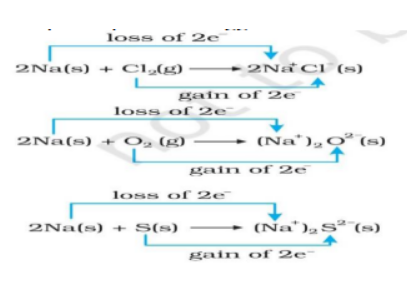
$2\text{Na}(\text{s})+\text{Cl2}\text{g}\rightarrow2\text{NaCl}(\text{s})$ $4\text{Na}(\text{s})+\text{O}_2\text{g}\rightarrow2\text{Na}_2\text{o}(\text{s})$ $2\text{Na}(\text{s})+\text{S}\text{(s)}\rightarrow2\text{Na}_2\text{S}(\text{s})$ are redox reactions because in each of these reactions sodium is oxidised due to the addition of either oxygen or more electronegative element to sodium. Simultaneously, chlorine, oxygen and sulphur are reduced because to each of these, the electropositive element sodium has been added. From our knowledge of chemical bonding we also know that sodium chloride, sodium oxide and sodium sulphide are ionic compounds and perhaps better written as $\mathrm{Na}+\mathrm{Cl}-(\mathrm{s}),\left(\mathrm{Na}^{+}\right)_2 \mathrm{O}^2-(\mathrm{s})$, and $\left(\mathrm{Na}^{+}\right)_2 \mathrm{~S}^{2-}(\mathrm{s})$. Development of charges on the species produced suggests us to rewrite the reactions in the following manner: For convenience, each of the above processes can be considered as two separate steps, one involving the loss of electrons and the other the gain of electrons. As an illustration, we may further elaborate one of these, say, the formation of sodium chloride. $2\text{Na}(\text{s})\rightarrow2\text{Na}^+\text{g}+2\bar{\text{e}}$ $\text{Cl}_2\text{g}+2\bar{\text{e}}\rightarrow2\text{C}\bar{\text{I}}\text{ (g)}$ Each of the above steps is called a half reaction, which explicitly shows involvement of electrons. Sum of the half reactions gives the overall reaction $2\text{Na}(\text{s})+\text{Cl}_2\text{(g)}\rightarrow2\text{Na}^+\text{CI}(\text{s})\text{ or } 2\text{NaCI}(\text{s})$ Above Reactions suggest that half reactions that involve loss of electrons are called oxidation reactions. Similarly, the half reactions that involve gain of electrons are called reduction reactions. To summarise, we may mention that Oxidation: Loss of electron(s) by any species. Reduction: Gain of electron(s) by any species. Oxidising agent: Acceptor of electron(s). Reducing agent: Donor of electron(s).

  1. Addition of electronegative element to a substance is known as..
  1. Oxidation
  2. Reduction
  3. Redox reaction
  4. All the above
  1. Removal of electronegative element to a substance is known as ..
  1. Oxidation
  2. Reduction
  3. Redox reaction
  4. All the above
  1. Acceptor of electrons is …
  1. Reducing Agent
  2. Catalytic Agent
  3. Oxidising Agent
  4. None of above
  1. Donor of electrons is…
  1. Organic Agent
  2. Catalytic Agent
  3. Oxidising Agent
  4. Reducing Agent
  1. Oxidation and Reduction occurs simultaneously is known as …
  1. Exothermic reaction
  2. Endothermic reaction
  3. Redox reaction
  4. Neutralization reaction
The molecular orbital theory is based on the principle of a linear combination of atomic orbitals. According to this approach when atomic orbitals of the atoms come closer, they undergo constructive interference as well as destructive interference giving molecular orbitals, i.e., two atomic orbitals overlap to form two molecular orbitals, one of which lies at a lower energy level (bonding molecular orbital). Each molecular orbital can hold one or two electrons in accordance with Pauli's exclusion principle and Hund's rule of maximum multiplicity.
For molecules up to $N _2$, the order of filling of orbitals is:
Image
Bond order $=\frac{1}{2}$ [bonding electrons - antibonding electrons]
Bond order gives the following information:
I. If bond order is greater than zero, the molecule/ion exists otherwise not.
II. Higher the bond order, higher is the bond dissociation energy.
III. Higher the bond order, greater is the bond stability.
IV. Higher the bond order, shorter is the bond length.

1. Arrange the following negative stabilities of $CN , CN ^{+}$and $CN ^{-}$in increasing order of bond. (1)
2. The molecular orbital theory is preferred over valence bond theory. Why? (1)
3. Ethyne is acidic in nature in comparison to ethene and ethane. Why is it so? (2)
OR
Bonding molecular orbital is lowered by a greater amount of energy than the amount by which antibonding molecular orbital is raised. Is this statement correct? (2)
IUPAC (International Union of Pure and Applied Chemistry) system of nomenclature. Common names are useful and in many cases indispensable, particularly when the alternative systematic names are lengthy and complicated. A systematic name of an organic compound is generally derived by identifying the parent hydrocarbon and the functional group(s) attached to it. By using prefixes and suffixes, the parent name can be modified to obtain the actual name. In a branched-chain compound, small chains of carbon atoms are attached at one or more carbon atoms of the parent chain. The small carbon chains (branches) are called alkyl groups. An alkyl group is derived from a saturated hydrocarbon by removing a hydrogen atom from carbon. Abbreviations are used for some alkyl groups. For example, methyl is abbreviated as Me, ethyl as Et, propyl as Pr and butyl as Bu.

1. Draw the structure of 3-Ethyl-4,4-dimethylheptane. (1)
2. How is the numbering in branched chain hydrocarbon done?
3. Derive the structure of 2-Chlorohexane. (2)
OR
Why $CH _4$ after becoming- $CH _3$ called a methyl group? (2)
Read the passage given below and answer the following questions from 1 to 5.
Hydrogen Peroxide $(H_2O_2)$ Hydrogen peroxide is an important chemical used in pollution control treatment of domestic and industrial effluents.It can be prepared by the following methods.
i) Acidifying barium peroxide and removing excess water by evaporation under reduced pressure gives hydrogen.
$\text{BaO}_2.8\text{H}_2\text{O}(\text{s})+\text{H}_2\text{SO}_4\text{(aq)}\rightarrow\text{BaSO}_4\text{(s)}+\text{H}_2\text{O}_2\text{(aq)}+8\text{H}_2\text{O}\text{l}$
ii) Peroxodisulphate, obtained by electrolytic oxidation of acidified sulphate solutions at high current density, on hydrolysis yields hydrogen.
$2\text{HSO}_\bar{4}(\text{aq})\xrightarrow{\text{Electrolysis}}\text{HO}_3\text{SOOSO}_3\text{H}(\text{aq})\xrightarrow{\text{Hydrolysis}}2\text{HSO}_\bar{4}\text{(aq)}+2\text{H}^+\text{(aq)}+\text{H}_2\text{O}_2\text{aq}$
This method is now used for the laboratory preparation of $D_2O_{2.}$
_{$\text{K}_2\text{S}_2\text{O}_8(\text{s})+2\text{D}_2\text{O}\text{(l)}\rightarrow2\text{KDSO}_4(\text{aq})+\text{D}_2\text{O}_2\text{(l)}$}
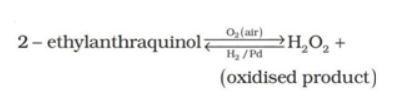
iii) Industrially it is prepared by the auto- oxidation of 2-alklylanthraquinols. 2 ethylanthraquinol H O oxidised product.

In this case 1% $H_2O_2$ is formed. It is extracted with water and concentrated to $\sim30\%$ (by mass) by distillation under reduced pressure. It can be further concentrated to $\sim85\%$ by careful distillation under low pressure. The remaining water can be frozen out to obtain pure $H_2O_2$. Physical Properties of the pure state $H_2O_2$ is an almost colourless (very pale blue) liquid. Its important physical properties. $H_2O_2$ is miscible with water in all proportions and forms a hydrate $H_2O_2.$ $H_2O$ (mp 221K). A 30% solution of $H_2O_2$ is marketed as ‘100 volume’ hydrogen peroxide. It means that one millilitre of 30% $H_2O_2$ solution will give 100 mL of oxygen at STP. Commercially marketed sample is 10 V, which means that the sample contains 3% $H_2O_2$ . Structure Hydrogen peroxide has a non-planar structure.
$H_2O_2$ decomposes slowly on exposure to light.
$2\text{H}_2\text{O}_2\text{(l)}\rightarrow2\text{H}_2\text{O}(\text{l})+\text{O}_2\text{(g)}$
In the presence of metal surfaces or traces of alkali (present in glass containers), the above reaction is catalysed. It is, therefore, stored in wax-lined glass or plastic vessels in dark. Urea can be added as a stabiliser. It is kept away from dust because dust can induce explosive decomposition of the compound.
Its wide scale use has led to tremendous increase in the industrial production of $H_2O_2$. Some of the uses are listed below:
i) In daily life it is used as a hair bleach and as a mild disinfectant. As an antiseptic it is sold in the market as
ii) It is used to manufacture chemicals like sodium perborate and per – carbonate, which are used in high quality detergents.
iii) It is used in the synthesis of hydroquinone, tartaric acid and certain food products and pharmaceuticals (cephalosporin)
iv) It is employed in the industries as a bleaching agent for textiles, paper pulp, leather, oils, fats,
v) Nowadays it is also used in Environmental (Green) Chemistry. For example, in pollution control treatment of domestic and industrial effluents, oxidation of cyanides, restoration of aerobic conditions to sewage wastes,
Heavy water, $D_2O$ It is extensively used as a moderator in nuclear reactors and in exchange reactions for the study of reaction mechanisms. It can be prepared by exhaustive electrolysis of water or as a by-product in some fertilizer industries. It is used for the preparation of other deuterium compounds, for example:
Dihydrogen can be used as a fuel .Dihydrogen releases large quantities of heat on combustion. The data on energy released by combustion of fuels like dihydrogen, methane, LPG etc. are compared in terms of the same amounts in mole, mass and volume Hydrogen Economy is an alternative. The basic principle of hydrogen economy is the transportation and storage of energy in the form of liquid or gaseous dihydrogen. Advantage of hydrogen economy is that energy is transmitted in the form of dihydrogen and not as electric power. It is for the first time in the history of India that a pilot project using dihydrogen as fuel was launched in October 2005 for running automobiles. Initially 5% dihydrogen has been mixed in CNG for use in four-wheeler vehicles. The percentage of dihydrogen would be gradually increased to reach the optimum level. Nowadays, it is also used in fuel cells for generation of electric power. It is expected that economically viable and safe sources of dihydrogen will be identified in the years to come, for its usage as a common source of energy.
  1. In India, a pilot project using dihydrogen as fuel was launched in… for running automobiles.
  1. October 2005
  2. May 2004
  3. August 2014
  4. February 2010
  1. Structure Hydrogen peroxide has a … structure.
  1. Bilateral
  2. Non-planar
  3. Planar
  4. Cubic
  1. One millilitre of 30% $H_2O_2$ solution will give … mL of oxygen at STP.
  1. 30
  2. 10
  3. 100
  4. 300
  1. …. is extensively used as a moderator in nuclear reactors and in exchange reactions for the study of reaction mechanisms.
  1. $H_2O_2$
  2. $T_2O$
  3. $H_2O$
  4. $D_2O$
  1. Colour of pure state $H_2O_2$ is ..
  1. Very Pale red
  2. Very Pale yellow
  3. Very Pale green
  4. Very Pale blue