Question
Read the passage given below and answer the following questions from $1$ to $5$. When an object is in motion, its position changes with time. But how fast is the position changing with time and in what direction? To describe this, we define the quantity average velocity. Average velocity is defined as the change in position or displacement (x) divided by the time intervals (t), in which the displacement occurs: $\text{V}=\frac{\text{x2}-\text{x1}}{\text{t2}-\text{t1}}=\frac{\triangle\text{x}}{\triangle\text{t}}$ Where $x2$ and $x1$ are the positions of the object at time t2and t1, respectively. The SI unit for velocity is m/s or $m s^{–1},$ although km $h^{–1} $ is used in many everyday applications. Like displacement, average velocity is also a vector quantity. Average speed is defined as the total path length travelled divided by the total time interval during which the motion has taken place: Average speed = Total path length/ Total time interval. Average speed has obviously the same unit $(m s^{–1})$ as that of velocity. But it does not tell us in what direction an object is moving. Thus, it is always positive (in contrast to the average velocity which can be positive or negative). If the motion of an object is along a straight line and in the same direction, the magnitude of displacement is equal to the total path length. The velocity at an instant is defined as the limit of the average velocity as the time interval Dt becomes infinitesimally small. In other words $\text{V}=\lim_{\text{dt}-0}\frac{\text{dx}}{\text{dt}}$
$\text{V}=\frac{\text{dx}}{\text{dt}}$ Note that for uniform motion, velocity is the same as the average velocity at all instants. Instantaneous acceleration is defined in the same way as the instantaneous velocity $\text{A}=\lim_{\text{dt}-0}\frac{\text{dv}}{\text{dt}}$
$\text{A}=\frac{\text{dv}}{\text{dt}}$
  1. For uniform motion instantaneous velocity is same as:
  1. Average velocity
  2. Average acceleration
  3. Instantaneous speed
  4. None of these
  1. If velocity is constant then
  1. Acceleration is zero
  2. Acceleration is positive
  3. Acceleration is negative
  4. None of these
  1. Define average speed
  1. Define instantaneous acceleration
  1. Define average velocity

Answer

  1. (a) Average velocity
  2. (a) Acceleration is zero
  3. Average speed is defined as the total path length travelled divided by the total time.
Average speed= Total path length/ Total time interval.
Average speed has SI unit of m/ s. it is scalar quantity it has only magnitude and doesn’t have any direction. it is always positive
  1. Instantaneous acceleration is defined rate of change of velocity with time when time tends to zero
$\text{A}=\lim_{\text{dt}-0}\frac{\text{dv}}{\text{dt}}$
$\text{A}=\frac{\text{dv}}{\text{dt}}$
  1. Average velocity is defined as the change in position or displacement $(Dx)$ divided by the time intervals $(Dt),$ in which the displacement occurs:
$\text{V}=\frac{\text{x2}-\text{x1}}{\text{t2}-\text{t1}}=\frac{\triangle\text{x}}{\triangle\text{t}}$
Where $x2$ and $x1$ are the positions of the object at time $t2$ and $t1 $, respectively. The SI unit for velocity is m/ s or $m s^{–1}.$

Need a full question paper?

Generate a complete, print-ready paper with questions like this in minutes — across 16+ boards, with answer keys.

Start Generating Free

Similar questions

Read the passage given below and answer the following questions from 1 to 5. According to Hooke’s law, within the elastic limit, the stress applied to a body is directly proportional to the corresponding strain. $\text{Stress}\propto\text{Strain}$ or Stress = E × Strain or $\frac{\text{Stress }}{\text{Strain}}=\text{E}$ Where E is the constant of proportionality and is known as coefficient of elasticity or modulus of elasticity. Hooke’s law is an empirical law and is found to be valid for most materials. However, there are some materials which do not exhibit this linear relationship.
  1. According to Hooke’s law of elasticity, if stress is increased, the ratio of stress to strain:
  1. Decreases
  2. Increases
  3. Becomes zero
  4. Remains constant
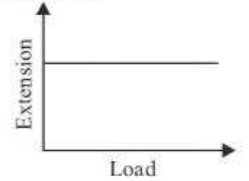
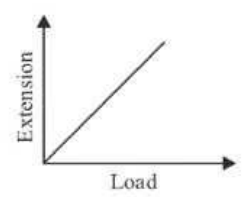
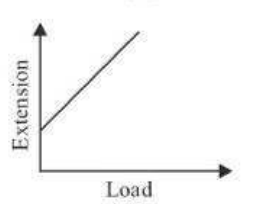
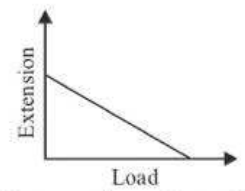
  1. Within elastic limit, which of the following graphs correctly represents the variation of extension in the length of a wire with the external load?
  1. According to Hooke’s law, ifstressis reduced to one-third, the ratio of stress to strain:
  1. Is increased to three time
  2. Is decreased
  3. Is zero
  4. Remains constant.
  1. Hooke’s law defines:
  1. Stress
  2. Strain
  3. Modulus of elasticity
  4. Elastic limit.
  1. Whenever a material is loaded with elasitic limits, stress is ......... strain.
  1. Equal to
  2. Directly proportional to
  3. Inxessely propotional to
  4. None of the above given remains constant.
Read the passage given below and answer the following questions from 1 to 5. Centre of Mass:
The centre of mass of a body or a system of bodies is the point which moves as though all of the mass were concentrated there and all external forces were applied to it. Hence, a point at which the entire mass of the body or system of bodies is supposed to be concentrated is known as the centre of mass. If a system consists of more than one particles (or bodies) and net external force on the system in a particular direction is zero with centre of mass at rest. Then, the centre of mass will not move along that direction. Even though some particles of the system may move along that direction.
  1. The centre of mass of a system of two particles divides, the distance between them:
  1. in inverse ratio of square of masses of particles
  2. in direct ratio of square of masses of particles
  3. in inverse ratio of masses of particles
  4. in direct ratio of masses of particles
  1. Two bodies of masses 1kg and 2 kg are lying in xy-plane at ( -1, 2 ) and ( 2, 4 ) respectively. What are the coordinates of the centre of mass?
  1. $\big(1,\frac{10}{3}\big)$
  2. (1, 10)
  3. (0, 1)
  4. None of these
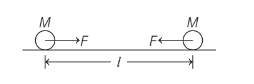
  1. Two balls of same masses start moving towards each other due to gravitational attraction, if the initial distance between them is l. Then, they meet at:
  1. $\frac{\text{ l}}{2}$
  2. l
  3. $\frac{\text{ l}}{3}$
  4. $\frac{\text{ l}}{4}$
  1. All the particles of a body are situated at a distance R from the origin. The distance of centre of mass of the body from the origin is:
  1. $=\text{R}$
  2. $\leq\text{R}$
  3. $>\text{R}$
  4. $\geq\text{R}$
  1. Two particles A and B initially at rest move towards each other under a mutual force of attraction. At the instant, when the speed of A is v and the speed of B is 2v, the speed of centre of mass of the system is:
  1. zero
  2. v
  3. 1. 5v
  4. 3v
A metallic loop is placed in a nonuniform magnetic field. Will an emf be induced in the loop?
Read the passage given below and answer the following questions from (i) to (v). Pressure of an Ideal Gas: according to kinetic theory of gases pressure is given by $\text{P}=\frac{1}{3}\text{ nmv}^2$
Where, n is number of molecules per unit volume, m is mass and $v^2$ is mean squared speed. Though we choose the container to be a cube, the shape of the vessel really is immaterial. The average kinetic energy of a molecule is proportional to the absolute temperature of the gas; it is independent of pressure, volume or the nature of the ideal gas. This is a fundamental result relating temperature, a macroscopic measurable parameter of a gas (a thermodynamic variable as it is called) to a molecular quantity, namely the average kinetic energy of a molecule. The two domains are connected by the Boltzmann constant and given by $E = k_bT$. Where kb is Boltzmann constant having value of $1.38 \times 10^{-23}$ joule per Kelvin. We have seen that in thermal equilibrium at absolute temperature T, for each translational mode of motion, the average energy is $\frac{1}{2}\text{K}_\text{b}\text{t}$. The most elegant principle of classical statistical mechanics (first proved by Maxwell) states that this is so for each mode of energy: translational, rotational and vibrational. That is, in equilibrium, the total energy is equally distributed in all possible energy modes, with each mode having an average energy equal to $\frac{1}{2}\text{K}_\text{b}\text{t}$. This is known as the law of equipartition of energy. Accordingly, each translational and rotational degree of freedom of a molecule contributes $\frac{1}{2}\text{K}_\text{b}\text{t}$ to the energy, while each vibrational frequency contributes $2\times\frac{1}{2}\text{Kb T}=\text{K}_\text{b}\text{T}$ since a vibrational mode has both kinetic and potential energy modes.
  1. Boltzmann constant has value of:
  1. 1.38 × 10 - 23 joule per Kelvin.
  2. 1.38 × 10 - 28 joule per Kelvin.
  3. 1.38 × 10 - 30 joule per Kelvin.
  4. None of these.
  1. SI unit of Boltzmann constant is given by:
  1. Joules per meter
  2. Joules per Kelvin
  3. Joules per Newton
  4. None of these
  1. According to kinetic theory give formula for pressure of idea gas.
  2. According to kinetic theory what is average kinetic energy of molecules of ideal gas?
  3. What is law of equipartition of energy?
What can be said about the centre of mass of a uniform hemisphere without making any calculation? Will its distance from the centre be more than $\frac{\text{r}}{2}$ or less than $\frac{\text{r}}{2}?$
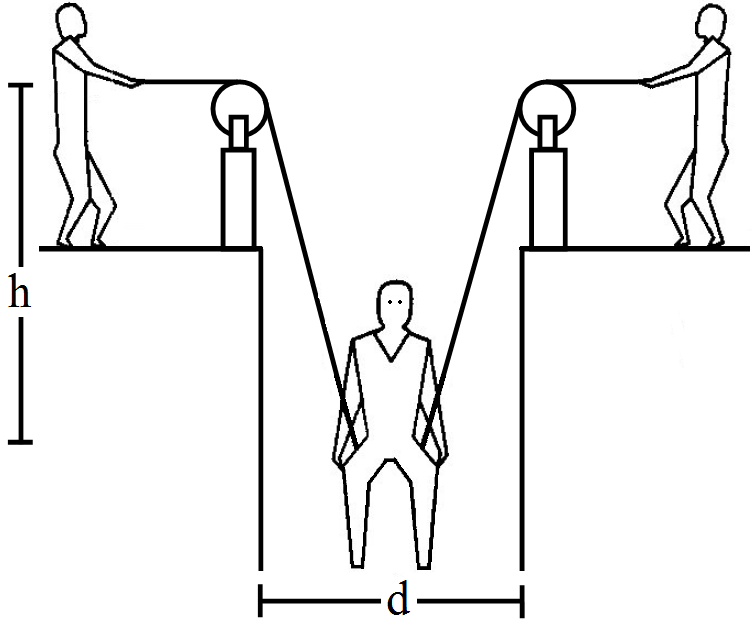
A man has fallen into a ditch of width d and two of his friends are slowly pulling him out using a light rope and two fixed pulleys as shown in figure. Show that the force (assumed equal for both the friends) exerted by each friend on the road increases as the man moves up. Find the force when the man is at a depth h.
The absolute temperature of air in a region linearly increases from $T_1$ to $T_2$ in a space of width d . Find the time taken by a sound wave to go through the region in terms of $\mathrm{T}_1, \mathrm{~T}_2, \mathrm{~d}$ and the speed v of sound at 273 K . Evaluate this time for $T_1=280 \mathrm{~K}, T_2=310 \mathrm{~K}, d=33 \mathrm{~m}$ and $\mathrm{v}=330 \mathrm{~m} / \mathrm{s}$.
While watering a distant plant, a gardener partially water than in fresh closes the exit hole of the pipe by putting his finger on it. Explain why this results in the water stream goirig to a larger distance.
A small object is embedded in a glass sphere $(\mu=1.5)$ of radius 5.0cm at a distance 1.5cm left to the centre. Locate the image of the object as seen by an observer standing.
  1. To the left of the sphere.
  2. To the right of the sphere.
$50cc$ of oxygen is collected in an inverted gas jar over water. The atmospheric pressure is $99.4kPa$ and the room temperature is $27°C$. The water level in the jar is same as the level outside. The saturation vapour pressure at $27°C$ is $3.4kPa$. Calculate the number of moles of oxygen collected in the jar.