Question
The household supply of electricity is at 220V (rms value) and 50Hz. Find the peak voltage and the least possible time in which the voltage can change from the rms value to zero.

Answer

$\text{E}_\text{rms}=220\text{V}$$\text{Frequency}=50\text{Hz}$
  1. $\text{E}_\text{rms}=\frac{\text{E}_0}{\sqrt{2}}$
$\Rightarrow\ \text{E}_0=\text{E}_\text{rms}\sqrt{2}$
$=\sqrt{2}\times220=1.414\times220$
$=311.08\text{V}=311\text{V}$
  1. Time taken for the current to reach the peak value = Time taken to reach the 0 value from r.m.s.
$\text{I}=\frac{\text{I}_0}{\sqrt{2}}$
$\Rightarrow\ \frac{\text{I}_0}{\sqrt{2}}=\text{I}_0\sin\omega\text{t}$
$\Rightarrow\ \omega\text{t}=\frac{\pi}{4}$
$\Rightarrow\ \text{t}=\frac{\pi}{4\omega}=\frac{\pi}{4\times22\pi\text{f}}$
$=\frac{\pi}{8\pi50}=\frac{1}{400}=2.5\text{ms}$

Need a full question paper?

Generate a complete, print-ready paper with questions like this in minutes — across 16+ boards, with answer keys.
Start Generating Free

Similar questions

In tug of war, the team that exerts a larger tangential force on the ground wins. Consider the period in which a team is dragging the opposite team by applying a larger tangential force on the ground. List which of the following works are positive, which are negative and which are zero?
  1. Work by the winning team on the losing team.
  2. Work by the losing team on the winning team.
  3. Work by the ground on the winning team.
  4. Work by the ground on the losing team.
  5. Total external work on the two teams.
A bar magnet makes 40 oscillations per minute in an oscillation magnetometer. An identical magnet is demagnetized completely and is placed over the magnet in the magnetometer. Find the time taken for 40 oscillations by this combination. Neglect any induced magnetism.
A closed bottle contains some liquid. The bottle is shaken vigorously for 5 minutes. It is found that the temperature of the liquid is increased. Is heat transferred to the liquid? Is work done on the liquid? Neglect expansion on heating.
Because to the space charge in a diode valve:
  1. The plate current decreases.
  2. The plate voltage increases.
  3. The rate of emission of thermions increases.
  4. The saturation current increases.
Read the passage given below and answer the following questions from 1 to 5. The kinetic energy possessed by an object of mass, m and moving with a uniform velocity, v is $\text{K}=\frac{1}{2}\times\text{mv}^2=\frac{1}{2}\text{v}.\text{v}$ Kinetic energy is a scalar quantity. The kinetic energy of an object is a measure of the work and The energy possessed by an object is thus measured in terms of its capacity of doing work. The unit of energy is, therefore, the same as that of work, that is, joule (J). Work energy theorem: The change in kinetic energy of a particle is equal to the work done on it by the net force. Mathematically $K_f - K_i = W$ Where Ki and Kf are respectively the initial and final kinetic energies of the object. Work refers to the force and the displacement over which it acts. Work is done by a force on the body over a certain displacement.
  1. Kinetic energy is:
  1. Scalar quantity
  2. Vector quantity
  3. None of these
  1. Which of the following has same unit?
  1. Potential energy and work
  2. Kinetic energy and work
  3. Force and weight
  4. All of the above
  1. What is work energy theorem?
  1. Kinetic energy is scalar quantity. Justify the statement.
  1. Give formula for kinetic energy of body.
On a winter day, the outside temperature is 0°C and relative humidity 40%. The air from outside comes into a room and is heated to 20°C. What is the relative humidity in the room? The saturation vapour pressure at 0°C is 4.6mm of mercury and at 20°C it is 18mm of mercury.
When we rub our hands they become warm. Have we supplied heat to the hands?
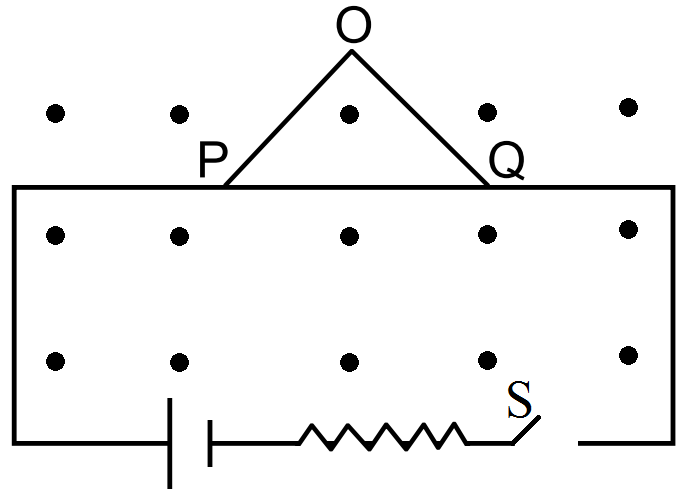
Shows a rod PQ of length 20.0cm and mass 200g suspended through a fixed point O by two threads of lengths 20.0cm each. A magnetic field of strength 0.500T exists in the vicinity of the wire PQ, as shown in the figure. The wires connecting PQ with the battery are loose and exert no force on PQ.
  1. Find the tension in the threads when the switch S is open.
  2. A current of 2.0A is established when the switch S is closed. Find the tension in the threads now.
If the earth's magnetic field has a magnitude $3.4 \times 10^{-5} T$ at the magnetic equator of the earth what would be its value at the earth's geomagnetic poles?
Read the passage given below and answer the following questions from 1 to 5. The proportional region within the elastic limit of the stress-strain curve is of great importance for structural and manufacturing engineering designs. The ratio of stress and strain, called modulus of elasticity, is found to be a characteristic of the material. Experimental observation show that for a given material, the magnitude of the strain produced is same whether the stress is tensile or compressive. The ratio of tensile (or compressive) stress $(\sigma)$ to the longitudinal strain $(\in)$ is defined as Young’s modulus and is denoted by the symbol Y. $\text{Y}=\frac{\sigma}{\in}$ Since strain is a dimensionless quantity, the unit of Young’s modulus is the same as that of stress i.e., $N-m^{-2}$ or Pascal (Pa). As steel has more modulus of elasticity than copper brass and aluminum hence steel is preferred in heavy-duty machines and in structural designs. Wood, bone, concrete and glass have rather small Young’s moduli. Answer the following.
  1. If stress strain changes then young’s modulus is:
  1. Also changes.
  2. Remains constant.
  3. Either changes or remains constant depends on amount of stress and strain.
  4. None of these.
  1. SI unit of young’s modulus is:
  1. $N-m^{-2}​​​​​​​$
  2. Pascal (Pa).
  3. $N-m^{-2}​​​​​​​$​​​​​​​ or Pascal (Pa).
  4. None of these
  1. Which of the following is more elastic
  1. Aluminum
  2. Steel
  3. Wood
  4. Glass
  1. Defines young’s modulus. Give its SI unit and dimensions.
  1. Why steel is more preferred in heavy industries than copper and brass?