Question
The electrochemical cell shown below is concentration cell.
$M \mid M ^{2+}$ (saturated solution of a sparingly soluble salt, $\left.MX _2\right)\left|\left| M ^{2+}\left(0.001 mol dm ^{-3}\right)\right| M\right.$ The emfof the cell depends on the difference in concentrations of $M ^{2+}$ ions at the two electrodes. The emf of the cell at 298 K is 0.059 V . The following questions are multiple choice questions. Choose the most appropriate answer:
  1. The solubility product ($K_{sp'} mol^3 dm^{-9})$ of $MX_2$ at 298 K based on the information available for the given concentration cell is $(\text{take }2.303 \times \text{R}\times \frac{298}{\text{F}} = 0.059)$
  1. $2 \times 10^{-15}$
  2. $4 \times 10^{-15}​​​​​​​$
  3. $3 \times 10^{-12}​​​​​​​$
  4. $1 \times 10^{-12}​​​​​​​$
  1. The value of $\triangle\text{G}$ (in kJ $mol^{-1}​​​​​​​$) for the given cell is (take $1 F = 96500 C mol^{-1})$
  1. 3.7
  2. -3.7
  3. 10.5
  4. -11.4
  1. The equilibrium constant for the foUowing reaction is:
$\text{Fe}^{2+}+\text{Ce}^{4+}\rightleftharpoons\text{Ce}^{3+}+\text{Fe}^{3+}$

(Given, $\text{E}^\circ_\frac{\text{Ce}^{4+}}{\text{Ce}^{3+}}=1.44\text{V}$ and $\text{E}^\circ_\frac{\text{Fe}^{3+}}{\text{Fe}^{2+}}=0.68\text{V}$)
  1. $7.6 \times 10^{12}$​​​​​​​
  2. $6.5 \times 10^{10}$
  3. $5.2 \times 10^9$
  4. $3.4 \times 10^{12}​​​​​​​$
  1. The solubility product of a saturated solution of $Ag_2CrO_4 $in water at 298 K if the emf of the cell
$Ag|Ag^+ (satd. Ag_2CrO_4 soln) || Ag^+ (0.1 M) | Ag$

is 0.164V at 298 K, is:
  1. $3.359 \times 10^{-12} mol^3 L^{-3}$​​​​​​​
  2. $2.287 \times 10^{-12} mol^3 L^{-3}$
  3. $1.158 \times 10^{-12} mol^3 L^{-3}$
  4. $4.135 \times 10^{-12} mol^3 L^{-3}$
  1. To calculate the emf of the cell, which of the foUowing options is correct?
  1. emf $= E_{cathode}- E_{anode}$​​​​​​​
  2. emf $= E_{anode}- E_{cathode}$
  3. emf $= E_{anode} + E_{cathode}$
  4. None of these.

Answer

  1. (b) $4 \times 10^{-15}$
  1. Explanation:
    $\text{E}_\text{cell}=\frac{0.059}{1}\log\frac{[\text{Ag}^+]_\text{RHS}}{[\text{Ag}^+]_\text{LHS}}$
    $0.164=\frac{0.059}{1}\log\frac{0.1}{[\text{Ag}^+]_\text{LHS}}$
    $[\text{Ag}^+]_\text{LHS}=1.66\times10^{-4}\text{M}$
    So, $[\text{CrO}^{2-}_4]=\frac{1.66\times10^{-4}}{2}$
    $\text{K}_\text{Sp}(\text{Ag}_2\text{CrO}_4)=[\text{Ag}^+]^2[\text{CrO}_4^{2-}]$
    $= (1.66\times10^{-4} )^2\Big(\frac{1.66\times10^{-4}}{2}\Big)$
    $=2.287\times10^{-12} \text{mol}^{3} \text{L}^{-3}$
  2. (a) emf $= E_{cathode}- E_{anode}$
  3. Explanation:
    $\text{E}^\circ_\text{cell}=\frac{0.059}{1}\log\text{K}_\text{C}$
    $\text{E}^\circ_\text{cell}=\text{E}^\circ_\frac{{\text{Fe}^{2+}}}{{\text{Fe}^{3+}}}+\text{E}^\circ_\frac{\text{Ce}^{4+}}{\text{Ce}^{3+}}$
    $= -0.68 + 1.44 = 0.76 \text{V}$
    $\log_{10}\text{K}_\text{C}=\frac{0.76}{0.059}=12.88$
    $\text{K}_\text{C}=7.6\times10^{12}$
  4. (b) 2.287 × 10⁻¹² mol3 L-3
  5. >Explanation:
    $\triangle\text{G}=\text{nFE}=-2\times96500\times0.059$
    = -11387 J mol-1 = -11.4 kJ mol-1
  6. (a) 7.6 × 10¹²
  7. Explanation:
    $0.059=\frac{+0.059}{2}\log\frac{0.001}{[\text{M}^{2+}]}$
    $\log\frac{0.001}{[\text{M}^{2+}]}=2$ or $[\text{M}^{2+}]=10^{-5}$
    Let solubility of sah be S mol/ litre.
    Thus, $\text{MX}_2\xrightarrow{\ \ \ \ }\text{M}^{2+}+2\text{X}^-\\\ \ \text{S}\ \ \ \ \ \ \ \ \ \ \ \ \text{S}\ \ \ \ \ \ \ \ \ \ 2\text{S}$
    $\therefore\text{K}_\text{sp}=4\text{S}^3=4\times(10^{-5})^3=4\times10^{-15}$
  8. (d) -11.4

Need a full question paper?

Generate a complete, print-ready paper with questions like this in minutes — across 16+ boards, with answer keys.

Start Generating Free

Similar questions

The concentration of potassium ions inside a biological cell is at least twenty times higher than the outside. The resulting potential difference across the cell is important in several processes such as transmission of nerve impulses and maintaining the ion balance. A simple model for such a concentration cell involving a metal $M$ is,
$M_{(s)} | M^+(aq.; 0.05$ molar$) || M^+(aq; 1$ molar$) | M_{(s)}$
The following questions are multiple choice questions. Choose the most appropriate answer:
  1. For the above cell,
  1. $\text{E}_\text{cell}<0;\Delta\text{G}>0$
  2. $\text{E}_\text{cell}>0;\Delta\text{G}<0$
  3. $\text{E}_\text{cell}<0;\Delta\text{G}^\circ>0$
  4. $\text{E}_\text{cell}>0;\Delta\text{G}^\circ<0$
  1. If the 0.05 molar solution of $M^+$ is replaced by a $0.0025$ molar $M^+$ solution, then the magnitude of the cell potential would be:
  1. $130mV$
  2. $185mV$
  3. $154mV$
  4. $600mV$
  1. The value of equilibrium constant for a feasible cell reaction is:
  1. $< 1$
  2. $= 1$
  3. $> 1$
  4. Zero
  1. What is the emf of the cell when the cell reaction attains equilibrium?
  1. $1$
  2. $0$
  3. $> 1$
  4. $< 1$
  1. The potential of an electrode change with change in:
  1. Concentration ofions in solution.
  2. Position of electrodes.
  3. Voltage of the cell.
  4. All of these.
Read the passage given below and answer the following questions:
In an assembly of atoms or molecules, a solid phase is formed whenever the interatomic attractive forces significantly exceed the disruptive thermal forces and thus restrict the mobility of atoms, forcing them into more or less fixed positions. From energy considerations, it is evident that in such solids the atoms or molecules will always attempt to assume highly ordered structures which are characterised by symmetry. Depending on the nature of the active interatomic forces, all solids may be subdivided into the following categories :
Ionic solids: These solids consist of positively and negatively charged ions arranged in a regular fashion throughout the solid. These solids are very hard and brittle, have very high melting points and have high enthalpies of vaporisation, e.g., NaCl, MgO, KCl, LiCl etc.
Covalent solids: In these solids, the constituent particles are atoms which are linked together by a continuous system of covalent bonds. These bonds are strong and directional in nature. The covalent crystals are hard, have high melting points, are poor conductors of electricity. Diamond is a typical example of covalent solids.
Metallic solids: ln these solids, the constituent particles are positive ions immersed in a sea of mobile electrons. Metallic solids may be hard as well as soft. They are good conductors of heat and electricity, e.g., common metals such as nickel, copper and alloys.
Molecular solids: ln these the constituent particles are molecules. The molecules are held together by dispersion forces or London forces, dipole-dipole forces or hydrogen bonds.
In these questions (Q. No. i-iv), a statement of assertion followed by a statement of reason is given. Choose the correct answer out of the following choices.
  1. Assertion and reason both are correct statements, and reason is correct explanation for assertion.
  2. Assertion and reason both are correct statements, but reason is not correct explanation for assertion.
  3. Assertion is correct statement, but reason is wrong statement.
  4. Assertion is wrong statement, but reason is correct statement.
  1. Assertion: Molecular solids are characterized by low melting point.
Reason: Molecular solids are made up of covalent molecules.
  1. Assertion: Ionic solids are characterized by high melting and boiling point.
Reason: Ionic solids have coulombic forces of attraction between their ions.
  1. Assertion: Covalent solids are insulators of electricity.
Reason: Covalent solids are constituted by ions.
  1. Assertion: Diamond and graphite do not have the same covalent structure.
Reason: Silicon carbide is typical example of network solid.
  1. Assertion: Covalent solids have high melting points.
Reason: Covalent solids have strong electrostatic forces of attraction.
Read the passage given below and answer the following questions:
A mixture of two aromatic compounds $(A)$ and $(B)$ was separated by dissolving in chloroform followed by extraction with aqueous $KOH$ solution. The organic layer containing compound $(A)$, when heated with alcoholic solution of KOH produce $C_7H_5N (C)$ associated with unpleasant odour.
The following questions are multiple choice questions. Choose the most appropriate answer:
  1. What is A?
  1. $C_6H_5NH_2$
  2. $C_6H_5CH_3$
  3. $C_6H_5CH_3$
  4. None of these.
  1. The reaction of $(A)$ with alcoholic solution of $KOH$ to produce $(C)$ of unpleasant odour is called:
  1. Sandmeyer reaction.
  2. Carbylamine reaction.
  3. Ullmann reaction.
  4. Reimer-Tiemann reaction..
  1. The alkaline aqueous layer $(B)$ when heated with chloroform and then acidified give a mixture of isomeric compounds of molecular formula $C_7H_6O_2. (B)$ is:
  1. $C_6H_5CHO$
  2. $C_6H_5COOH$
  3. $C_6H_5CH_3$
  4. $C_6H_5OH$
  1. In the chemical reaction, $CH_3CH_2NH_2 + CHCl_3 + 3KOH \rightarrow (A)+ (B) + 3H_2O,$
  1. $C_2H_5NC$ and $KCl$
  2. $C_2H_5CN$ and $KCl$
  3. $CH_3CH_2CONH_2$ and $KCl$
  4. $C_2H_5NC$ and $K_2CO_3$
  1. Direct nitration of an aromatic compound (A) is not feasible because:
  1. The reaction cannot be stopped at the mononitration stage.
  2. A mixture of o, m and p-nitroaniline is always obtained.
  3. Nitric acid oxidises most of the aromatic compound to give oxidation products along with only a small amount of nitrated products.
  4. All of the above.
The following reaction, $\text{A}_{(\text{g})}\xrightarrow{\ \ \triangle\ \ \ }\text{P}_{(\text{g})}+\text{Q}_{(\text{g})}+\text{R}_{(\text{g})},$ follows first order kinetics. The half-life period of this reaction is $69.3s$ at $500^\circ C$. The gas A is enclosed in a container at $500^\circ C$ and at a pressure of $0.4$ atm.
The following questions are multiple choice questions. Choose the most appropriate answer:
  1. The rate constant for the reaction is:
  1. $0.4s^{-1}$
  2. $0.02s^{-1}$
  3. $0.01s^{-1}$
  4. $0.3s^{-1}$
  1. The pressure of the gas $A$ after $230$ s will be:
  1. $0.04$ atm
  2. $0.36$ atm
  3. $0.4$ atm
  4. $0.036$ atm
  1. The total pressure of the system after $230$ swill be:
  1. $2.15$ atm
  2. $1.12$ atm
  3. $0.4$ atm
  4. $3.08$ atm
  1. The plot ofln[A] vs twill be:
  1. Linear with slope $= k$
  2. Linear with intercept $= In[A]_0$
  3. Linear with slope $= In[A]_0$
  4. Linear with intercept $= [A]_0$
  1. Which of the following is not an example of first order reaction?
  1. $\text{C}_2\text{H}_{4(\text{g})}+\text{H}_{2(\text{g})}\rightarrow\text{C}_2\text{H}_{6(\text{g})}$
  2. $2\text{N}_2\text{O}_{5(\text{g})}\rightarrow4\text{NO}_{2(\text{g})}+\text{O}_{2(\text{g})}$
  3. $2\text{N}\text{H}_{3(\text{g})}\xrightarrow[\triangle]{\text{pt}}\text{N}_{2(\text{g})}+3\text{H}_{2(\text{g})}$
  4. $2\text{N}_2\text{O}_{(\text{g})}\xrightarrow{\ \ \triangle\ \ }2\text{N}_{2(\text{g})}+\text{O}_{2(\text{g})}$
For the reaction : $2\text{NO}_\text{(g)}+\text{Cl}_{2\text{(g)}}\rightarrow2\text{NOCl}_\text{(g)},$ the following data were collected. All the measurements were taken at $263K.$
Experiment No.
Initial [NO] (M)
Initial $[Cl_2]$ (M)
Initial rate of disapp. of $Cl_2 $ (M/ min)
$1.$
$0.15$
$0.15$
$0.60$
$2.$
$0.15$
$0.30$
$1.20$
$3.$
$0.30$
$0.15$
$2.40$
$4.$
$0.25$
$0.25$
$?$
The following questions are multiple choice questions. Choose the most appropriate answer:
  1. The molecularity of the reaction is:
  1. $1$
  2. $2$
  3. $3$
  4. $4$
  1. The expression for rate law is:
  1. $\text{r}=\text{k}[\text{NO}][\text{Cl}_2]$
  2. $\text{r}=\text{k}[\text{NO}]^2[\text{Cl}_2]$
  3. $\text{r}=\text{k}[\text{NO}][\text{Cl}_2]^2$
  4. $\text{r}=\text{k}[\text{NO}]^2[\text{Cl}_2]^2$
  1. The overall order of the reaction is:
  1. $2$
  2. $0$
  3. $1$
  4. $3$
  1. The value of rate constant is:
  1. $150.32\ M^{-2} \min^{-1}$
  2. $200.08\ M^{-1} \min^{-1}$
  3. $177.77\ M^{-2} \min^{-1}$
  4. $155.75\ M^{-1} \min^{-1}$
  1. The initial rate of disappearance of $Cl_2$ in experiment $4$ is:
  1. $1.75M\ \min^{-1}$
  2. $3.23M\ \min^{-1}$
  3. $2.25M\ \min^{-1}$
  4. $2.77M\ \min^{-1}$
Read the passage given below and answer the following questions: A compound (X) containing C, H and O is unreactive towards sodium. It also does not react with Schiff s reagent. On refluxing with an excess of hydroiodic acid, (X) yields only one organic product ( Y). On hydrolysis, (Y) yields a new compound (Z) which can be converted into (Y) by reaction with red phosphorus and iodine. The compound (Z) on oxidation with potassium permanganate gives a carboxylic acid. The equivalent weight of this acid is 60. The following questions are multiple choice questions. Choose the most appropriate answer:
  1. The compound (X) is an:
  1. Acid.
  2. Aldehyde.
  3. Alcohol.
  4. Ether.
  1. The IUPAC name of the acid formed is:
  1. Methanoic acid.
  2. Ethanoic acid.
  3. Propanoic acid.
  4. Butanoic acid.
  1. Compound (Y) is:
  1. Ethyl iodide.
  2. Methyl iodide.
  3. Propyl iodide.
  4. Mixture of (a) and (b).
  1. Compound (Z) is:
  1. Methanol.
  2. Ethanol.
  3. Propanol.
  4. Butanol.
  1. Compound (X) on treatment with excess of $Cl_2$ in presence of tight gives:
  1. $\propto-$ Chlorodiethyl ether.
  2. $\propto,\propto'-$ Dichlorodiethyl ether.
  3. Perchlorodiethyl ether.
  4. None of these.
Read the passage given below and answer the following questions:
The properties of the solutions which depend only on the number of solute particles but not on the nature of the solute are called colligative properties. Relative lowering in vapour pressure is also an example of colligative properties. For an experiment, sugar solution is prepared, for which lowering in vapour pressure was found to be 0.061 mm of Hg. (Vapour pressure of water at 20° C is 17.5 mm of Hg)
The following questions are multiple choice questions. Choose the most appropriate answer:
  1. Relative lowering of vapour pressure for the given solution is.
  1. 0.00348
  2. 0.061
  3. 0.122
  4. 1.75
  1. The vapour pressure (mm of Hg) of solution will be.
  1. 17.5
  2. 0.61
  3. 17.439
  4. 0.00348
  1. Mole fraction of sugar in the solution is.
  1. 0.00348
  2. 0.9965
  3. 0.061
  4. 1.75
  1. If weight of sugar taken is 5g in 108g of water, then molar mass of sugar will be.
  1. 358
  2. 120
  3. 240
  4. 400
  1. The vapour pressure (mm of Hg) of water at 293K when 25g of glucose is dissolved in 450g of water is.
  1. 17.2
  2. 17.4
  3. 17.120
  4. 17.02
Read the passage given below and answer the following questions :
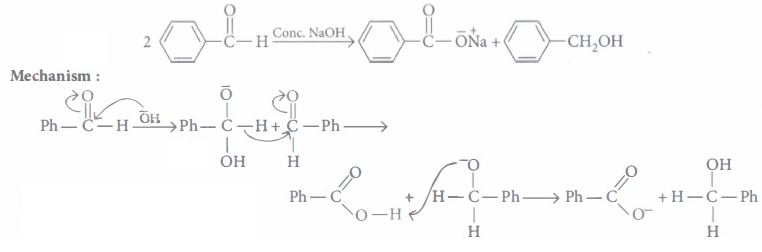
When an aldehyde with no a-hydrogen reacts with concentrated aqueous $NaOH$, half the aldehyde is converted to carboxylic acid salt and other half is converted to an alcohol. In other words, half of the reactant is oxidized
and other half is reduced. This reaction is known as Cannizzaro reaction

The following questions are multiple choice questions. Choose the most appropriate answer:
  1. A mixture of benzaldehyde and formaldehyde on heating with aqueous $NaOH$ solution gives:
  1. Benzyl alcohol and sodium formate.
  2. Sodium benzoate and methyl alcohol.
  3. Sodium benzoate and sodium formate.
  4. Benzyl alcohol and methyl alcohol.
  1. Which of the following compounds will undergo Cannizzaro reaction?
  1. $CH_3CHO$
  2. $CH_3COCH_3$
  3. $C_6H_5CHO$
  4. $C_6H_5CH_2CHO$
  1. Trichloroacetaldehyde is subjected to Cannizzaro's reaction by using $NaOH$. The mixture of the products contains sodium trichloroacetate ion and another compound. The other compounds is:
  1. 2, 2, 2-trichloroethanol
  2. Trichloromethanol
  3. 2, 2, 2-trichloropropanol
  4. Chloroform
  1. Which of the following reaction will not result in the formation of carbon-carbon bonds?
  1. Cannizzaro reaction
  2. Wurtz reaction
  3. Reimer- Tiemann reaction
  4. Friedel - Crafts acylation
Read the passage given below and answer the following questions:
Valence bond theory considers the bonding between the metal ion and the ligands as purely covalent. On the other hand, crystal field theory considers the metal-ligand bond to be ionic arising from electrostatic interaction between the metal ion and the ligands. In coordination compounds, the interaction between the ligand and the metal ion causes the five d-orbitals to split-up. This is called crystal field splitting and the energy difference between the two sets of energy level is called crystal field splitting energy. The crystal field splitting energy $(\Delta_0)$ depends upon the nature of the ligand. The actual configuration of complexes is divided by the relative values of $\Delta_0$ and P (pairing energy).
If $\Delta_0<\text{P},$ then complex will be high spin.
If $\Delta_0>\text{P},$ then complex will be low spin
The following questions are multiple choice questions. Choose the most appropriate answer:
  1. Which of the following ligand has lowest $\Delta_0$ value?
  1. $CN^-$
  2. $CO$
  3. $F^-$
  4. $NH_3$
  1. The crystal field splitting energy for octahedral $(\Delta_0)$ and tetrahedral $(\Delta_t)$ complex is related as:
  1. $\Delta_\text{t}=\frac{1}{2}\Delta_0$
  2. $\Delta_\text{t}=\frac{4}{9}\Delta_0$
  3. $\Delta_\text{t}=\frac{3}{5}\Delta_0$
  4. $\Delta_\text{t}=\frac{2}{5}\Delta_0$
  1. On the basis of crystal field theory, the electronic configuration of $d_4$ in two situations : (i) t.0 > P and (ii) t.0
  (i) (ii)
(a) $\text{t}^4_{2\text{g}}\text{e}^0_\text{g}$ $\text{t}^3_{2\text{g}}\text{e}^1_\text{g}$
(b) $\text{t}^3_{2\text{g}}\text{e}^1_\text{g}$ $\text{t}^4_{2\text{g}}\text{e}^0_\text{g}$
(c) $\text{t}^3_{2\text{g}}\text{e}^1_\text{g}$ $\text{t}^3_{2\text{g}}\text{e}^1_\text{g}$
(d) $\text{t}^4_{2\text{g}}\text{e}^0_\text{g}$ $\text{t}^4_{2\text{g}}\text{e}^0_\text{g}$
  1. Using crystal field theory, calculate magnetic moment of central metal ion of $[FeF_6]^{4-}$.
  1. 1.79B.M.
  2. 2.83B.M.
  3. 3.85B.M.
  4. 4.9B.M.
  1. Electronic configuration of d-orbitals in $[Ti(H_2O)_6]^{3+}$​​​​​​​ ion in an octahedral crystal field is:
  1. $\text{t}^1_{2\text{g}}\text{e}^0_\text{g}$
  2. $\text{t}^2_{2\text{g}}\text{e}^0_\text{g}$
  3. $\text{t}^0_{2\text{g}}\text{e}^1_\text{g}$
  4. $\text{t}^1_{2\text{g}}\text{e}^1_\text{g}$
Read the passage given below and answer the following questions:
The halogen elements show great resemblances to one another in their chemical behaviour and properties of their compounds with other elements. There is, however, a progressive change in properties from F through $Cl, Br,$ and I to At. F is most reactive among the halogens and in fact, from all other elements and it has certain other properties that set it apart from the other halogens.
In these questions (Q.No. i - iv), a statement of assertion followed by a statement of reason is given. Choose the correct answer out of the following choices.
  1. Assertion and reason both are correct statements and reason is correct explanation for assertion.
  2. Assertion and reason both are correct statements but reason is not correct explanation for assertion.
  3. Assertion is correct statement but reason is wrong statement.
  4. Assertion is wrong statement but reason is correct statement.
  1. Assertion: $F_2 $ has high reactivity.
Reason: $F_2$ has low bond dissociation enthalpy.
  1. Assertion: The bond between $F - F$ is weaker than between $Cl - Cl.$
Reason: Atomic size of $F$ is smaller than that of $Cl.$
  1. Assertion: Fluoride does not show oxidation number greater than zero.
Reason: The halogens chlorine, bromine and iodine can show positive oxidation state of $+1, +3$ and $+7.$
  1. Assertion: F atom has less negative electron affinity than Cl atom.
Reason: Additional electrons are repelled more effectively by $3p-$electrons in $Cl$ than by $2p-$electrons in Fatom.
  1. Assertion: Fluorine is strongest oxidising agent in halogens.
Reason: It displaces other halogens from its aqueous solution.