Question


Need a full question paper?
Generate a complete, print-ready paper with questions like this in minutes — across 16+ boards, with answer keys.
Explore more
Similar questions
Read the passage given below and answer the following questions: Lucas test is a test to differentiate between primary, secondary and tertiary alcohols. This test consists of treating an alcohol with Lucas' reagent, and turbidity, due to the formation of insoluble alkyl chloride, is observed. Lucas test is based on the difference in reacting of three classes of alcohols with hydrogen chloride via SN1 reaction. The different reactivity reflects the differing ease of formation of the corresponding carbocations. In these questions (Q. No. i-iv), a statement of assertion followed by a statement ofreason is given. Choose the correct answer out of the following choices.
- Assertion and reason both are correct statements and reason is correct explanation for assertion.
- Assertion and reason both are correct statements but reason is not correct explanation for assertion.
- Assertion is correct statement but reason is wrong statement.
- Assertion is wrong statement but reason is correct statement.
- Assertion: Equimolar mixture of cone. HCI and anhydrous ZnCl2 is called Lucas' reagent.
Reason: Lucas' reagent can be used to distinguish between methanol and ethanol.
- Assertion: 2-Methyl-2-butanol gives no turbidity with Lucas' reagent at room temperature.
Reason: It is a 3º alcohol.
- Assertion: Tertiary alcohols react fastest with Lucas' reagent by SN1 mechanism.
Reason: 3º carbocation is most stable.
- Assertion: Amongst the compounds, H2C = CHCH2OH (I), C6H5OH (II), CH3CH2CH2OH (III) and (CH3)3COH (IV), only (IV) reacts with Lucas' reagent at room temperature.
Reason: Tertiary alcohol gives turbidity immediately with Lucas' reagent.
- Assertion: Lucas test can be used to distinguish between 1-propanol and 2-propanol.
Reason: Lucas test is based upon the difference in reactivity of primary, secondary and tertiary alcohols with cone. HCI and anhyd. ZnCl2.
Read the passage given below and answer the following questions:
At 298 K, the vapour pressure of pure benzene, C6, H6 is 0.256 bar and the vapour pressure of pure toluene C6 H5 CH3 is 0.0925 bar. Two mixtures were prepared as follows:
At 298 K, the vapour pressure of pure benzene, C6, H6 is 0.256 bar and the vapour pressure of pure toluene C6 H5 CH3 is 0.0925 bar. Two mixtures were prepared as follows:
- 7.8g of C6 H6 + 9.2g of toluene
- 3.9g of C6 H6 + 13.8g of toluene
- The total vapour pressure (bar) of solution I is.
- 0.128
- 0.174
- 0.198
- 0.258
- Which of the given solutions have higher vapour pressure?
- I
- II
- Both have equal vapour pressure
- Cannot be predicted
- Mole fraction of benzene in vapour phase in solution I is.
- 0.128
- 0.174
- 0.734
- 0.266
- Which of the following statements is/are correct?
- Mole fraction of toluene in vapour phase is more in solution I.
- Mole fraction of toluene in vapour phase is less in solution I.
- Mole fraction of benzene in vapour phase is less in solution I.
- Only II
- Only I
- I and III
- II and III
- Solution I is an example of a/an.
- Ideal solution.
- Non-ideal solution with positive deviation.
- Non-ideal solution with negative deviation.
- Can't be predicted.
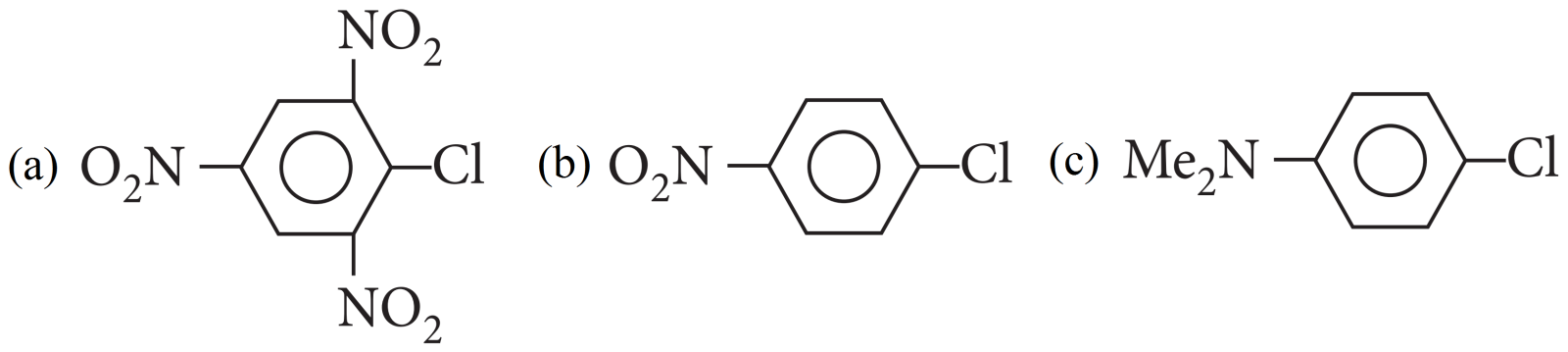
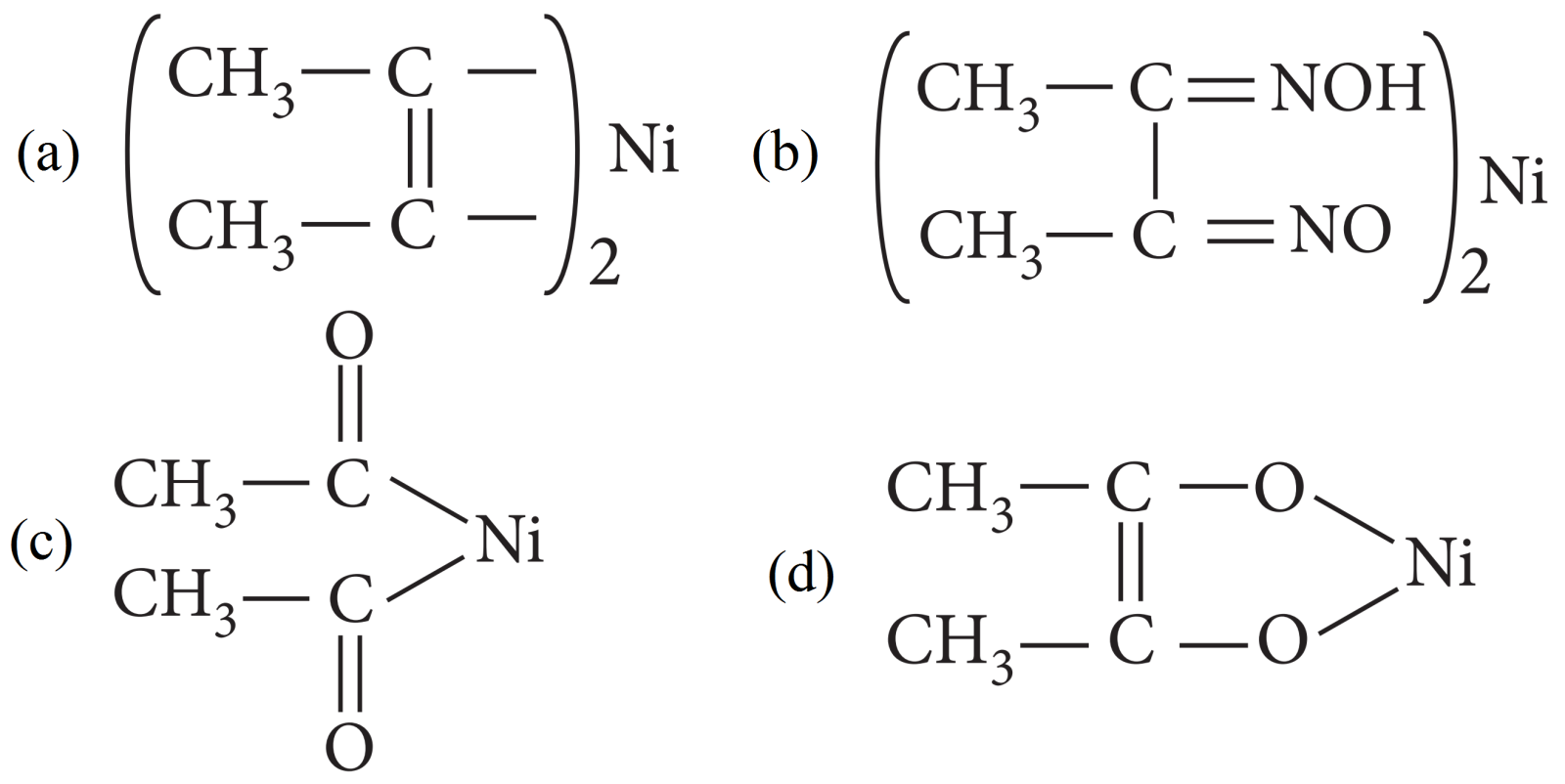
Read the passage given below and answer the following questions:
In haloalkanes, when a nucleophile stronger than the halide ion approaches the positively charged carbon atom of an alkyl halide, the halogen atom along with its bonding electron pair gets displaced and a new bond with the carbon and the nucleophile is formed. These reactions are called nucleophilic substitution reactions.
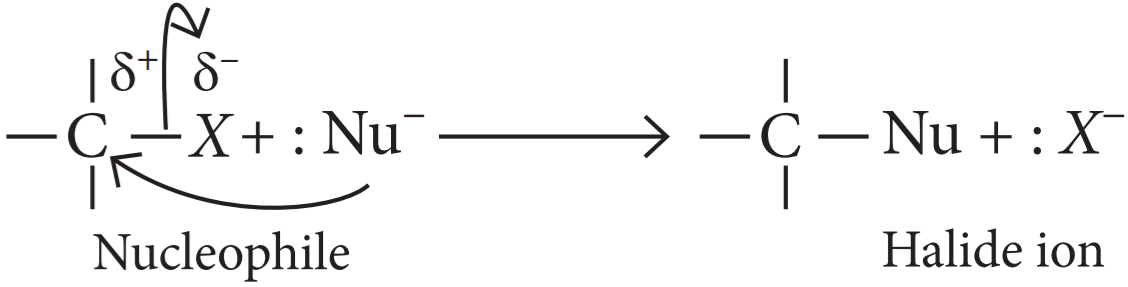
In these reactions the atom or group of atoms which loses its bond from carbon and takes on an additional pair of electrons is called leaving group. Halide ions are good leaving groups. Some important nucleophilic substitution reactions ofhaloalkanes with common nucleophiles are given in the table below.
Reagent | Nucleophile (Nu-) | Substitution product R-Nu | Class of main product | |
1. | NaOH or KOH or moist Ag2O | -OH | ROH | Alcohol |
2. | H2O | H2O | ROH | Alcohol |
3. | Nal | I- | R – I | Alkyl iodide |
4. | R'NH2 | $\text{R'}\ddot{\text{N}}\text{H}_2$ | RNHR' | Sec. amine |
5. | KCN | $\overline{\text{C}}\equiv\text{N}:$ | RCN | Nitrile (cyanide) |
6. | KNO2 | O = N – O- | R – O – N = O | Alkvl nitrite |
In these questions (Q. No. i-iv), a statement of assertion followed by a statement ofreason is given. Choose the correct answer out of the following choices.
- Assertion and reason both are correct statements and reason is correct explanation for assertion.
- Assertion and reason both are correct statements but reason is not correct explanation for assertion.
- Assertion is correct statement but reason is wrong statement.
- Assertion is wrong statement but reason is correct statement.
- Assertion: Alkyl halides are hydrolysed to alcohols by moist silver oxide.
Reason: RCI is hydrolysed to ROH easily but reactions slow down on addition of KI.
- Assertion: Alkyl halides fonn alkenes when heated above 300ºC.
Reason: CH3CH21 reacts slowly with strong base as compared to CD3CH2I.
- Assertion: RBr reacts with AgNO2 to give nitroalkane.
Reason: Silver nitrite (AgNO2) is an ionic compound, therefore the negative charge on nitrogen is the attacking site.
- Assertion: The nucleophilic substitution of vinyl chloride is difficult than ethyl chloride.
Reason: Vinyl group is electron donating group.
- Assertion: 2-Bromobutane on reaction with sodium ethoxide in ethanol gives 1-butene as the major product.
Reason: 1-Butene is less stable than 2-butene.
Read the passage given below and answer the following questions:
Coordination compounds are formulated and named according to the IUPAC system.
Few rules for naming coordination compounds are:
Coordination compounds are formulated and named according to the IUPAC system.
Few rules for naming coordination compounds are:
- In ionic complex, the cation is named first and then the anion.
- In the coordination entity, the ligands are named first and then the central metal ion.
- When more than one type of ligands are present, they are named in alphabetical order of preference without any consideration of charge.
- The IUPAC name of the complex [Pt(NH3)3Br(NO2)Cl]Cl is:
- Triamminechlorobromonitroplatinum (IV) chloride.
- Triamminebromonitrochloroplatinum (IV) chloride.
- Triamminebromidochloridonitroplatinum (IV) chloride.
- Triamminenitrochlorobromoplatinum (IV) chloride.
- The IUPAC name of [Ni(CO)4] is:
- Tetracarbonylnickel (II).
- Tetracarbonylnickel (0).
- Tetracarbonylnickelate (II).
- Tetracarbonylnickelate (0).
- As per IUPAC nomenclature, the name of the complex [Co(H2O)4(NH3)2]Cl3 is:
- Tetraaquadiamminecobalt (II) chloride.
- Tetraaquadiamminecobalt (III) chloride.
- Diamminetetraaquacobalt (II) chloride.
- Diamminetetraaquacobalt (III) chloride.
- Which of the following represents correct formula of dichloridobis(ethane -1, 2-diamine)cobalt (III) ion?
- [CoCl2(en)]2+
- [CoCl2(en)2]2+
- [CoCl2(en)]+
- [CoCl2(en)2]+
- Correct formula of pentaamminenitro-O-cobalt (III) sulphate is:
- [Co(NO2)(NH3)5]SO4
- [Co(ONO)(NH3)5]SO4
- [Co(NO2)(NH3)4](SO4)2
- [Co(ONO)(NH3)4](SO4)2
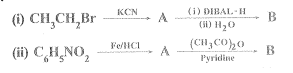
Give the structures of A and B in the following reactions
Read the passage given below and answer the following questions:
The amines are basic in nature due to the presence of a lone pair of electron on N-atom of the -NH2 group, which it can donate to electron deficient compounds. Aliphatic amines are stronger bases than NH3 because of the +I effect of the alkyl groups. Greater the number of alkyl groups attached to N-atom, higher is the electron density on it and more will be the basicity. Thus, the order of basic nature of amines is expected to be 3º > 2º > 1º, however the observed order is 2º > 1º > 3º. This is explained on the basis of crowding on N-atom of the amine by alkyl groups which hinders the approach and bonding by a proton, consequently, the electron pair which is present on N is unavailable for donation and hence 3º amines are the weakest bases.
Aromatic amines are weaker bases than ammonia and aliphatic amines. Electron-donating groups such as -CH3, -OCH3, etc. increase the basicity while electron-withdrawing substitutes such as -NO2, -CN, halogens, etc. decrease the basicity of amines. The effect of these substituents is more at p than at m-positions.
The following questions are multiple choice questions. Choose the most appropriate answer:
The amines are basic in nature due to the presence of a lone pair of electron on N-atom of the -NH2 group, which it can donate to electron deficient compounds. Aliphatic amines are stronger bases than NH3 because of the +I effect of the alkyl groups. Greater the number of alkyl groups attached to N-atom, higher is the electron density on it and more will be the basicity. Thus, the order of basic nature of amines is expected to be 3º > 2º > 1º, however the observed order is 2º > 1º > 3º. This is explained on the basis of crowding on N-atom of the amine by alkyl groups which hinders the approach and bonding by a proton, consequently, the electron pair which is present on N is unavailable for donation and hence 3º amines are the weakest bases.
Aromatic amines are weaker bases than ammonia and aliphatic amines. Electron-donating groups such as -CH3, -OCH3, etc. increase the basicity while electron-withdrawing substitutes such as -NO2, -CN, halogens, etc. decrease the basicity of amines. The effect of these substituents is more at p than at m-positions.
The following questions are multiple choice questions. Choose the most appropriate answer:
- Which one of the following is the strongest base in aqueous solution?
- Methyl amine.
- Tri methyl amine.
- Aniline.
- Dimethyl amine.
- Which order ofbasicity is correct?
- Aniline > m-toluidine > o-toluidine
- Aniline> o-toluidine > m-toluidine
- o-toluidine > aniline> m-toluidine
- o-toluidine < aniline < m-toluidine
- What is the decreasing order of basicity of primary, secondary and tertiary ethylamines and NH3?
- NH3 > C2H5NH2 > (C2H5)2NH > (C2H5)3N
- (C2H5)3N > (C2H5)2NH > C2H5NH2 > NH3
- (C2H5)2NH > C2H5NH2> (C2H5)3N > NH3
- (C2H5)2NH > (C2H5)3N > C2H5NH2 > NH3
- The order of basic strength among the following amines in benzene solution is:
- CH3NH2 > (CH3)3N > (CH3)2NH
- (CH3)3N > (CH3)2NH > CH3NH2
- CH3NH2 > (CH3)2NH > (CH3)3N
- (CH3)3N > CH3NH2 > (CH3)2NH
- Choose the correct statement.
- Methylamine is slightly acidic.
- Methylamine is less basic than ammonia.
- Methylamine is a stronger base than ammonia.
- Methylamine forms salts with alkalies.
Read the passage given below and answer the following questions: Fehling's reagent: Fehling's reagent is a mixture of two solutions. Fehllng's solution A is aqueous copper sulphate solution. Fehling's solution Bis alkaline sodium potassium tartarate (Rochelle salt). $\ \ \ \ \ \ \ \ \ \ \ \ \ \ \ \ \ \ \ \ \text{CH(OH)COONa}\\\text{CuSo}_{4\text{(aq)}}+|\\\ \ \ \ \ \ \ \ \ \ \ \ \ \ \ \ \ \ \ \ \text{CH(OH)COOK}$ It is a mild oxidising agent. It is weaker than Tollens' reagent. It oxidises only aliphatic aldehydes to carboxylate ions and itself gets reduced to reddish brown precipitate of cuprous oxide. Aromatic aldehydes do not respond to Fehling's test. This reaction is used for the test of aliphatic aldehydes known as Fehling's reagent test. In these questions (Q. No. l-iv), a statement of assertion followed by a statement ofreason is given. Choose the correct answer out of the following choices.
→- Assertion and reason both are correct statements and reason is correct explanation for assertion.
- Assertion and reason both are correct statements but reason is not correct explanation for assertion.
- Assertion is correct statement but reason is wrong statement.
- Assertion is wrong statement but reason is correct statement.
- Assertion: Fehling's solution can be used to distinguish between acetaldehyde and acetone.
Reason: Fehling's reagent is a mixture of two solutions.
- Assertion: Aromatic aldehydes can be distinguished from aliphatic aldehydes by Fehling's solution.
Reason: Aromatic aldehydes reduce Fehling's solution, but aliphatic aldehydes do not.
- Assertion: Fehling's solution oxidises acetaldehyde to acetic acid but not benzaldehyde to benzoic acid.
Reason: The C-H bond of -CHO group in benzaldehyde is stronger than in acetaldehyde.
- Assertion: CH3CHO and C6H5CH2CHO cannot be distinguished chemically by Fehling's solution.
Reason: CH3CHO and C6H5CH2CHO cannot be distinguished chemically by Fehling's solution.
- Assertion: Formaldehyde, when heated with Fehling's reagent produces a reddish brown ppt, of Cu.
Reason: Fehling's reagent oxidises fonnaldehyde to formate ion.
Nemst equation relates the reduction potential of an electrochemical reaction to the standard potential and activities of the chemical species undergoing oxidation and reduction. Let us consider the reaction, $\text{M}^{\text{n+}}_{(\text{aq})}\xrightarrow{\ \ \ \ \ \ \ \ }\text{nM}_\text{(s)}$ For this reaction, the electrode potential measured with respect to standard hydrogen electrode can be given as $\text{E}_{\Big(\frac{\text{M}^{\text{n+}}}{\text{M}}\Big)}=\text{E}^\circ_{\Big(\frac{\text{M}^\text{n+}}{\text{M}}\Big)}-\frac{\text{RT}}{\text{nF}}\text{ln}\frac{[\text{M}]}{[\text{M}^{\text{n}+}]}$ In these questions (Q. No. i-iv), a statement of assertion followed by a statement ofreason is given. Choose the correct answer out of the following choices.
→- Assertion and reason both are correct statements and reason is correct explanation for assertion.
- Assertion and reason both are correct statements but reason is not correct explanation for assertion.
- Assertion is correct statement but reason is wrong statement.
- Assertion is wrong statement but reason is correct statement.
- Assertion: For concentration cell, $\text{Zn}_{(\text{s})}|\text{ Zn}^{2+}_{\text{(aq)}}||\text{ Zn}^{2+}_{(\text{aq})}|\text{ Zn}\\\ \ \ \ \ \ \ \ \ \ \ \ \text{C}_1\ \ \ \ \ \ \ \ \text{C}_2$
For spontaneous cell reaction, C1 < C2
Reason: For concentration cell, $\text{E}_\text{cell}=\frac{\text{RT}}{\text{nF}}\log\frac{\text{C}_2}{\text{C}_1}$
For spontaneous reaction, $\text{E}_\text{cell}=+\text{ve}\Rightarrow\text{C}_2>\text{C}_1$
- Assertion: For the cell reaction, $\text{Zn}_{(\text{s})}+\text{Cu}^{2+}_{(\text{aq})}\xrightarrow{\ \ \ \ \ }\text{Zn}^{2+}_{(\text{aq})}+\text{Cu}_{(\text{s})}$ voltmeter gives zero reading at equilibrium.
Reason: At the equilibrium, there is no change in concentration of Cu2+ and Zn2+ ions.
- Assertion: The Nernst equation gives the concentration dependence of emf of the cell.
Reason: In a cell, current flows from cathode to anode.
- Assertion: Increase in the concentration of copper half cell in a cell, increases the emfofthe cell.
Reason: $\text{E}_\text{cell}=\text{E}^\circ_\text{cell}+\frac{0.059}{2}\log\frac{[\text{Cu}^{2+}]}{[\text{Zn}^{2+}]}$
- Assertion: Electrode potential for the electrode $\frac{\text{Mn}^+}{\text{Mn}}$ with concentration is given by the expression under STP conditions.
$\text{E}=\text{E}^\circ+\frac{0.059}{\text{n}}\log[\text{Mn}^{+}]$
Reason: STP conditions require the temperature to be 273K.