Question
Read the passage given below and answer the following questions:
The amines are basic in nature due to the presence of a lone pair of electron on N-atom of the -NH2 group, which it can donate to electron deficient compounds. Aliphatic amines are stronger bases than NH3 because of the +I effect of the alkyl groups. Greater the number of alkyl groups attached to N-atom, higher is the electron density on it and more will be the basicity. Thus, the order of basic nature of amines is expected to be 3º > 2º > 1º, however the observed order is 2º > 1º > 3º. This is explained on the basis of crowding on N-atom of the amine by alkyl groups which hinders the approach and bonding by a proton, consequently, the electron pair which is present on N is unavailable for donation and hence 3º amines are the weakest bases.
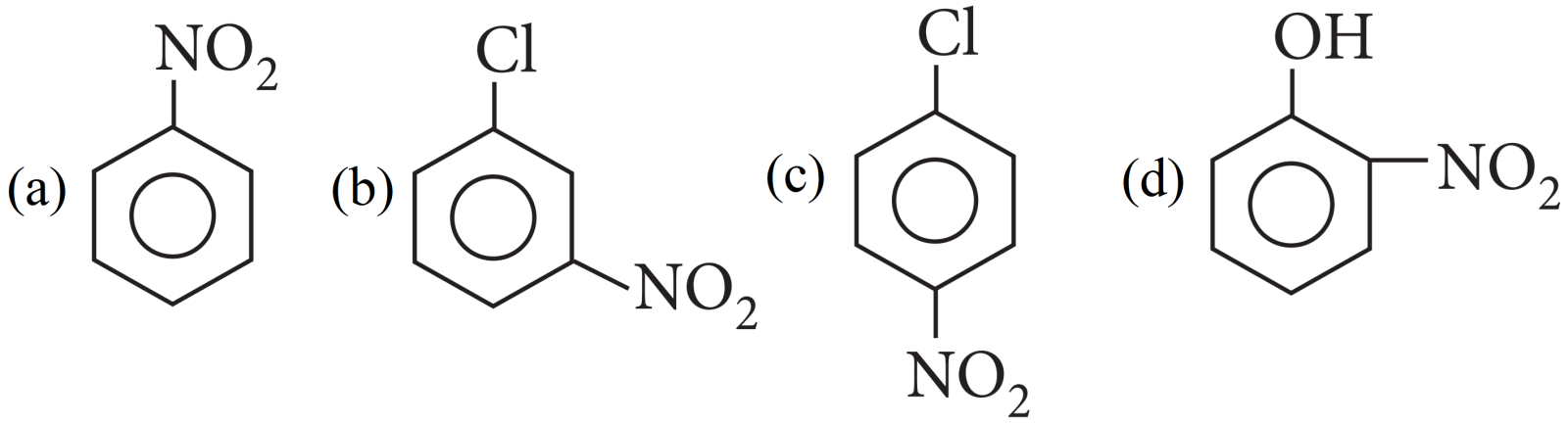
Aromatic amines are weaker bases than ammonia and aliphatic amines. Electron-donating groups such as -CH3, -OCH3, etc. increase the basicity while electron-withdrawing substitutes such as -NO2, -CN, halogens, etc. decrease the basicity of amines. The effect of these substituents is more at p than at m-positions.
The following questions are multiple choice questions. Choose the most appropriate answer:
  1. Which one of the following is the strongest base in aqueous solution?
  1. Methyl amine.
  2. Tri methyl amine.
  3. Aniline.
  4. Dimethyl amine.
  1. Which order ofbasicity is correct?
  1. Aniline > m-toluidine > o-toluidine
  2. Aniline> o-toluidine > m-toluidine
  3. o-toluidine > aniline> m-toluidine
  4. o-toluidine < aniline < m-toluidine
  1. What is the decreasing order of basicity of primary, secondary and tertiary ethylamines and NH3?
  1. NH3 > C2H5NH2 > (C2H5)2NH > (C2H5)3N
  2. (C2H5)3N > (C2H5)2NH > C2H5NH2 > NH3
  3. (C2H5)2NH > C2H5NH2> (C2H5)3N > NH3
  4. (C2H5)2NH > (C2H5)3N > C2H5NH2 > NH3
  1. The order of basic strength among the following amines in benzene solution is:
  1. CH3NH2 > (CH3)3N > (CH3)2NH
  2. (CH3)3N > (CH3)2NH > CH3NH2
  3. CH3NH2 > (CH3)2NH > (CH3)3N
  4. (CH3)3N > CH3NH2 > (CH3)2NH
  1. Choose the correct statement.
  1. Methylamine is slightly acidic.
  2. Methylamine is less basic than ammonia.
  3. Methylamine is a stronger base than ammonia.
  4. Methylamine forms salts with alkalies.
Answer

  1. (d) Dimethyl amine.

Explanation:

The increasing order of basicity of the given compounds is (CH3)2NH > CH3NH2 > (CH3)3N > C6H5NH2. Due to the +I effect of alkyl groups, the electron density on nitrogen increases and thus, the availability of the lone pair of electrons to proton increases and hence, the basicity of amines also increases. So, aliphatic amines are more basic than aniline. ln case of tertiary amine (CH3)3N, the covering of alkyl groups over nitrogen atom from all sides makes the approach and bonding by a proton relatively difficult, hence the basicity decreases. Electron withdrawing groups decrease electron density on nitrogen atom and thereby decreasing basicity.

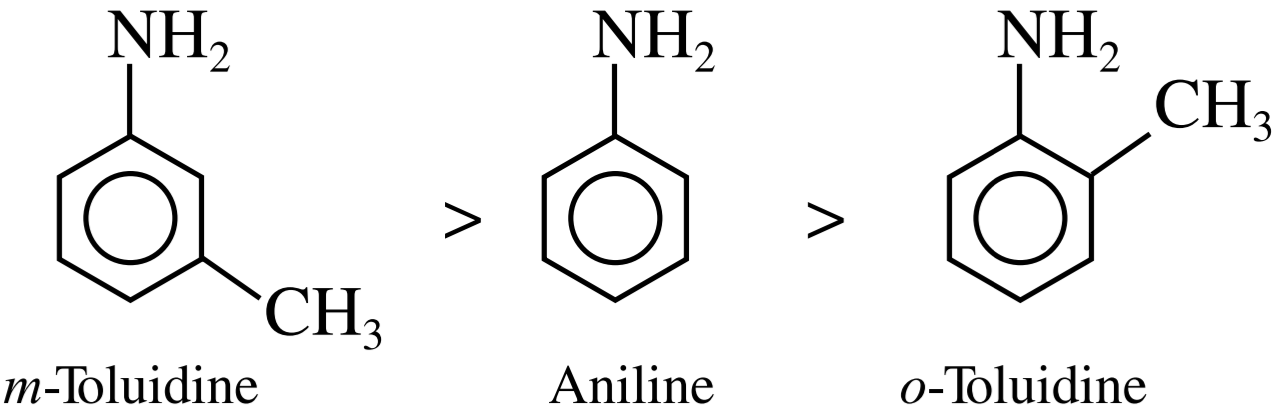
  1. (d) o-toluidine < aniline < m-toluidine

Explanation:

In general, electron donating ( +R) group which when present on benzene ring (-NH2, -OR, -R, etc.) at the para position increases the basicity of aniline.

Ortho substituted anilines are weaker bases than aniline due to ortho effect.

  1. (d) (C2H5)2NH > (C2H5)3N > C2H5NH2 > NH3

Explanation:

In case of ethylamines, the combined effect of (c) inductive effect, steric effect and salvation effect gives the order of basic strength as

$(\text{C}_2\text{H}_5)_2\text{NH}>(\text{C}_2\text{H}_5)_3\text{N}>\text{C}_2\text{H}_5\text{NH}_2>\text{NH}_3\\\ \ \ \ \ \ \ \ (2^\circ)\ \ \ \ \ \ \ \ \ \ \ \ \ \ \ \ \ \ (3^\circ)\ \ \ \ \ \ \ \ \ \ \ \ \ (1^\circ)$

  1. (b) (CH3)3N > (CH3)2NH > CH3NH2

Explanation:

In non-aqueous solvents the basic strength of alkyl amines follows the order:

tertiary amines> secondary amines> primary amines.

  1. (c) Methylamine is a stronger base than ammonia.

Explanation:

Methyl amine is stronger base than ammonia due to electron releasing inductive effect of methyl group.

Need a full question paper?

Generate a complete, print-ready paper with questions like this in minutes — across 16+ boards, with answer keys.

Start Generating Free

Similar questions

Read the passage given below and answer the following questions:

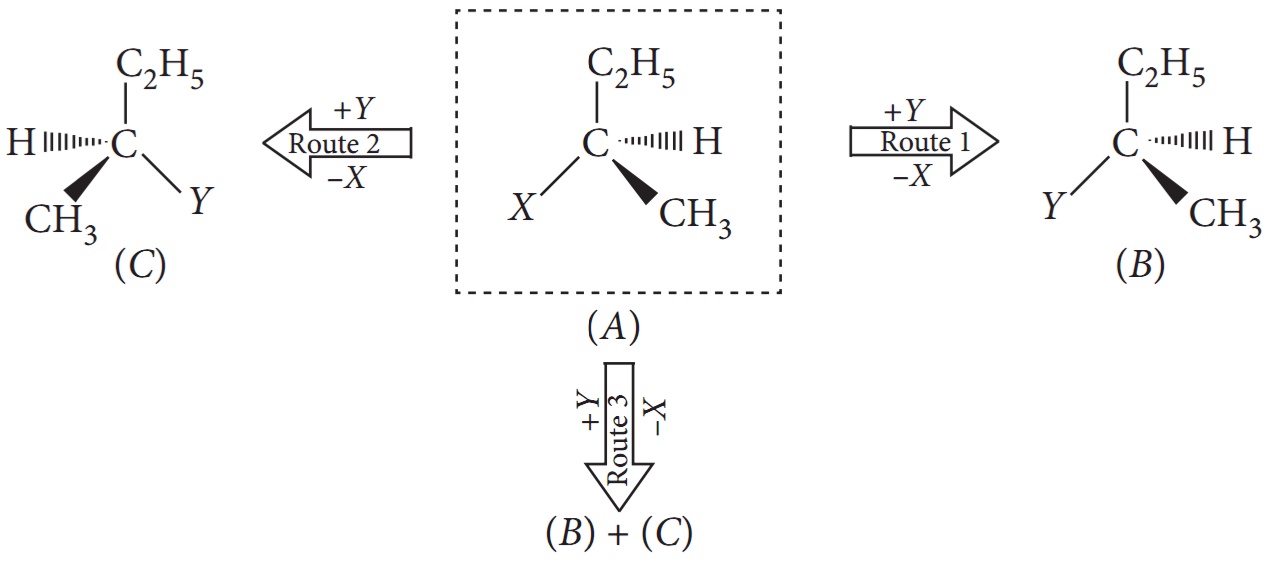
When a chemical reaction involves bond cleavage or bond formation at an asymmetric carbon atom, three different products may be formed. For example, during the substitution of a group X by Y in the following reaction, the three possible products may be shown below:

  1. If Bis the only product, the process is called retention of configuration because B has the same configuration as the starting reactant (A).
  2. If C is the only product, the process is called inversion of configuration because C has the configuration opposite to the starting reactant (A).
  3. If an equimolar mixture of Band C (r.e., a 50 : 50 mixture) is fanned, then the process is called racemisation and the product is optically inactive because one isomer will rotate the light in the direction opposite to another.

In these questions (Q. No. i-iv), a statement of assertion followed by a statement of reason is given. Choose the correct answer out of the following choices.

  1. Assertion and reason both are correct statements and reason is correct explanation for assertion.
  2. Assertion and reason both are correct statements but reason is not correct explanation for assertion.
  3. Assertion is correct statement but reason is wrong statement.
  4. Assertion is wrong statement but reason is correct statement.
  1. Assertion: A reaction is said to be stereospecific if a particular stereoisomer of the reactant produces a specific stereoisomer of the product.

Reason: Bromination of cis-2-butene gives meso-2, 3-dibromobutane which is stereospecific.

  1. Assertion: Addition of Br2 to cis-but-2-ene is stereoselective.

Reason: SN2 reactions are stereospecific as well as stereoselective.

  1. Assertion: Optically active 2-iodobutane on treatment with Nal in acetone undergoes recemization.

Reason: Repeated Walden inversions on the reactant and its product eventually gives a racemic mixture.

  1. Assertion: SN2 reaction of an optically active alkyl halide with an aqueous solution of KOH always gives an alcohol with opposite sign of rotation.

Reason: SN2 reactions always proceed with inversion of configuration.

  1. Assertion: Nudeophilic substitution reaction of an optically active alkyl halide gives a mixture of en an ti om ers.

Reason: The reaction occurs by SN2 mechanism.


Read the passage given below and answer the following questions:

Carbohydrates are polyhydroxy aldehydes and ketones and those compounds which on hydrolysis give such compounds are also carbohydrates. The carbohydrates which are not hydrolysed are called monosaccharides. Monosaccharides with aldehydic group are called aldose and those which free ketonic groups are called ketose. Carbohydrates are optically active. Number of optical isomers = 2n

Where n = numberofasymmetric carbons. Carbohydrates are mainlysynthesised by plants during photosynthesis. The monosaccharides give the characteristic reactions of alcohols and carbonyl group (aldehydes and ketones). It has been found that these monosaccharides exist in the form of cyclic structures. In cyctization, the -OH groups (generally C5 or C4 in aldohexoses and C5 or C6 in ketohexoses) combine with the aldehyde or keto group. As a result, cyclic structures of five or six membered rings containing one oxygen atom are formed, e.g., glucose forms a ring structure. Glucose contains one aldehyde group, one IO alcoholic group and four 2° alcoholic groups in its open chain structure.

The following questions are multiple choice questions. Choose the most appropriate answer:

  1. First member of ketos sugar is:
  1. Ketotriose.
  2. Ketotetrose.
  3. Ketopentose.
  4. Ketohexose.
  1. In CH2OHCHOHCHOHCHOHCHOHCHO, the number of optical isomers will be:
  1. 16
  2. 8
  3. 32
  4. 4
  1. Some statements are given below:
  1. Glucose is aldohexose.
  2. Naturally occurring glucose is dextrorotatory.
  3. Glucose contains three chiral centres.
  4. Glucose contains one 1° alcoholic group and four 2° alcoholic groups.

Among the above, correct statements are:

  1. 1 and 2 only
  2. 3 and 4 only
  3. 1, 2 and 4 only
  4. 1, 2, 3 and 4
  1. Two hexoses fonn the same osazone, find the correct statement about these hexoses.
  1. Both of them must be aldoses.
  2. They are epimers at C-3.
  3. The carbon atoms I and 2 in both have the same configuration.
  4. The carbon atoms 3, 4 and 5 in both have the same configuration.
  1. Which of the following reactions of glucose can be explained only by its cyclic structure?
  1. Glucose forms cyanohydrin with HCN.
  2. Glucose reacts with hydroxylamine to form an oxime.
  3. Pentaacetate of glucose does not react with hydroxylamine.
  4. Glucose is oxidised by nitric acid to gluconic acid.
Read the passage given below and answer the following questions :
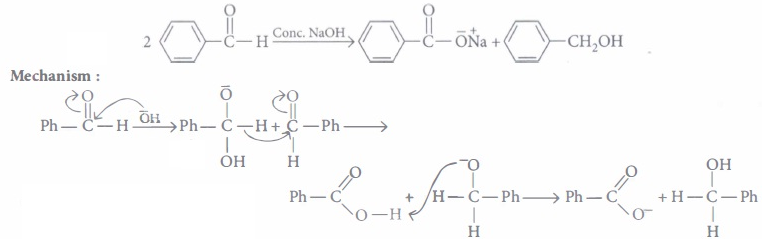
When an aldehyde with no a-hydrogen reacts with concentrated aqueous NaOH, half the aldehyde is converted to carboxylic acid salt and other half is converted to an alcohol. In other words, half of the reactant is oxidized
and other half is reduced. This reaction is known as Cannizzaro reaction

The following questions are multiple choice questions. Choose the most appropriate answer:
  1. A mixture of benzaldehyde and formaldehyde on heating with aqueous NaOH solution gives:
  1. Benzyl alcohol and sodium formate.
  2. Sodium benzoate and methyl alcohol.
  3. Sodium benzoate and sodium formate.
  4. Benzyl alcohol and methyl alcohol.
  1. Which of the following compounds will undergo Cannizzaro reaction?
  1. CH3CHO
  2. CH3COCH3
  3. C6H5CHO
  4. C6H5CH2CHO
  1. Trichloroacetaldehyde is subjected to Cannizzaro's reaction by using NaOH. The mixture of the products contains sodium trichloroacetate ion and another compound. The other compounds is:
  1. 2, 2, 2-trichloroethanol
  2. Trichloromethanol
  3. 2, 2, 2-trichloropropanol
  4. Chloroform
  1. Which of the following reaction will not result in the formation of carbon-carbon bonds?
  1. Cannizzaro reaction
  2. Wurtz reaction
  3. Reimer- Tiemann reaction
  4. Friedel - Crafts acylation
The potential of each electrode is known as electrode potential. Standard electrode potential is the potential when concentration of each species taking part in electrode reaction is unity and the reaction is taking place at 298K. By convention, the standard electrode potential of hydrogen (SHE) is 0.0V. The electrode potential value for each electrode process is a measure of relative tendency of the active species in the process to remain in the oxidised/ reduced form. The negative electrode potential means that the redox couple is stronger reducing agent than $\frac{\text{H}^+}{\text{H}_2}$ couple. A positive electrode potential means that the redox couple is a weaker reducing agent than the $\frac{\text{H}^+}{\text{H}_2}$ couple. Metals which have higher positive value of standard reduction potential form the oxides of greater thermal stability.

In these questions (Q. No. i-iv), a statement of assertion followed by a statement ofreason is given. Choose the correct answer out of the following choices.

  1. Assertion and reason both are correct statements and reason is correct explanation for assertion.
  2. Assertion and reason both are correct statements but reason is not correct explanation for assertion.
  3. Assertion is correct statement but reason is wrong statement.
  4. Assertion is wrong statement but reason is correct statement.
  1. Assertion: An electrochemical cell can be set-up only if the redox reaction is spontaneous.

Reason: A reaction is spontaneous if the free energy change is negative.

  1. Assertion: The standard electrode potential of hydrogen is 0.0V.

Reason: It is by convention.

  1. Assertion: The more negative is the standard reduction potential, greater is its ability to displace H2 from acid.

Reason: Strength of reducing agent increases with the increase in negative value of the standard reduction potential.

  1. Assertion: The negative value of standard reduction potential means that reduction takes place on this electrode with reference to hydrogen electrode.

Reason: The standard electrode potential of a half cell has a fixed value.

  1. Assertion: The absolute value of electrode potential cannot be determined experimentally.

Reason: The electrode potential values are generally determined with respect to SHE.

What is fructose? Explain the structure of fructose.
Read the passage given below and answer the following questions:
A chlorocompound (A) on reduction with Zn-Cu and ethanol gives the hydrocarbon (B) with five carbon atoms. When (A) is dissolved in dry ether and treated with sodium metal it gave 2, 2, 5, 5 - tetramethylhexane. The treatment of (A) with alcoholic KCN gives compound ( C).
The following questions are multiple choice questions. Choose the most appropriate answer:
  1. The compound (A) is:
  1. 1-chloro-2, 2-dimethylpropane.
  2. 1-chloro-2, 2-dimethyl butane.
  3. 1-chloro-2-methyl butane.
  4. 2-chloro-2-methyl butane.
  1. The reaction of (C) with Na, C2H5OH gives:
  1. (CH3)3C CH2CONH2
  2. (CH3)3C NH2
  3. (CH3)3C CH2CH2NH2
  4. (CH3)2CHCH2NH2
  1. The reaction of (C) with Na, C2H5OH is called:
  1. Gilman reaction.
  2. Mendius reaction.
  3. Grooves process.
  4. Swart's reaction.
  1. The reaction of (A) with aq. KOH will preferably favour:
  1. SN1 mechanism.
  2. SN2 mechanism.
  3. E1 mechanism.
  4. E2 mechanism.
  1. Compound (B) is:
  1. N-pentane.
  2. 2, 2-dimethylpropane.
  3. 2-methylbutane.
  4. None of these.
Read the passage given below and answer the following questions:
The concentration of a solute is very important in studying chemical reactions because it determines how often molecules collide in solution and thus indirectly determine the rate of reactions and the conditions at equilibrium. There are several ways to express the amount of solute present in a solution. The concentration of a solution is a measure of the amount of solute that has been dissolved in a given amount of solvent or solution. Concentration can be expressed in terms of molarity, molality, parts per million, mass percentage, volume percentage, etc.
The following questions are multiple choice questions. Choose the most appropriate answer:
  1. A solution is prepared using aqueous Kl which is turned out to be 20% w/w Density of Kl is 1.202 g/mL the molality of the given solution and mole fraction of solute are respectively.
  1. 1.95m, 0.120
  2. 1.5m, 0.0263
  3. 2.5m, 0.0569
  4. 3.0m, 0.0352
  1. The molarity (in mol L-1) of the given solution will be.
  1. 1.56
  2. 1.89
  3. 0.263
  4. 1.44
  1. Which of the following is correct relationship between mole fraction and molality?
  1. $\text{x}_2=\frac{\text{mM}_1}{1+\text{mM}_1}$
  2. $\text{x}_2=\frac{\text{mM}_1}{1-\text{mM}_1}$
  3. $\text{x}_2=\frac{1+\text{mM}_1}{\text{mM}_1}$
  4. $\text{x}_2=\frac{1-\text{mM}_1}{\text{mM}_1}$
  1. Which of the following is temperature dependent?
  1. Molarity
  2. Molality
  3. Mole fraction
  4. Mass percentage
  1. Which of the following is true for an aqueous solution of the solute in terms of concentration?
  1. 1M = 1m
  2. 1M > 1m
  3. 1M < 1m
  4. Cannot be predicted
Read the passage given below and answer the following questions:
Amines are alkyl or aryl derivatives of ammonia formed by replacement of one or more hydrogen atoms. Alkyl derivatives are called aliphatic amines and aryl derivatives are known as aromatic amines. The presence of aromatic amines can be identified by performing dye test. Aniline is the simplest example of aromatic amine. It undergoeselectrophilic substitution reactions in which -NH2 group strongly activates the aromatic ring through delocalisation of lone pair of electrons of N-atom. Aniline undergoes electrophilic substitution reactions. Ortho and para positions to the -NH2 group become centres of high electrons density. Thus, -NH2 group is ortho and para-directing and powerful activating group.
The following questions are multiple choice questions. Choose the most appropriate answer:
  1. Cyclohexylamine and aniline can be distinguished by:
  1. Hinsberg test.
  2. carbylamine test.
  3. Lassaigne test.
  4. azo dye test.
  1. Which of the following compounds gives dye test?
  1. Aniline.
  2. Methyl amine.
  3. Diphenyl amine.
  4. Ethyl amine.
  1. Aniline when acetylated, the major product on nitration followed by alkaline hydrolysis gives:
  1.  Acetanilide.
  2. o-nitroacetanitide.
  3. p-nitroaniline.
  4. m-nitroanitine.
  1. Oxidation of aniline with manganese dioxide and sulphuric acid produces:
  1. Phenylhydroxylamine.
  2. Nitrobenzene.
  3. p-benzoquinone.
  4. Phenol.
  1. Aniline when treated with cone. HNO3 and H2S04 gives:
  1.  p-phenylenediamine.
  2. m-nitroaniline.
  3. p-benzoquinone.
  4. Nitrobenzene.
Read the passage given below and answer the following questions:
To explain bonding in coordination compounds various theories were proposed. One of the important theory was valence bond theory. According to that, the central metal ion in the complex makes available a number of empty orbitals for the formation of coordination bonds with suitable ligands. The appropriate atomic orbitals of the metal hybridise to give a set of equivalent orbitals of definite geometry.
The d-orbitals involved in the hybridisation may be either inner d-orbitals i.e., (n - 1)d or outer d-orbitals i.e., nd. For example, Co3+ forms both inner orbital and outer orbital complexes, with ammonia it forms [Co(NH3)6]3+ and with fluorine it forms [CoF6]3- complex ion.
The following questions are multiple choice questions. Choose the most appropriate answer:
  1. Which of the following is not true for [CoF6]3-?
  1. It is paramagnetic.
  2. It has coordination number of 6.
  3. It is outer orbital complex.
  4. It involves d2sp3 hybridisation.
  1. [Cr(H2O)6]Cl3 (at. no. of Cr = 24) has a magnetic moment of 3.83B.M. The correct distribution of 3d-electrons in the central metal of the complex is:
  1. $3\text{d}^1_\text{xy},3\text{d}^1_{\text{x}^2-\text{y}^2},3\text{d}^1_\text{yz}$
  2. $3\text{d}^1_\text{xy},3\text{d}^1_{\text{yz}},3\text{d}^1_\text{zx}$
  3. $3\text{d}^1_\text{xy},3\text{d}^1_{\text{zy}},3\text{d}^1_{\text{z}^2}$
  4. $3\text{d}^1_{\text{x}^2-\text{y}^2},3\text{d}^1_{\text{z}^2},3\text{d}^1_\text{xz}$
  1. Which of the following is true for [Co(NH3)6]3+?
  1. It is an octahedral, di magnetic and outer orbital complex.
  2. It is an octahedral, paramagnetic and outer orbital complex.
  3. It is an octahedral, paramagnetic and inner orbital complex.
  4. It is an octahedral, di magnetic and inner orbital complex.
  1. The paramagnetism of [CoF6]3- is due to.
  1. 3 electrons.
  2. 4 electrons.
  3. 2 electrons.
  4. 1 electron.
  1. Which of the following is an inner orbital or low spin complex?
  1. [Ni(H2O)6]3+
  2. [FeF6]3-
  3. [Co(CN)6]3-
  4. [NiCl4]2-