Question
Read the Source/ Text given below and answer these questions:
There is a Diwali celebration in the $DPS$ school Janakpuri New Delhi. Girls are asked to prepare Rangoli in a triangular shape. They made a rangoli in the shape of $\triangle ABC.$ Dimensions of $\triangle\text{ABC}$ are $26\ cm, 28\ cm, 25\ cm.$
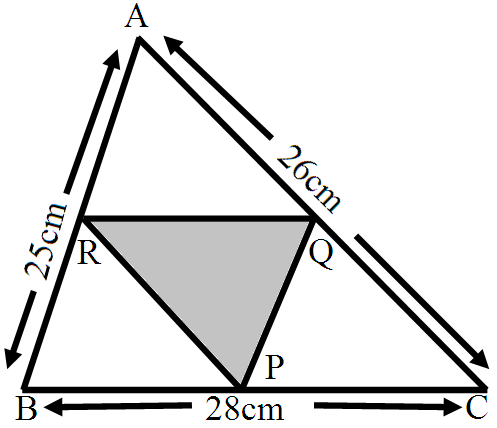
$i.$ In fig, $R$ is mid$-$point of $AB$ and $RQ \| BC$ then $AQ$ is equal to:
$a. BC$
$b. RB$
$c. QC$
$d. AD$
$ii.$ In fig $R$ and $Q$ are mid-points of $AB$ and $AC$ respectively. The length of $RQ$ is:
$a. 14$
$b. 13$
$c. 12.5$
$d.13.5$
$iii.$ If Garland is to be placed along the side of $\triangle\text{QPR}$ which is formed by joining midpoint, what is the length of garland:
$a. 79\ cm$
$b. 39.5\ cm$
$c. 35\ cm$
$d.79.5\ cm$
$iv.$ In the following figure $R, P$ and $Q$ are the mid-points of $AB, BC,$ and $AC$ respectively. Which of the following is the area of $\triangle\text{PQR}?$
$a. \frac12\text{ar (ABC)}$
$b. \frac{1}{3}\text{ar (ABC)}$
$c. \frac14\text{ar (ABC)}$
$d.\frac16\text{ar (ABC)}$
$v. R, P, Q$ are the mid-points of corresponding sides $AB, BC, CA$ in $\triangle\text{ABC}$ the figure so obtained $BPQR$ will be:
$a.$ Parallelogram.
$b.$ Trapezium.
$c.$ Quadrilateral.
$d.$ None of these.
Answer

$(i)$
$(c)$
$QC$
$(ii)$
$(a)$
$14$
$(iii)$
$(b)$
$39.5\ cm$
$(iv)$
$(c)$
$\frac14\text{ar (ABC)}$
$(v)$
$(a)$
Parallelogram.

Need a full question paper?

Generate a complete, print-ready paper with questions like this in minutes — across 16+ boards, with answer keys.

Start Generating Free

Similar questions

Atul likes to observe the stars with his telescope. He likes to track the movements of stars in the sky.
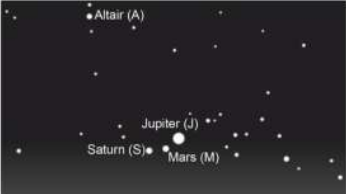
He took a picture of the night sky one day. On that day, Mars was equidistant from Saturn and Jupiter.Image

He draws a circle such that the dots showing the planets Mars $(M),$ Jupiter $(J),$ Saturn $(S)$ and a star Altair $(A)$ lies on the boundary of a circle and $\angle SMJ = 150^\circ .$
$1.$ What is the measure of $\angle SAJ?$
$A. 30^\circ $
$B. 45^\circ $
$C. 150^\circ $
$D. 210^\circ $
$2.$ Atul claims that the quadrilateral $MJAS$ is a kite.
What additional information is required to conirm his claim$?$
$A.$ Distance between Altair and Saturn is equal to the distance between Mars and Jupiter.
$B.$ Distance between Altair and Jupiter is equal to the distance between Mars and Saturn.
$C.$ Distance between Altair and Saturn is equal to the distance between Altair and Mars.
$D.$ Distance between Altair and Saturn is equal to the distance between Altair and Jupiter.
$3.$ The adjacent sides of quadrilateral $A$ are equal to corresponding sides of Quadrilateral $B.$ All angles of Quadrilateral A measure $90^\circ .$ The angles of Quadrilateral $B$ are $120^\circ , 60^\circ , 120^\circ $ and $60^\circ $ respectively.
Which quadrilateral has a greater area? Give reasons.
$4.$ Sanya has a triangular piece of land. She wants to divide it into four equal areas. Suggest a way to do so.
$5.$ Does joining four distinct points always produce a quadrilateral? Justify your answer.
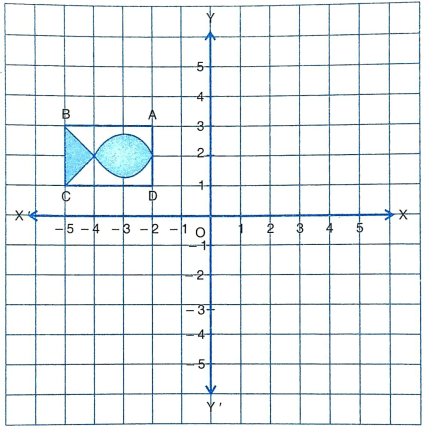
For Maths integrated project, Sonia created a symmetrical design on Cartesian plain. She drew a fish in a rectangle ABCD in the 2nd quadrant as shown in figure.
Image
Based on the above information, answer the following questions:
(i) Find the sum of abscissa of points A and B.
(ii) Find the area of rectangle ABCD.
(iii) What will be the new coordinates of A, B, C and D to draw the reflection of fish in the $3^{\text {rd }}$ quadrant across $x$-axis.
(iv) What will be the new coordinates of A, B, C and D to draw the fish by shifting each vertex of the rectangle 5 units to the right.
Read the following text carefully and answer the questions that follow:
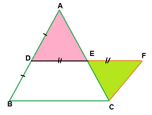
Haresh and Deep were trying to prove a theorem. For this they did the following
Image
$i.$ Draw a triangle $ABC$
$ii. \ D$ and E are found as the mid points of $AB$ and $AC$
$iii.\ DE$ was joined and $DE$ was extended to $F$ so $DE = EF$
$iv. \ FC$ was joined.
Questions :
$i. \triangle ADE$ and $\triangle EFC$ are congruent by which criteria?
$ii.$ Show that $C F \| A B$.
$iii.$ Show that $C F=B D$.
OR
Show that $D F=B C$ and $D F \| B C$.
Read the following text carefully and answer the questions that follow:
Once upon a time in Ghaziabad was a corn cob seller. During the lockdown period in the year $2020$, his business was almost lost.
So, he started selling corn grains online through Amazon and Flipcart. Just to understand how many grains he will have from one corn cob, he started counting them.
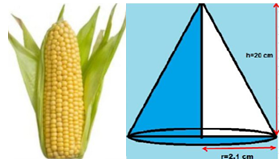
Being a student of mathematics let's calculate it mathematically. Let's assume that one corn cob $($see Fig.$),$ shaped somewhat like a cone, has the radius of its broadest end as $2.1 \ cm$ and length as $20 \ cm.$
Image
$i.$ Find the curved surface area of the corn cub.
$ii.$ What is the volume of the corn cub?
$iii.$ If each $1 \ cm^2 $ of the surface of the cob carries an average of four grains, find how many grains you would find on the entire cob?
OR
How many such cubs can be stored in a cartoon of size $20 \ cm \times 25 \ cm \times 20 \ cm$.
Read the following text carefully and answer the questions that follow:
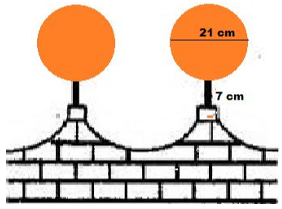
The front compound wall of a house is decorated by wooden spheres of diameter $21 \ cm,$ placed on small supports as shown in figure. $25$ such spheres are used for this purpose and are to be painted silver. Each support is a cylinder and is to be painted black.
Image
$i.$ what will be the total surface area of the spheres all around the wall?
$ii$. Find the cost of orange paint required if this paint costs $20$ paise per $\ cm^2$.
$iii.$ How much orange paint in liters is required for painting the supports if the paint required is $3 ml$ per $\ cm^2$ ?
OR
What will be the volume of total spheres all around the wall?
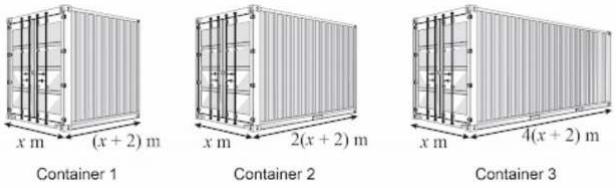
A shipment service provider uses three types of containers for shipping materials. The height and
width of the three containers are the same. The containers’ height is $0.15 m$ more than their width, and the volume of the smallest container is $652 m^3$
Image
$1.$ Write a polynomial relating Container $1’s$ length, breadth and height with its volume.
$2.$ Which of the following statements is true$?$
$A.$ The volume of the three containers is the same.
$B.$ The length of the three containers is the same.
$C.$ The volume of Container $3$ is $2,608 m^3.$
$D.$ The length of Container $3$ is $4$ times the length of Container $2.$
$3.$ What is the height of each container$?$
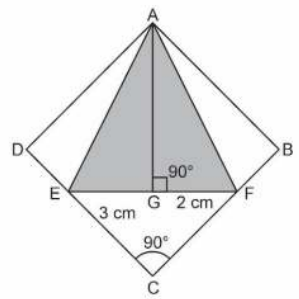
In the given figure, $\triangle AFB ≅ \triangle AFG, \triangle ADE ≅ AGE$ and $\angle EAF = 45^\circ .$
Image
$1.$ What is the measure of $\angle DAB?$
$A. 60^\circ $
$B. 90^\circ $
$C. 120^\circ $
$D. 135^\circ $
$2.$ What is the length of $AD?$
$3.$ What is the area of the shaded region$?$
$A. 12.5\ cm^2$
$B. 15\ cm^2$
$C. 20\ cm^2$
$D. 36\ cm^2$
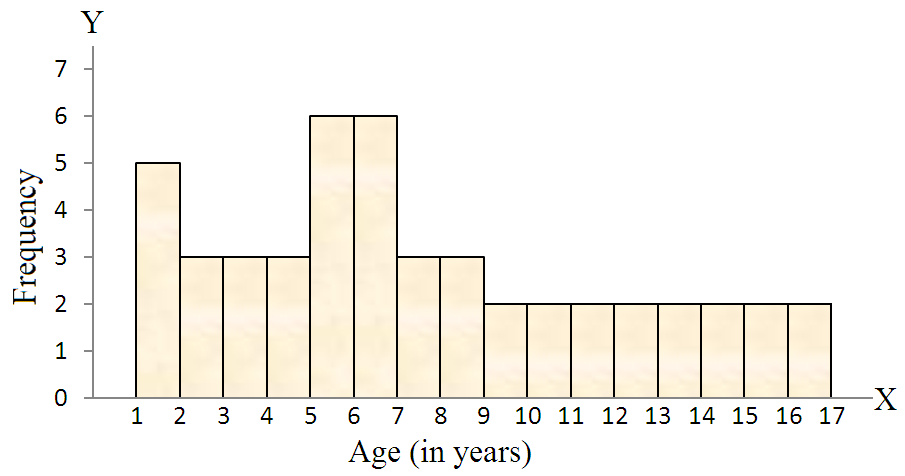
Read the Source Text given below and answer these questions: In an effort to provide high$-$quality and safe playgrounds for kids, our reputable manufacturers adhere to the playground safety guidelines set forth by the Indian Consumer Product Safety Commission $(\text{CPSC})$ and the Indian Society for Advancement of Materials and Processing Engineering $(\text{ISAMPE}).$ These organizations set the guidelines for determining the types of playground equipment that is appropriate for kids within specific age groups: $2-3$ years, $3-5$ years, $5-7$ years, $7-10$ years, $10-15$ years, and $15-17$ years. A random survey of the number of children of various age groups playing in a park was found as follows:
 
Age (in years)
Number of children
$1-2$
$5$
$2-3$
$3$
$3-5$
$6$
$5-7$
$12$
$7-10$
$9$
$10-15$
$10$ 
$15-17$
$4$
The histogram is as given below:
$i.$ In this question, the class sizes are different. So, calculate the adjusted frequency for each class by using the following formula:

Frequency density or adjusted frequency for class:

$a. \frac{\text{Minimum class size}}{\text{Class size of this class}}\times$ Its Frequency
$b. \frac{\text{Minimum class mark}}{\text{Class size of this class}}\times$ Its Frequency
$c. \frac{\text{Minimum Frequency}}{\text{Class size of this class}}\times$ Its class size
$d. \frac{\text{Minimum class mark}}{\text{Class mark of this class}}$
$ii.$ In this question the minimum class size is:
$a. 0$
$b. 1$
$c. 2$
$d. 3$
$iii.$ The class limits of third class interval $3-5:$
$a.$ Lower limit $= 5,$ upper limit $= 3$
$b.$ Lower limit $= 5,$ upper limit $= 7$
$c.$ Lower limit $= 3,$ upper limit $= 5$
$d. $Lower limit $= 7,$ upper limit $= 5$
$iv.$ Adjusted Frequency for class interval $5-7$ and $7-10:$
$a. 3, 6$
$b. 3, 3$
$c. 6, 6$
$d. 6, 3$
$v.$ Find the class mark of class $15 - 17:$
$a. 16$
$b. 12$
$c. 25$
$d. 2$
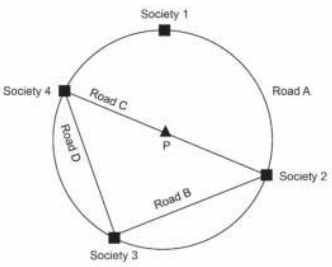
Given below is the map giving the position of four housing societies in a township connected by a circular road $A.$Image

Society $2$ and $3$ are connected by straight road $B,$ society $4$ and $2$ are connected by straight road $C$ and society $ 4$ and 3 are connected by road $D.$ Point $P$ denotes the position of a park. The park is equidistant to all four societies.
Rubina claims that it is not possible to construct another circular road connecting all four societies.
$1.$ Which of the following options justiies Rubina’s claim?
$A.$ Equal chords of congruent circles subtend equal angles at the centre.
$B.$ The perpendicular from the centre of a circle to a chord bisects the chord.
$C.$ There is a unique circle passing through three non-collinear points.
$D.$ Points equidistant from a given point will lie on a circle.
$2$ What is the position of the park P with respect to road $A?$
$A.$ Chord
$B.$ Centre
$C.$ Sector
$D.$ Segment
$3.$ The length of Road $B$ is equal to the length of Road $D.$
Which of the following options can be true for the roads in the township$?$
$A.$ Road $B$ bisects Road $D.$
$B.$ Road $B$ and Road make an acute angle.
$C.$ Road $B,$ Road $C$ and Road $D$ are of equal length.
$D. $ Road $B$ and Road $D$ subtend equal angles at society $1.$
$4.$ Alex says, “The angle made by road $B$ on road $D$ is a right angle.”
Jai and Angad give different justiications to support Alex’s claim.
Jai says, “Angles in the same segment of a circle are equal.”
Angad says, “The angle in a semicircle is a right angle.”
Who has given the correct justiication$?$
Read the Source Text given below and answer these questions:

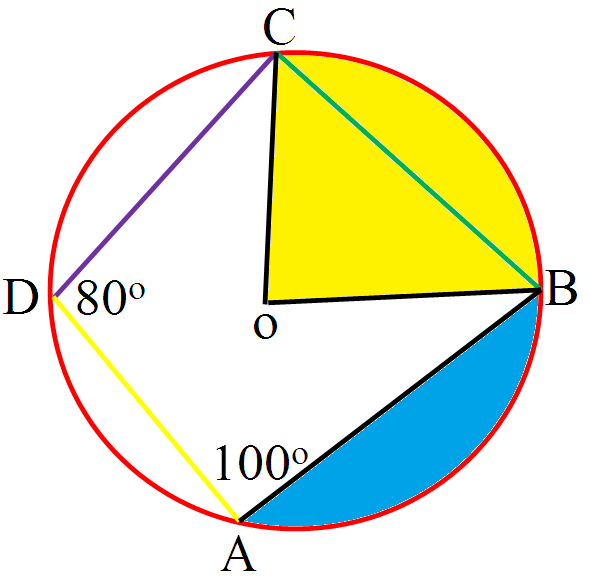
 There was a circular park in Defence colony At Delhi. For fencing purpose Poles $A, B, C$ and $D$ were installed at the circumference of the park. Ram tied wires From $A$ to $B$ to $C$ and $C$ to $D,$ He managed to measure the $\angle\text{A}=100^\circ$ and $\angle\text{D}=80^\circ$ The point $O$ in the middle of the park is the center of the circle. Now answer the following questions:
$i.$ What is the value of $\angle\text{B}?$
$a. 80^\circ $
$b. 100^\circ $
$c. 90^\circ $
$d. 70^\circ $
$ii.$ What is the value of $\angle\text{C}?$
$a. 80^\circ $
$b. 100^\circ $
$c. 90^\circ $
$d. 70^\circ $
$iii.$ What is the special type of quadrilateral $\text{ABCD}?$
$a.$ Square.
$b.$ Rectangle.
$c.$ Cyclic quadrilateral.
$d.$ Trapezium.
$iv.$ What is the property of cyclic quadrilateral?
$a.$ Opposite angles are supplementary.
$b.$ Adjacent angles are equal.
$c.$ Opposite angles are equal.
$d.$ Adjacent angles are complementary.
$v.$ What you will call the yellow shaded shape $\text{OBC}?$
$a.$ Segment.
$b.$ Arc.
$c.$ Chord.
$d.$ Sector.