Question
Represent the numbers √5 and √10 on a number line.

Answer

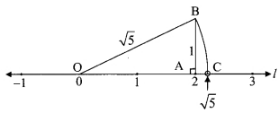
i. Draw a number line and take point $A$ at 2 .
Draw $A B$ perpendicular to the number line such that $A B=1$ unit.
In $\triangle OAB , m \angle OAB =90^{\circ}$
$\therefore(O B)^2=(O A)^2+(A B)^2 \ldots[$ [Pythagoras theorem]
$=(2)^2+(1)^2$
$\therefore( OB )^2=5$
$\therefore OB =\sqrt{ } 5$ units.... [Taking square root of both sides]
With O as centre and radius equal to OB , draw an arc to intersect the number line at C .

Image

The coordinate of the point C is $√5 $.
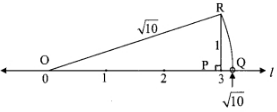
ii. Draw a number line and take point Pat 3 .
Draw $P R$ perpendicular to the number line such that $P R=1$ unit.
In $\triangle O P R, m \angle O P R=90^{\circ}$
$\therefore( OR )^2=( OP )^2+( PR )^2 \ldots$ [Pythagoras theorem]
$=(3)^2+(1)^2$
$\therefore( OR )^2=10$
$\therefore OR =\sqrt{ } 10$ units. $\ldots$. [Taking square root of both sides]
With O as centre and radius equal to OR , draw an arc to intersect the number line at Q .
The coordinate of the point Q is $\sqrt{ } 10$.
Image
The coordinate of the point Q is $√10 $.

Need a full question paper?

Generate a complete, print-ready paper with questions like this in minutes — across 16+ boards, with answer keys.
Start Generating Free

Similar questions

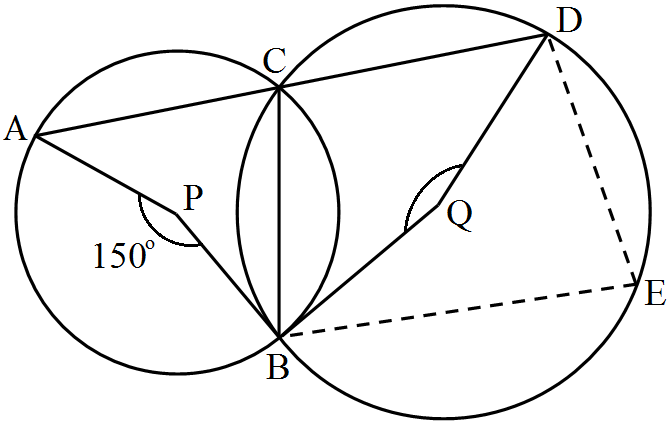
In the given figure, P and Q are centres of two circles intersecting at B and C. ACD is a straight line. Then, $\angle\text{BQD} =$
Construct ∆PQR, such that QR = 6.5 cm, ∠PQR = 60° and PQ – PR = 2.5 cm.
If $\text{x}+\frac{1}{\text{x}}=3, $ then find the value of $\text{x}^6+\frac{1}{\text{x}^6}.$
In a circle of radius $5\ cm$, $AB$ and $CD$ are two parallel chords of lengths $8\ cm$ and $6\ cm$ respectively. Calculate the distance between the chords if they are:
  1. On the same side of the centre.
  2. On the opposite sides of the centre.
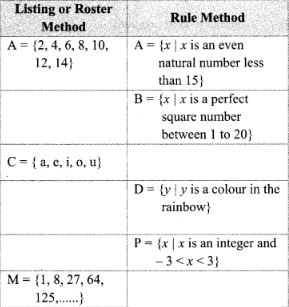
Fill in the blanks given in the following table
Image
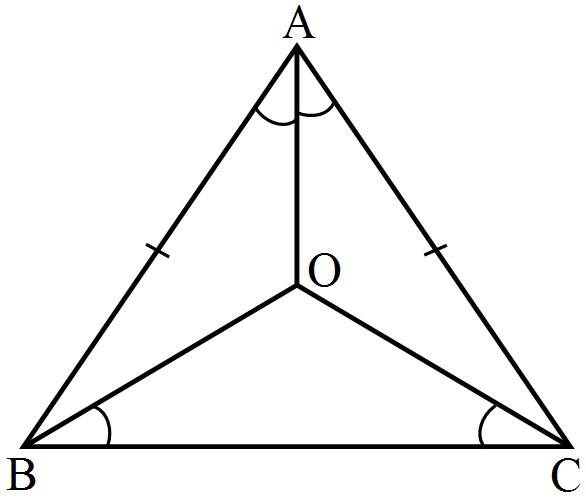
In $\triangle\text{ABC,}$ AB = AC and the bisectors of $\angle\text{B}$ and $\angle\text{C}$ meet at a point O. Prove that BO = CO and the ray AO is the bisector of $\angle\text{A}.$
Two circles with centres O and O' intersect at two points A and B. A line PQ is drawn parallel to OO' through A or B, intersecting the circles at P and Q. Prove that PQ = 2OO'.
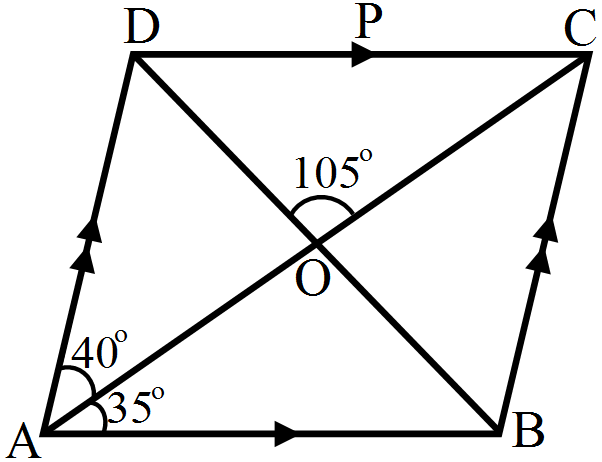
In the adjoining figure, ABCD is a parallelogram in which $\angle\text{BAO}=35^{\circ},\angle\text{DAO}=40^{\circ}$ and $\angle\text{COD}=150^{\circ}.$ Calculate
  1. $\angle\text{ABO},$
  2. $\angle\text{ODC},$
  3. $\angle\text{ACB},$
  4. $\angle\text{CBD}.$
In the given figure, AB and CD are two chords of a circle, intersecting each other at a point E. Prove that $\angle\text{AEC}=\frac{1}{2}$(angle subtended by arc CXA at the centre + angle subtended by arc DYB at the centre).
Divide each of the following polynomials by synthetic division method and also by linear division method. Write the quotient and the remainder : $(x^4 + 2x^3 + 3x^2 + 4x + 5) ÷ (x + 2)$