Resistance $n$, each of $r\; ohm$, when connected in parallel give an equivalentresistance of $R\; ohm$. If these resistances were connected in series, the combination would have a resistance in $ohms$, equal to
AIPMT 2004, Medium


Download our appand get started for free
Experience the future of education. Simply download our apps or reach out to us for more information. Let's shape the future of learning together!No signup needed.*
Similar Questions
- 1View SolutionGiven three equal resistors, how many different combination of all the three resistors can be made
- 2$62.5 \times {10^{18}}$ electrons per second are flowing through a wire of area of cross-section $0.1\,{m^2}$, the value of current flowing will be ............ $A$View Solution
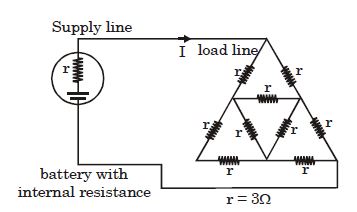
- 3By which of the following single load resistance the load bridge should be replaced so that the power to the load remains unchanged ................ $\Omega$View Solution
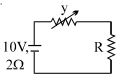
- 4In the figure shown the power generated in $y$ is maximum when $y = 5\,\Omega$ . Then $R$ is .............. $\Omega$View Solution
- 5Two wires $A$ and $B$ made of same material and having their lengths in the ratio $6 : 1$ are connected in series. The potential difference across the wires are $3\,V$ and $2\,V$ respectively. If $r_A$ and $r_B$ are the radii of $A$ and $B$ respectively, then $\frac{{{r_B}}}{{{r_A}}}$ isView Solution
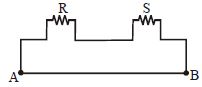
- 6In a meter bridge, the null point is found at a distance of $25\, cm$ from $A$ . If now a resistance of $10\,\Omega $ is connected in parallel with $S$, the null point occurs at mid point of $AB$. The value of $R$ is .............. $\Omega$View Solution
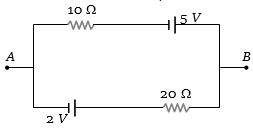
- 7The current in the given circuit is ................ $A$View Solution
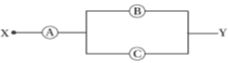
- 8$A, \,B$ and $C$ are voltmeters of resistance $R, \,1 .5R$ and $3R$ respectively as shown in the figure. When some potential difference is applied between $X$ and $Y,$ the voltmeter readings are $V_A, \,V_B$ and $V_C$ respectively. ThenView Solution
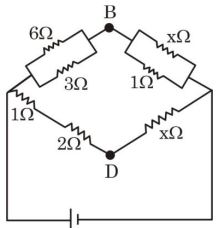
- 9If the potential difference between $B$ and $D$ is zero, the value of $x$ is $\frac{1}{n} \Omega$. The value of $n$ is .......View Solution
- 10The resistance of a wire is$10\,\Omega $. Its length is increased by $10\%$ by stretching. The new resistance will now be .......... $\Omega$View Solution