Two wires $A$ and $B$ made of same material and having their lengths in the ratio $6 : 1$ are connected in series. The potential difference across the wires are $3\,V$ and $2\,V$ respectively. If $r_A$ and $r_B$ are the radii of $A$ and $B$ respectively, then $\frac{{{r_B}}}{{{r_A}}}$ is
Medium


Download our appand get started for free
Experience the future of education. Simply download our apps or reach out to us for more information. Let's shape the future of learning together!No signup needed.*
Similar Questions
- 1A heater coil connected to a supply of a $220\, V$ is dissipating some power ${P_1}.$ The coil is cut into half and the two halves are connected in parallel. The heater now dissipates a power ${P_2}.$ The ratio of power ${P_1}\,\,:\,\,{P_2}$ isView Solution
- 2View SolutionThe material of wire of potentiometer is
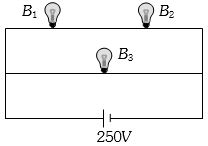
- 3A $100\, W$ bulb $B_1$, and two $60\,W$ bulbs $B_2$ and $B_3$, are connected to a $250\, V$ source, as shown in the figure. Now $ W_1, W_2$ and $W_3$ are the output powers of the bulbs $B_1, B_2$ and $B_3$, respectively. ThenView Solution
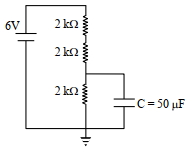
- 4A capacitor of $50 \,\mu {F}$ is connected in a circuit as shown in figure. The charge on the upper plate of the capacitor is $......\,\mu {C} .$View Solution
- 5In a large building, there are $15$ bulbs of $40\ W$, $5$ bulbs of $100\ W, 5$ fans of $80\ W$ and $1$ heater of $1\ kW$. The voltage of electric mains is $220\ V$. The minimum capacity of the main fuse of the building will be ................ $A$View Solution
- 6In a neon discharge tube $2.9 \times {10^{18}}\,N{e^ + }$ ions move to the right each second while $1.2 \times {10^{18}}$ electrons move to the left per second. Electron charge is $1.6 \times {10^{ - 19}}\,C$. The current in the discharge tubeView Solution
- 7Find current in $6\,\Omega $ resistanceView Solution
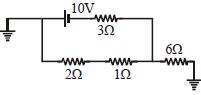
- 8A $25\, watt$, $220\, volt$ bulb and a $100\, watt$, $220\, volt$ bulb are connected in parallel across a $220\, volt$ line. Which bulb will glow more brightlyView Solution
- 9$n$ identical cells each of $e.m.f.$ $E$ and internal resistance $r$ are connected in series. An external resistance $R$ is connected in series to this combination. The current through $R$ isView Solution
- 10The resistance ofeach arm of the Wheatstone's bridge is $10\; ohm$. A resistance of $10 \;ohm$ is connected in series with a galvanometer then the equivalent resistance across the battery will beView Solution