Question
Resolving power of a microscope can $NOT$ be increased by

Answer

Resolving power $\propto \frac{a}{\lambda f}$

$a :$ aperture

$\lambda:$ wavelength

$\mathrm{f}:$ focal length

By immersing objective lens in oil, resolving power increases.

Need a full question paper?

Generate a complete, print-ready paper with questions like this in minutes — across 16+ boards, with answer keys.
Start Generating Free

Similar questions

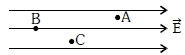
$A, B$ and $C$ are three points in a uniform electric field. The electric potential is
When Ultraviolet radiation of a certain frequency falls on a potassium target, the photo electrons released can be stopped completely by a retarding potential of $0.6 \,V$. If the frequency of the radiation is increased by $10 \%$, this stopping potential rises to $0.9 \,V$. The work function of potassium is ........ $eV$
When radiation of wavelength $\lambda $ is incident on a metallic surface, the stopping potential is $4.8$ volts. If the same surface is illuminated with radiation of double the wavelength, then the stopping potential becomes $1.6$ volts. Then the threshold wavelength for the surface is
A jar contains a gas and few drops of water at $T K.$ The pressure in the jar is $830 \,mm$ of mercury. The temperature of jar is reduced by $1\%.$ The saturated vapour pressure of water at the two temperatures are $30 \,mm$ and $ 25\, mm$ of mercury. Then the new pressure in the jar will be ..... $mm$ of $Hg$
Find the maximum tension in the spring if initially spring at its natural length when block is released from rest.
Fountains usually seen in gardens are generated by a wide pipe with an enclosure at one end having many small holes. Consider one such fountain which is produced by a pipe of internal diameter $2$ $cm$ in which water flows at a rate $3$ $ms^{^{-1}}$. The enclosure has $100$ holes each of diameter $0.05$ $cm$. The velocity of water coming out of the holes ids ( in $ms^{^{-1}}$) 
Two point masses $m$ and $4 m$ are separated by a distance $d$ on a line. A third point mass $m_0$ is to be placed at a point on the line such that the net gravitational force on it is zero. The distance of that point from the $m$ mass is ..............
Let $[ {\varepsilon _0} ]$ denote the dimensional formula of the permittivity of vacuum. If $M =$ mass, $L=$ length, $T =$ time and $A=$ electric current, then:
An electron moving with a velocity ${\vec V_1} = 2\,\hat i\,\, m/s$ at a point in a magnetic field experiences a force ${\vec F_1} =  - 2\hat j\,N$ .  If the electron is moving with a velocity ${\vec V_2} = 2\,\hat j \,\,m/s$ at the same point, it experiences a force ${\vec F_2} =  + 2\,\hat i\,N$ .  The force the electron would experience if it were moving with a velocity ${\vec V_3} = 2\hat k$  $m/s$ at the same point is
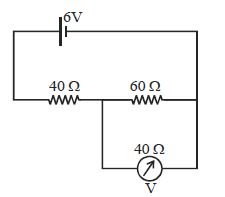
The reading of voltmeter in the circuit shown is ............. $V$