MCQ
Reynold's number (Re) can be defined as:
  • A
    $\frac{\rho\eta}{\text{vd}}$
  • B
    $\frac{\text{vd}}{\rho}$
  • C
    $\frac{\rho\text{vd}}{\eta\text{d}}$
  • D
    $\text{d}\rho\frac{\text{v}}{\eta}$

Answer

  1. $\text{d}\rho\frac{\text{v}}{\eta}$

Need a full question paper?

Generate a complete, print-ready paper with questions like this in minutes — across 16+ boards, with answer keys.

Start Generating Free

Similar questions

Which of the following will change the time period as they are taken to moon?
  1. A simple pendulum.
  2. A physical pendulum.
  3. A torsional pendulum.
  4. A spring-mass system.
$540\, g$ of ice at $0^oC$ is mixed with $540\, g$ of water at $80^oC$. The final temperature of the mixture is
The centre of a wheel rolling on a plane surface moves with a speed v0. A particle on the rim of the wheel at the same level as the centre will be moving at speed:

  1. $\text{Zero.}$

  2. $\text{v}_0$

  3. $\sqrt2\text{v}_0$

  4. $2\text{v}_0$

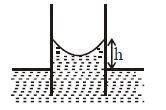
Two vertical parallel plates are partially submerged in water. The distance between plate is equal to $d$. Water rises due to surface tension $T$, the width of plate is $l$, and contact angle of water with glass is $0^o$. Find the force of attraction between the plates.
When a ferromagnetic material goes through a hysteresis loop, the magnetic susceptibility:
  1. Has a fixed value.
  2. May be zero.
  3. May be infinity.
  4. May be negative.
A bar magnet is moved along the axis of a copper ring placed far away from the magnet, Looking from the side of the magnet an anticlockwise current is found to be induced in the ring. Which of the following may be true?
  1. The south pole faces the ring and the magnet moves towards it.
  2. The north pole faces the ring and the magnet moves towards it.
  3. The south pole faces the ring and the magnet moves away from it.
  4. The north pole faces the ring and the manget moves away from it.
Dimensions of $\frac{1}{{{\mu _0}{\varepsilon _0}}}$, where symbols have their usual meaning, are 
If the velocity of a particle is given by $v = {(180 - 16x)^{1/2}} m/s$, then its acceleration will be.......$ms^{-2}$
The period of oscillation of a mass $M$ suspended from a spring of negligible mass is $T$. If along with it another mass $M$ is also suspended, the period of oscillation will now be
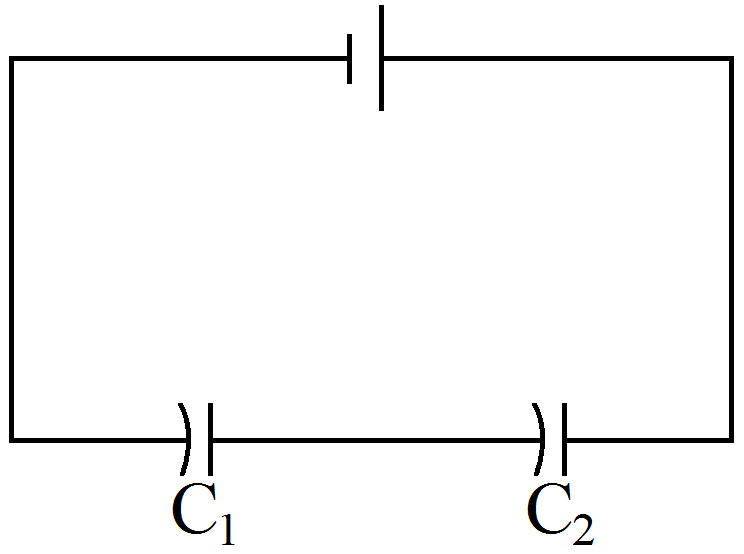
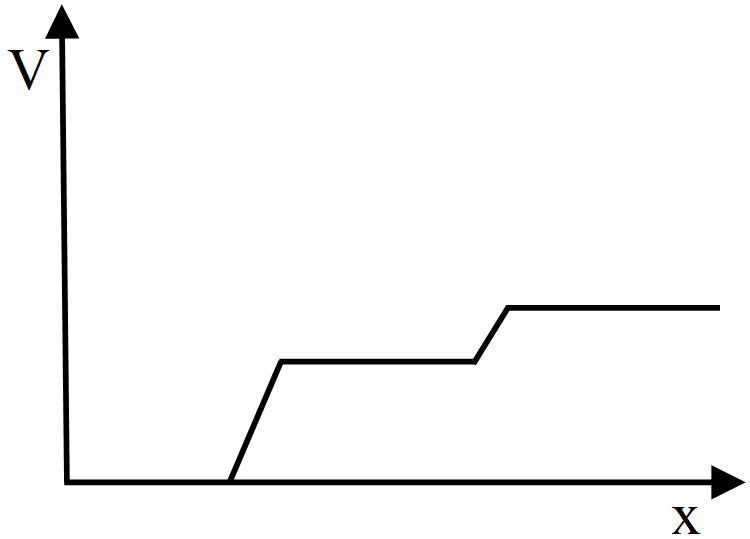
Figure shows two capacitors connected in series and joined to a battery. The graph shows the variation in potential as one moves from left to right on the branch containing the capacitors:


  1. C1 > C2
  2. C1 = C2
  3. C1 < C2
  4. The information is not sufficient to decide the relation between C1 and C2.