Question
✓
Answer
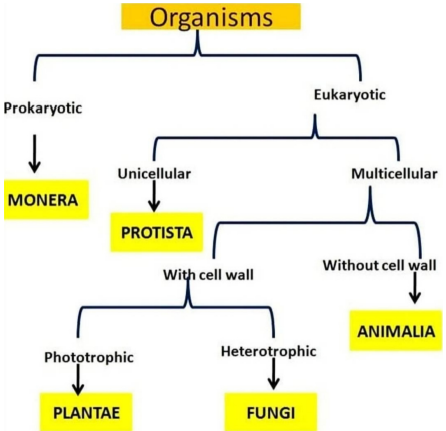
i. All organisms are multicellular, eukaryotes with heterotrophic mode of nutrition.
ii.
iii. Linnaeus used artificial system kingdom of classification.
Drawbacks of Linnaeus two kingdom classification:
• Linnaeus developed a Two Kingdom system of classification with Plantae and Animalia kingdoms.
• This system did not distinguish between eukaryotes and prokaryotes, unicellular and multicellular organisms, photosynthetic (green algae) and non-photosynthetic (fungi) organisms.
OR
No, Fungi-Autotrophic (Photosynthetic) and Heterotrophic is not correct match. The walls of the fungi were made of chitin, whereas the green plants had a cellulose cell wall.
ii.
| Prokaryotic cell | Eukaryotic cell |
| Genetic material is not enclosed in a nuclear envelope and is present suspended in the cytoplasm in a region called nucleoid. | Genetic material is enclosed within the nucleus by a nuclear envelope and is not present in direc contact with cytoplasm. |
| Cell wall is made up of peptidoglycan. | Cell wall is made up of chitin in fungi and cellulose in plants. |
| Nucleolus is absent. | Nucleolus is present. |
Drawbacks of Linnaeus two kingdom classification:
• Linnaeus developed a Two Kingdom system of classification with Plantae and Animalia kingdoms.
• This system did not distinguish between eukaryotes and prokaryotes, unicellular and multicellular organisms, photosynthetic (green algae) and non-photosynthetic (fungi) organisms.
OR
No, Fungi-Autotrophic (Photosynthetic) and Heterotrophic is not correct match. The walls of the fungi were made of chitin, whereas the green plants had a cellulose cell wall.
Need a full question paper?
Generate a complete, print-ready paper with questions like this in minutes — across 16+ boards, with answer keys.
Explore more
Similar questions
What is called endoplasmic reticulum? Write any four differences between smooth endoplasmic reticulum and rough endoplasmic reticulum.
For the classification of housefly, correctly match the terms given in Column-I with the terms given in Column-II.
| Column-I | Column-II |
| 1. Family | (i) Arthropoda |
| 2. Order | (ii) Insecta |
| 3. Class | (iii) Muscidae |
| 4. Phylum | (iv) Diptera |
Various parts of the plant such as stems leaves, and even fruits are modified into underground parts to perform various functions such as stems, leaves, and even fruits.
The stems in ginger and banana are underground and swollen due to storage of food. They are called rhizome. Rhizome of ginger is a modification of stem because it bears nodes, internodes, terminal buds, scaly leaves and buds, which give rise to aerial shoots. It is not a root because root does not have nodes and internodes. Also, rhizome does not perform the function of roots i.e. anchorage and absorption, rather it serve as reservoir for storage of food. Similarly, corm is an underground stem in Colocasia (jimikand) The tips of the underground stem in potato become swollen due to accumulation of food and forms tuber.
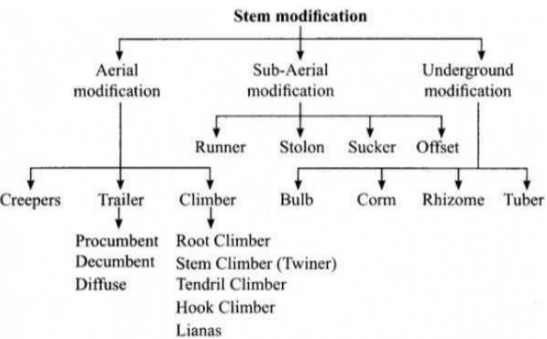
i. Observe the given flow chart and mention what are the four types of Underground stem modification also mention one example of each. (1)
ii. Ginger is an underground stem but why it is distinguished from a root? (1)
iii. Why do the tips of modified stems in potatoes become swollen? (2)
OR
Are all underground parts of a plant roots? (2)
The stems in ginger and banana are underground and swollen due to storage of food. They are called rhizome. Rhizome of ginger is a modification of stem because it bears nodes, internodes, terminal buds, scaly leaves and buds, which give rise to aerial shoots. It is not a root because root does not have nodes and internodes. Also, rhizome does not perform the function of roots i.e. anchorage and absorption, rather it serve as reservoir for storage of food. Similarly, corm is an underground stem in Colocasia (jimikand) The tips of the underground stem in potato become swollen due to accumulation of food and forms tuber.
i. Observe the given flow chart and mention what are the four types of Underground stem modification also mention one example of each. (1)
ii. Ginger is an underground stem but why it is distinguished from a root? (1)
iii. Why do the tips of modified stems in potatoes become swollen? (2)
OR
Are all underground parts of a plant roots? (2)
Write four differences between lined and unlined sutures.
There are thousands of different eubacteria or 'true bacteria'. They are characterized by the presence of a rigid cell wall, and if motile, a flagellum. The cyanobacteria (also referred to as blue-green algae) have chlorophyll a similar to green plants and are photosynthetic autotrophs. The cyanobacteria are unicellular, colonial or filamentous, freshwater/marine or terrestrial algae. The colonies are generally surrounded by gelatinous sheath. They often form blooms in polluted water bodies. Some of these organisms can fix atmospheric nitrogen in specialized cells called heterocysts, e.g., Nostoc and Anabaena. Chemosynthetic autotrophic bacteria oxidise various inorganic substances such as nitrates, nitrites and ammonia and use the released energy for their ATP production. They play a great role in recycling nutrients like nitrogen, phosphorous. iron and Sulphur.
(1) Which of the following can be termed as 'Photosynthetic Autotrophs'
(a) All monerans (b) Chemosynthetic Bacteria (c) Cyanobacteria (d) All Eubacteria
(2) Blue green algae are characterized by :
(a) They often form blooms in polluted water bodies.
(b) Some of these organisms can fix atmospheric nitrogen
(c) Their colonies are generally surrounded by gelatinous sheath.
(d) All of these
(3) Which is incorrect about Heterocysts:
(a) These are specialized cells
(b) These are present in all Cyanobacteria.
(c) Nostoc and Anabaena have Heterocysts.
(d) Organisms having these cells can fix atmospheric nitrogen
(4) Green plants are similar to Blue green algae in having:
(a) chlorophyll a (b) Heterocysts (c) chlorophyll b (d) None of these
(5) Which of these can be described as ‘true Bacteria’.
(a) Cyanobacteria only
(b) Only Chemosynthetic autotrophic bacteria
(c) Bacteria without cell wall.
(d) Eubacteria
(1) Which of the following can be termed as 'Photosynthetic Autotrophs'
(a) All monerans (b) Chemosynthetic Bacteria (c) Cyanobacteria (d) All Eubacteria
(2) Blue green algae are characterized by :
(a) They often form blooms in polluted water bodies.
(b) Some of these organisms can fix atmospheric nitrogen
(c) Their colonies are generally surrounded by gelatinous sheath.
(d) All of these
(3) Which is incorrect about Heterocysts:
(a) These are specialized cells
(b) These are present in all Cyanobacteria.
(c) Nostoc and Anabaena have Heterocysts.
(d) Organisms having these cells can fix atmospheric nitrogen
(4) Green plants are similar to Blue green algae in having:
(a) chlorophyll a (b) Heterocysts (c) chlorophyll b (d) None of these
(5) Which of these can be described as ‘true Bacteria’.
(a) Cyanobacteria only
(b) Only Chemosynthetic autotrophic bacteria
(c) Bacteria without cell wall.
(d) Eubacteria
Write the functions of human kidney.
What is the lymphatic system? Describe the functions of the lymph.
Write any four economic importance of Pteridophyta.