Question
✓
Answer
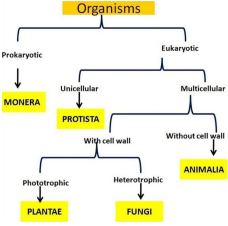
i. All organisms are multicellular, eukaryotes with heterotrophic mode of nutrition.
ii.
iii. Linnaeus used artificial system kingdom of classification.
Drawbacks of Linnaeus two kingdom classification:
• Linnaeus developed a Two Kingdom system of classification with Plantae and Animalia kingdoms.
• This system did not distinguish between eukaryotes and prokaryotes, unicellular and multicellular organisms, photosynthetic (green algae) and non-photosynthetic (fungi) organisms.
OR
No, Fungi-Autotrophic (Photosynthetic) and Heterotrophic is not correct match. The walls of the fungi were made of chitin, whereas the green plants had a cellulose cell wall.
ii.
| Prokaryotic cell | Eukaryotic cell |
| Genetic material is not enclosed in a nuclear envelope and is present suspended in the cytoplasm in a region called nucleoid. | Genetic material is enclosed within the nucleus by a nuclear envelope and is not present in direct contact with cytoplasm. |
| Cell wall is made up of peptidoglycan. | Cell wall is made up of chitin in fungi and cellulose in plants. |
| Nucleolus is absent. | Nucleolus is present. |
Drawbacks of Linnaeus two kingdom classification:
• Linnaeus developed a Two Kingdom system of classification with Plantae and Animalia kingdoms.
• This system did not distinguish between eukaryotes and prokaryotes, unicellular and multicellular organisms, photosynthetic (green algae) and non-photosynthetic (fungi) organisms.
OR
No, Fungi-Autotrophic (Photosynthetic) and Heterotrophic is not correct match. The walls of the fungi were made of chitin, whereas the green plants had a cellulose cell wall.
Need a full question paper?
Generate a complete, print-ready paper with questions like this in minutes — across 16+ boards, with answer keys.
Explore more
Similar questions
Write any four differences in the cortex of monocotyledon and dicotyledon stem.
Name the respiratory organ of the following animals and draw a labelled diagram of the cross section of an air alveolus of a pulmonary vessel.
1. Hydra, 2. Earthworms, 3. Cockroaches, 4. Pelaemon, 5. Fishes, 6. Pigeons.
1. Hydra, 2. Earthworms, 3. Cockroaches, 4. Pelaemon, 5. Fishes, 6. Pigeons.
Bryophyta (bryophytes) A division of plants which for some authors includes the mosses (Musci) and liverworts (Hepaticae), but is now often taken to include only the mosses; liverworts having been assigned divisional status as Hepatophyta. Bryophytes differ from algae in that the multicellular gametangium is surrounded by a protective jacket of sterile cells; gametangia of algae are usually unicellular and never have a protective jacket of sterile cells. Although bryophytes lack differentiated water-conducting vessels, and rely largely or entirely on water absorbed from rain falling on the plants, or from a moist atmosphere, some larger species may have simple water-conducting cells. They lack true roots, but possess root-like rhizoids which anchor them to a substrate and which can absorb water and minerals. The plants all show a heteromorphic alternation of generations, with a green vegetative gametophyte (the familiar moss or liverwort plant) and a sporophyte which typically takes the form of a (usually stalked) capsule and which is partially or wholly parasitic on the gametophyte. Most bryophytes are land plants and are found worldwide in a range of habitats. They are known from Devonian rocks, but there is no evidence to link them with either the green algae or the more advanced pteridophytes.
(1) A characteristic feature of bryophytes is:
(a) a dominant and parasitic sporophyte
(b) a dominant and spore-producing gametophyte
(c) a small sporophyte phase, which is dependent on the gametophyte
(d) sporophytes stay for a longer duration.
(2) Find the true statement about bryophytes:
(a) they have chloroplasts
(b) they have archegonia
(c) they are thalloid
(d) all of the above.
(3) Among the following which is not characteristics feature of bryophyte:
(a) Motile sperms
(b) Presence of archegonium
(c) Water essential for fertilization
(d) Independent sporophyte
(4) Bryophytes differ from pteridophytes in:
(a) Swimming antherozoids
(b) An independent gametophyte
(c) Archegonia
(d) Lack of vascular tissue
(5) In bryophytes, antherozoids are-
(a) Biflagellate
(b) Multiflagellate
(c) Sometimes biflagellate and sometimes multiflagellate.
(d) Biflagellate in a few species and multiflagellate in the rest.
(1) A characteristic feature of bryophytes is:
(a) a dominant and parasitic sporophyte
(b) a dominant and spore-producing gametophyte
(c) a small sporophyte phase, which is dependent on the gametophyte
(d) sporophytes stay for a longer duration.
(2) Find the true statement about bryophytes:
(a) they have chloroplasts
(b) they have archegonia
(c) they are thalloid
(d) all of the above.
(3) Among the following which is not characteristics feature of bryophyte:
(a) Motile sperms
(b) Presence of archegonium
(c) Water essential for fertilization
(d) Independent sporophyte
(4) Bryophytes differ from pteridophytes in:
(a) Swimming antherozoids
(b) An independent gametophyte
(c) Archegonia
(d) Lack of vascular tissue
(5) In bryophytes, antherozoids are-
(a) Biflagellate
(b) Multiflagellate
(c) Sometimes biflagellate and sometimes multiflagellate.
(d) Biflagellate in a few species and multiflagellate in the rest.
Alex used to go to vegetable market with his grandfather, a retired biology teacher. Grandfather told Alex that brinjal, chillies and tomato belong to the same family of plants and asked him to find out the similarity in these plants. Alex found that it's a large family, commonly called as the ' potato family'. Plants belonging to this family are mostly herbs, shrubs and rarely small trees. Many plants belonging to this family are source of food, spice, medicine, fumigatory, and ornamental.
(1).The name of this family is
(a) Solanaceae (b) Fabaceae (c) Liliaceae (d) Brassica ear.
(2). Fruits of this family are known as
(a) Berry or capsule (b) Legume (c) Endosperm (d) Cotyledon.
(3). Aestivation in calyx and corolla of this family is
(a) Valvate (b) Imbricate (c) Twisted (d) Vexillary.
(4). Stamens of the flowers belonging to this family are mostly attached with petals.This condition is known as
(a) Epipetalous (b) Epiphyllous (c) Polyandrous (d) Monoadelphous
(5). Medicinal plants belonging to this family are
(a) Belladonna, Ashwagandha
(b) Aloe, Asparagus
(c) Tobacco, Petunia
(d) Muliathi, Spice.
(1).The name of this family is
(a) Solanaceae (b) Fabaceae (c) Liliaceae (d) Brassica ear.
(2). Fruits of this family are known as
(a) Berry or capsule (b) Legume (c) Endosperm (d) Cotyledon.
(3). Aestivation in calyx and corolla of this family is
(a) Valvate (b) Imbricate (c) Twisted (d) Vexillary.
(4). Stamens of the flowers belonging to this family are mostly attached with petals.This condition is known as
(a) Epipetalous (b) Epiphyllous (c) Polyandrous (d) Monoadelphous
(5). Medicinal plants belonging to this family are
(a) Belladonna, Ashwagandha
(b) Aloe, Asparagus
(c) Tobacco, Petunia
(d) Muliathi, Spice.
Differentiate between neural control and hormonal control.
Draw a labelled diagram of the schematic view of human respiratory system. Write any four differences between right lung and left lung.
Write a note on bulliform cells. Write any three differences between exarch and endarch.
Define oxygen dissociation curve. Can you suggest any reason for its sigmoidal pattern?
As what is Equisetum commonly known? Write any four differences between Bryophytes and Pteridophytes.