MCQ
Select the appropriate property of an ideal gas
  • A
    Its molecules are infinitesimally small
  • B
    There are no forces of interaction between its molecules
  • C
    It strictly obeys the ideal gas laws
  • All of these

Answer

Correct option: D.
All of these
d
(d)

All of the statements are true for an ideal gas.

Need a full question paper?

Generate a complete, print-ready paper with questions like this in minutes — across 16+ boards, with answer keys.

Start Generating Free

Similar questions

Angular momentum of a single particle moving with constant speed along circular path:
Among the given following system of unit which is not based on unit of mass, length and time?
The specific heat of a gas at constant volume is $21.2\, J/mole/°C.$ If the temperature is increased by $1°C$ keeping the volume constant, the change in its internal energy will be ...... $J$
A ball of mass $1 \;kg$ is thrown vertically upwards and returns to the ground after $3\; seconds$. Another ball, thrown at $60^{\circ}$ with vertical also stays in air for the same time before it touches the ground. The ratio of the two heights are
The molecules of a given mass of a gas have a $r.m.s.$ velocity of $200\, m/sec$ at $27°C$ and $1.0 \times {10^5}\,N/{m^2}$ pressure. When the temperature is $127°C$ and pressure is $0.5 \times {10^5}\,N/{m^2}$, the $r.m.s.$ velocity in $m/sec$ will be
An organ pipe of length $L$ open at both ends is found to vibrate in its first harmonic when sounded with a tuning fork of $480\, Hz$. What should be the length of a pipe closed at one end, so that it also vibrates in its first harmonic with the same tuning fork ?
The condition for a uniform spherical mass $m$ of radius $r$ to be a black hole is [$G=$ gravitational constant and $g=$ acceleration due to gravity]
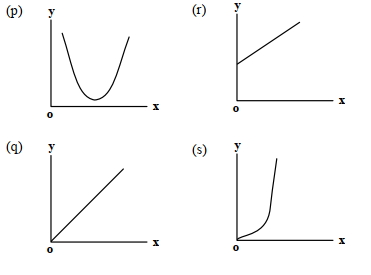
Column $I$ gives a list of possible set of parameters measured in some experiments. The variations of the parameters in the form of graphs are shown in Column $II$. Match the set of parameters given in Column $I$ with the graph given in Column $II$. Indicate your answer by darkening the appropriate bubbles of the $4 \times 4$ matrix given in the $ORS$.
Column $I$ Column $II$
$(A)$ Potential energy of a simple pendulum (y axis) as a function of displacement ( $\mathrm{x}$ axis) $Image$
$(B)$ Displacement (y axis) as a function of time (x axis) for a one dimensional motion at zero or constant acceleration when the body is moving along the positive $\mathrm{x}$-direction $Image$
$(C)$ Range of a projectile (y axis) as a function of its velocity ( $\mathrm{x}$ axis) when projected at a fixed angle $Image$
$(D)$ The square of the time period (y axis) of a simple pendulum as a function of its length ( $\mathrm{x}$ axis) $Image$

The displacement of a particle is given by $y = 5 \times {10^{ - 4}}\sin (100t - 50x)$, where $x$ is in meter and $t$ in sec, find out the velocity of the wave  .... $m/sec$
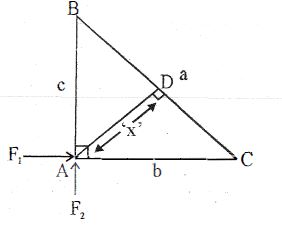
Two forces acting on point $A$ along their side and having magnitude reciprocal to length of side then resultant of these forces will be proportional to