MCQ
Select the incorrect statement about ideal gas.
  • A
    Molecules of a gas are in incessant random motion colliding against one another and with the walls of the container.
  • The gas is not isotropic and the constant $(1/3)$ in equation $P = (1/3)\rho v^2_{rms}$ is result of this property
  • C
    The time during which a collision lasts is negligible compared to the time of free path between collisions.
  • D
    There is no force of interaction between molecules among themselves or between molecules and the wall except during collision.
Answer

Correct option: B.
The gas is not isotropic and the constant $(1/3)$ in equation $P = (1/3)\rho v^2_{rms}$ is result of this property
b
$B)$ incorrect Isotropic property says that the various properties of a material are independent of direction hence the constant $\left(\frac{1}{3}\right)$ is the result of the assumption that the velocity of molecule is same in all three axis $x, y, z$

Need a full question paper?

Generate a complete, print-ready paper with questions like this in minutes — across 16+ boards, with answer keys.

Start Generating Free

Similar questions

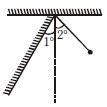
A simple pendulum of length $1\,m$ is allowed to oscillate with amplitude $2^o$. It collides elastically with a wall inclined at $1^o$ to the vertical. Its time period will be : (use $g = \pi ^2$ )
A ship is travelling due east at $10\, km/hr$. $A$ ship heading $30^o$ east of north is  always due north from the first ship. The speed of the second ship in $km/hr$ is
Two trains travelling on the same track are approaching each other with equal speeds of $40\, m/s$. The drivers of the trains begin to decelerate simultaneously when they are just $2.0\, km$ apart. Assuming the decelerations to be uniform and equal, the value of the deceleration to barely avoid collision should be.........$m/{s^2}$
Two carnot engines $A$ and $B$ operate in series such that engine $A$ absorbs heat at $T_{1}$ and rejects heat to a sink at temperature $T$. Engine $B$ absorbs half of the heat rejected by engine $A$ and rejects heat to the sink at ${T}_{3}$. When workdone in both the cases is equal, the value of ${T}$ is 
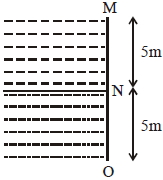
Two liquids of densities $\rho_{1}$ and $\rho_{2}\left(\rho_{2}=2 \rho_{1}\right)$ are filled up behind a square wall of side $10\; \mathrm{m}$ as shown in figure. Each liquid has a height of $5 \;\mathrm{m} .$ The ratio of the forces due to these liquids exerted on upper part $MN$ to that at the lower pait $NO$ is (Assume that the liquids are not mixing)
$KE$ of a body is increased by $44 \%$. What is the percent increase in the momentum is ...... $\%$
There is an air bubble of radius $1.0\,mm$ in a liquid of surface tension $0.075\,Nm ^{-1}$ and density $1000\,kg$ $m ^{-3}$ at a depth of $10\,cm$ below the free surface. The amount by which the pressure inside the bubble is greater than the atmospheric pressure is $....Pa \left( g =10\,ms ^{-2}\right)$
Two projectiles are thrown with same initial velocity making an angle of $45^{\circ}$ and $30^{\circ}$ with the horizontal respectively. The ratio of their respective ranges will be.
A projectile is thrown with velocity $U=20\ m/s ± 5\%$ at an angle $60^o.$ If the projectile falls back on the ground at the same level then    ......... $m$ of following can not be a possible answer for range.
Plane angle and solid angle have :