Question
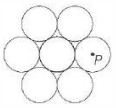
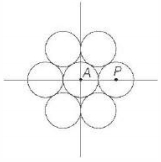
Seven identical coins are rigidly arranged on a flat table in the pattern shown below, so that each coin touches its neighbours. Each coin is a thin disc of mass $m$ and radius $r$. Here note, that the moment of inertia of an individual coin about an axis passing through centre and perpendicular to the plane of the coin is $\frac{m r^2}{2}$.The moment of inertia of the system of seven coins about an axis that passes through the point $P$ (the centre of the coin positioned directly to the right of the central coin) and perpendicular to the plane of the coins is ..........$m r^2$
Answer

(c)

Moment of inertia of given configuration about an axis through point $A$ (centre of middle disc), using parallel axes theorem is

$I_A=\frac{m r^2}{2}+6\left(\frac{m r^2}{2}+m(2 r)^2\right)$

$=m r^2\left(\frac{1}{2}+\frac{6}{2}+24\right)=\frac{55}{2} m r^2$

Now, again using parallel axes theorem, moment of inertia of configuration about $P$ is

$I_P=I_A+M_{ total } \times d^2$

$=\frac{55}{2} m r^2+7 m(2 r)^2=\frac{111}{2} m r^2$

Need a full question paper?

Generate a complete, print-ready paper with questions like this in minutes — across 16+ boards, with answer keys.

Start Generating Free

Similar questions

The magnitude of electric force on $2\, \mu \,C$ charge placed at the centre $O$ of two  equilateral triangles each of side $10 \,cm$, as shown in figure is $P$. If charge $A, B, C, D, E$ and $F$ are $2\, \mu \,C, 2\, \mu \,C, 2\, \mu \,C,-2\, \mu \,C, -2\, \mu \,C, -2\, \mu \,C$   respectively, then $P$ is :.....$N$
In the given circuit the cells have zero internal resistance. The currents (in Amperes) passing through resistance $R_1$ and $R_2$ respectively, are
In a transformer $220\, ac$ voltage is increased to $2200\, volts$. If the number of turns in the secondary are $2000$, then the number of turns in the primary will be
One end of a horizontal thick copper wire of length $2 L$ and radius $2 R$ is welded to an end of another horizontal thin copper wire of length $L$ and radius $R$. When the arrangement is stretched by a applying forces at two ends, the ratio of the elongation in the thin wire to that in the thick wire is :
Four identical particles of mass $M$ are located at the corners of a square of side $‘a’$. What should be their speed if each of them revolves under the influence of other’s gravitational field in a circular orbit circumscribing the square?
A circular coil of diameter $7\,cm$ has $24$ $turns$ of wire carrying current of $ 0.75\,A$. The magnetic moment of the coil is
A double convex lens of focal length $20 cm$ is made of glass of refractive index $3 / 2$. When placed completely in water ${(_a}{\mu _w} = 4/3)$, its focal length will be.....$cm$
In a stationary wave, all particles are
Two metallic spheres of radii $1\,\, cm$ and $3\,\, cm$ are given, charges of $-1$$ \times {10^{ - 2}}$ $C$ and $5$$ \times {10^{ - 2}}\,C$ respectively. If these are connected by a conducting wire, the final charge on the bigger sphere is
A mixture of $2\, moles$ of helium gas (atomic mass $= 4\, u$), and $1\, mole$ of argon gas (atomic mass $= 40\, u$) is kept at $300\, K$ in a container. The ratio of their rms speeds $\left[ {\frac{{{V_{rms}}{\rm{(helium)}}}}{{{V_{rms}}{\rm{(argon)}}}}} \right]$, is close to